April 21, 2026 opinion archive. Updated September 14, 2026: The city’s ordinance took effect April 23. Its current notice places new applications on a waitlist as the residential cap is approached. See the City of South Lake Tahoe’s official VHR page for current rules and permit information. The article below reflects the debate at publication.
Two days.
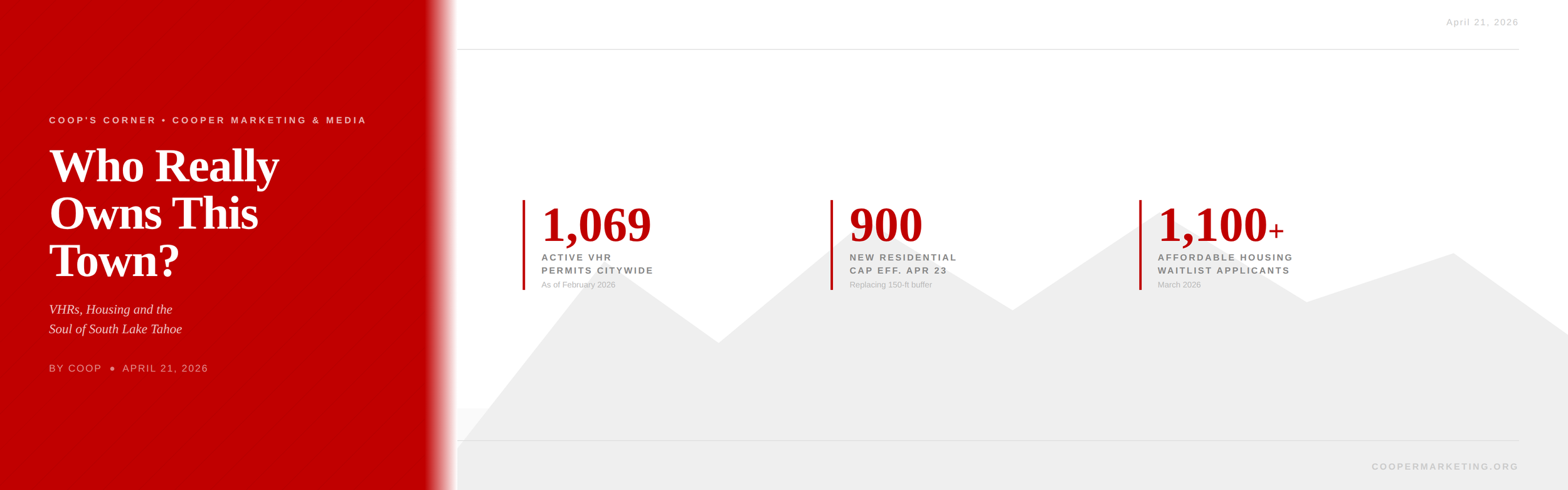
Two days from right now, on Thursday, April 23, 2026, the City of South Lake Tahoe's new 900-permit cap on vacation home rentals in residential zones takes effect. That is not a finish line. It is a starting point. And starting points only matter if somebody decides to start.
The Numbers, Right Now
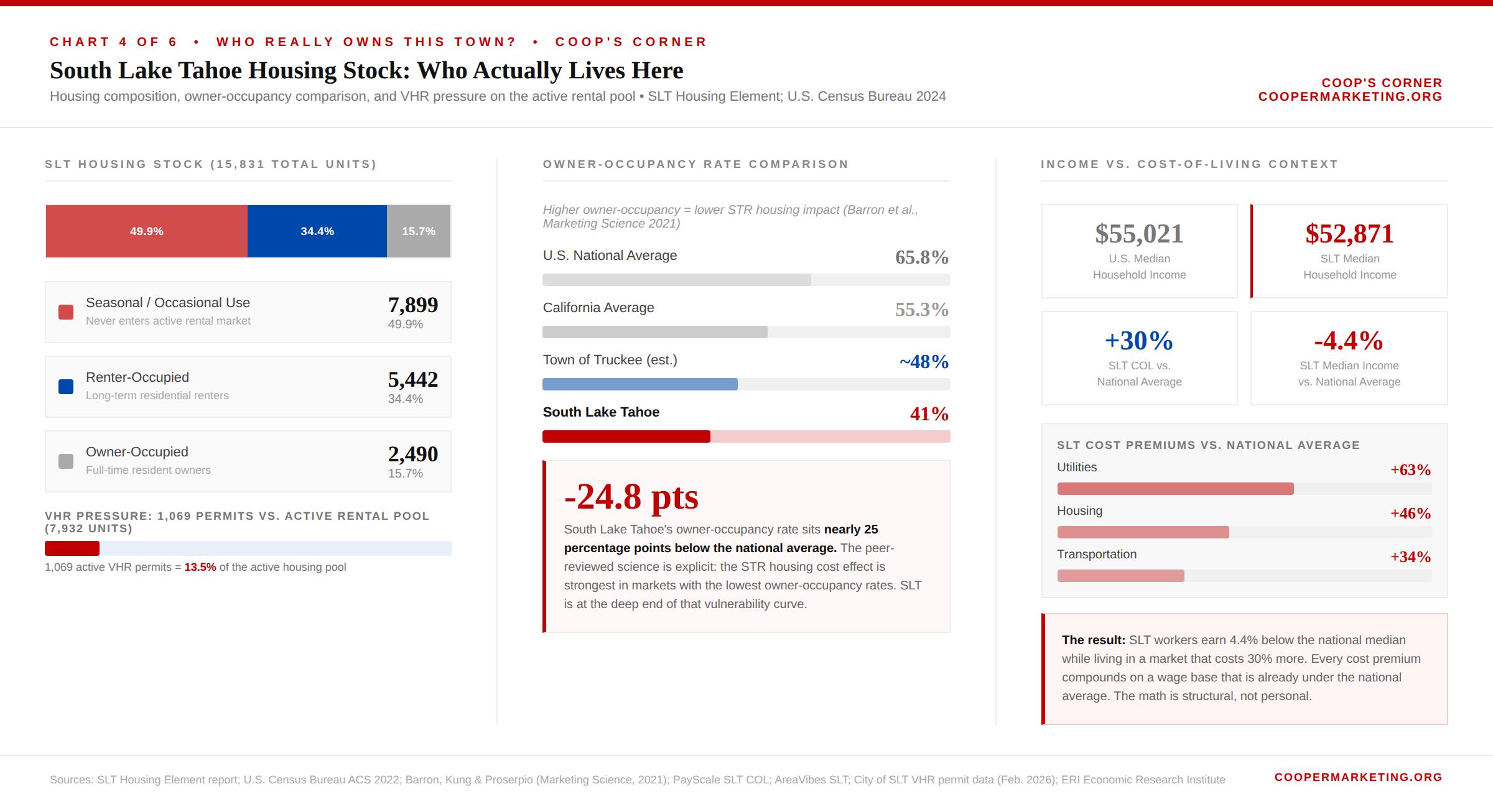
As of February 2026, there are 1,069 active VHR permits operating in the city. Since the city began accepting applications again in July 2025, 562 new permits have been issued. Another 270 applications were denied under the 150-foot buffer rule. That buffer is now gone, replaced by the 900-permit cap that takes effect Thursday.
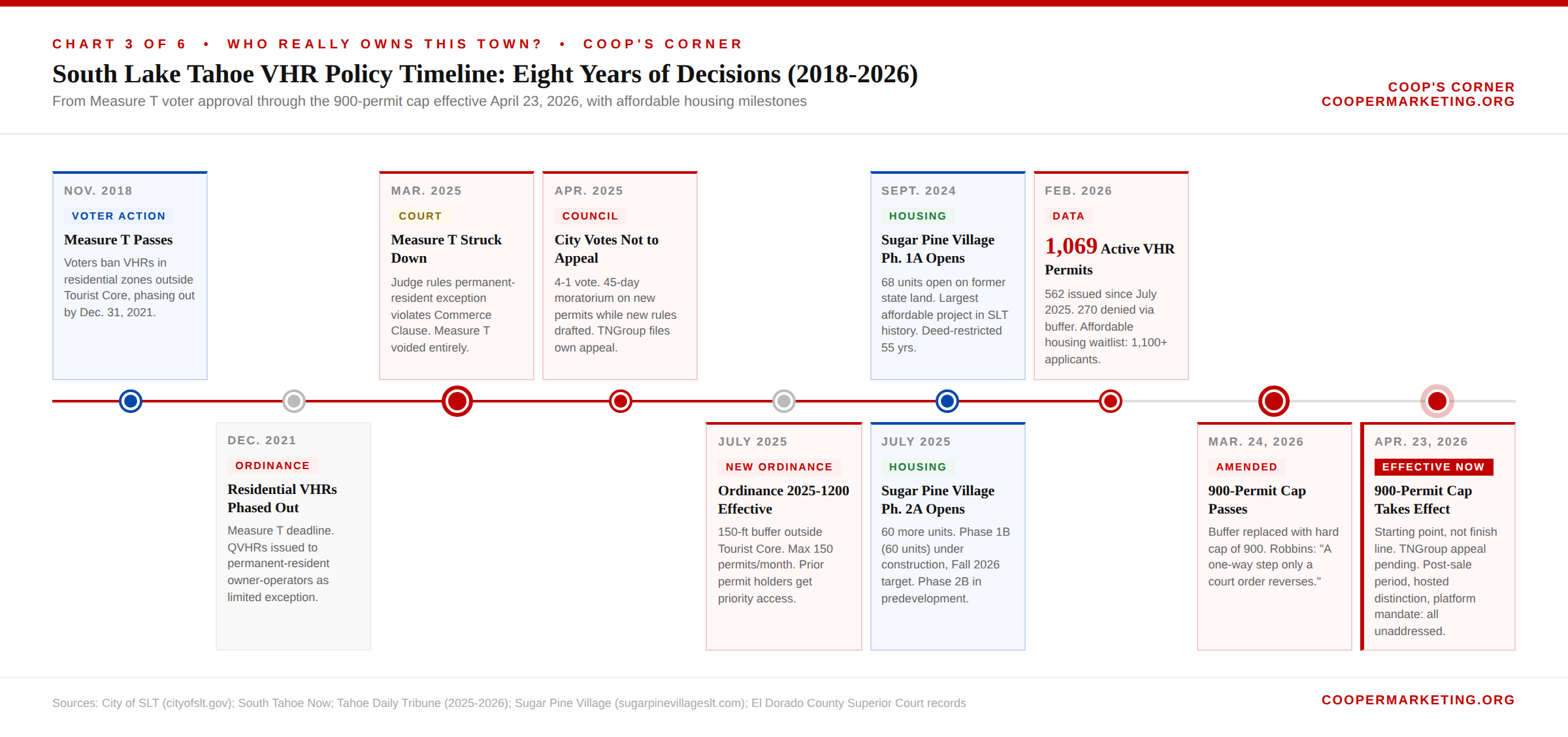
To get here took seven years of political struggle, two ballot measures, multiple court rulings, and a community divided so evenly that the original Measure T passed by exactly 58 votes in 2018. It was struck down by an El Dorado County judge in March 2025. The City Council voted not to appeal in April 2025. The Tahoe Neighborhoods Group filed its own appeal, which remains pending.
The 900 cap is real. And it is not enough on its own.
What the Rest of the Basin Has Already Figured Out
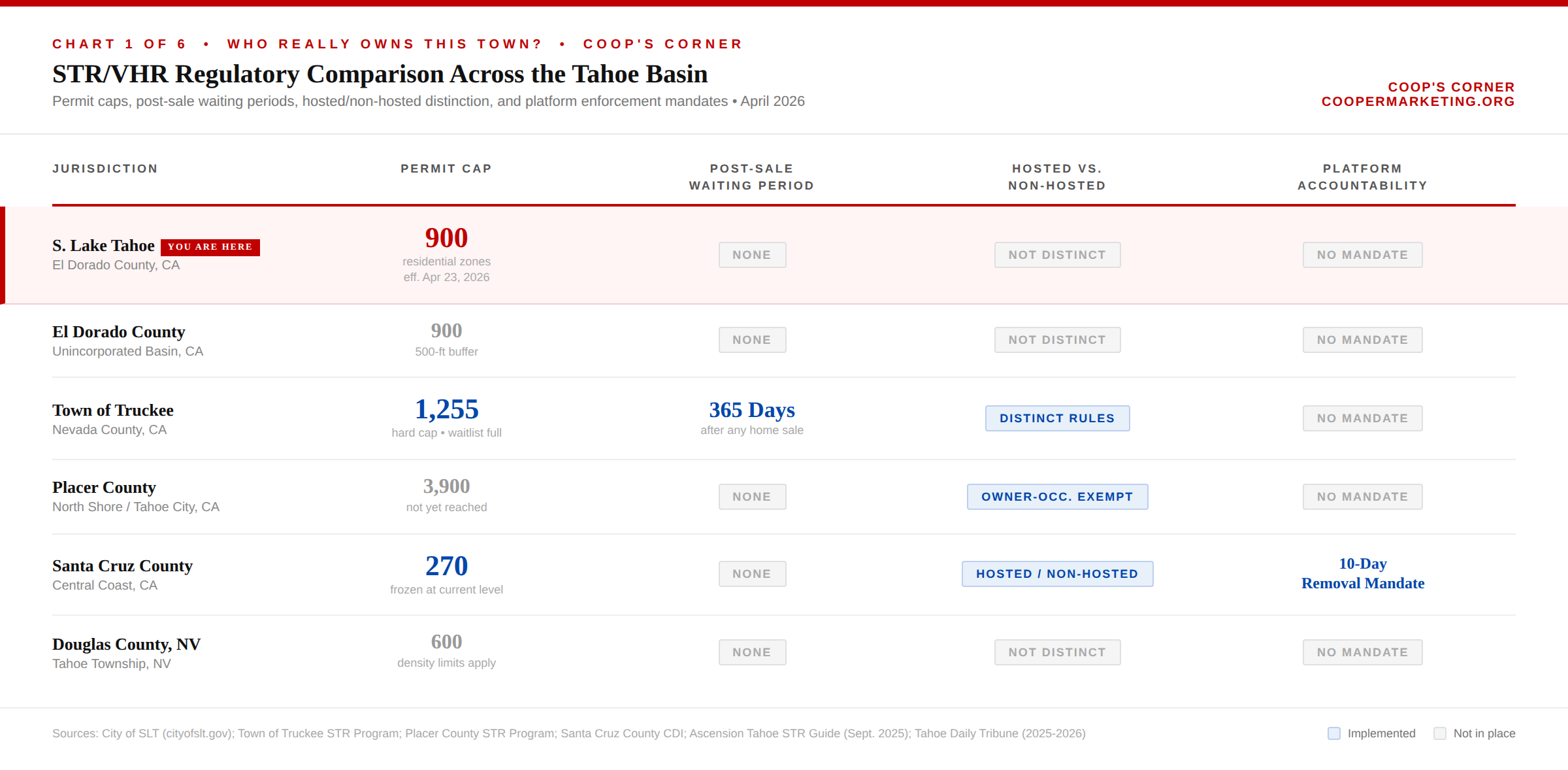
The Town of Truckee has operated a hard permit cap of 1,255 for years. Their waitlist is full. More importantly, they implemented a 365-day waiting period before any property sold can be converted to a VHR. That single tool has done more to slow speculative investment-to-STR conversion than any other policy in the region.
Placer County caps STRs countywide at 3,900 permits. They set a 15 percent alarm threshold relative to total housing stock, based on hard experience: at that saturation level, school district employees were living in their cars and camping in the forest to keep their jobs. The county backed off when it got too close.
Santa Cruz County froze non-hosted vacation rentals at 270 units in August 2025 and did something South Lake Tahoe has never done: they made Airbnb and Vrbo responsible for removing unpermitted listings within 10 days of notice. Not the city. The platforms.
These are policy examples from the Tahoe region and elsewhere in California.
Follow the Money
The money behind this debate is not neutral, and it has never been.
When Measure T went to the voters in 2018, the committee formed to defeat it was called "Save Tahoe Jobs: Vote No on Measure T." Their year-end campaign filing showed total contributions of $478,575. The largest contributors were the California Association of Realtors and Airbnb. It lost by 58 votes. When a global platform and a statewide trade association spend nearly half a million dollars on a local ballot measure and still lose, it tells you something about how strongly this community has felt about this issue.
$478,575 spent to defeat Measure T in 2018. The opposition raised nearly half a million dollars and lost by 58 votes.
The financial interests on the pro-VHR side are structural and well-resourced. They include the management companies that earn 20 to 30 percent of every rental dollar. The platforms that collect 3 percent from hosts and 14 to 16 percent from guests on every transaction, and send that money out of the community. The absentee investors who purchased property in South Lake Tahoe specifically for its STR conversion potential. And the California Association of Realtors, whose institutional interest in VHR expansion is tied directly to higher property values and transaction commissions.
The financial interests on the workforce side are diffuse and underfunded. They are the checker at Raley's, the server at Primo's, the bike mechanic at Sports Ltd, the bartender at Steamers, and the budtender. None of them has a trade association with a $478,000 campaign budget. None of them hired a political consultant. They just went to the polls.
Understanding who benefits from each permit issued, and who absorbs the cost, is not an abstraction. It is the central question this council has never formally answered.
The Part I Know Personally
I run the Kirkwood Ski Education Foundation. I manage operations at Camp Richardson Marina. I have spent 33 years in the ski, snow, surf, and bike industries, most of it based right here in the South Lake Tahoe basin.
The KSEF loses coaches every season. Not because the program is not good, not because the kids are not worth coaching, but because a coach who earns $20 per hour cannot afford to live in this town. The math is not complicated.
Here is the illustration used in this article: $20 per hour, 40 paid hours a week and 52 paid weeks a year gives about $3,467 in gross monthly pay. At $1,500 in monthly rent, rent alone takes about 43% of gross pay. Using the article’s estimated $2,750 take-home figure, it takes about 55% of take-home pay. Actual taxes, paid hours and available rents vary.
HUD’s housing-cost measure includes rent and utilities. For this illustration, 30% of the $3,467 gross monthly income is about $1,040. Rent of $1,500 is about $460 above that benchmark before utilities. The earlier $832 and $668 figures used the wrong income basis.
Illustration: $3,467 gross monthly pay × 30% = about $1,040 for housing costs. A $1,500 rent is about $460 higher, before utilities.
The marina hiring picture is the same. Every position we post draws fewer applications than the year before. The people who used to apply, the ones who would have stayed and built careers here, have done the math and moved somewhere they can afford to live. We are not losing workers to competitors. We are losing them to basic arithmetic.
The infrastructure consequences of this math extend beyond individual workers. Lake Valley Fire Protection District had $517,000 budgeted for reimbursements for medical calls to vacation rentals in the Meyers area in 2024-25. That funding was cut in the 2025-26 budget when El Dorado County TOT revenue dropped by more than $3 million, from $7.2 million returned to the Tahoe Basin in 2024-25 to just $4.1 million in 2025-26.
VHRs generate the emergency calls. When TOT revenue is insufficient to cover the cost of those calls, the fire district absorbs the shortfall. The community absorbs the risk. This is not theoretical. It is documented. The city has never commissioned a formal audit of VHR-generated service costs versus VHR-generated revenue. That analysis is long overdue.
The Work That Is Already Happening
I want to be clear about what is already being done, because it matters and it deserves recognition.
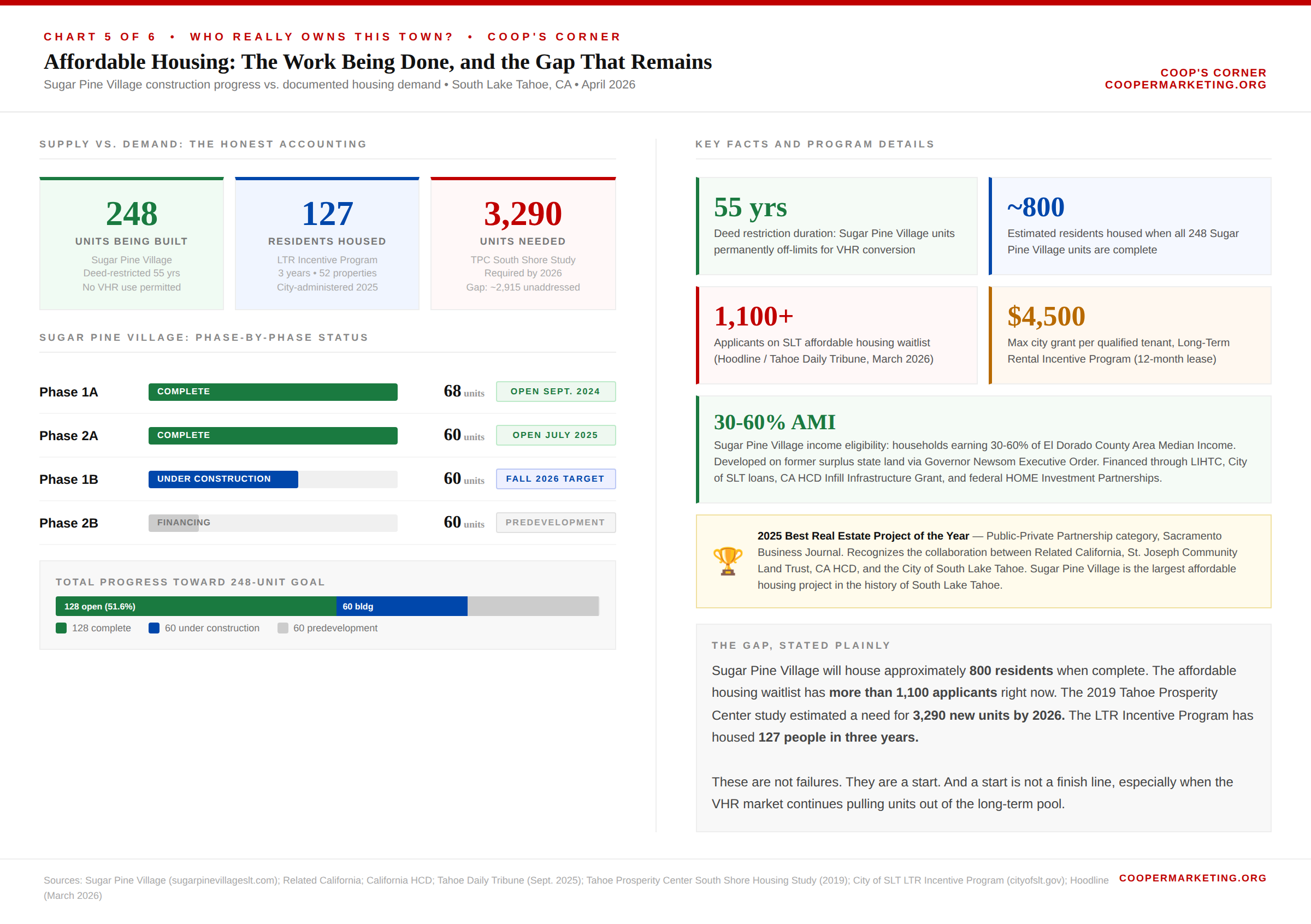
Sugar Pine Village is the largest affordable housing project in the history of South Lake Tahoe. Phase 1A opened in September 2024 with 68 units on former state land, deed-restricted for 55 years, with no VHR conversion permitted. Phase 2A opened in July 2025 with 60 more units. Phase 1B, another 60 units, is under construction with a Fall 2026 target. Phase 2B is in predevelopment. The total project is 248 units, built with a financing structure that includes LIHTC credits, city loans, the California Housing Finance Agency, and a Governor's executive order releasing surplus state land. The Sacramento Business Journal named it Best Real Estate Project of the Year for public-private partnerships in 2025.
The city's Long-Term Rental Incentive Program has housed 127 residents across 52 properties over three years, using grants of up to $4,500 per tenant to encourage landlords to convert short-term rentals to long-term leases.
These are not small things. The people who built them deserve credit. But 248 units, against a documented need for 3,290 new units by 2026, is not a solution. It is a beginning. And a beginning with more than 1,100 people on the affordable housing waitlist today is a beginning that is already behind.
A Map Forward: Including the Number We Have Never Named
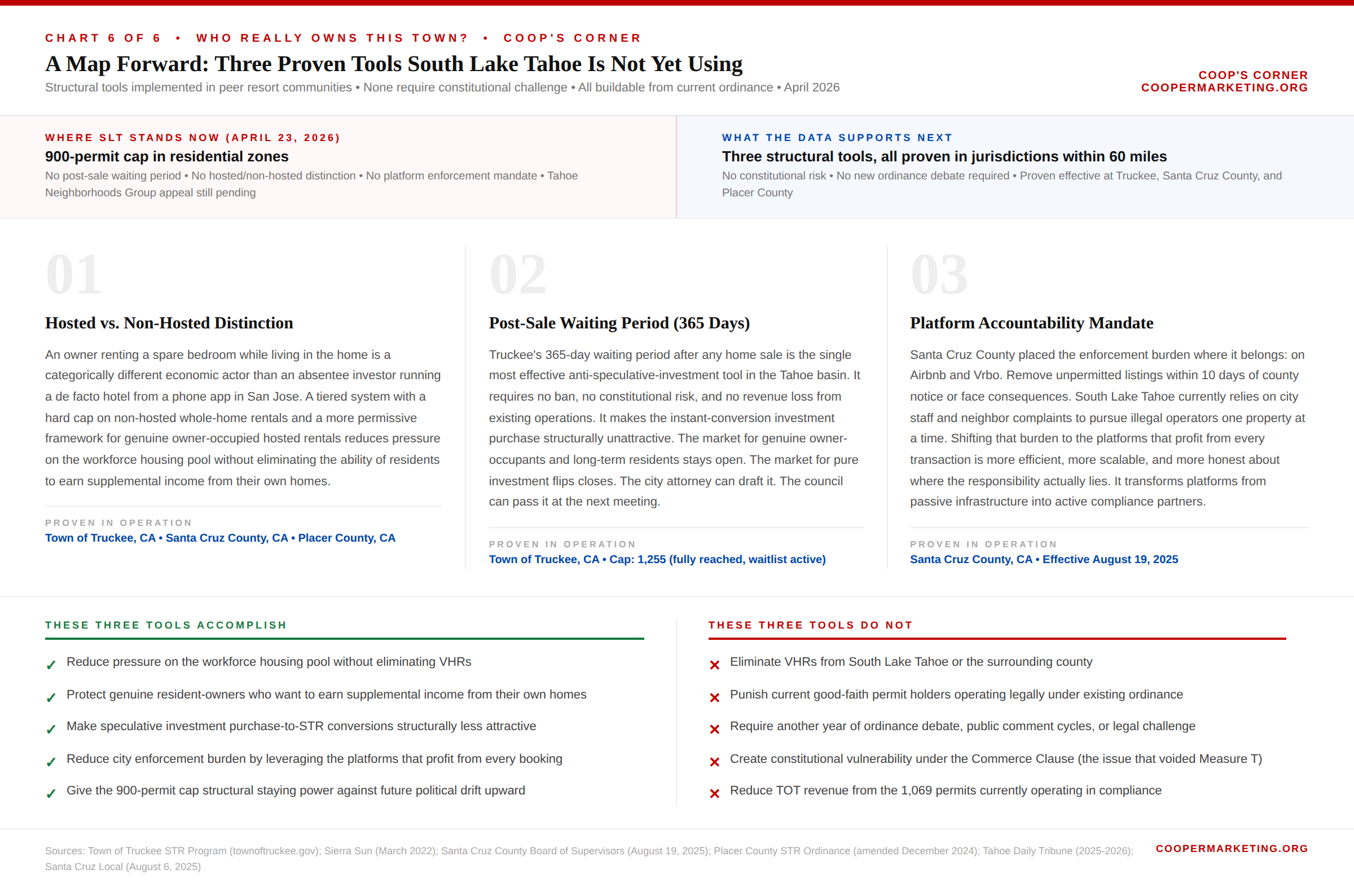
Three proven tools South Lake Tahoe is not yet using:
1. Hosted versus non-hosted distinction. An owner renting a spare bedroom while living in their home is a categorically different economic actor than an absentee investor running a de facto hotel. A tiered system with stricter caps on non-hosted whole-home rentals and a more permissive framework for genuine owner-occupied hosted rentals reduces pressure on the workforce housing pool without eliminating the ability of residents to earn supplemental income from their own homes.
2. Post-sale waiting period of 365 days. Truckee's 365-day waiting period after any home sale is the single most effective anti-speculative tool in the Tahoe basin. Any local proposal needs legal review and a public process. It makes the instant-conversion investment purchase structurally unattractive. The city attorney can draft it. The council can pass it at the next meeting.
3. Platform accountability mandate. Santa Cruz County placed the enforcement burden where it belongs: on Airbnb and Vrbo. Remove unpermitted listings within 10 days of county notice or face penalties. South Lake Tahoe currently relies on city staff pursuing illegal operators one property at a time. Shifting that burden to the platforms that profit from every transaction is more efficient, more scalable, and more honest about where the responsibility actually lies.
And then there is the question this council has never formally answered: what is the right number?
The research gives us a framework. Against South Lake Tahoe's active residential pool of roughly 7,932 units (total housing stock minus the 49.9 percent that is seasonal or occasional use and never available to the workforce), the current 1,069 active VHR permits represent 13.5 percent. The 900-permit cap brings that to approximately 11.4 percent. Placer County's alarm bell rang at 15 percent. Sedona, Arizona is targeting 5 percent of total housing stock. East Bay Charter Township in Michigan caps at 2.5 percent.
The communities that have found the most durable balance did not pick a single number in isolation. They used a combination: a total permit number anchored to local housing stock analysis, a geographic distribution requirement, and an owner-occupancy differential. That framework is not hypothetical. RRC Associates has built exactly this model for Summit County, Colorado, Pitkin County, Colorado, and Teton County, Wyoming. It exists. South Lake Tahoe has never commissioned it. It should be the first agenda item at the next council meeting.
South Lake Tahoe has never formally answered: What is the right number of VHRs for this community? The research framework exists. The city just has not used it.
The Call That Needs to Happen Now
This is not a letter to the editor. It is a direct request to six people who can act.
Mayor Cody Bass: Post-sale waiting period. Truckee has run this policy for years without constitutional challenge. The city attorney's office can have draft language ready before the end of May. Put it on the agenda.
Mayor Pro Tem Keith Roberts: Commission the fiscal analysis. VHRs generate TOT revenue. They also generate fire and EMS calls, road wear, enforcement costs, and housing displacement costs that are absorbed by the community. The net number has never been audited. Before the council approves one more permit above 900, it should know what those permits actually cost the city to service.
Councilmember Scott Robbins: Hosted versus non-hosted distinction. You said it in the chamber in March: "We have voted to give property owners and investors a proactive financial incentive to evict their tenants and turn their homes into Airbnbs because it's perceived to be more profitable." The tool that changes that incentive structure is the hosted/non-hosted distinction. Name it from the dais.
Councilmember David Jinkens: Platform accountability. You have 35 years of city management experience. You know what compliance burden on city staff looks like at scale. The Santa Cruz County model places that burden on Airbnb and Vrbo, not on code enforcement. Direct staff to draft an equivalent ordinance.
Councilmember Heather Horgan: Workforce housing threshold. Before the 900-permit cap is amended upward by any future council, there should be a binding policy requirement that a minimum percentage of the city's active housing pool must be available at workforce-accessible rents. Name that percentage. Put it in code.
Supervisor Brooke Laine: City-county coordination is the missing piece. The city sets VHR policy for its incorporated area. The county sets it for the unincorporated basin. They are the same housing market. A worker does not choose to rent inside or outside city limits based on jurisdiction. A coordinated cap, a coordinated waiting period, and a coordinated platform mandate across both jurisdictions is the only framework that actually closes the arbitrage gap.
The cap takes effect on Thursday. The conversation needs to happen today.
Thursday is not the answer. Thursday is the floor. The coaches who left, the servers who drive over the summit every night, the mechanic who stopped applying, the marina hire who never came back, they are watching to see whether the floor becomes a foundation or just another starting point that leads nowhere.
South Lake Tahoe has the tools. It has the research. It has the peer examples. It has the political will, documented in a vote that nearly half a million dollars in outside spending could not buy.
This place is worth it. So are the people who make it run.
Not tomorrow. Now.
Coop is the founder of Cooper Marketing & Media, a 33-year veteran of the ski, snow, surf, and bike industries, an old-salt U.S. Coast Guard Aviation Survivalman and Rescue Swimmer (RS#69), Tahoeian, outdoor enthusiast, and self-described #Stokeoligist. He writes Coop's Corner from South Lake Tahoe, California.
Correction, September 14, 2026: April 23 falls on Thursday. The housing example now correctly applies 30% to gross income and distinguishes gross pay from estimated take-home pay. The conflicting chart was removed. Santa Cruz examples are elsewhere in California, not within 60 miles of South Lake Tahoe.