I called Britta Winans down a line at KirkwoodMtn before most people knew her name.
Standing at the base with a microphone in my hand, watching a fearless young skier from Truckee charge terrain that would make grown men hesitate, I remember thinking: this one is different. That was the Tahoe Junior Freeride Series, the TJFS. Our regional proving ground. It was raw, loud, and alive in the way only a grassroots comp can be. No FIS oversight. No viral video quotas. Just young guns sending it in front of their people, on mountains they loved.
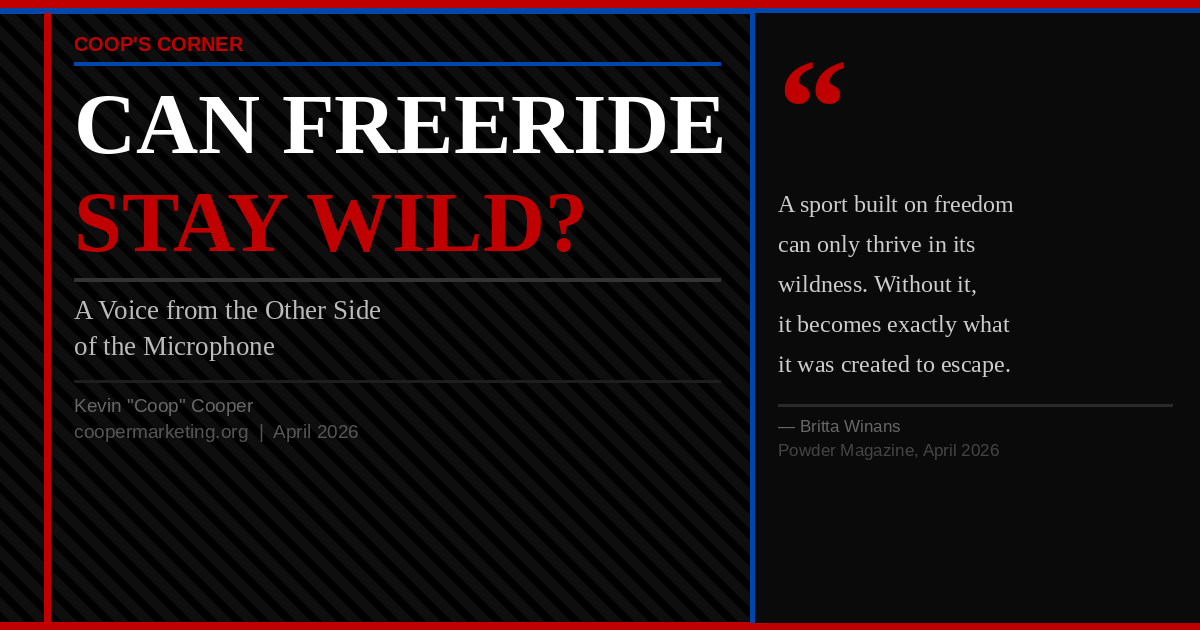
So when Britta published her piece in Powder Magazine last week, “Can Freeride Stay Wild?”, I read every word twice. Not just because she is one of ours, but because she said out loud what a lot of people in this industry have been quietly thinking for years. And coming from someone actively competing on the Freeride World Tour, not watching from the outside, that takes guts.
She is right about a lot. And I can say that because I have been on enough sides of this thing to have some standing in the conversation. Not as an elite athlete. I was never that. I am the chief bottle washer and cook of this mountain town, a solid skier/rider who loved the sport enough to give it most of his life in one form or another. But that life has taken me through some consequential rooms, and I have seen enough to know when something worth protecting is starting to slip.
My relationship with freeride competition did not start in a broadcast booth. It started on snow.
My first comp was 1993 at KirkwoodMtn. There was no Freeride World Tour. This was the North American circuit, whatever they were calling it that season, and I still have the old shirt, the poster, and a few bruised memories and ego to prove I was there. And if you were part of those early days, you know exactly what that energy felt like.
The names say it all: Tonto. Befu. Patterson. Daiek. Garbones. LB. Govvy. Reuter. Probert. Boucher. Tele-Rob. PB. A-Bomb. Carlin. And so, so many more. McConkey was on the judges panel that day, which tells you everything you need to know about the era. Characters, every one of them. Skiers and riders who were not chasing rankings, broadcast deals, or follower counts. They were chasing the mountain. They were chasing each other. And the energy on those comp days was something I have never been able to fully describe to anyone who was not standing there in above Carnel’s. It was about you and the mountain, and nothing else existed outside of that.
That feeling lit something in me that never went out.
Over the years, I found myself on the other side of the coin as well. I had the honor and privilege of being deeply involved in producing and executing one, two, three, four, and five-star Freeride World Tour events right here at KirkwoodMtn, in the Cirque. One of the most consequential venues the tour ever touched. I watched those events grow. I watched the infrastructure expand, the media requirements multiply, and the grassroots energy slowly get folded into a much larger, much more corporate machine.
And now I stand at the base of TJFS comps with a small voice and microphone in my hand, calling the next-level gen of freeriders into a future I am not entirely sure has their best interests in mind.
That is a complicated place to stand. But it is an honest one.
The Gravity Problem, Again
I have written before about what I call the Gravity Problem in skiing: the systemic forces of consolidation, commercialization, and control that pull independent, spirited corners of this sport downward toward corporate uniformity. What Britta is describing in freeride is that same gravitational pull, just wearing a different jacket.
The FIS now owns the Freeride World Tour. Freeride is being positioned for Olympic consideration. And anyone who has watched what Olympification historically does to counterculture sports has a reasonable basis for concern about where that pattern leads. Snowboarding, BMX, skateboarding: every one of them traded a piece of their soul for broadcast rights, medal ceremonies, and a seat at the IOC table. The pipe got bigger. The tricks got more technical. And somewhere along the way, the thing that made those sports matter to their original communities quietly left the building.
Whether freeride follows that same pattern is not certain. But the conditions that produced it elsewhere are present here, and that is worth naming clearly.
Content Over Competition - 120 seconds?
Here is the part that stings a little, because I have been on both sides of the media equation. Britta notes that producing a viral video now holds higher status than the competition itself. And she is not wrong.
The moment corporate partnership money entered freeride, it brought its metrics with it: impressions, engagement, reach, followers. A flawless run on a five-star venue that no one clips and shares is worth less to a sponsor than a sketchy send with 2 million views. That is just math, from a marketing standpoint. But it is corrosive math for a sport trying to maintain competitive integrity.
When the most valuable thing an athlete can produce is content, the competition becomes the backdrop, not the event. And when the event is the backdrop, you have already lost the thread.
The Sammy Carlson Question
Britta raises the Sammy Carlson option as a kind of ideological exit ramp: walk away from competition entirely and commit to the expressive, spiritual, unrestricted side of freeride. No scoreboard. No rankings. No FIS credentials. Just a skier and a mountain and a camera pointed at something real.
I respect that path deeply. But I do not think it scales as a solution.
What Sammy represents is important, but it is available to a relatively small number of athletes who have already built the commercial platform to survive without comp results driving their sponsorship value. For the young gun from Truckee who needs qualifying results to get noticed, walking away from the tour is not a philosophical choice. It is a closed door.
The Carlson path is a ceiling exit. Most athletes are still trying to find the front door.
This Is Not a Freeride Problem. It Is an Action Sports Problem.
Let us zoom out for a moment, because what is happening in competitive freeride is not unique to competitive freeride. It is the latest chapter in a story that has been playing out across the action sports world for the better part of three decades.
Look at professional surfing. The WSL, World Surf League, took a sport built entirely on stoke, on reading swells in the dark and paddling out before sunrise with your crew, and turned it into a broadcast property with judging criteria, rankings points, and broadcast windows that sometimes force elite surfers to compete in conditions that would embarrass the ocean they grew up on. The soul is still in there somewhere. But it shares the building with a lot of marketing infrastructure now.
Look at skateboarding. Street skating was born in the cracks of parking lots and drainage ditches, a direct rejection of institutional sport. Then the X Games arrived. Then the Olympics. And now we have a generation of elite skaters who train with the rigor of Olympic gymnasts, which produces remarkable athleticism, but which is a fundamentally different relationship with the craft than what built the culture in the first place.
The X Games deserve credit for amplifying action sports to a global audience and delivering real economic opportunity to athletes who previously had none. That matters. But the X Games also accelerated the commodification of the very counterculture identities that made those sports compelling to broadcast in the first place. The two things happened simultaneously, and we should be honest about both.
And then there is the brand story, which nobody in the industry wants to say too loudly, but everybody already knows.
The brands that built action sports culture, the ones whose stickers covered every board, binding, bumper, and helmet, were founded by people who surfed before work, skied because they could not stop, and slept in vans near the trailhead. They understood the sports because they were the sports. That era produced Quiksilver, Billabong, Volcom, VZ, Arnette, Avalanche, 4FRNT, Burton, Sims, Lib, Crap, Harvest, Glissade, Palmer, Jones, and dozens of others that carried genuine cultural authority because they were built from the inside out.
Most of them are gone now. Not off the shelves. Off the soul.
Quiksilver and Billabong are properties of Boardriders, a holding company. Volcom is a licensed brand operated under Authentic Brands Group, an entity whose business model is acquiring cultural IP and monetizing it through licensing arrangements. Oakley is owned by EssilorLuxottica. Salomon and Atomic sit inside Amer Sports, whose largest shareholder is ANTA Sports. These are not small-batch board companies run by people who check the surf report before staff meetings. These are portfolio assets managed by teams whose expertise is capital allocation, not carving a line.
None of that is inherently villainous. Capital is how scale gets built. But let us not pretend that the person making brand decisions for a licensed action sports property inside a global holding group has the same orientation toward the culture as the person who founded it in a garage with wax on their hands. They do not. And the culture feels it, even when it cannot always name what changed.
The young guns coming up now are inheriting a landscape where the brands that were supposed to represent their values are largely controlled by CFOs who have never dropped in, sent it, or paddled out for a sunrise session with the crew. That is not cynicism. That is just the ledger as it stands.
The Climate Complication Nobody Wants to Say Out Loud
Britta touches on it, and I will push it further. But I want to be fair about it, because this one is complicated.
Here in Tahoe, this winter was a gut punch. The West took it on the chin, hard. Cancellations stacked up. Conditions were thin, inconsistent, and uncooperative across the board. Venues that have hosted world-class freeride events for years sat scraped and compromised, without the snowpack depth a Technical Director could responsibly build a venue on. The mountains were not delivering, and the schedule did not care.
But here is where I pump the brakes on easy criticism. The Freeride World Tour production teams are not sitting in an office somewhere flipping through calendars. These crews are on the move, season after season, traveling across multiple countries, hauling gear, building venues from scratch on terrain that has no right to be a competition venue, and doing it all at the mercy of the same Mother Nature that humbled the rest of us this winter. The logistical weight that those teams and their Technical Directors carry is real, and it deserves acknowledgment before it receives critique.
So is the fixed-calendar model imperfect against a rapidly shifting climate reality? Yes. Does that imperfection put production teams, athletes, and organizers in an impossible position when conditions deteriorate? Also yes. Do I have a clean answer for how to solve it? No. I do not. Not one I can put in a tidy paragraph and feel good about.
What I can say is this: I hear every word Britta wrote. The tension between the structure the tour requires to exist and the wildness the sport requires to matter is real, and it is only going to intensify as our winters become less predictable. That tension is worth naming honestly, even when none of us has a clean solution in our back pocket.
The mountain will always have the final vote. The question is whether the organizations governing this sport are building enough flexibility to respect that fact, or whether they are still betting against it.
What the TJFS Gets Right
I keep coming back to those mornings at the base, watching the next-level gen drop into terrain that matters. And I want to be clear about something: my pull to be part of the Tahoe Junior Freeride Series has never really been about the competition format. It has been about the families. The young guns, the youts coming up through the ranks. The coaches. And the Krew that is TJFS.
This organization, Tahoe Freeride, is family. Full stop. It is stoked, it is community, it is friendship, sportsmanship, and pride, wrapped up in a 501(c)(3) that runs some of the most well-executed junior freeride comps in the country. The TJFS Board and the crew that shows up at every event, at every mountain they explore, across every weekend of the season, bring a level of dedication and production value that deserves far more recognition than it gets.
For me, it has always been about every athlete. Every run. Each turn. Every stomped landing. Every single moment from the time we turn the mic on to the last run of the day. That countdown, with Randy, is everything: 3, 2, 1, dropping. Those three seconds contain the whole sport. The fear, the commitment, the trust in the mountain and in yourself. That is freeride. That is the soul of it.
No FIS credential makes that moment feel more real. And no corporate partnership can manufacture it.
The formats Britta points to, Natural Selection, the Silver Belt, the Backcountry Invitational, and I’d toss in the Rahlves Banzai into the mix, are not novelties. They are course corrections. They are the sport remembering what it was built on: peer judging, athlete-driven venues, formats that reward creativity and vision alongside execution. If the FWT wants to survive the next decade with any cultural relevance intact, it would be wise to study these events closely rather than dismiss them as fringe alternatives.
The Soul Is the Why
Britta’s piece, at its core, is a question about soul. And the soul of this sport is the reason any of us showed up in the first place.
I can still close my eyes and feel that first KirkwoodMtn comp in 1993. The cold. The sound of skis and boards on snow. The names echoing down the mountain. Tonto. Befu. Patterson. Daiek. Garbones. None of them were riding for a score. If we are being honest, they wanted that massive $500 check, the bragging rights, a possible nod from a ski or board sponsor, and a free lift ticket and gear. But underneath all of that, they were out there because the mountain asked them to be, and they answered.
That is the why. That is what we are fighting to protect.
The sport does not need to reject competition to stay true to itself. But it does need to honestly examine the parts of its current structure that are working against its own future: the financial walls, the corporate content requirements, the rigid scheduling against an increasingly uncooperative climate, and the broader industry pattern where cultural authority drifts steadily toward people who have never stood at the top of a venue and felt what it means to commit.
Lower the barriers. Flex the calendar. Empower the athletes. Reward expression alongside execution.
And for the love of everything that ever made a skier step to the edge of something big and beautiful and say yes: preserve the wildness.
A Final Word on Britta Winans
I want to close here not with a principle, but with a person.
Britta Winans is the real deal. I watched her grow up on these mountains, called her down lines when she was a young gun cutting her teeth on the TJFS circuit, and I have watched her carry that same fire into the highest levels of the sport. The fact that she is willing to publish this piece, by name, while actively competing on the tour she is critiquing, is not a small thing. That is intellectual courage. That is exactly the kind of voice freeride needs from the inside of the tent right now, not angry outsiders with a grudge, but committed insiders with a conscience and the credibility to back it up.
Her piece in Powder is worth your time. Read it, share it, and think hard about what she is asking. She is not trying to burn the sport down. She is trying to remind it what it was built for.
That wildness is not a marketing asset.
It is the whole point.
- Coop | RS#69
Correction, September 14, 2026: ANTA Sports is Amer Sports’ largest shareholder. An earlier version incorrectly called it the majority owner.