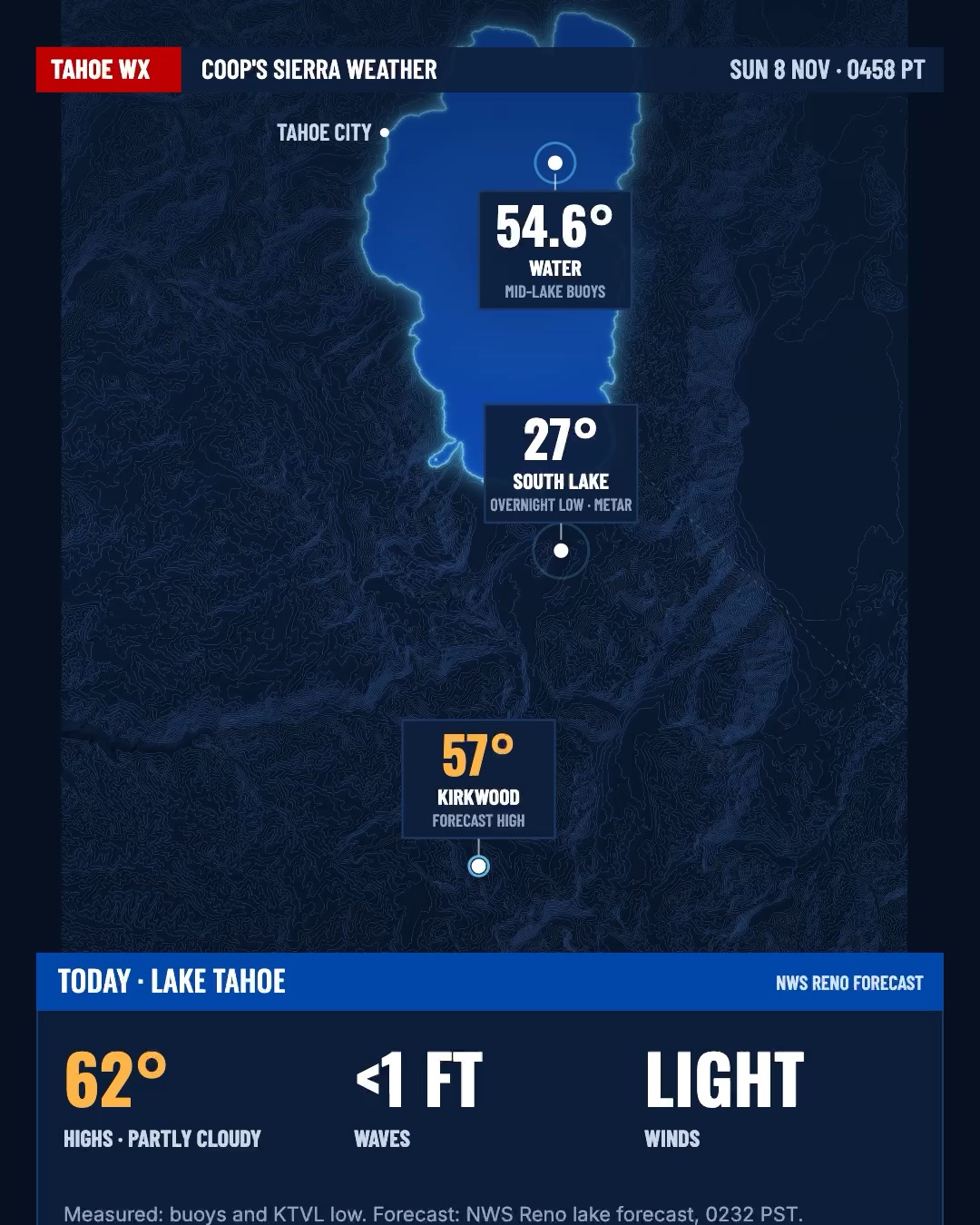
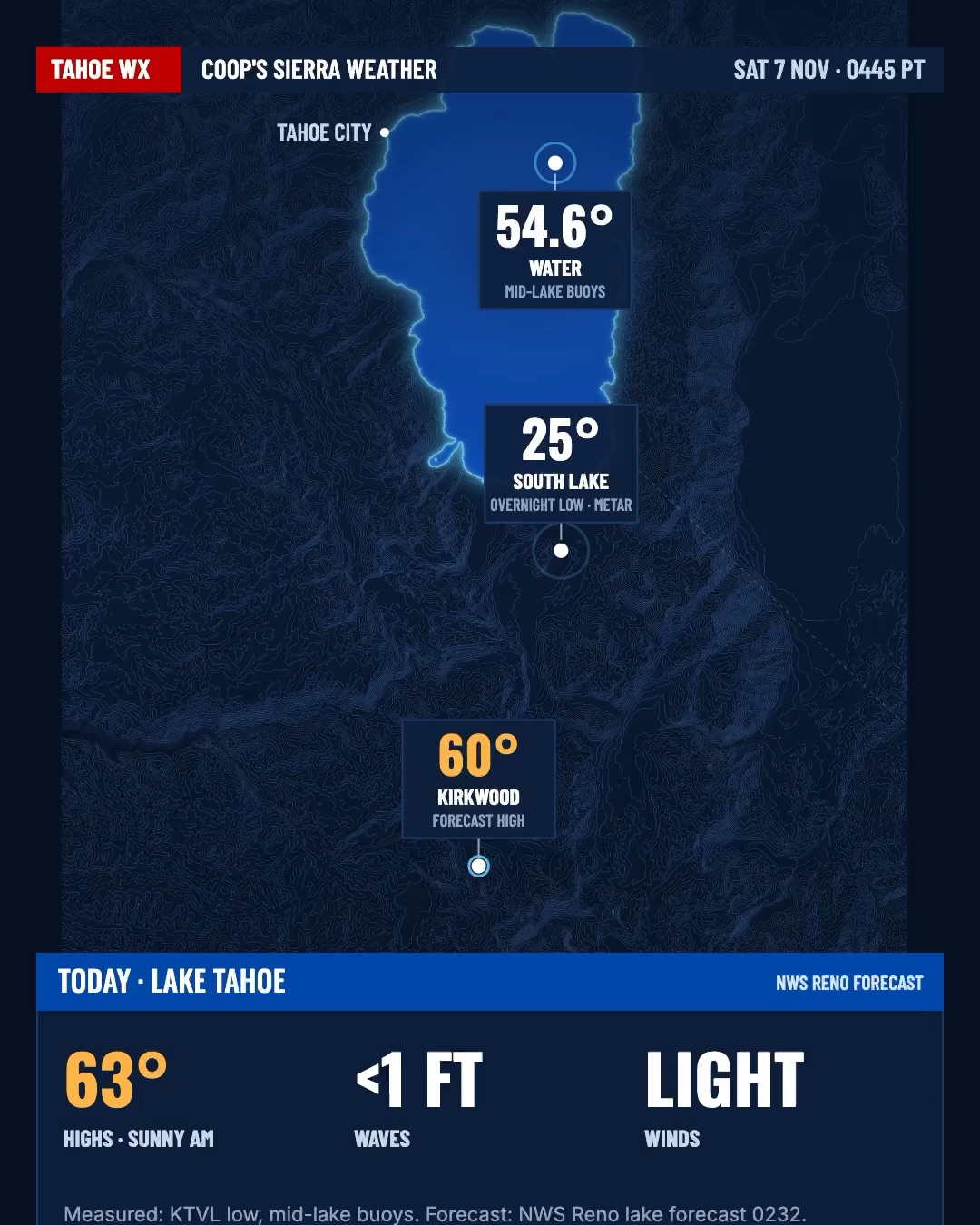
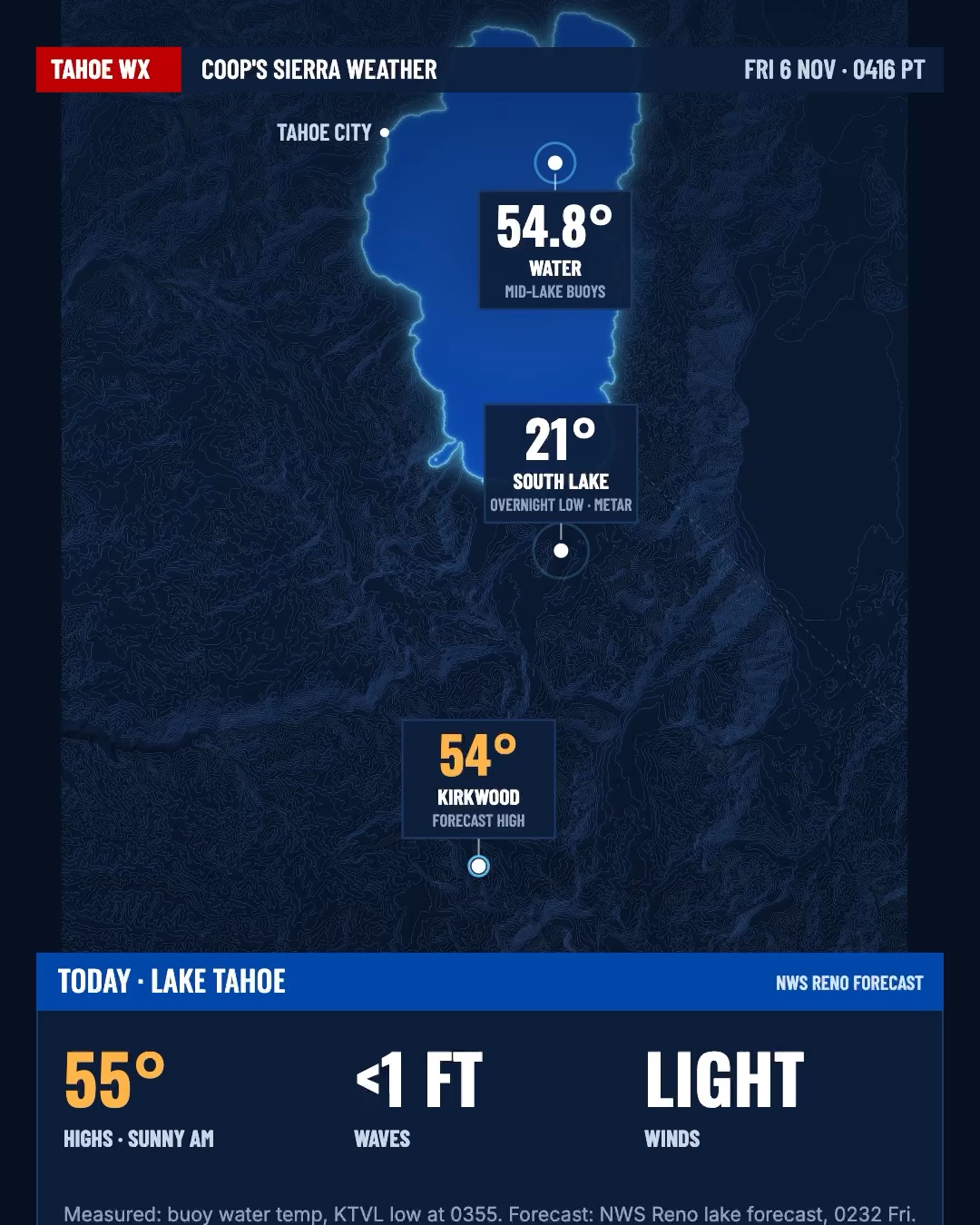
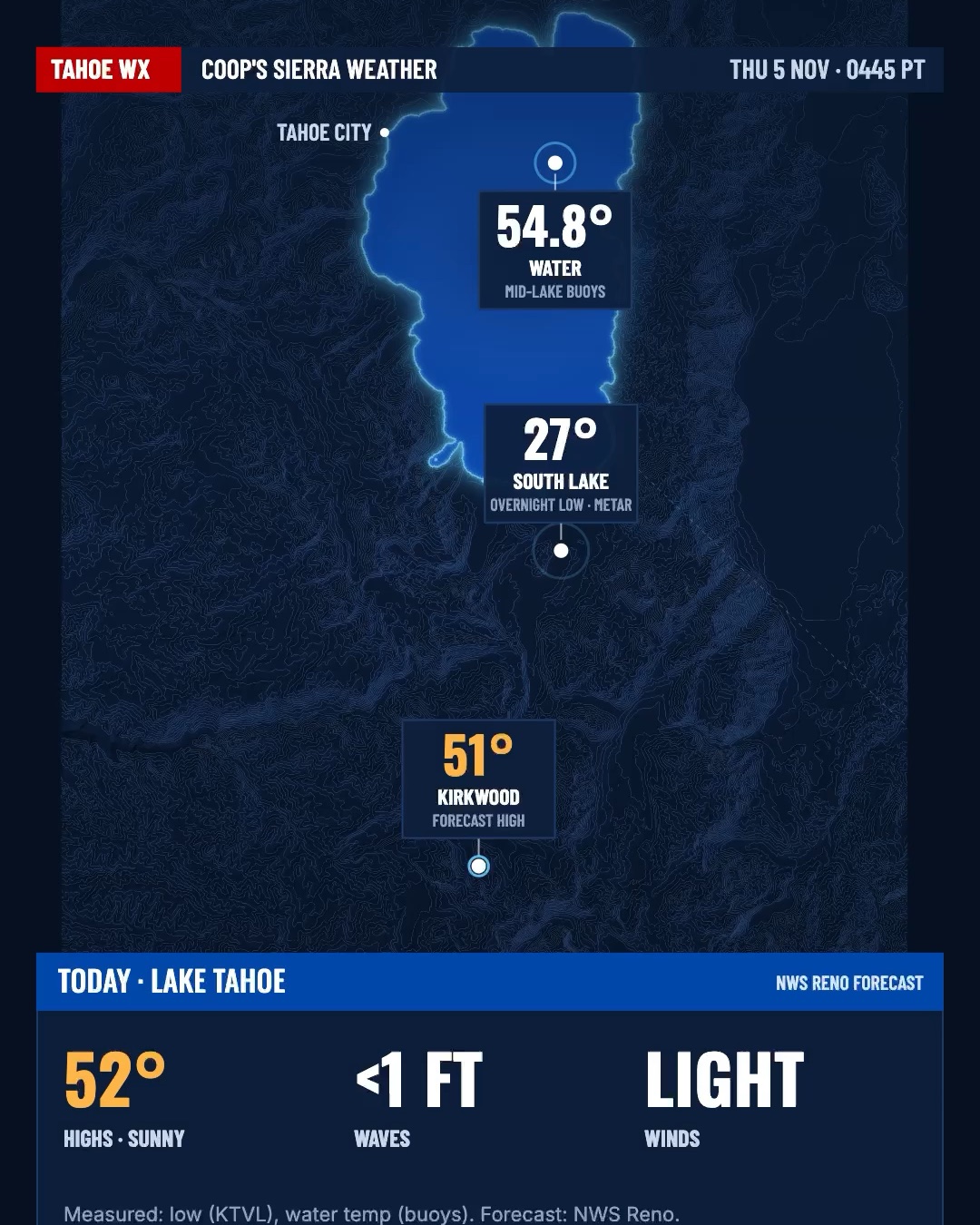
Tahoe Weather. Boots on the Ground.
I'm Coop. Snow and stoke all winter, wind and water all summer, 24/7/365. This is the regional intel I use myself: live mountain sensors, peak winds, the avalanche centers, and the models I actually read. Real numbers first. My read second.
Snow in the forecast
The Sierra read first, straight from the two forecast offices that cover us. ❄ lines are every sentence in the discussion that gives a snow amount, a chance, or an elevation. Each office prints on its own card, in its own words, never blended.
Lake Tahoe, Truckee and Reno are NWS Reno's area. KirkwoodMtn and the Sierra south of I-80 are NWS Sacramento's. We read both every desk run. Sources: NWS Reno ↗ · NWS Sacramento ↗
Snow and wind by spot
Totals, timing, snow level and snow quality for the next 72 hours and the week, pulled live from the NWS forecast grid every visit.
Loading the NWS forecast grid…
These are forecasts for one grid cell, about 2.5 km across, at the elevation shown on the card. Snow is summed from NWS's own 6 hour amounts and never rounded up. Gusts are converted from knots and rounded down. Quality is an estimate from NWS's snow-to-water ratio for the snow hours: under 8:1 wet and dense, 8 to 12 medium, 13 to 15 light, 16 and up light and dry. It reads "not established" when there is too little snow in the grid to say. Sources: NWS forecast grid (api.weather.gov) ↗, KirkwoodMtn stations ↗, NRCS SNOTEL ↗. Each card links its own spot.
Seven days on the mountain
Loading the forecast…
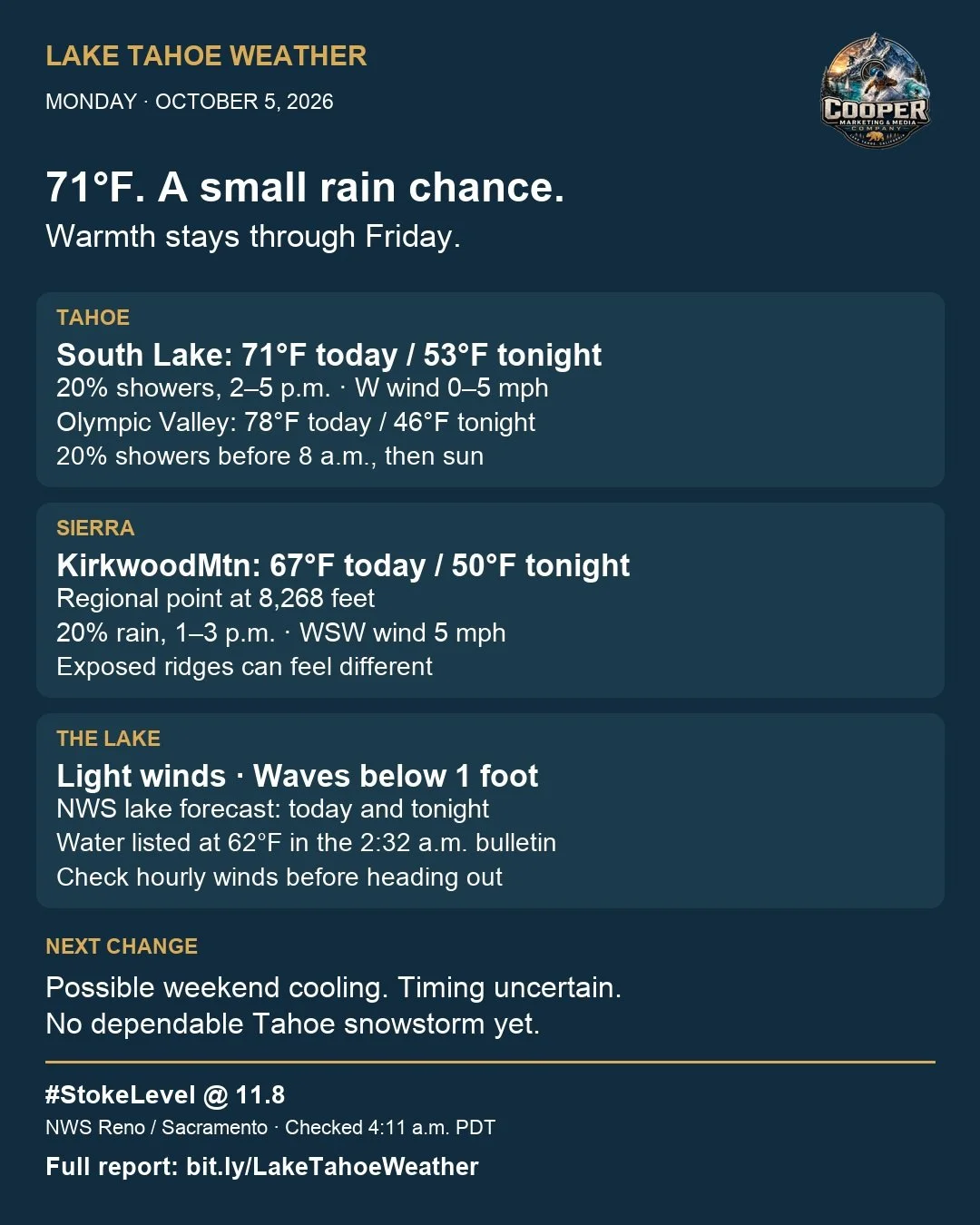
Highs and lows in °F, wind in mph, chance of precipitation in %. Source: NWS Reno (South Lake Tahoe, Olympic Valley, Truckee, Mammoth Lakes) and NWS Sacramento (KirkwoodMtn).
Avalanche bottom line
Loading the avalanche centers…
The bottom line is quoted word for word from each center. Read the full forecast on their site before you head out. Know before you go.
Sources: Sierra Avalanche Center ↗ · Eastern Sierra Avalanche Center ↗
KirkwoodMtn live
Source: Kirkwood Mountain Resort weather stations. Wet bulb tells snowmakers and snow levels the truth that air temperature hides. 24 hour new snow is from the snow plot depth sensors and gets checked against the morning report.
Snow by resort
Each resort's own snow report when it is current. Before a resort reports for the season, the nearest measured station stands in, and the card names it. 0 means the sensor read zero. "Not reporting" means there is no source. Est. is a snow water estimate, never a measured number.
Sources: KirkwoodMtn ↗ · Sugar Bowl ↗ · Mammoth ↗ · Palisades Tahoe ↗ · Mt. Rose ↗. Stations: Kirkwood Whiskey plot ↗ · Snow Lab ↗ · SNOTEL 784 ↗ · SNOTEL 652 ↗
Peak winds
Ridge wind tells you what the lifts are going to do before the lift report does. Direction is where the wind blows from.
Sources: NWS Reno remote weather data through api.weather.gov, and the KirkwoodMtn Cornice Express station. Speeds in mph. Times are Pacific.
The independent benchmark
Source: Central Sierra Snow Lab. Science, not marketing. When the Snow Lab says it snowed, it snowed.
The next 60 hours
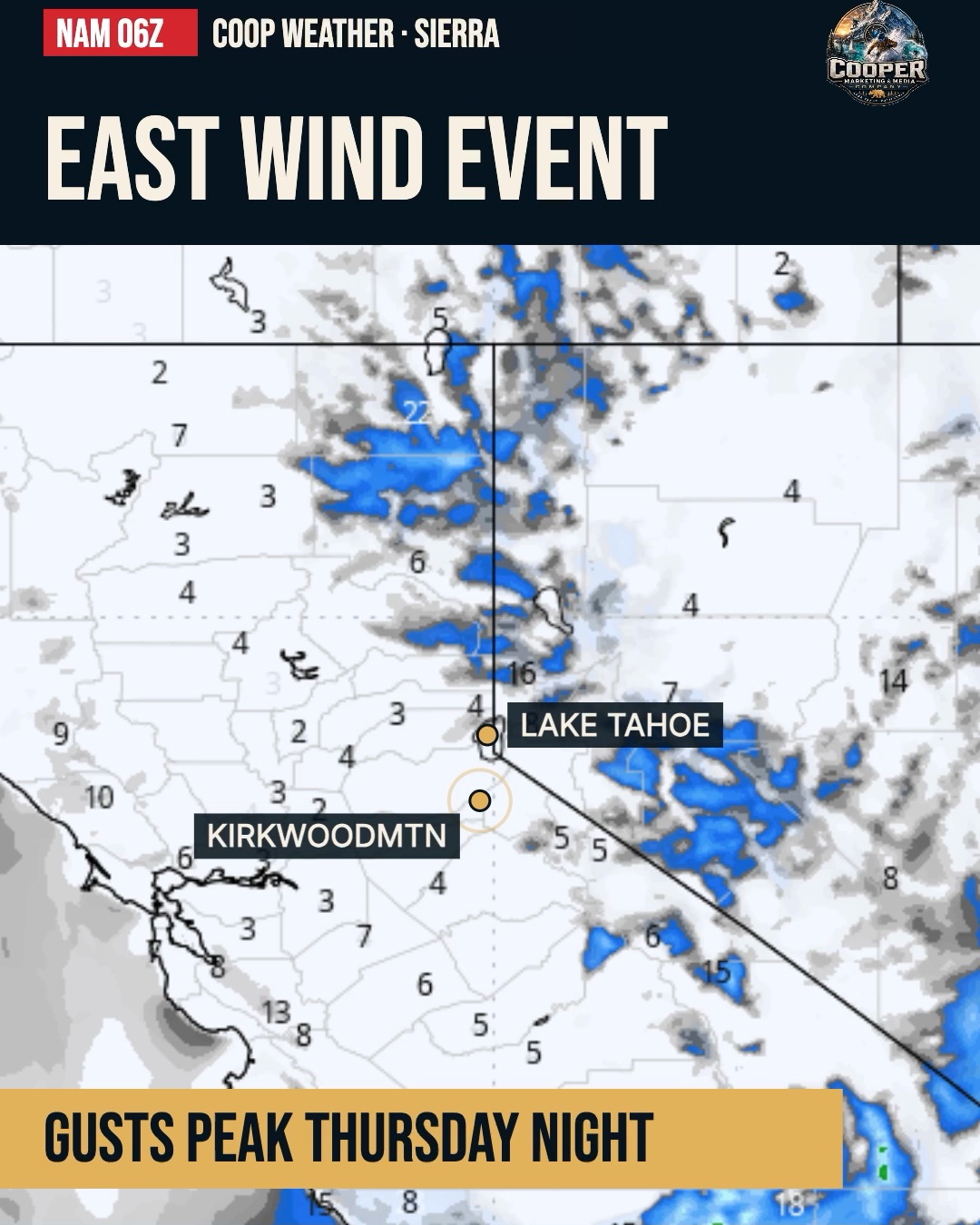
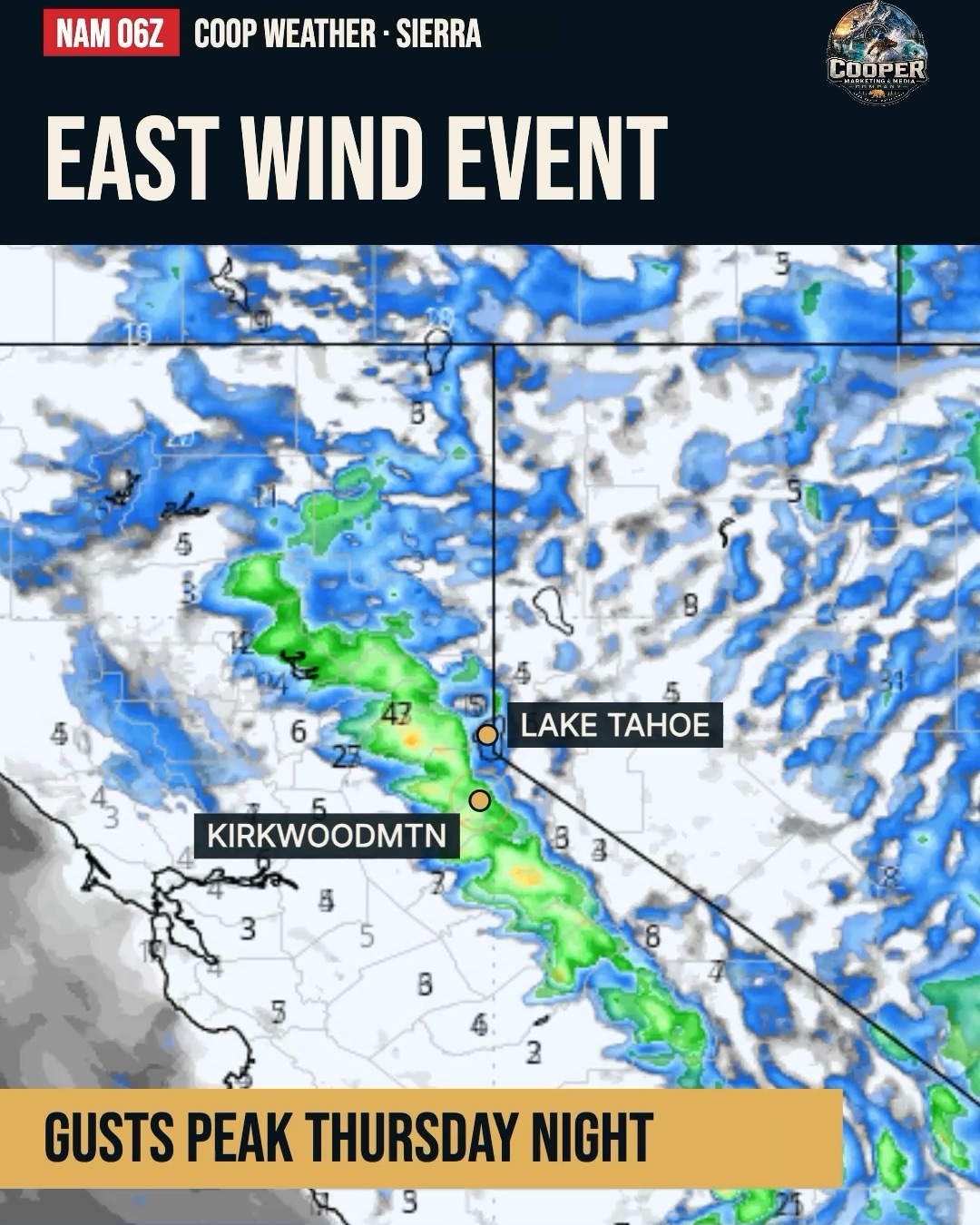
High resolution, short fuse. This is the model I lean on for storm timing, snow levels, and wind on the ridges inside two and a half days. Every map runs as a 40 second loop.
Source: WeatherBell maps ↗, RRFS 3 km from NOAA NCEP. Frames refresh with every desk run (0400, 1000, 1600, 2200).
The pattern ahead
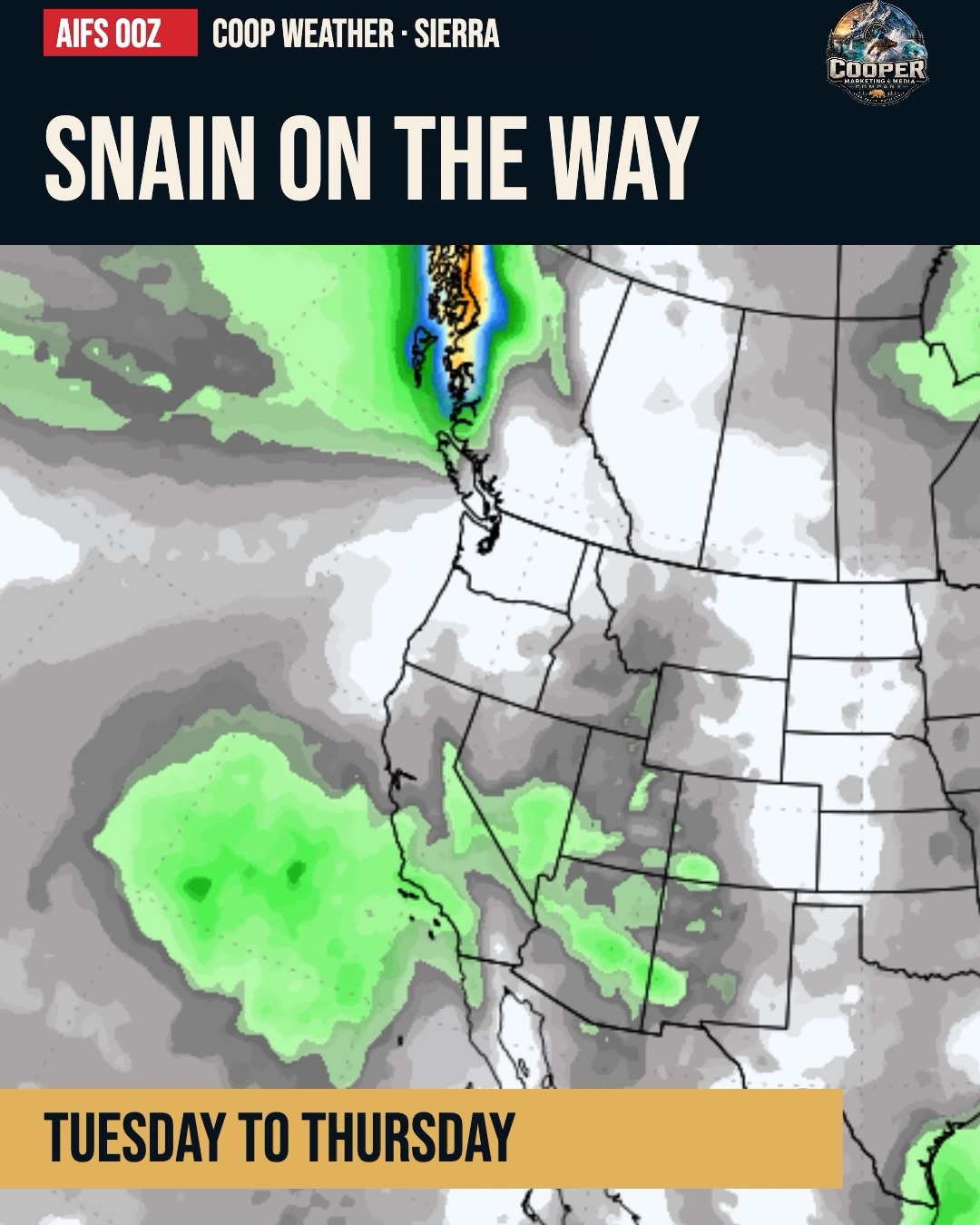
Out past day five I trust the crowd, not one run. The AIFS ensemble mean smooths the noise so the real signal shows. Big trough off the coast and a lower 500 mb height anomaly over the West is what storm cycles look like before they show up.
Source: WeatherBell maps ↗, ECMWF AIFS ensemble from ECMWF. Frames refresh with every desk run (0400, 1000, 1600, 2200).
What's coming off the Pacific
Colder cloud tops show brighter. Tall, cold tops on the infrared are where the moisture and the energy live.
Source: WeatherBell maps ↗, GOES infrared from NOAA. Frames refresh with every desk run (0400, 1000, 1600, 2200).
Model and satellite maps © WeatherBell Analytics, used under license by Cooper Marketing & Media. Underlying data from NOAA NCEP, ECMWF, and NOAA GOES.
Radar, live
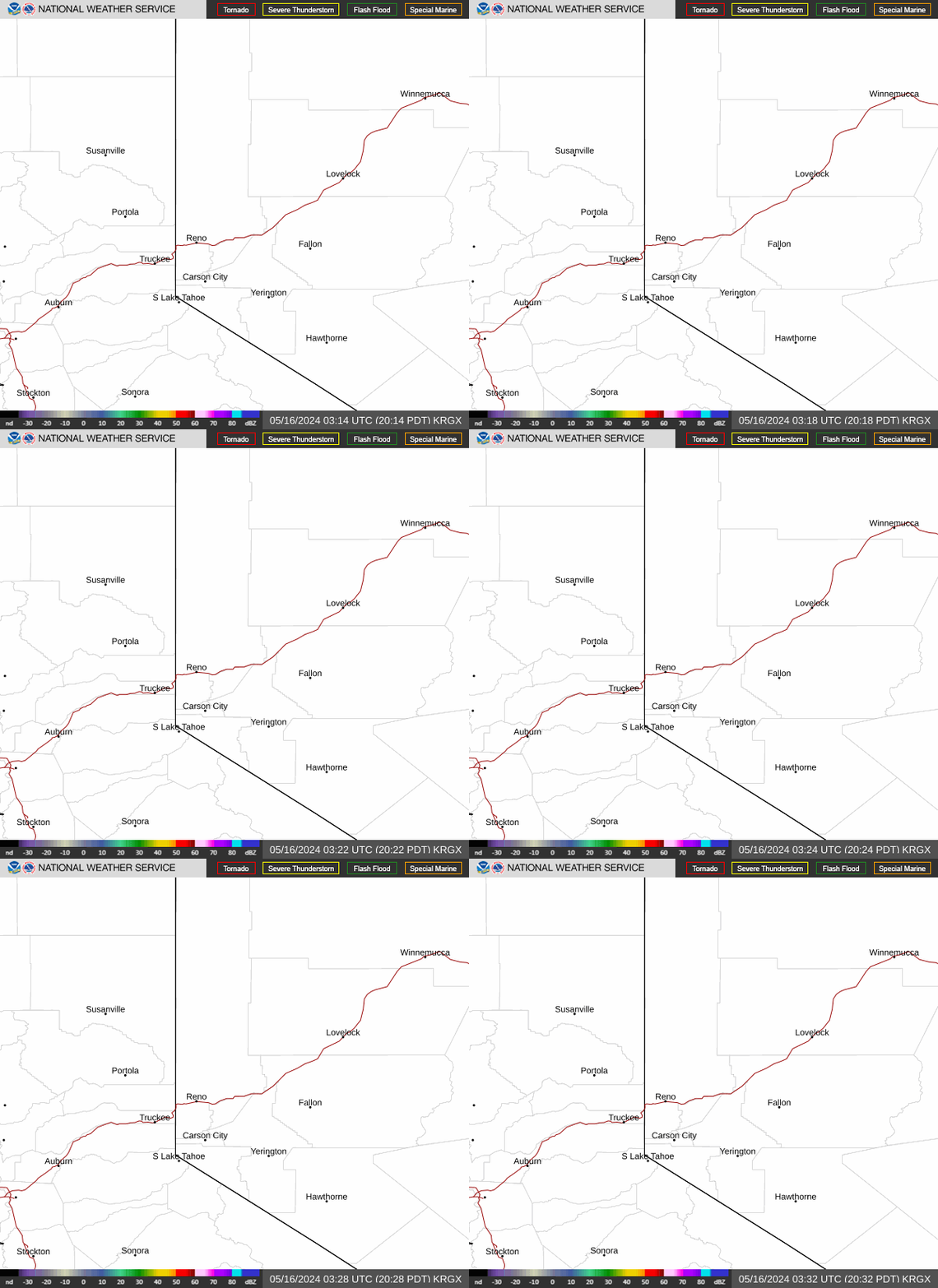
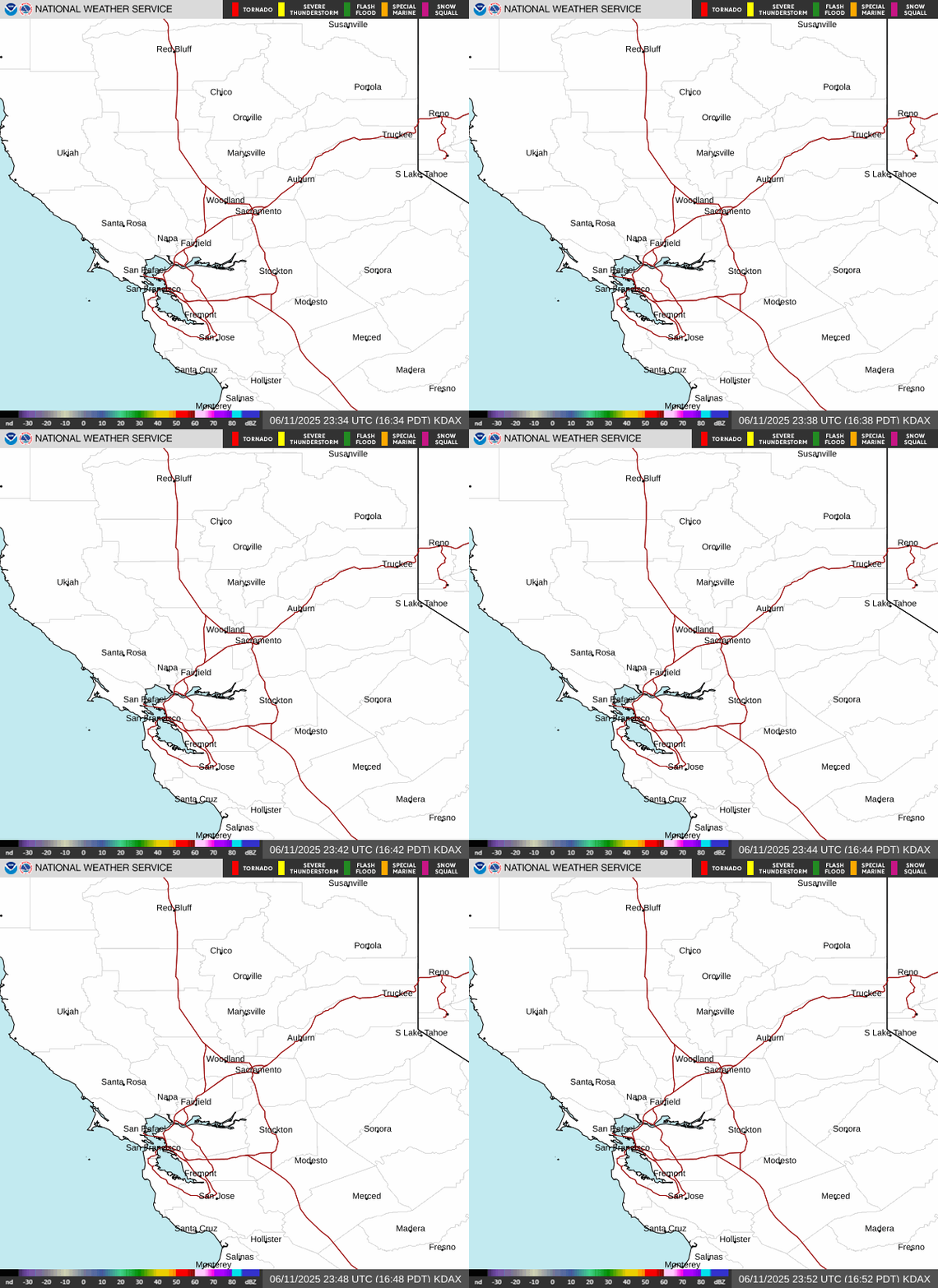
Source: NWS radar ↗ and NOAA STAR ↗. Mountains block the low beams, so radar can miss light snow on the crest.
Webcams
Roads and chain controls
Caltrans cameras
Road text is Caltrans' own wording at the time shown. Conditions change fast; open the Caltrans page before you drive.
More road links
Chain controls change by the hour on storm days. Check before you leave the valley, not at the chain station.
How we did
We print the numbers, then we check them. Every call below is graded against the station that measured it. When we miss, it goes at the top, with the size.
We grade the numbers we print, and most come from NWS Reno and NWS Sacramento. Ridge calls are checked against one ridge sensor, Cornice Express, so a gust on a higher peak can beat it. The South Lake Tahoe airport runs colder than town on clear, calm nights. Hit: within 3° on temperature, inside the stated range or within 10 mph on gusts, within 1" or 25% on snow. Close: within double that. Miss: anything more.
Measured at: South Lake Tahoe airport KTVL ↗ · KirkwoodMtn Cornice Express and Whiskey plot ↗
Wind on the lake and the passes
Caples Lake near Kirkwood 1E (CAP)
SQV8200 · Squaw Valley
Lake Tahoe Buoy West
Swipe across for every hour. Winter runs in mph; knots come back with the sailing season in May. Source: Windfinder.
Read the maps like a forecaster
Wet bulb vs. air temperature
Wet bulb is the temperature air cools to when it evaporates water. Snowmakers want it around 28°F or colder. Falling snow can survive above-freezing air when the wet bulb sits near or below 32°F, which is why it can snow at 35°F on a dry day.
Snow level
The elevation where rain turns to snow. On Tahoe storms it can swing thousands of feet. A 7,000 foot snow level means lake level gets rain and the upper mountain gets snow.
500 mb height anomaly
The pressure pattern about 18,000 feet up. Blues and purples over the West mean a trough, cooler air, and an open door for Pacific storms. Reds mean a ridge, dry weather, and sunshine. Watch the 5 day average for the pattern, not the daily wiggles.
Snow ratio: 10:1 vs. the real thing
The 10:1 maps assume one inch of water makes ten inches of snow. Cold storms run 15:1 or better, #ColdSmokePow. Warm, wet early season storms can run 6:1 to 8:1, #GorillaSnot that builds base. Read the snow total maps as a range, not a promise.
Ensemble mean vs. a single run
An ensemble runs the model dozens of times with tiny changes. The mean shows where most runs agree. When a single run shows a monster storm the ensemble does not, that is noise until proven otherwise.
Helicity and shear
Both measure how wind changes with height. In the Sierra they flag gusty, turbulent days and the rare strong thunderstorm. High values on a storm day mean lift wind holds and wind loading on lee slopes, which matters for lift ops and avalanche danger.
Wind direction
Direction is where the wind blows from. A southwest wind of 225 comes from the southwest. In Tahoe, strong southwest flow ahead of a storm loads northeast facing slopes.
Sources: NWS glossary ↗ · How NWS measures snow ↗
A big El Niño is real. A big Tahoe winter is not a done deal.
The facts. NOAA's Climate Prediction Center has an El Niño Advisory in effect. In the October 8, 2026 discussion, the monthly Niño-3.4 index ran +2.1°C and Niño-1+2 +3.9°C, with heat stacked deep below the surface in the eastern Pacific. CPC puts a strong to very strong event through January to March 2027 at better than 83%, and gives an 83% chance that October to December tops +2.5°C, which would beat every El Niño on record back to 1950.
My read. Loud signal in the Pacific. Softer signal at Lake Tahoe. Strong El Niño winters tilt the odds wetter for California, and the tilt is strongest for Southern California. Up here the record is mixed: some strong years buried us, some ran warm with high snow levels and rain on the lower mountain. El Niño loads the dice. It does not roll them. Storm track, snow levels, and timing still decide the season, one system at a time.
What I'm watching. The subtropical jet lining up with the Sierra, snow levels on each storm, and whether the first real cold arrives on time. When a storm is inside the model range below, I'll call it straight. Until then, stay level and stay stoked.
Weekly values are CPC's satellite sea surface read for the week of October 7, against 1991 to 2020 normals. Monthly values and the odds come from the CPC discussion. CPC measures event strength with the Relative Oceanic Niño Index (RONI); historic means a 3-month RONI of +2.5°C or more. Next CPC discussion: November 12, 2026.
CPC outlooks, refreshed by NOAA every day
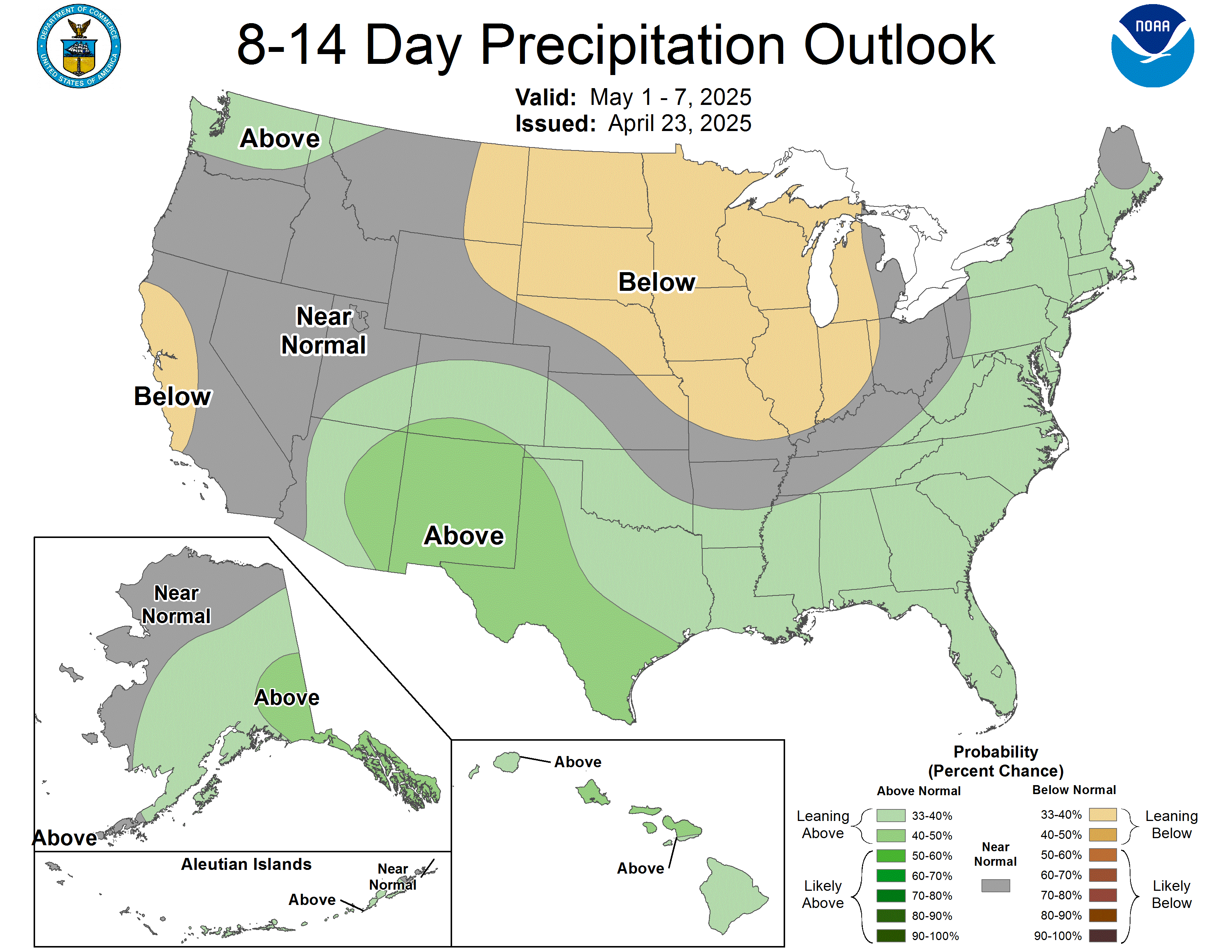
Green means the odds lean wetter than normal, brown drier. Blue leans colder, orange warmer. These are odds, not amounts.