TWENTY-FIVE DAYS
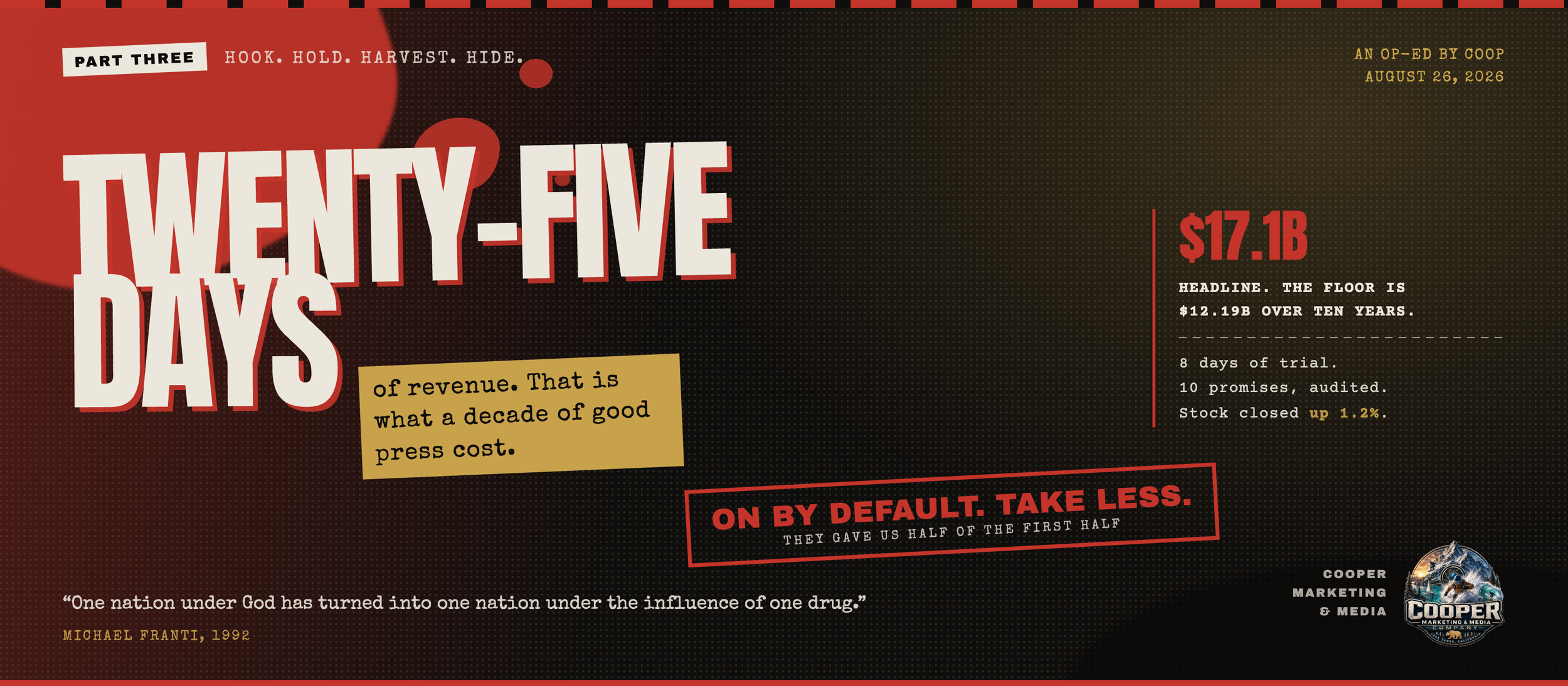
They paid up to $17.1 billion for a decade of it, and the stock barely twitched. Every promise, audited. End of chapter. Not the book.
"One nation under God has turned into one nation under the influence of one drug." Michael Franti, The Disposable Heroes of Hiphoprisy, 1992
Eight days. That is how long they lasted.
The trial that was supposed to run into October, the one with the sworn testimony and the internal documents and the man who built the safety tools sitting there telling eight people they were built to fail, folded midway through its second week. Meta wrote a check and walked out into the California morning like a guy settling a bar tab on his way somewhere better.
Seventeen point one billion dollars, said the headlines.
Then I looked at the tape.
The stock popped four percent, gave it all back, went negative, and closed up 1.2 percent.
Understand what that means, because it is the whole story and the market needed about ninety seconds to say it. A company just made an existential threat evaporate, and the people who own it could not be bothered to celebrate. No party. No panic. A shrug from the only jury Menlo Park has ever actually feared.
They were never afraid. That is the finding. Every solemn word about how seriously they take the safety of our children, delivered under oath in a federal courthouse, and their own shareholders priced it at roughly nothing by the closing bell.
So let us go through it. Ten headline promises. Some are real, and I will tell you which, because the moment I start shading things I become the subject of my own column.
WHAT SEVENTEEN BILLION DOLLARS ACTUALLY IS
The number is a costume. Take it off.
The floor, the part they actually have to pay, is $12.19 billion over ten years, split among 47 states, the District of Columbia, and three territories. Fifty-one jurisdictions. Texas cut its own deal for a billion more, which is why you may have seen "$18 billion" on some front pages.
The distance between that floor and the headline is about $4.9 billion, and it arrives only if TikTok, YouTube, and Snapchat accept comparable terms. More than a quarter of the penalty is not a penalty. It is a wager on the competition, and I will come back to how long that bet is.
Guaranteed cash out the door: $1.22 billion a year.
Meta booked $60.801 billion in revenue last quarter. Up twenty-eight percent. Profit went the other way, net income falling fourteen percent to $15.848 billion on soaring costs, and I want that on the record before I use it, because it cuts against me.
Revenue is $668 million a day. About $27.8 million an hour.
Divide it.
Meta earns each year's payment in roughly forty-four hours.
Somebody is already typing that revenue is not profit. Correct. So run it the hard way, on that shrinking net income. Call it $174 million a day, money in the pocket after everything.
Each year's payment is about seven days of profit. Seven days out of three hundred sixty-five, for ten years.
The objection does not survive the second calculation. They rarely do.
The Motley Fool ran the deal against the ledger and called it twenty-five days of revenue, working off the $16.7 billion figure the wires were using. Against the $17.1 billion the attorneys general actually announced, it is closer to twenty-six. And against the floor, the money they are certain to pay, it is eighteen days of revenue, spread across ten years.
Two things make that comparison generous to Meta rather than unfair, and I want them on the record. The payments are fixed in nominal dollars while revenue has been compounding at double digits, so the burden in year ten is a fraction of the burden in year one. And I am measuring against a single quarter. The trade only gets cheaper for them from here.
Now, the thing I got wrong when I first drafted this, and I would rather correct myself than have you find it.
Meta booked $2.4 billion in legal charges last quarter and told investors the youth trials "may ultimately result in a material loss." I read that as a reserve for this case. It was not. That was general legal expense, and Meta has since said it will book roughly $10 billion in the third quarter for this settlement.
So they did not pre-fund the harm. What they did was tell their shareholders, in writing, before a single juror was seated, that a material loss was coming and roughly what shape it would take. Then they closed at a price that says nobody was surprised.
THE ONLY JURY THEY EVER CARED ABOUT
Jim Cramer says out loud at 9:53 in the morning what fund managers say quietly at eleven:
"Meta goes negative: this is one hated stock.. i mean like despised. The big existential loss is off the table; the plaintiffs bar likely to fold.. This was a huge win. Shocked it doesn't matter."
One minute later, running my arithmetic before I did:
"It is important to note that when Meta doesn't react to something they will owe $1.3 billion a year–drop in the bucket–instead of $100 billion a year–and it doesn't matter, that stock is considered odious."
Drop in the bucket. From a man whose entire job is talking you into owning it.
That is the review. Everything after this is me showing my work.
THE TEN HEADLINE PROMISES, AUDITED
1. A two-hour daily cap for under-18s across Facebook and Instagram combined, with pauses at 15, 60, and 90 minutes. Five years, stretching to ten and tightening to sixty minutes per app if the competition signs.
Gets its own section below. Sharpen a knife.
2. Night block, midnight to 6 a.m., liftable only by a parent. Notifications dead 10 p.m. to 7 a.m.
Real. The best thing in the document. Sleep is the machinery through which most of this damage runs, and a hard default at the product level works whether or not a tired parent ever finds a menu.
My complaint was going to be that midnight is late, because the wreckage starts around ten. Then I read the fine print. If the competitors sign, the block expands on both ends, to 10 p.m. through 7 a.m. Nine hours instead of six.
They knew midnight was late. They wrote the better version and made it conditional on their rivals.
One caveat that cuts both ways, and I would rather raise it than have Meta raise it. Instagram Teen Accounts have muted notifications from 10 p.m. to 7 a.m. by default since September 2024. The notification half of this is not new. What is new is the access block, which locks the door rather than silencing the phone, and that is a genuine escalation.
But hold that thought, because it sets up the best fact in this entire story. When Meta was choosing freely, with no attorney general in the room, it nudged teens off the app at sixty minutes. The binding cap the attorneys general just accepted and held a press conference about is 120.
3. No push notifications 8 a.m. to 3 p.m. on weekdays, August 15 through June 15.
Real, and small. It kills the buzz, not the app. A kid opens it under the desk anyway. But defaults are how the world actually gets built, and this is a default.
4. Robust age assurance.
The load-bearing wall, poured out of vagueness. Every other promise assumes the platform knows who is a child. No release specifies a standard, a method, or a metric. Béjar testified last week that on Instagram specifically, the attitude toward children under 13 was "don't ask, don't tell." Massachusetts notes the framework will not require users to hand over government identification, which tells you what it will not do and nothing about what it will. If this one is soft, the other nine are wallpaper.
5. Measures to identify and remove users under 13.
Real, and eleven years late. Internal research cited in the court filings put four million under-13s on Instagram in 2015. Their own count. The kids stayed, because kids are where the future users come from, and an executive said as much.
6. A ban on cosmetic-procedure filters and on displaying like and reaction counts for under-18s.
Real, and it is a ban rather than a restriction, which is better than I expected. It touches the comparison. It does not touch the loop.
7. Safeguards on bullying, eating disorder and self-harm content, and a requirement that Meta respond to 90 percent of teen reports of harmful content within six hours.
I had the sneer already written. Meta has been announcing safeguards on those three since before some of these kids could read, and "safeguards" is a word with no edges.
Then I found the second half of that bullet, and I want to be loud about it, because it is the only hard number in the entire settlement. Ninety percent. Six hours. Countable, auditable, true or false, no press release required.
Now two honest caveats, because a Meta lawyer will raise both if I do not.
The obligation is to respond to reports. Not to act. Not to remove. Somebody should be reading the consent judgment for what "respond" turns out to mean.
And here is the harder one, which I had wrong in my first draft. Béjar's research found 51 percent of teens had a bad or harmful experience in the previous seven days. Of those, one percent ever filed a report. Of those reports, two percent produced any action. Multiply them, and you get two harmful experiences in ten thousand that ever end in a takedown.
So this provision governs the second bottleneck and leaves the first one completely alone. Ninety percent of reports answered in six hours does nothing whatsoever for the ninety-nine percent of kids who never file one.
It is still the only line in this document that can be caught failing, and it should have been the headline on every story today. It was a bullet point.
8. An option for under-18s to switch to a non-personalized feed, plus parental controls over algorithmic feeds and autoplay.
A real concession, and the airbag joke told back to us with a straight face. An option a fourteen-year-old has to go find. Béjar stood in that courtroom seven days ago and said most people will not turn the setting on. It's like you have to turn on the airbag every time you get into the car.
A week later, here it is in the settlement, wearing fresh paint. Make it the default, and I will stand up and applaud.
9. Stronger parental controls, including alerts for alt accounts, setting changes, and contact from suspicious accounts.
The alt-account alert is smarter than it sounds, because a second account is precisely how a thirteen-year-old defeats item five. Everything else here is opt-in by construction. A safety feature that requires the victim's parent to locate it is a legal document, not a safety feature.
10. An independent auditor with expansive access and a direct line to the attorneys general, plus an injunction against false or misleading safety claims.
The sharpest teeth in the deal, and almost nobody is writing about them. Everything in every settlement comes down to whether anyone checks. And because this enters as a consent judgment, lying about safety stops being a public relations inconvenience and becomes contempt of a federal court order.
Given that Part One of this series was essentially a list of things Meta said that Meta's own research contradicted, that clause carries more weight than its placement suggests.
Two things nobody is saying out loud. The five-year clock that governs the time limits may or may not govern the auditor. No release I can find says, and the reporting conflicts, with at least one outlet putting most of these controls at ten years. And Judge Gonzalez Rogers still has to enter the judgment. Read the order when it lands, not the press release.
NOW THE PART THAT MADE ME PUT THE COFFEE DOWN
Gallup asked American teenagers how long they spend on each platform. Total: 4.8 hours a day.
The split. YouTube: 1.9 hours. TikTok 1.5. Instagram 0.9. Facebook 0.3.
Add the last two. They are the only two this settlement touches.
One hour and twelve minutes.
The cap is two hours.
The leash is nearly twice the length of the dog.
For the median American teenager, the marquee provision of a seventeen billion dollar settlement, the thing the attorneys general held a press conference about, does nothing at all. It was built above the roof and then photographed from the ground.
Be careful with that, though, because a median is not a population. Gallup also found 51 percent of teens clear four hours a day across platforms, and girls average 5.3 hours against boys at 4.4. Nobody has published the per-platform distribution, which means nobody outside Menlo Park can tell you what share of teenagers clear two hours on Instagram alone. Those kids exist; they are disproportionately girls, and they are precisely the children in the complaints. For them the cap may matter enormously.
So the honest version is this. The cap clears the median roof by a wide margin. Whether it binds the tail is the only question that matters, and the answer is in a drawer in Menlo Park.
And direct messages are carved out of the notification bans. The overnight blackout and the school-hours blackout both let DMs through, along with account security alerts. The single most intense thing a teenager does on these apps, the private thread that runs all night and is where the bullying and the sextortion actually live, is the one thing still permitted to buzz at two in the morning.
Whether DMs also pass through the two-hour cap and the midnight access block is not stated in any release I could find. It is the first question somebody should ask when the consent judgment is docketed.
Now let me argue against myself, because that is the only reason to trust anything else here.
The Gallup survey is from 2023. Self-reported. Snapchat was not among the seven platforms tested. Ages 13 to 19, which means it includes eighteen- and nineteen-year-olds; the cap does not govern, so the true under-18 figure is probably a little higher than what I quoted.
I went looking for something better, and there is nothing better. Pew's December 2025 teen survey measures how often kids check, not how long they stay on each app. Gallup 2023 remains the best per-platform number anyone has published, and if Meta holds a superior one it is in a drawer in Menlo Park with everything else.
And an average is only an average. The cap absolutely bites for heavy users in the top quartile, and heavy users are exactly the kids in trouble. For them it may matter enormously. I am not throwing that away.
But look at the top of that list one more time. YouTube at 1.9 hours. TikTok at 1.5.
Neither is bound by a syllable of this. Neither is Threads, or WhatsApp, or Quest. Every release names Facebook and Instagram, and stops.
Thirty-four years ago, Franti complained about "150 channels 24 hours a day, you can flip through all of them, and still there's nothing worth watching."
One hundred fifty. That was the number that horrified him. And the thing had an off switch, sat in one room, and eventually ran out of channels at two in the morning.
We built one that never ends, put it in the kid's pocket, and gave it a file on her.
READ THE LIST AGAIN AND TELL ME WHAT IS NOT THERE
Go back over all ten. Time limits. Night blocks. School hours. Age checks. Under-13 removal. Filters. Like counts. Response times. A feed toggle. Parental controls. An auditor.
Every one is about when you look and what you see.
Data appears exactly once in all of this, and not the way you would hope. Several releases note the deal also wipes out the states' Cambridge Analytica claims, Meta's sharing of nonpublic Facebook user information with third parties before the 2016 election. Colorado books an extra $11.4 million for it.
That is not a rule about tomorrow. That is a receipt for yesterday, and Meta just bought the release.
What is in none of them, from any of the fifty-one jurisdictions, is a single forward-looking word about data collection, about data retention, or about targeted advertising to minors.
The feed opt-out is the nearest anything comes, and I have given it full credit. But an opt-out is a switch, and the file keeps growing either way.
Nothing in this document says take less. Nothing says delete what you already took.
One disclosure, since I just told you to read the order and not the release. I am reading press releases because the consent judgment has not been entered. But settlement authors write their releases to advertise their wins, and not one of fifty-one chose to advertise a single limit on data. That silence is not proof. It is a very loud absence, and I will read the judgment the day it lands and tell you if I was wrong.
So when you ask whether Zuckerberg and that crowd intend to keep collecting your data, tracking your movements, and renting access to your kids to whoever bids, I do not have to speculate, and neither do you. The settlement answers it in the negative space.
Yes. They will. It was never on the table. The harvest runs tomorrow exactly as it did yesterday, on the same twenty-two-year file, and this afternoon's close is nearly a trillion and a half dollars of capital, confirming you read the document correctly.
They bought a decade of headlines about how much they care, for eighteen days of revenue, while denying they did anything wrong. They did deny it. It is in the filings.
That is what seventeen billion dollars buys. Not remorse. Not reform. A press cycle and a receipt.
THE PINCER
Here is the cleverest thing in this document, and I have to tip my hat while my skin crawls.
That contingent $4.9 billion pays out only if Snapchat, TikTok, and YouTube accept comparable terms, and comparable means more than adopting the rules. It reportedly means matching their own payments. If they sign, Meta's own leash gets shorter: sixty minutes per platform instead of two hours combined, ten years instead of five, the night block running 10 p.m. to 7 a.m.
So Meta has been handed roughly five billion reasons to go strap the same handcuffs on its competitors, and the competitors have billions of reasons to tell them to pound sand. Which means the number on the front page is likelier to stay $12.19 billion than to become $17.1 billion, and everybody who drafted it knew that when they wrote the headline.
Meta is not even being coy about the recruiting. Chief legal officer C.J. Mahoney called the framework groundbreaking and said it would "empower parents to easily manage how their children access our platforms." He then added that "its success depends on all other social media platforms following Meta's lead," naming TikTok and YouTube.
Following Meta's lead. The defendant, on the day it settled, casting itself as the standard-setter for the industry it just paid twelve billion dollars to get out from under.
And then the part I did not expect.
The day before this settlement landed, the Pennsylvania Attorney General sued Snap in Philadelphia on a broader version of the same theory: addictive design, Snapstreaks, misleading parents about mature content, disappearing messages, and a friend-finding feature that put minors in front of predatory adults. Snap fell seven percent the next day, as Meta was signing.
So the attorneys general are not waiting for Meta to recruit anyone. They are going at the others directly, with today's settlement sitting on the table as the template for what surrender looks like. Meta's five-billion-dollar incentive and forty-odd state law offices are now aimed at the same targets from opposite directions.
You wanted a run at TikTok and Snapchat. It started before most of us had coffee, and it did not need one of us.
SO IS IT REAL CHANGE
You asked straight. Here it is straight.
Partly. Far less than the number implies. More than nothing.
Real: the night blocks. Removing the under-13s, if anyone enforces it. The alt-account alerts. Ninety percent in six hours, whatever "respond" turns out to mean. The auditor, for five years. The injunction against lying, now carrying a federal judge's signature.
Some kids will sleep through the night who were not sleeping through the night. I am not going to sneer at that. It might be the whole ballgame for a fourteen-year-old somewhere tonight, and I would take that trade every time.
Theater: a cap set above the median, with the overnight and school-hours blackouts letting private messages through. A feed fix that requires a child to go hunting through a settings menu. Parental controls that require a parent to do the same. Five years of promises against a file on your kid that is twenty-two years old and still filling. And none of it lives yet, because the changes arrive "within months," which means nothing here can be caught failing until sometime next year.
Beneath all of it, the machine, burning exactly the fuel it always burned, with the fuel line untouched by a single clause on a single page in any of those fifty-one announcements.
Real change was one line. The same line I have given you three weeks running.
On by default, and take less.
They gave us most of the first half. None of the second. And their shareholders shrugged, which tells you exactly which half was ever going to cost them anything.
THE DRUG OF THE NATION
I have been calling the screen a cathode ray nipple for three columns now, and I owe somebody a credit, because the phrase is not mine.
It is Michael Franti's. The Disposable Heroes of Hiphoprisy, 1992, and he had already cut a version with the Beatnigs four years before that. Television, the Drug of the Nation. Six and a half minutes of a man reading the indictment over a drum machine.
"Where imagination is sucked out of children by a cathode ray nipple."
Thirty-four years. He was talking about a wooden box in the living room, and every line he wrote lands harder on the feed than it ever did on the box.
He said television was "the reason why less than 10 percent of our Nation reads books daily." I gave you the current numbers in Part One, and they are worse now than the thing he was angry about. Reading for pleasure fell from 28 percent of American adults in 2004 to 16 percent in 2023.
He said it was the place "where image takes precedence over wisdom," where "sound bite politics are served to the fast food culture." He wrote that before the ninety-second clip existed. Before the paid influencer, before the ring light, before a thirteen-year-old could be measured continuously by four companies at once.
And then he asked the question this entire series has been circling, and I do not think anybody has improved on it since:
"T.V., is it the reflector or the director? Does it imitate us or do we imitate it?"
That is the whole argument between me and every person who has written to tell me I am too hard on the platforms, and every person who has written to tell me I am too easy on the parents. Reflector or director. Are they showing us what we are, or making us into it.
The honest answer, thirty-four years on and with the internal documents finally unsealed, is both, and the loop runs in both directions, and that is precisely why it is so hard to get out of.
The machine learns what holds you, then serves more of it, then learns from what you did with that, and around it goes. Franti did not have the word for a recommendation engine because nobody did. He just watched a nation sit too close and called it a drug.
His last line about the box is the one I cannot shake, and it is the reason I keep coming back to this even when I would rather be outside:
"T.V. is the only wet nurse that would create a cripple."
The box, at least, did not follow the kid to school. It did not know her name, her friends, her insecurities, or what she almost bought at two in the morning. It did not have twenty-two years on her.
We took the thing Franti was already calling a drug in 1992, and we improved the delivery mechanism.
END OF CHAPTER
Do we need any of it? To be happy, to trade ideas, to have friends?
No. We ran the entire human operation for two hundred thousand years without a feed and produced every friendship, every idea, and every decent afternoon anybody has ever had. The kids do not need it either. What they need is a place to be together where nobody is measuring them, and we used to call that a park.
Now let me be useful about the how, because I have watched enough of these fights to know where the leverage sits, and I would rather hand you something that works than something that feels good.
Forget the stock. I know you want to hit them there. Today settles it. They absorbed a seventeen-billion-dollar headline and closed up. Anger does not move that ticker, and anybody selling you a boycott that will is selling you a feeling. This newsletter does not deal in those.
And forget waiting for a shutdown order. Nobody is switching these platforms off by decree in this country, and honestly nobody should be able to, because a government holding a kill switch for speech it dislikes is a worse animal than the thing it kills. Say what you want about that lake house. I do not want the alternative, and neither do you once you think it through.
Here is the version that actually closes them.
You close a platform by leaving it.
Not as a metaphor. Mechanically. The teenagers are the asset. That user base is the whole valuation, the thing Béjar testified the company reorganized itself around, the reason four million under-13s stayed on a service that officially banned them. Every kid who walks out is not sentiment. It is inventory. It is the number in the deck that sets the number on the ticker.
A platform with no young people on it is not a platform. It is a server bill.
So do not click. Do not repost, not even to dunk on it, because the dunk pays the same as the applause. Report the spam. Cut the diatribe loose. Keep the phone out of the bedroom and take the incoming fire when you do it, because you will. And take the kids somewhere with weather in it this Saturday, with the phone left in the truck.
That is not surrender. It is the only lever in this story that has never once failed.
Money in these settlements, Texas's separate billion explicitly and others besides, is earmarked by the states for youth mental health, crisis services, digital literacy, and after-school and outdoor programs. Good. Take the outdoor money and build something a kid can stand on.
Eighteen days of revenue bought them a decade of good press. It bought them nothing from us.
This chapter closes today. The book does not.
Three more companies have the same business model, the same lawyers, and the same spreadsheet, and one of them got sued the day before this deal was signed. The road out runs straight through every platform built to hook you, hold you, harvest you, and rent what it took to the highest bidder.
We are going to walk all of it.
An afternoon costs nothing. They cannot bill it, target it, or sell it, and they cannot take it unless you hand it over.
Go spend it outside.
And when you get there, notice what is not happening. Nothing is counting. Nothing is learning. Nothing is deciding what you should see next.
One nation under the influence of one drug, the man said, in 1992, about a box with a hundred and fifty channels.
We can put it down. That is the whole finding. Everything else in this column is arithmetic.
#FuckFacebook