The SAVE America Act - is not what you think…
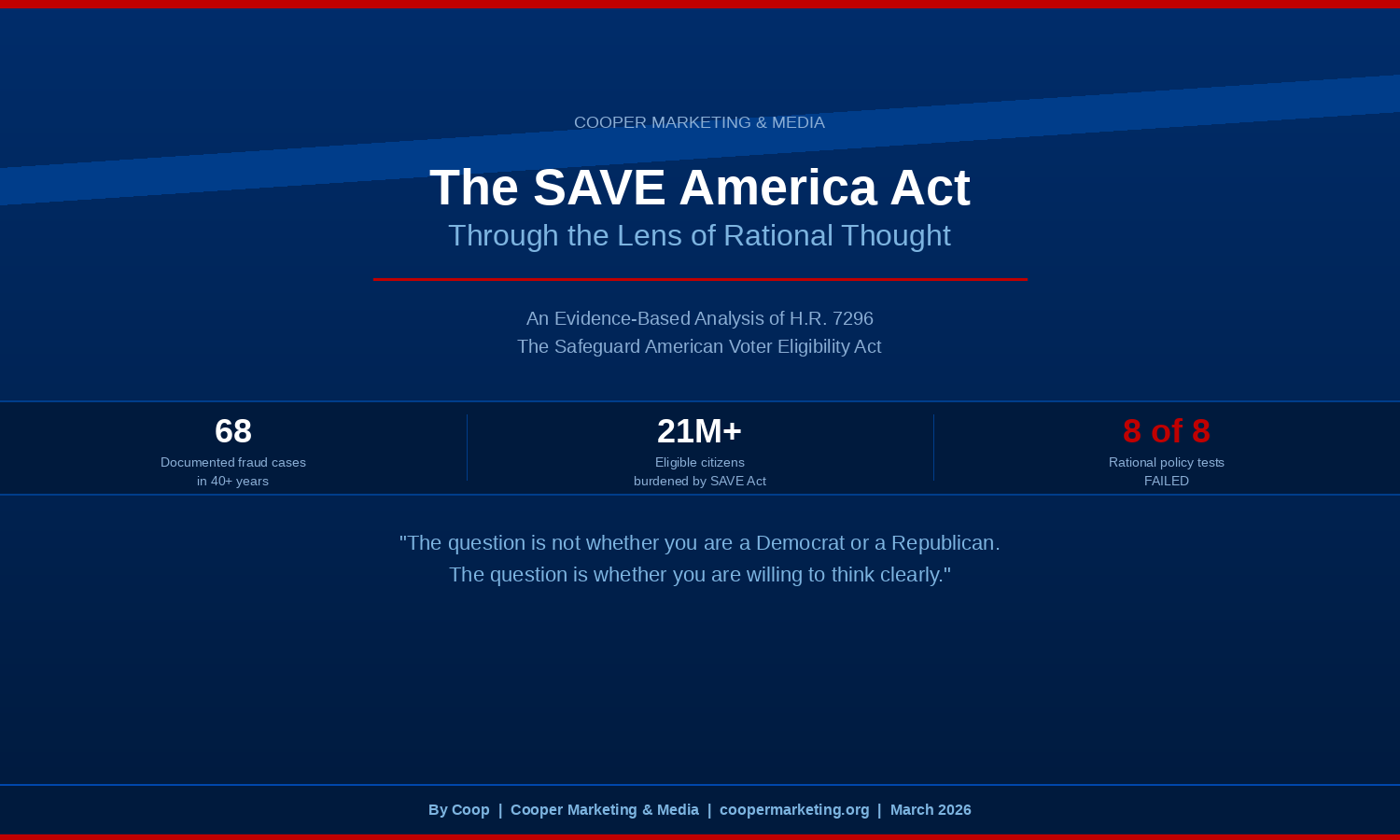
Through the Lens of Rational Thought
An Evidence-Based Analysis of H.R. 7296, the Safeguard American Voter Eligibility Act
The One Thing We All Agree On
Before I get into frameworks, data, cognitive science, or the bill itself, let me say something that should not need saying but apparently does:
Nobody who loves this country wants fraudulent elections. Nobody.
Not Democrats. Not Republicans. Not independents. Not the 83% who support voter ID, nor the 17% who have concerns about how it is implemented. Every actual patriot, every citizen who gives a damn about this republic, wants the same thing: elections you can trust. A system that works. Results that are legitimate. A democracy that functions the way the founders intended, where the will of the people is accurately counted and faithfully executed.
That is not controversial. That is the baseline. That is the starting line that every single American stands on, regardless of party, regardless of ideology, regardless of which cable news channel they leave on in the background.
The disagreement is not about the destination. It never was. The disagreement is about whether the people claiming to protect our elections are actually protecting them, or whether they are exploiting your legitimate desire for election integrity to sell you something else entirely. And the only way to answer that question is to look at what the legislation actually does, measured against what the data actually shows.
So let us start there. Not with teams. Not with slogans. Not with a pillow salesman’s fever dreams or a former president’s inability to accept a loss. Let us start with the one thing that unites every honest American: the elections should be fair, free, secure, and trusted. Period.
Now, let us see if the SAVE America Act actually delivers that, or if it just says it does.
Before You Pick a Side, Pick a Method
There is a question that should come before every policy debate in this country, and almost nobody asks it: How are you evaluating this?
Not what do you believe. Not which team are you on. How are you thinking about the problem? What method are you using to separate what is real from what feels real? Because those are two very different things, and the distance between them is where most of American politics lives right now.
I am going to walk through the SAVE America Act, the Safeguard American Voter Eligibility Act (H.R. 7296), introduced by Representative Chip Roy of Texas. I am going to do it without a party registration, without a cable news chyron, and without the cognitive shortcuts that make most political analysis worthless before the first paragraph ends. What I am going to use instead are the tools of rational inquiry: evidence, probability, base rates, outcome measurement, and the intellectual honesty to follow data wherever it leads, even when it lands somewhere uncomfortable.
If that approach sounds familiar, it should. Some of the most important thinkers of the last two decades have been making the case that human beings are capable of extraordinary reasoning when they choose to use it, and capable of extraordinary self-deception when they do not. The frameworks I am applying here draw from that tradition: evaluate claims against evidence, measure outcomes rather than intentions, check your own tribal loyalties at the door, and treat policy as an ongoing experiment rather than a loyalty test.
The question is not whether you are a Democrat or a Republican. The question is whether you are willing to think clearly about what this bill actually does.
The Traps Your Brain Sets Before You Read a Single Page
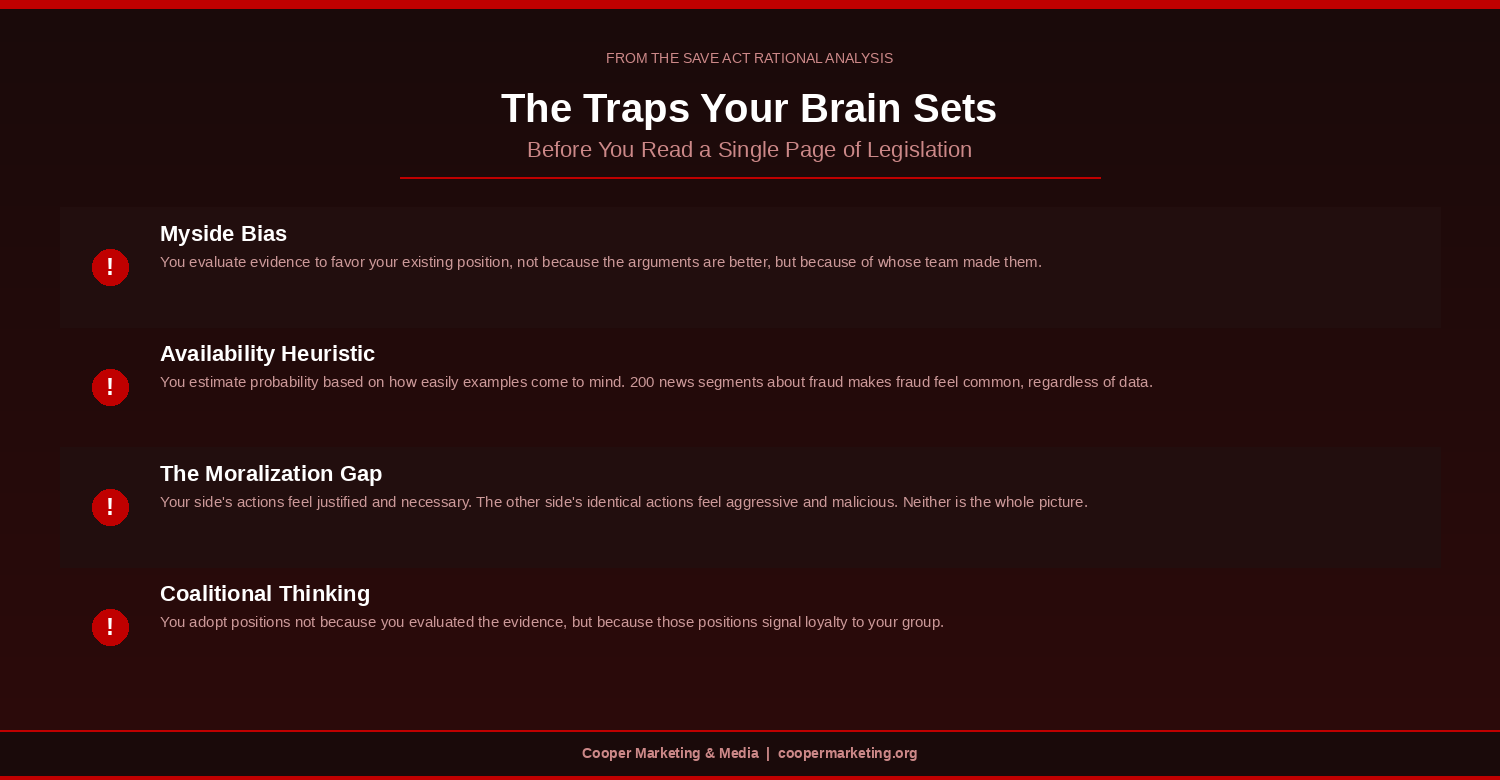
Before I get into the bill itself, I need to name the cognitive machinery that will fight you every step of the way. Not because you are stupid. Because you are human. Every brain on the planet runs the same flawed software, and understanding the bugs is the only way to write better code.
Myside Bias
This is the big one. Myside bias is the tendency to evaluate evidence, generate arguments, and test hypotheses in a way that favors your existing position. It is not the same as confirmation bias, which is about what information you seek out. Myside bias is about how you process information you already have. You seize on every argument that serves your tribe and dismiss those that serve your opponents, not because the arguments are better or worse, but because of whose team made them.
Applied to the SAVE America Act: if you identify as conservative, you are neurologically primed to read this bill as a commonsense election security measure. If you identify as liberal, you are primed to read it as voter suppression. Both reactions happen before the rational mind engages. The goal of this analysis is to engage the rational mind first.
The Availability Heuristic
You estimate the probability of an event based on how easily examples come to mind. If you have seen 200 news segments about voter fraud, you believe voter fraud is common, regardless of what the actual data says. The media functions as an availability machine: it selects for dramatic, unusual, and threatening stories, which creates a systematic distortion of perceived reality.
Applied here: non-citizen voting gets enormous media coverage relative to its actual occurrence. The Heritage Foundation, which actively seeks these cases, has documented 68 over 40+ years. The Bipartisan Policy Center found 77 instances from 1999 to 2023. In a country that has cast over one billion ballots in that period, these numbers are statistically negligible. But they do not feel negligible, because availability has nothing to do with statistics and everything to do with salience.
The Moralization Gap
When your side does something, it feels measured, justified, and necessary. When the other side does the exact same thing, it feels aggressive, reckless, and malicious. This asymmetry is not hypocrisy in the way people usually mean it. It is a structural feature of human moral psychology. Both sides genuinely experience their own actions as defensive and the other’s as offensive.
Applied here: requiring voter ID feels like common sense if you already have ID. It feels like suppression if you are one of the 21 million Americans who lack the required documents. Neither feeling is the whole picture. Rational analysis requires holding both realities simultaneously.
Coalitional Thinking
Human beings evolved in small groups where your survival depended on your coalition. That wiring did not disappear. In modern politics, it means people adopt positions not because they have independently evaluated the evidence, but because those positions signal loyalty to their group. The result: astonishing flip-flops on policy when party leaders change their stance, because the position was never about the policy. It was about the badge.
Applied here: voter ID polls at 83% approval across party lines. But the specific mechanisms of voter ID legislation split sharply along partisan lines, not because the mechanisms are inherently liberal or conservative, but because each party has claimed a position, and deviation from that position is treated as disloyalty.
If any of these traps feel uncomfortably familiar, good. That means your rational mind is already doing its job.
What the SAVE America Act Actually Does
The Safeguard American Voter Eligibility Act (H.R. 7296) was introduced by Representative Chip Roy (R-TX) and has become a centerpiece of the GOP election integrity platform. Here is what the bill contains, stripped of political framing:
The Core Provisions
• Documentary proof of citizenship required: To register to vote in a federal election, applicants must present physical documents proving U.S. citizenship: a passport, a birth certificate, or naturalization papers. This must be done in person or with certified copies.
• Eliminates current registration methods: The National Voter Registration Act of 1993 (Motor Voter) allowed registration by mail and at government offices using a simple attestation of citizenship under penalty of perjury. The SAVE Act would require documentary proof instead, effectively ending mail-in registration, online registration, and same-day registration for anyone who cannot produce documents on the spot.
• DHS cross-referencing: The Department of Homeland Security would cross-reference voter rolls against its databases to identify potential non-citizens. States would be required to act on DHS findings.
• No federal funding: The bill authorizes no federal appropriations. All costs of implementation, including new verification infrastructure, document processing, and voter roll maintenance, would be borne entirely by state and local governments.
• Criminal penalties expanded: Enhanced penalties for election officials who fail to comply with the new requirements.
Measuring the Bill Against Reality
Rational analysis requires comparing a proposed solution to the actual scale and nature of the problem it claims to solve. It also requires examining the unintended consequences the solution creates. Here is where the SAVE America Act collides with data.
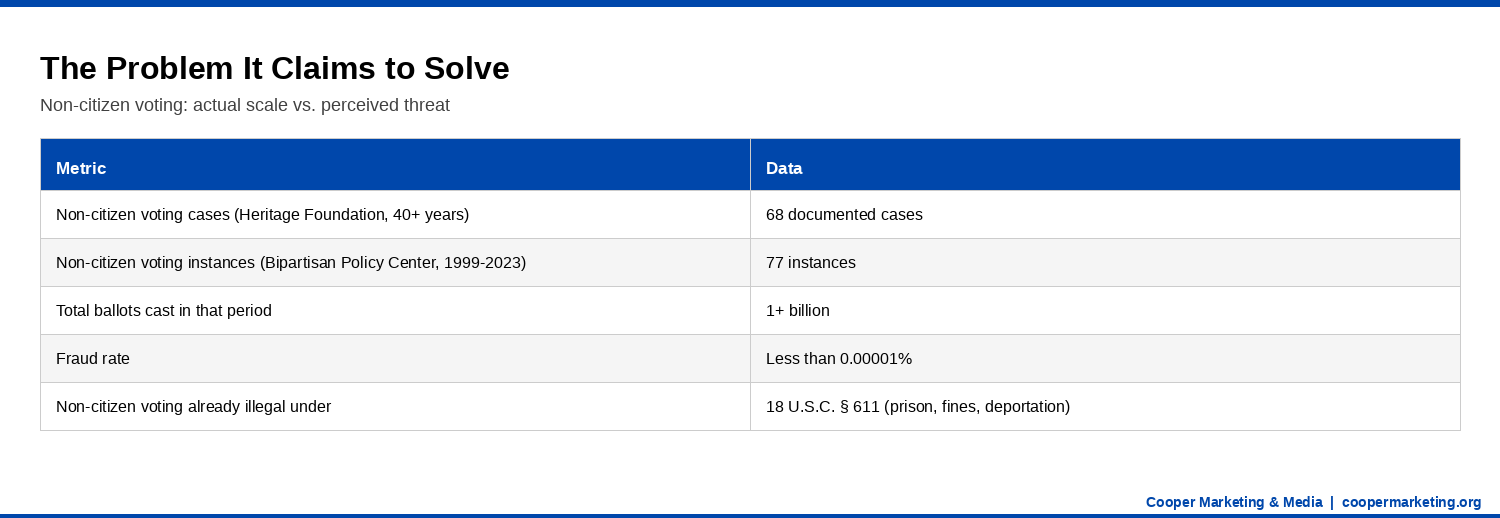
This is a base rate problem. The base rate of non-citizen voting in federal elections is so low that it rounds to zero. A rational response to a near-zero base rate is not a massive new enforcement regime. It is proportional countermeasures targeted at the specific failure points where those rare instances occur.
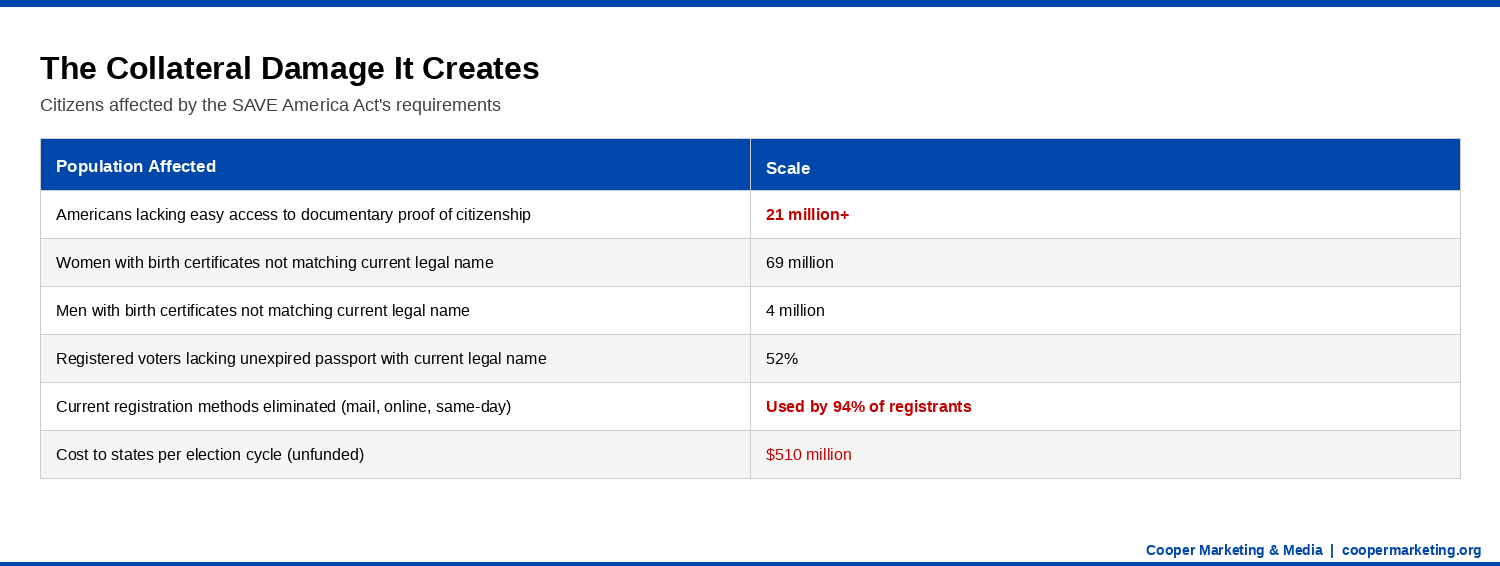
Read those numbers through a rational framework. The bill proposes to solve a problem affecting fewer than 80 documented instances over four decades by creating barriers that affect 21 million eligible citizens. That is a ratio of roughly 260,000 citizens burdened for every case of non-citizen voting addressed. No engineer would accept that failure rate. No physician would prescribe that side-effect profile. No rational actor would call that a good trade.
What the Bill Does Not Advertise
Rational analysis also requires reading the fine print. Legislation that is truly about its stated purpose contains provisions that serve that purpose. Legislation that is about something else entirely buries unrelated provisions where casual readers will not find them.
The DHS Voter Data Pipeline
The SAVE Act grants the Department of Homeland Security access to voter registration data for cross-referencing purposes. It contains no restrictions on secondary use of that data, no data minimization requirements, no sunset provisions, and no independent oversight of how that data is stored, shared, or analyzed. In a rational policy framework, you do not create a massive new government database with no privacy guardrails unless the database itself is the objective.
The Unfunded Mandate
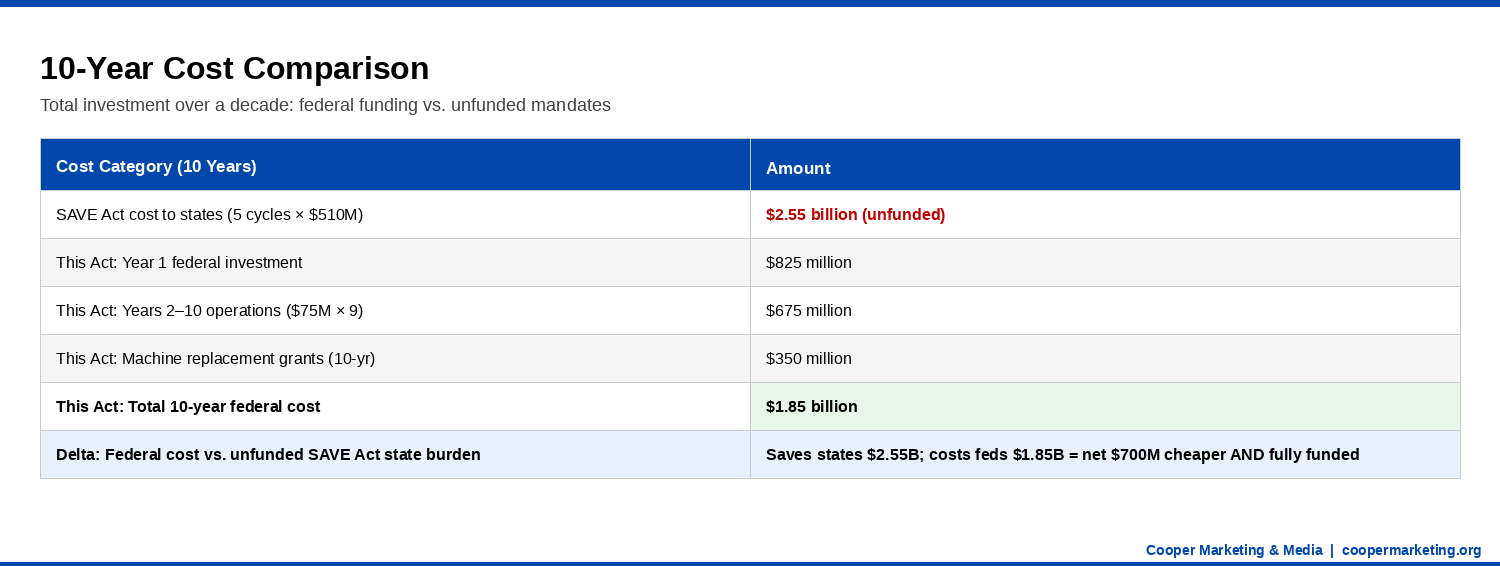
Zero federal dollars are authorized. States absorb an estimated $510 million per election cycle. This is not an oversight. In a rational framework, an unfunded mandate is a designed-to-fail provision. It allows the bill’s sponsors to claim credit for election integrity while ensuring that underfunded states, disproportionately those with large minority populations, cannot implement the requirements. The blame for failure is then shifted to the states.
Mass Voter Purge Mechanisms
The DHS cross-referencing provision, combined with no notice requirements and no due process protections, creates the infrastructure for mass voter roll purges. Purging voter rolls is not inherently wrong; maintenance is necessary. But purging without notice, without cure periods, and without protections against false positives is not maintenance. It is suppression dressed as housekeeping.
Enhanced Criminal Penalties for Election Officials
The bill expands criminal liability for election officials who fail to comply. In a rational framework, you threaten people with prison when you want compliance through fear, not competence. Combined with the bill’s complexity and zero funding for training, this provision functions as a deterrent against administering elections at all. When 38% of election officials already report threats and harassment, adding criminal prosecution risk accelerates the exodus of competent administrators.
The Rational Verdict
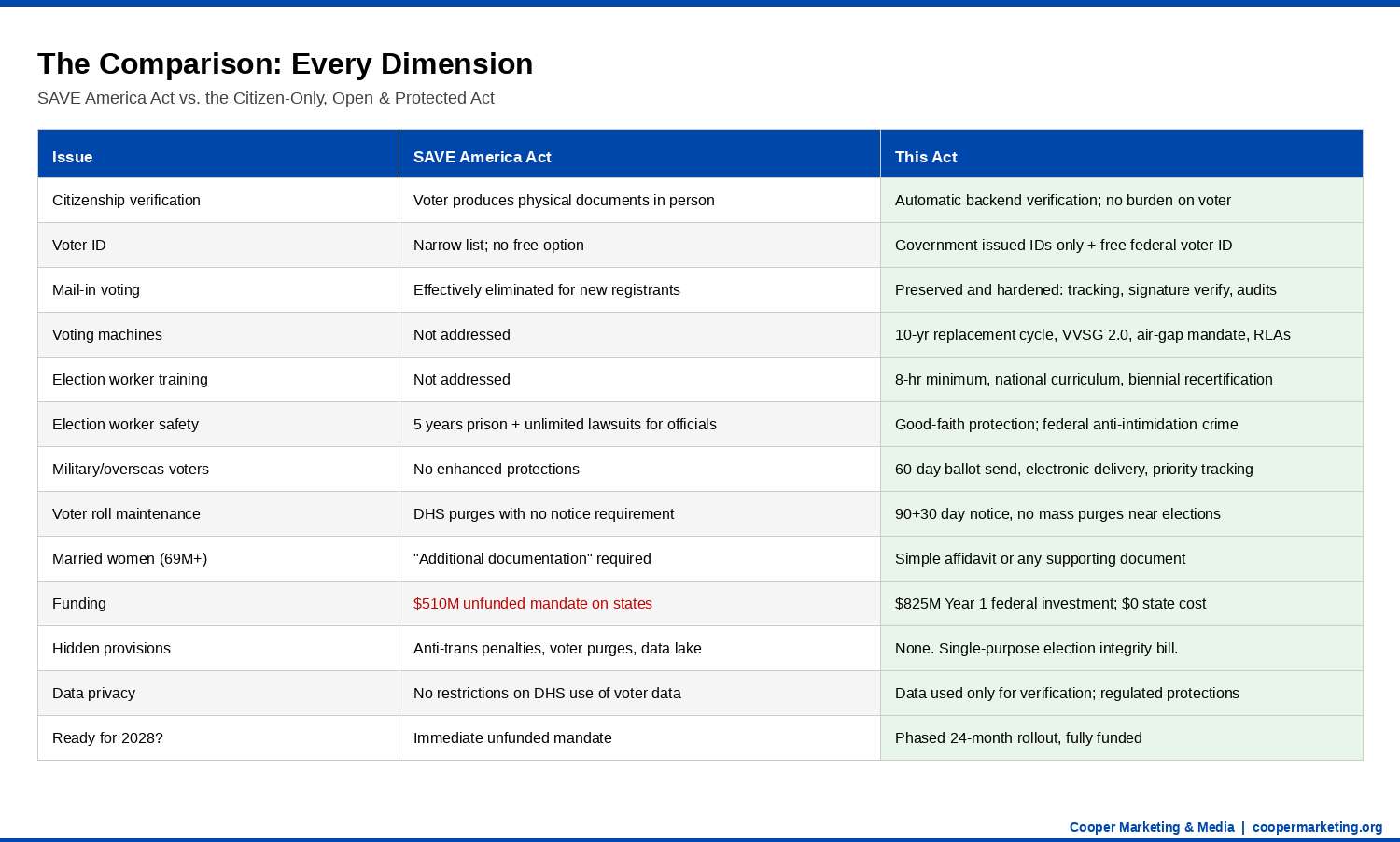
Measured against the frameworks of evidence-based policy analysis, the SAVE America Act fails on every dimension:
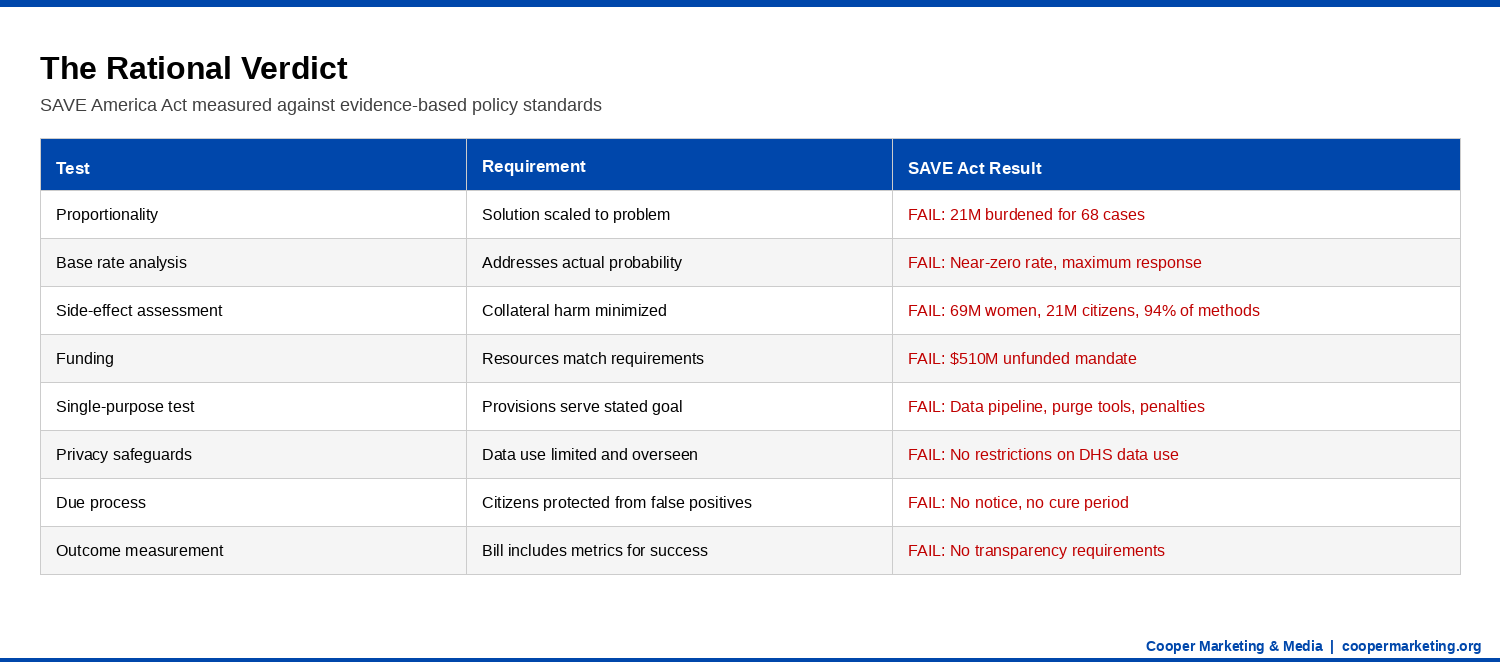
This is not a bill designed to solve a problem. It is a bill designed to look like it solves a problem while achieving a different set of objectives: expanding government surveillance of voter data, creating infrastructure for voter roll manipulation, imposing disproportionate burdens on populations that trend Democratic, and providing talking points for the next election cycle.
That is not a partisan conclusion. That is a structural analysis based on what the bill actually contains, measured against what the data actually shows.
The Bigger Question: What If You Do Not Have to Pick a Side?
Here is where this analysis goes somewhere that most political commentary is afraid to go.
The operating assumption of American politics is that you must choose: Democrat or Republican. Blue or Red. Left or Right. And once you choose, you adopt the full platform, defend every provision, attack every opponent, and treat deviation as betrayal. That is not politics. That is sports fandom applied to governance, and it is making us stupid.
The cognitive science is clear on this: coalitional thinking, the evolutionary wiring that makes us form teams and fight for tribal dominance, is the single greatest obstacle to rational governance. It produces myside bias at industrial scale. It turns policy debates into loyalty tests. It rewards the loudest voices, not the clearest thinkers. And it has created a political landscape where 68 cases of non-citizen voting justify burdening 21 million citizens, because the math does not matter when the badge does.
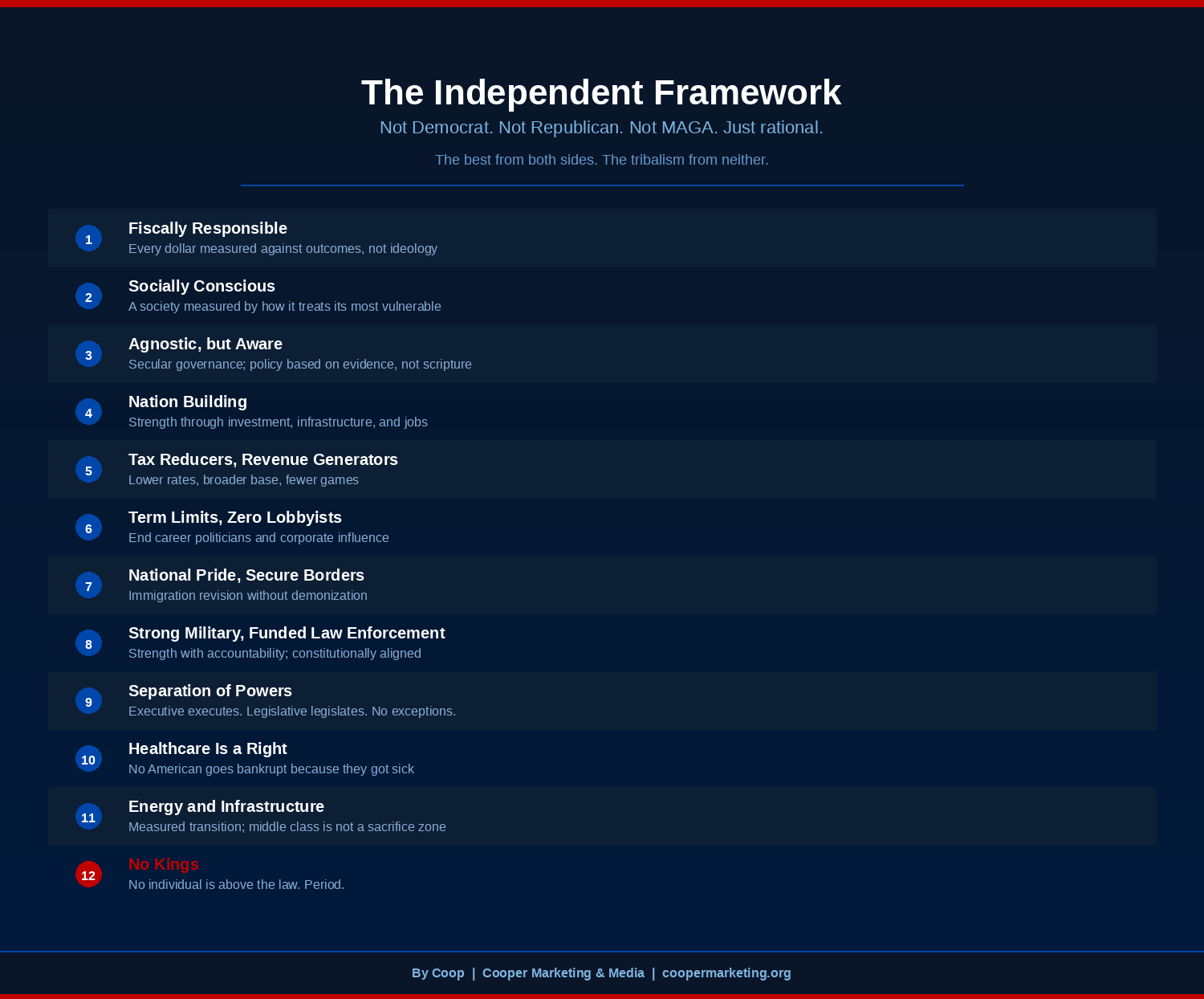
A Third Path: The Independent Framework
What if there were a political identity built not on a party platform, but on a method? Not "I am a Democrat," or "I am a Republican," or "I am MAGA." Just: I evaluate policy on evidence, I measure outcomes, and I take the best ideas from wherever they come from.
That is not centrism. Centrism splits the difference between two positions and calls it wisdom. This is something different. It is an independent framework built on rational principles, and it draws from the strongest elements of both major parties while rejecting the tribalism, performative outrage, and intellectual laziness that have hollowed them out.
Here is what that framework looks like:
Fiscally Responsible
Every dollar of public spending should be measured against outcomes. Not against ideology, not against slogans, against measurable results. If a program works, fund it. If it does not, cut it. That is not conservative or liberal. That is rational. The national debt is not a talking point; it is a math problem, and it requires the intellectual honesty to acknowledge that tax cuts without spending cuts are deficits in disguise, and spending programs without accountability are waste in disguise.
Socially Conscious
A society is measured by how it treats its most vulnerable members. That is not a progressive slogan; it is a statement about the kind of civilization you want to live in. Social consciousness means acknowledging that structural inequality exists, that it produces measurable harm, and that rational policy can reduce it. It does not mean every problem is oppression, and it does not mean individual responsibility is a myth. It means holding both truths at once.
Agnostic, but Aware
Governance should be secular. Full stop. The Constitution enshrines this. But secular governance does not mean hostility toward religion. It means policy is based on evidence and reason rather than any single faith tradition. You can hold deep religious convictions and still agree that legislation should be testable, falsifiable, and grounded in data rather than scripture. The moment you legislate theology, you have violated the social contract with every citizen who does not share your beliefs.
Nation Building Through Strength
Real national strength is not measured in military parades or tough talk on social media. It is measured in infrastructure that works, an education system that produces capable citizens, a manufacturing base that employs the middle class, and an economy that creates opportunity rather than concentrating it. Investment in your own country is not socialism. It is the most basic function of competent governance. Build the roads. Fund the schools. Train the workforce. That is how you project strength, by being strong, not by performing strength.
Tax Reducers, Revenue Generators
The conversation about taxes in this country is deliberately stupid. One side says cut taxes, the other says raise them, and neither side is honest about the math. The rational position: reduce the tax burden on working and middle-class Americans by generating revenue through economic growth, closing loopholes that benefit the wealthiest at the expense of the system, and eliminating the corporate welfare that costs taxpayers hundreds of billions while producing nothing. Lower rates, broader base, fewer games. This is not radical. It is arithmetic.
Term Limits and Zero Tolerance for Lobbyists
Career politicians and professional lobbyists are the two structural diseases of American democracy. Term limits prevent the accumulation of unchecked power and force regular infusions of new perspectives. Zero tolerance for lobbyist influence means elected officials serve the people who voted for them, not the corporations that funded them. Both parties resist this for obvious reasons: the current system benefits the people currently in it. That is exactly why it needs to change.
National Pride, Security, Secure Borders, Immigration Revision
You can love your country, secure your borders, and enforce immigration law without demonizing immigrants or manufacturing crises for political gain. National pride means believing in what America can be, not weaponizing patriotism as a purity test. Border security means functional, well-funded systems, not theatrical walls and family separations. Immigration revision means acknowledging that the system is broken, that both parties have failed to fix it for decades, and that rational reform requires both enforcement and a path forward for the millions of people already woven into the fabric of this economy.
Strong Military, Funded Law Enforcement, Constitutionally Aligned
A strong military and well-funded law enforcement are essential. But strength without accountability is tyranny. Constitutionally aligned means the military and police operate within the boundaries the founders established, with civilian oversight, with due process, and with the understanding that their authority is derived from the people, not the other way around. "Back the Blue" and "accountability" are not opposites. They are prerequisites for each other.
Separation of Powers
This is not negotiable. The executive branch executes. The legislative branch legislates. The judicial branch interprets. When any branch encroaches on another, the system breaks. Executive orders are not legislation. Judicial rulings are not policy mandates. And Congress does not get to abdicate its responsibilities by handing them to the executive every time a tough vote is on the table. Separation of powers is the operating system of the republic, and you do not get to rewrite the kernel because your party holds a temporary majority.
Healthcare Is a Right, Not a Privilege
Every other developed democracy on Earth has figured this out. The United States spends more per capita on healthcare than any country in the world and gets worse outcomes than most. That is not a values debate. That is a performance failure. Rational policy demands a system where no American goes bankrupt because they got sick, where preventive care is accessible, and where the profit motive does not override the treatment motive. You can disagree on the mechanism, single-payer, public option, regulated marketplace, but the principle is not debatable: a nation that lets its citizens die from treatable conditions because they cannot afford care is failing at the most basic level of governance.
Energy and Infrastructure: Measured Approach
Climate change is real. Fossil fuels have powered the modern world. Both statements are true simultaneously, and any policy framework that denies either one is unserious. The rational approach: transition to clean energy as fast as technology and economics allow, invest in infrastructure that protects communities from climate impacts already locked in, and do not sacrifice the livelihoods of working Americans on ideological timelines that physics and engineering do not support. The middle class is not a sacrifice zone for anyone’s climate theology or anyone’s fossil fuel theology.
No Kings
This is the simplest and most important principle. No individual is above the law. No president, no senator, no billionaire, no movement leader. The founders built a republic specifically to prevent the concentration of power in any single person. When anyone, from any party, begins to speak as though they alone can fix the system, they are telling you exactly what they intend to break. The answer to every aspiring king is the same answer it has been since 1776: No.
Shed the Label
I did not write this to tell you how to vote. I wrote it to suggest that you might want to think about how you think before you do.
The SAVE America Act is a bad bill. Not because Democrats say so. Because the data says so. The problem it claims to solve barely exists. The collateral damage it creates is enormous. The provisions it hides serve purposes its authors do not advertise. And it is funded by precisely nothing.
But the solution is not to rally behind whatever the other party proposes instead. The solution is to shed the label entirely. Stop being a Democrat. Stop being a Republican. Stop being MAGA, which at this point is just a font choice on a hat that signals you have outsourced your critical thinking to a man who could not tell the truth if it came with a tax break.
Be an independent thinker. Take the fiscal discipline that the right claims but never delivers. Take the social consciousness that the left claims but often overcomplicates. Take the constitutional principles that both parties invoke and neither party consistently follows. And build something that works.
The frameworks for rational thinking exist. The data is available to anyone willing to read it. The tools for evaluating policy on evidence rather than team loyalty are sitting right in front of you.
You do not need a party to think clearly. You do not need a cable news host to interpret reality for you. You do not need a red hat or a blue yard sign to know that 68 cases of fraud do not justify disenfranchising 21 million Americans.
You just need to think.
Data Sources
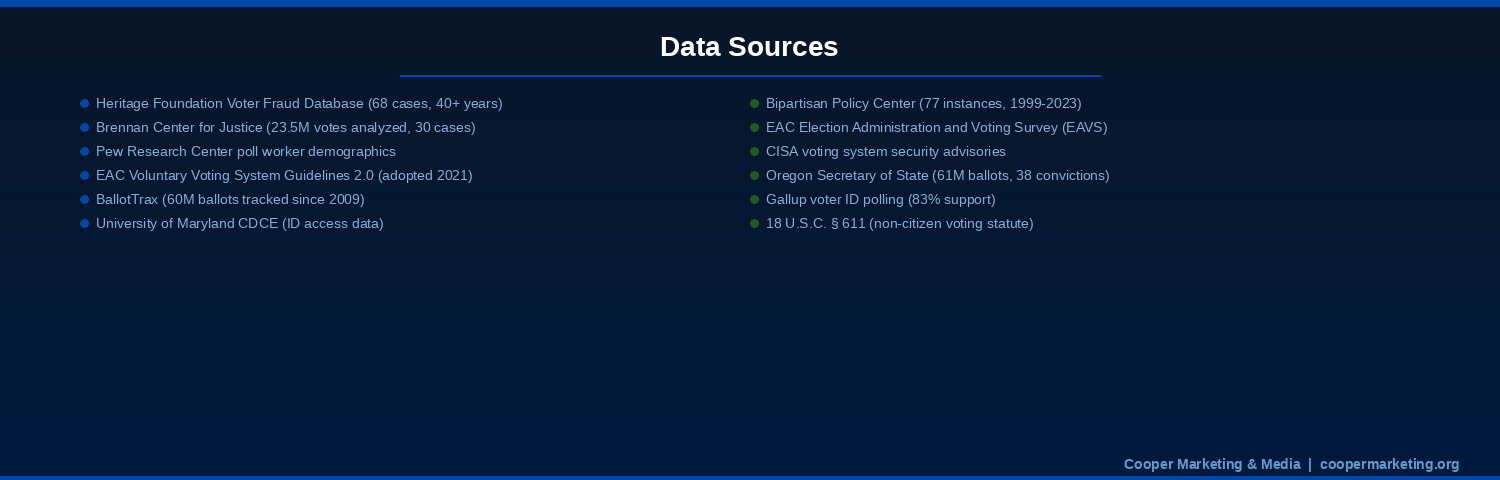
Heritage Foundation Voter Fraud Database (68 cases, 40+ years); Bipartisan Policy Center (77 instances, 1999-2023); Brennan Center for Justice (23.5M votes analyzed, 30 cases); University of Maryland Center for Democracy and Civic Engagement (21M+ without documents); Pew Research Center poll worker demographics; Census Bureau passport data; CBO scoring of H.R. 7296; Gallup voter ID polling (83% support); 18 U.S.C. § 611 (non-citizen voting statute); National Association of Counties implementation cost analysis.
Frameworks Referenced
The analytical frameworks applied in this article draw on established traditions in cognitive science, behavioral economics, and evidence-based policy analysis, including work on myside bias, the availability heuristic, coalitional psychology, base-rate analysis, the moralization gap, proportionality testing, and outcome measurement. Readers interested in these frameworks may find the following valuable: Rationality: What It Is, Why It Seems Scarce, Why It Matters (2021); Enlightenment Now: The Case for Reason, Science, Humanism, and Progress (2018); The Better Angels of Our Nature: Why Violence Has Declined (2011); Thinking, Fast and Slow by Daniel Kahneman (2011); Nudge by Richard Thaler and Cass Sunstein (2008).
The Citizen-Only, Open & Protected Voter Verification Act
What This Act Does: In Plain English
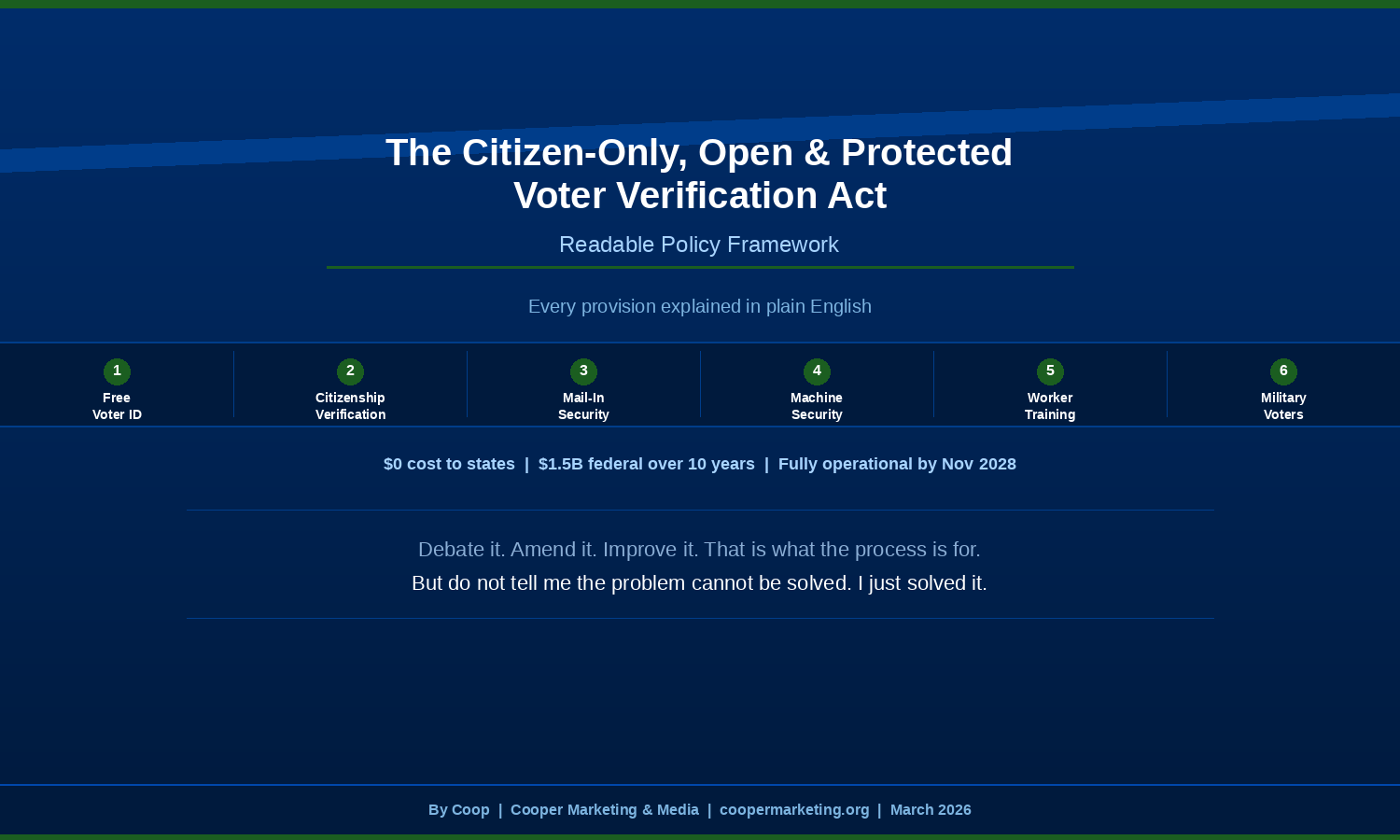
This Act solves five problems at once: it verifies that only citizens vote, it secures mail-in ballots, it locks down voting machines, it trains the people who run our elections, and it does all of it without making it harder for eligible Americans to participate. Every provision is designed to be fully operational before the November 2028 presidential election.
1. Free Voter ID for Every American
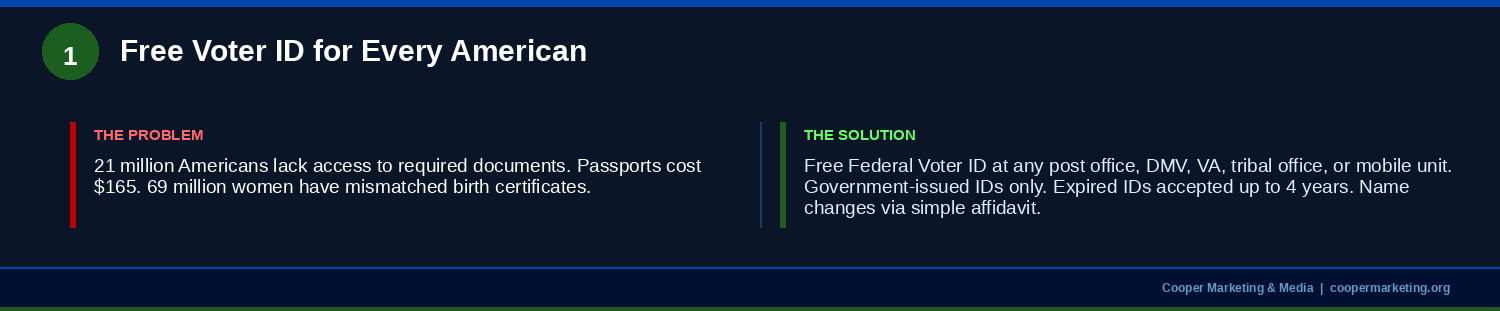
The problem: 21 million Americans lack easy access to required documents. Passports cost $165. Some rural Americans live 8 hours from an election office. 69 million women have birth certificates that do not match their married names. 52% of registered voters lack an unexpired passport with their current legal name.
The solution: The federal government creates a free Voter ID card available at any post office, DMV, VA facility, Tribal office, or mobile unit. No cost to the citizen. Citizenship is verified automatically through existing federal databases when you apply. You get a photo ID that works at any polling place.
The Act also accepts a broad list of government-issued IDs: state driver’s license, passport, military ID, tribal ID, VA card, and the free federal card. Expired IDs up to 4 years accepted. Name changes handled with a simple affidavit.
2. Automatic Citizenship Verification
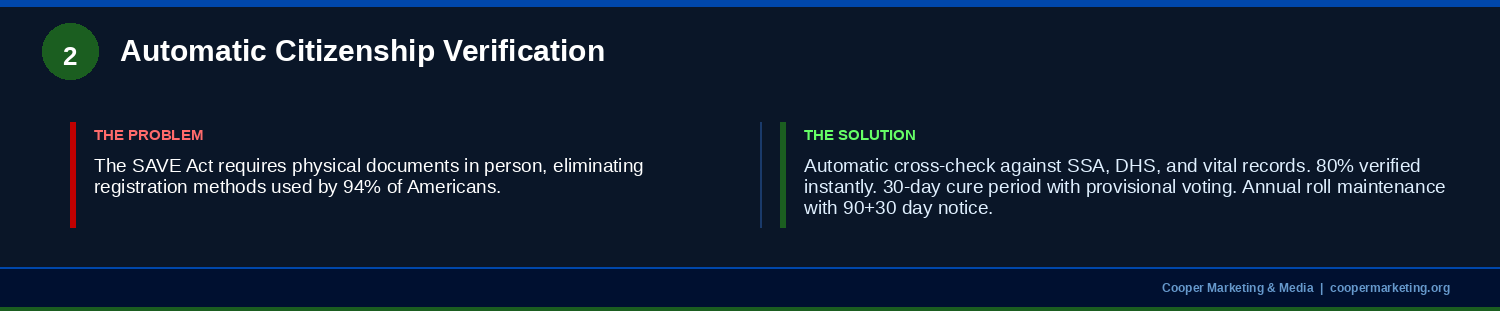
The problem: The SAVE America Act requires voters to produce physical citizenship documents in person. This eliminates registration methods used by 94% of Americans.
The solution: When you register, the system automatically cross-checks your information against Social Security, DHS, and state vital records. For approximately 80% of Americans, verification is instant. If there is a discrepancy, you get a letter with 30 days to fix it, and you can vote provisionally in the meantime. The system does the work, not you.
Annual voter roll maintenance uses the same system. If your citizenship cannot be verified, you get a 90-day notice (registration stays active), then a second certified-mail notice with 30 more days. No mass purges within 90 days of an election. Every state publishes an annual transparency report showing exactly how many people were flagged, verified, and removed.
3. Secure Mail-In Voting
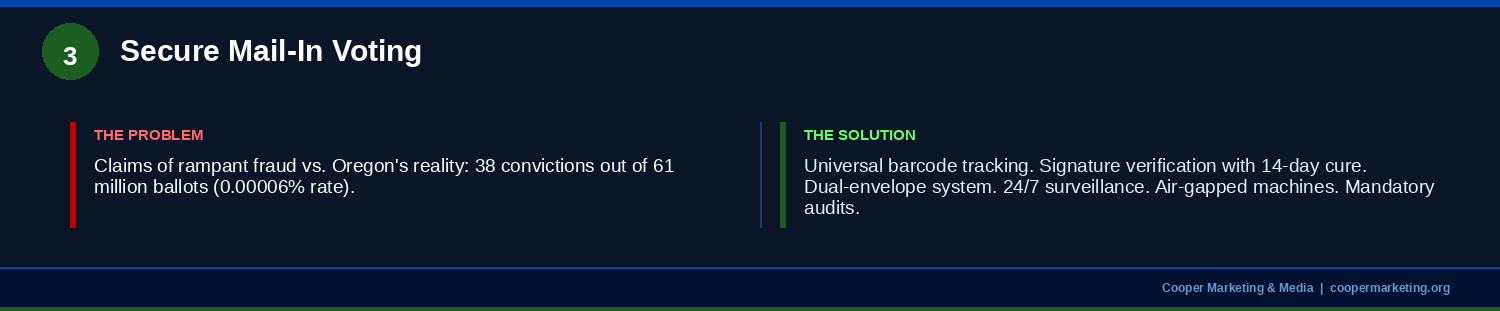
The facts: Oregon has conducted all-mail elections for 25+ years: 61 million ballots, 38 fraud convictions, 0.00006% fraud rate. The system works. But confidence matters, so this Act hardens it further.
The solution: Every mail ballot gets a unique barcode. You track it like a package: mailed, received, counted. Signatures verified by trained staff. Mismatches trigger a 14-day cure period (no ballot rejected without contacting you). Dual-envelope system protects ballot secrecy. Counting facilities have 24/7 cameras, air-gapped machines, and mandatory audits.

4. Voting Machine Security
The facts: 24 states (41+ million voters) use machines first deployed over 10 years ago. Many run unsupported software like Windows XP. CISA has documented specific vulnerabilities in election equipment, though no evidence exists of exploitation in actual elections. Researchers found voters miss over 93% of errors when reviewing ballots on electronic screens. Machines cost $2,500–$3,000 each, budgeted at one per 250–300 voters.
The solutions:
• Paper ballot mandate: Every jurisdiction must use voter-verified paper ballots or paper audit trails. No paperless electronic voting in federal elections. Jurisdictions still using paperless systems must transition by January 1, 2028, with federal grants covering 75% of replacement costs.
• 10-year replacement cycle: No machine may be used more than 10 years past its EAC certification date. Federal grants cover 75% of the replacement. Two-year waivers available only if the machine meets current security standards and the jurisdiction has a funded replacement plan.
• VVSG 2.0 certification: All machines must meet the latest EAC Voluntary Voting System Guidelines, adopted in 2021 and representing the current federal security standard.
• Air-gap mandate: No voting machine, tabulation device, or election management system may connect to the internet, any wireless network, or any external network during the election period. Machines must not contain wireless hardware, or it must be physically disabled and verified during pre-election testing.
• Risk-limiting audits: Every state must conduct risk-limiting audits before certifying results (5% risk limit). If the audit cannot confirm the outcome, full hand count required. All audits are open to public observation.
• Logic and Accuracy testing: Every machine tested before every election with pre-audited test decks. Results must match exactly. Public demonstrations required.
• Chain of custody: Bipartisan teams verify all equipment movement. Tamper-evident seals logged and verified at every transfer. Security cameras on all storage facilities.
5. Election Worker Training and Protection
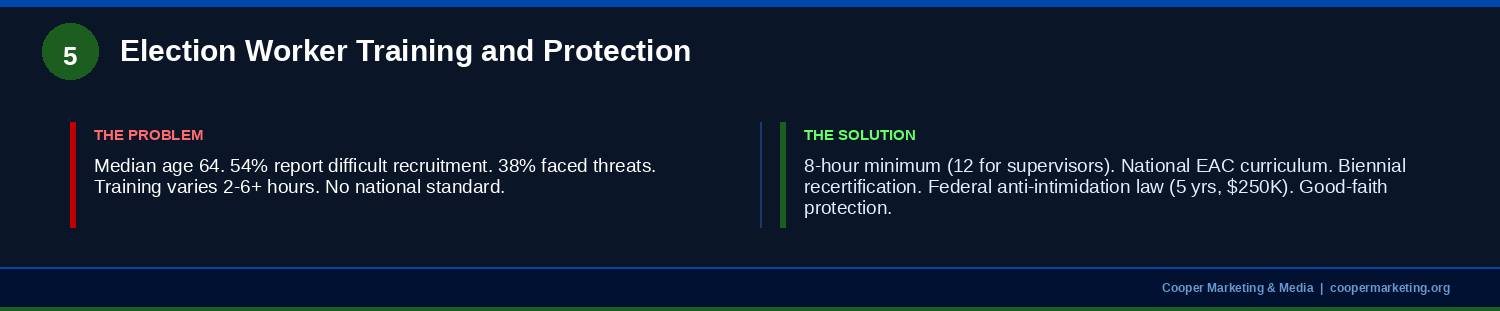
The facts: America needs ~1 million poll workers per presidential election. Median age: 64. Over 60% are 61+. Only 9% are under 25. 54% of jurisdictions report recruitment is difficult. 38% of election officials have faced threats or harassment. Training varies from 2 hours in some states to 6+ in others. There is no national standard.
The solutions:
• 8-hour national minimum: All poll workers complete at least 8 hours of training, including hands-on equipment simulation, voter ID verification procedures, accessibility requirements, de-escalation, and emergency protocols. Supervising officials: 12 hours. No lecture-only training.
• National baseline curriculum: The EAC develops a standardized curriculum in consultation with election officials from both parties. States can add requirements but cannot reduce the baseline.
• Biennial recertification: Every election worker recertifies every 2 years with updated training on legal changes, new equipment, and core competency refreshers.
• Workforce pipeline: Federal grants for college partnerships, student poll worker programs with stipends and academic credit, and compensation increases to at least minimum wage for all training and service hours. Goal: median poll worker age below 50 by 2032.
• Federal anti-intimidation law: Threatening an election worker is a federal crime: up to 5 years, $250,000 fine. Election officials acting in good faith are protected from criminal prosecution and private lawsuits. Whistleblower protections for officials reporting violations.

6. Military and Overseas Voters
The solution: Ballots sent 60 days before Election Day (up from 45). Electronic delivery available. Every military ballot gets priority tracking. If a state fails to send your ballot on time, you use a federal write-in ballot that counts for all races. Every base has a trained Voting Assistance Officer.
Funding and Cost Analysis
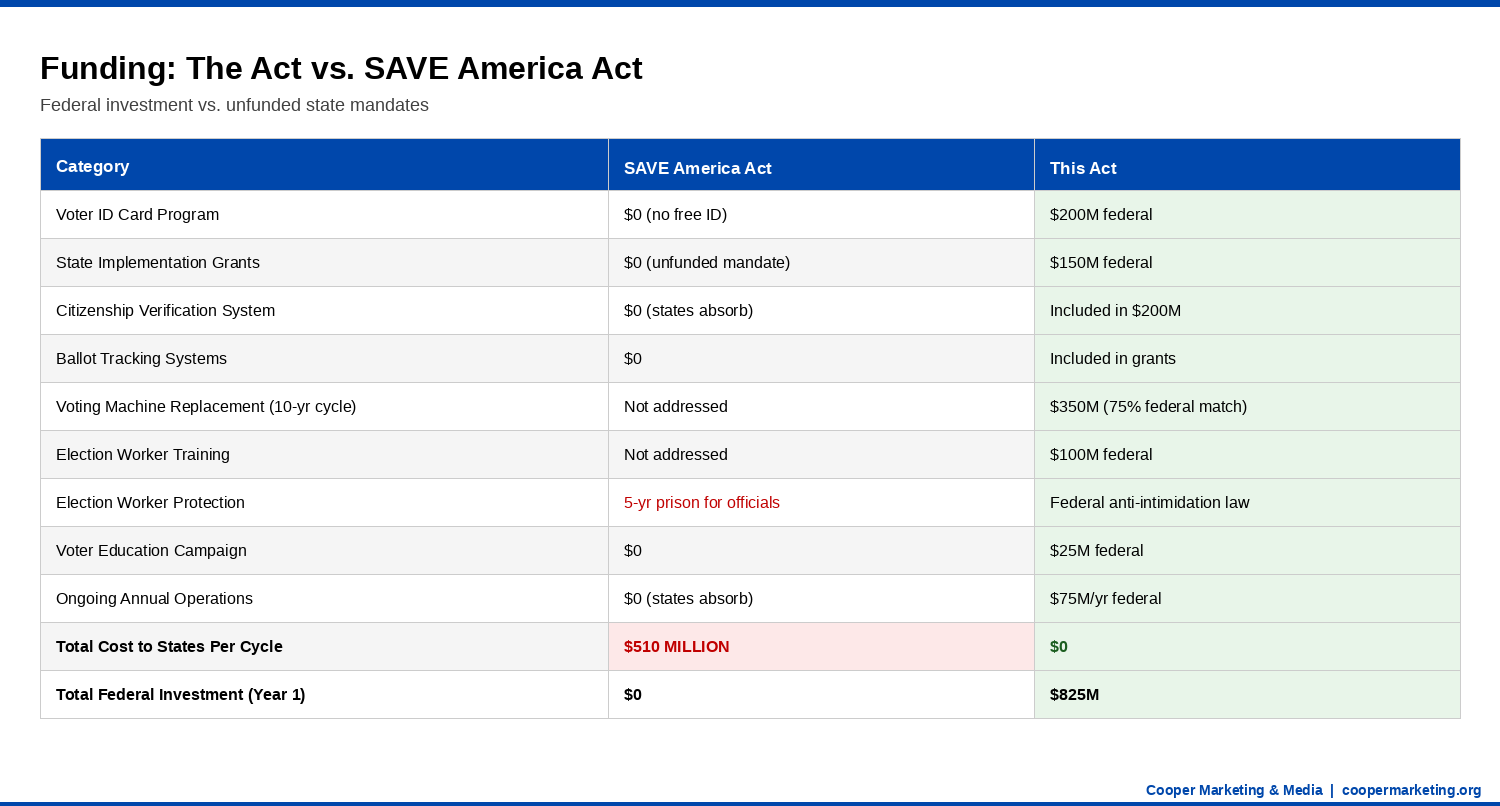
The SAVE America Act imposes $510 million per election cycle on states with zero federal funding. This Act is fully federally funded:
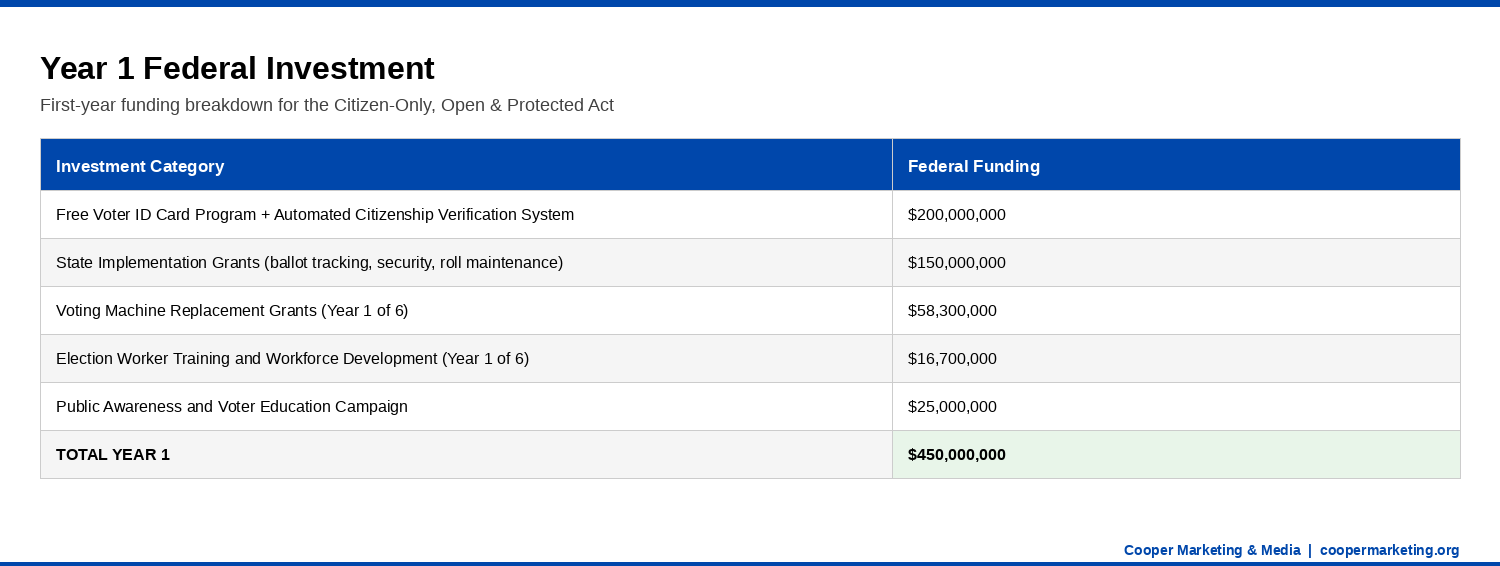
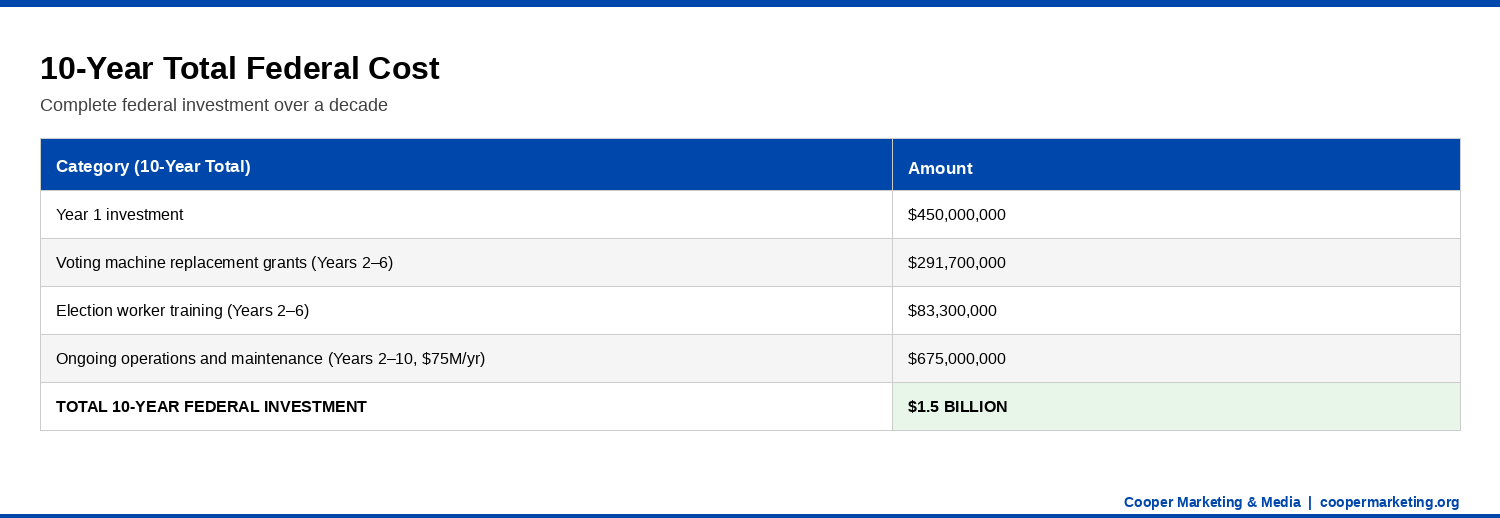
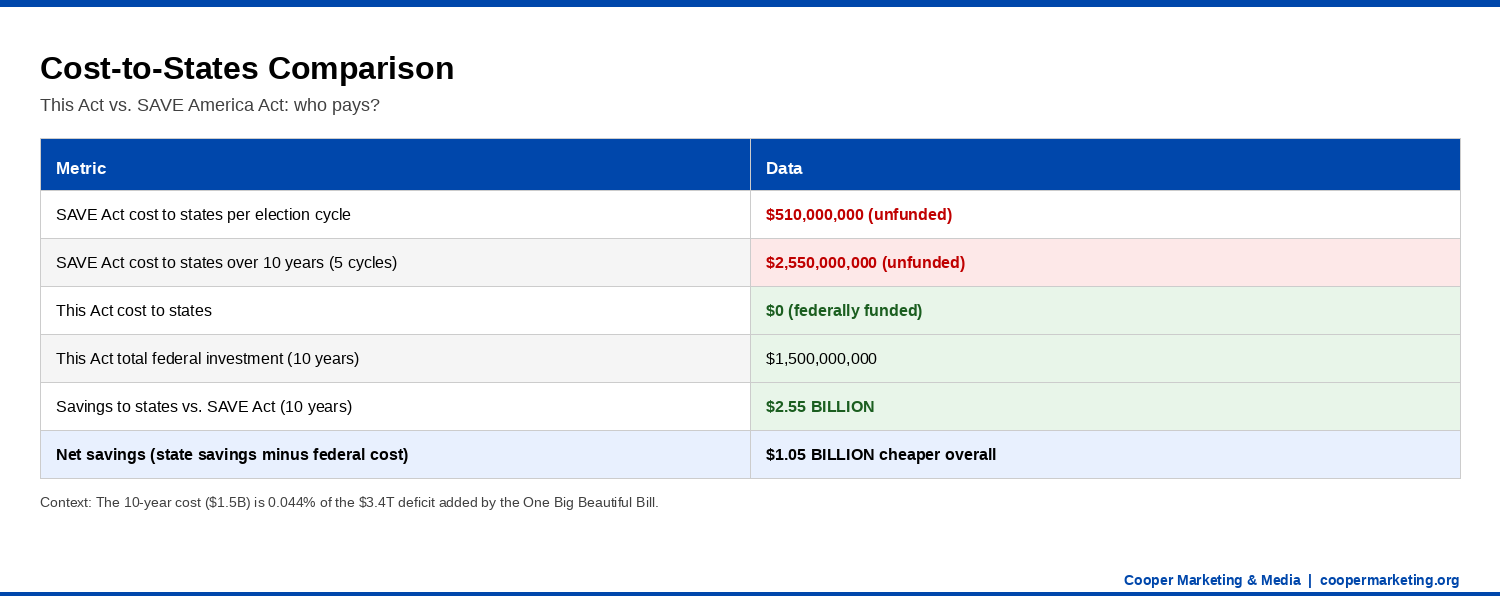
Context: The 10-year federal cost of this Act ($1.5 billion) is 0.044% of the $3.4 trillion deficit added by the One Big Beautiful Bill. It is less than the cost of two F-35 fighter jets per year.
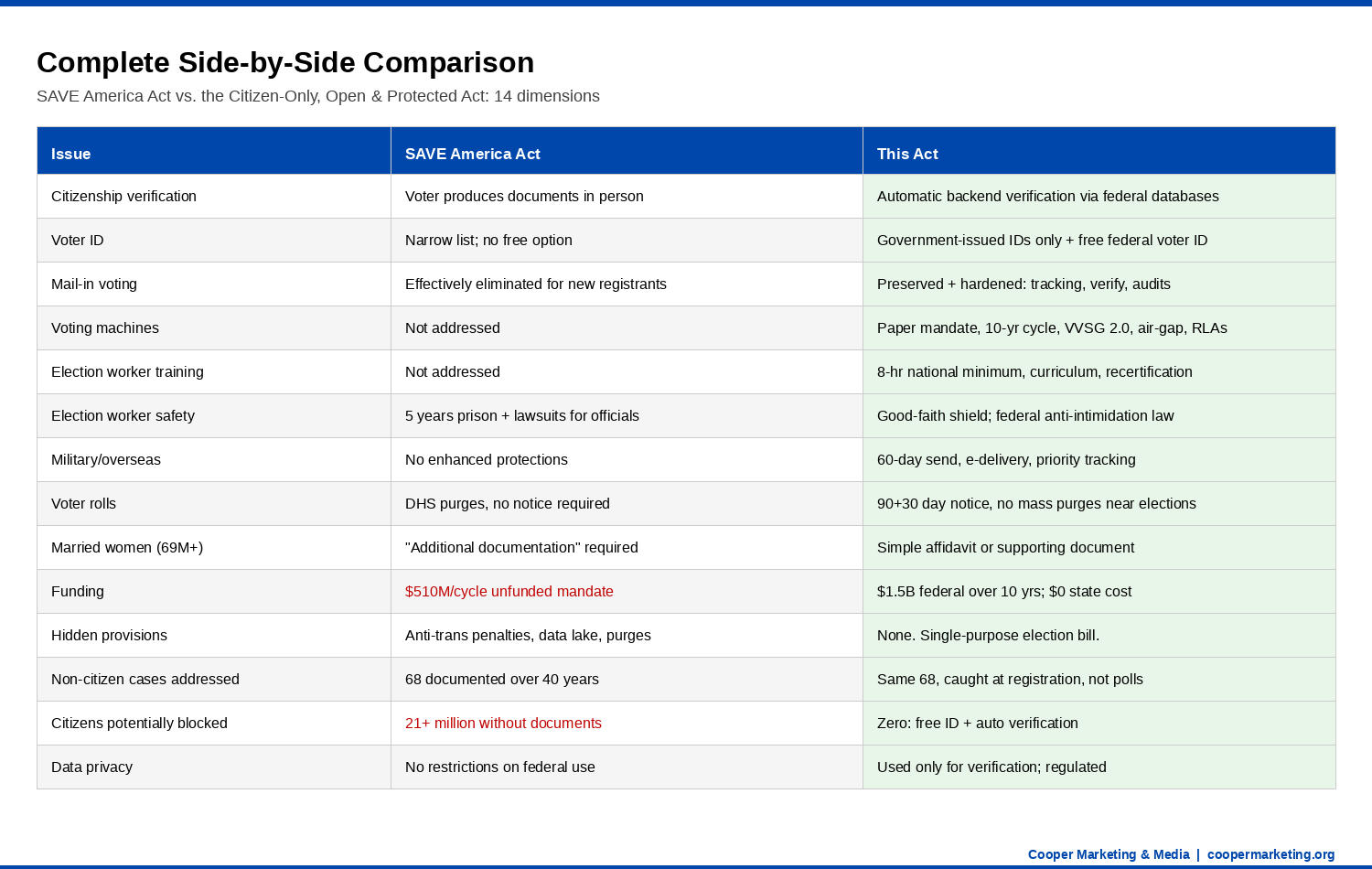
To establish the Citizen-Only, Open & Protected Voter Verification Act, to ensure that only United States citizens participate in Federal elections, to safeguard the right of every eligible citizen to register and vote without unreasonable burden, to modernize mail-in ballot security, to establish voting machine security standards, to create national election worker training and protection requirements, to protect overseas and military voters, and for other purposes.
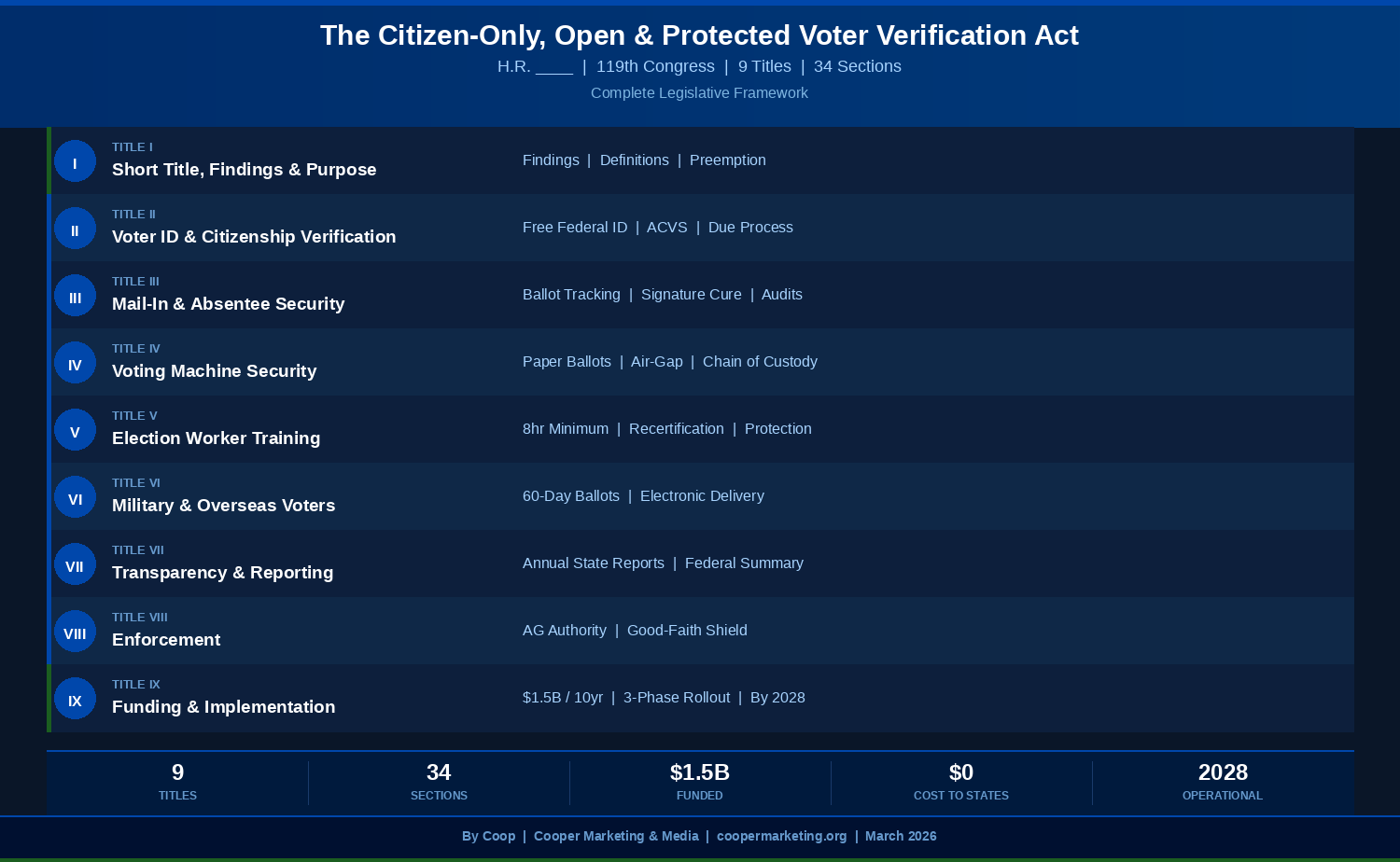
Be it enacted by the Senate and House of Representatives of the United States of America in Congress assembled,
TITLE I: SHORT TITLE, FINDINGS, AND PURPOSE
SEC. 101. Short Title
This Act may be cited as the “Citizen-Only, Open & Protected Voter Verification Act.”
SEC. 102. Findings
The Congress finds the following:
1. The right to vote in Federal elections is reserved exclusively to citizens of the United States under the Constitution.
2. Existing Federal law (18 U.S.C. § 611) prohibits non-citizen voting in Federal elections and imposes criminal penalties including imprisonment and deportation.
3. Documented instances of non-citizen voting in Federal elections are exceedingly rare, with the Heritage Foundation database containing 68 confirmed cases nationally over 40 years and the Bipartisan Policy Center documenting 77 instances between 1999 and 2023.
4. Public confidence in election integrity is essential to democratic governance. Gallup polling shows 83 percent of Americans support voter identification requirements regardless of party affiliation.
5. Approximately 21 million eligible citizens lack ready access to documentary proof of citizenship. Fifty-two percent of registered voters lack an unexpired passport with their current legal name. Sixty-nine million women and four million men hold birth certificates that do not match their current legal name.
6. Modern database technology enables automated citizenship verification at the point of registration without requiring voters to produce physical documents, achieving verification for approximately 80 percent of Americans through existing Federal databases.
7. States operating all-mail elections have demonstrated fraud rates below 0.001 percent while maintaining high voter participation. Oregon recorded 38 criminal convictions out of 61 million ballots cast over 20 years.
8. Twenty-four states use voting machines first deployed more than 10 years ago, many running unsupported software. Electronic voting machines have a recommended lifespan of 10 years.
9. Fifty-four percent of election jurisdictions report difficulty recruiting poll workers. The median poll worker age is 64. Thirty-eight percent of local election officials have experienced threats, harassment, or abuse.
10. Members of the uniformed services and citizens residing overseas face unique barriers to electoral participation and require enhanced protections.
SEC. 103. Purpose
The purpose of this Act is to:
(a) ensure that only United States citizens register for and vote in Federal elections;
(b) safeguard the right of every eligible citizen to register and vote without unreasonable burden or expense;
(c) modernize voter registration through automated citizenship verification using existing Federal databases;
(d) establish a free Federal voter identification card available to all eligible citizens;
(e) secure mail-in and absentee ballot processes through mandatory tracking, verification, and audit requirements;
(f) establish mandatory voting machine security standards including paper ballot requirements, replacement cycles, and risk-limiting audits;
(g) create national minimum standards for election worker training, recertification, and protection;
(h) enhance protections for members of the uniformed services and overseas voters;
(i) require annual transparency reporting on voter roll maintenance and election administration; and
(j) provide Federal funding to States for implementation.
SEC. 104. Definitions
In this Act:
11. The term “eligible citizen” means an individual who is a citizen of the United States, is at least 18 years of age (or will be at the time of the next Federal election), is not disqualified from voting under the laws of the State of the individual's residence, and meets the residency requirements of the State.
12. The term “Federal election” means any general, special, or primary election held solely or in part for the purpose of electing a candidate for the office of President, Vice President, Presidential elector, Member of the Senate, Member of the House of Representatives, Delegate from the District of Columbia, or Resident Commissioner.
13. The term “election period” means the period beginning 48 hours before the opening of polls and ending upon certification of results by the relevant State election authority.
14. The term “election worker” means any individual, whether compensated or volunteer, who performs duties in connection with the administration of a Federal election, including poll workers, election judges, precinct officials, and election volunteers. The term “election official” means any individual appointed or designated by a State or local government to supervise, direct, or manage the administration of a Federal election.
15. The term “UOCAVA voter” means an absent uniformed services voter or an overseas voter, as defined in section 107 of the Uniformed and Overseas Citizens Absentee Voting Act (52 U.S.C. § 20310).
16. The term “risk-limiting audit” means a post-election audit procedure that provides strong statistical evidence that the reported election outcome is correct, or that corrects a wrong outcome, by examining individual paper ballots drawn at random using a specified risk limit.
17. The term “State” means each of the several States, the District of Columbia, the Commonwealth of Puerto Rico, Guam, American Samoa, the United States Virgin Islands, and the Commonwealth of the Northern Mariana Islands.
18. The term “Commission” means the Election Assistance Commission.
SEC. 105. Preemption
(a) FEDERAL ELECTIONS. This Act shall supersede any State or local law that conflicts with the requirements of this Act with respect to Federal elections.
(b) STATE AND LOCAL ELECTIONS. Nothing in this Act shall be construed to preempt State laws governing State or local elections.
(c) HIGHER STANDARDS. Nothing in this Act shall be construed to prevent a State from adopting or enforcing requirements that provide greater protections for voters or impose stricter security standards than those established under this Act.
TITLE II: VOTER IDENTIFICATION AND CITIZENSHIP VERIFICATION
SEC. 201. Free Federal Voter Identification Card
(a) ESTABLISHMENT. The Election Assistance Commission, in coordination with the United States Postal Service, shall establish a program to issue a free Federal Voter Identification Card to any eligible citizen of the United States who requests one.
(b) NO FEE. No fee shall be charged for the issuance, replacement, or renewal of a Federal Voter Identification Card.
(c) DISTRIBUTION POINTS. Federal Voter Identification Cards shall be available for application and issuance at:
19. any United States Post Office;
20. any State department of motor vehicles office;
21. any office of the Department of Veterans Affairs;
22. any tribal government office recognized by the Bureau of Indian Affairs;
23. mobile issuance units deployed to rural and underserved communities on a schedule determined by the Commission.
(d) VERIFICATION. Issuance shall require verification of United States citizenship through the Automated Citizenship Verification System established under Section 203.
(e) DESIGN. The card shall include the bearer's name, photograph, date of birth, and a unique identification number. The card shall not include the bearer's Social Security number or residential address.
(f) TIMELINE. The program shall begin accepting applications not later than 180 days after enactment and achieve full operational capacity not later than 18 months after such date.
SEC. 202. Accepted Forms of Voter Identification
(a) IN GENERAL. A State shall accept any of the following forms of identification for purposes of voting in a Federal election:
24. a Federal Voter Identification Card issued under Section 201;
25. a valid State-issued driver's license or identification card;
26. a valid United States passport or passport card;
27. a valid military identification card;
28. a valid tribal identification card;
29. a valid Department of Veterans Affairs health identification card;
30. any other form of government-issued identification determined acceptable by the Election Assistance Commission.
(b) EXPIRED IDENTIFICATION. A State shall accept an identification document described in subsection (a) that has been expired for not more than 4 years.
(c) NAME DISCREPANCY. If the name on the identification does not match the voter's registration, the voter may cast a regular ballot upon presenting any supporting document evidencing the name change or upon signing an affidavit under penalty of perjury attesting that the name on the identification is a former legal name of the voter.
SEC. 203. Automated Citizenship Verification System
(a) ESTABLISHMENT. The Election Assistance Commission, in coordination with the Social Security Administration and the Department of Homeland Security, shall establish an Automated Citizenship Verification System (ACVS) for use by State election officials in verifying the citizenship status of voter registration applicants.
(b) OPERATION. The ACVS shall:
31. accept voter registration data submitted electronically by State election officials;
32. cross-reference such data against records maintained by the Social Security Administration, the DHS SAVE program, and State vital records offices;
33. return a verification result of “confirmed,” “pending,” or “unable to verify” within 72 hours;
34. for “pending” or “unable to verify” results, provide the applicant written notice and not less than 30 days to provide supplementary documentation;
35. during any pending verification, permit the applicant to cast a provisional ballot that shall be counted upon successful verification.
(c) DATA PROTECTION. Information submitted to or generated by the ACVS shall be used exclusively for verifying voter eligibility and shall not be shared with, transferred to, or accessed by any Federal agency for any other purpose.
(d) ACCURACY STANDARDS. The Commission shall publish annual reports on ACVS performance including false positive rates, false negative rates, and resolution timelines.
SEC. 204. Annual Voter Roll Maintenance and Due Process
(a) ANNUAL CROSS-CHECK. Each State shall conduct an annual cross-check of voter registration rolls against the ACVS.
(b) NOTICE REQUIREMENT. If a registered voter's citizenship cannot be verified, the State shall send written notice by first-class mail and electronic communication, provide not less than 90 days to respond, and maintain the voter's registration in active status during the notice period.
(c) REMOVAL. A State may remove a voter only after the 90-day period expires without response, a second certified-mail notice has been sent, and an additional 30 days has elapsed.
(d) PROHIBITION ON MASS PURGES. No systematic removal within 90 days of a Federal election except for confirmed deceased individuals or written requests.
TITLE III: MAIL-IN AND ABSENTEE BALLOT SECURITY
SEC. 301. Universal Ballot Tracking
(a) Each State permitting mail-in voting in Federal elections shall implement a ballot tracking system assigning a unique barcode or QR code to each ballot, enabling voter tracking from mailing through counting, and providing automated notifications at each processing stage.
SEC. 302. Signature Verification and Cure Process
(a) Each State shall verify signatures on mail-in ballot envelopes against signatures on file, performed by trained election personnel.
(b) CURE PERIOD. If a signature cannot be verified, the State shall notify the voter within 24 hours and provide not less than 14 days to verify identity.
(c) No mail-in ballot shall be rejected for signature mismatch unless the voter has been notified and the cure period has expired.
SEC. 303. Physical Security Standards
(a) Ballot processing facilities shall maintain continuous video surveillance, controlled access with documented chain of custody, air-gapped tabulation equipment, and a dual-envelope system separating voter identification from ballot content.
SEC. 304. Mandatory Post-Election Audits
(a) MAIL-IN BALLOT AUDIT. In addition to the risk-limiting audits required under Section 405, each State shall conduct a separate post-election audit of mail-in ballot processing, covering not less than 5 percent of precincts selected at random, comparing hand-counted mail-in ballots to machine-tabulated results. Results shall be published within 30 days.
(b) ESCALATION. Discrepancies greater than 0.5 percent between hand-counted and machine-tabulated results in any audited precinct shall trigger a full hand recount of all mail-in ballots in that precinct.
(c) RELATIONSHIP TO TITLE IV. The audit required under this section is supplementary to, and does not replace, the risk-limiting audit of all ballots required under Section 405 of this Act.
TITLE IV: VOTING MACHINE SECURITY AND INTEGRITY
SEC. 401. Paper Ballot Requirement
(a) MANDATORY PAPER RECORD. No voting system used in a Federal election shall record or tabulate votes unless it produces a voter-verified paper record that the voter can review before casting the ballot and that serves as the official ballot of record for audit and recount purposes.
(b) PHASE-OUT OF PAPERLESS SYSTEMS. Jurisdictions using paperless electronic voting systems as of the date of enactment shall transition to systems meeting subsection (a) not later than January 1, 2028.
(c) FEDERAL MATCHING GRANTS. The Election Assistance Commission shall provide matching grants covering 75 percent of the cost of replacement for jurisdictions transitioning from paperless systems under subsection (b).
SEC. 402. Voting System Certification Standards
(a) VVSG 2.0 REQUIREMENT. Beginning January 1, 2028, no voting system may be used in a Federal election unless it has been certified under the Voluntary Voting System Guidelines version 2.0, as adopted by the Election Assistance Commission on February 10, 2021, or any subsequent version.
(b) TESTING. All voting systems must be tested by an EAC-accredited Voting System Test Laboratory prior to deployment.
SEC. 403. Mandatory Replacement Cycle
(a) 10-YEAR MAXIMUM. No voting machine may be used in a Federal election more than 10 years after the date of its initial EAC certification, unless the Commission grants a waiver of not more than 2 years upon demonstration that the machine meets current security standards and the jurisdiction has a funded replacement plan.
(b) REPLACEMENT GRANTS. The Election Assistance Commission shall administer grants covering 75 percent of the cost of voting machine replacement for jurisdictions meeting the requirements of this section.
(c) BUDGETING STANDARD. Jurisdictions shall maintain not fewer than one voting machine per 300 registered voters, with backup units equal to 10 percent of the active fleet.
SEC. 404. Network Isolation and Air-Gap Mandate
(a) PROHIBITION. No voting machine, ballot tabulation device, election management system, or electronic pollbook used in a Federal election shall be connected to the internet, any wireless network, cellular network, Bluetooth device, or any external network at any time during the election period, defined as the period beginning 48 hours before the opening of polls and ending upon certification of results.
(b) WIRELESS CAPABILITY. Voting machines and tabulation devices deployed for Federal elections shall not contain wireless communication hardware, or such hardware shall be physically disabled and verified as non-functional during pre-election testing.
(c) REMOVABLE MEDIA PROTOCOLS. The Commission shall promulgate regulations governing the use of removable media (USB drives, memory cards) with election equipment, including chain-of-custody requirements, virus scanning protocols, and write-protection standards.
SEC. 405. Risk-Limiting Audits
(a) REQUIREMENT. Each State shall conduct a risk-limiting audit of each Federal contest before certification of final results, with a risk limit of not greater than 5 percent.
(b) METHODOLOGY. Audits shall use a ballot comparison or batch comparison method as determined by the State, provided the methodology meets the statistical requirements established by the Commission.
(c) ESCALATION. If the audit cannot confirm the reported outcome within the risk limit, the State shall conduct a full hand count of the affected contest.
(d) PUBLIC OBSERVATION. All risk-limiting audit procedures shall be open to public observation.
SEC. 406. Pre-Election Logic and Accuracy Testing
(a) Every voting machine and tabulation device planned for use in a Federal election, including backup units, shall undergo Logic and Accuracy testing before each election.
(b) Testing shall include pre-audited test ballots covering every contest, candidate, and ballot measure, including intentionally overvoted ballots to verify rejection capabilities.
(c) Results from test decks must match the pre-determined audit script exactly. Any discrepancy shall require remediation and re-testing before the machine is deployed.
(d) Public demonstrations of Logic and Accuracy testing shall be conducted with advance notice and opportunity for public review.
SEC. 407. Chain of Custody
(a) Each State shall establish and publish chain-of-custody procedures for all voting equipment covering storage, transport, deployment, use, and post-election retention.
(b) All movement of voting equipment shall be documented with date, time, location, personnel, and verified by at least two individuals from different political parties or no party affiliation.
(c) Tamper-evident seals shall be applied to all voting machines and tabulation devices during storage and transit, with seal numbers logged and verified at each custody transfer.
(d) Security cameras shall monitor voting equipment storage facilities at all times.
TITLE V: ELECTION WORKER TRAINING, RECRUITMENT, AND PROTECTION
SEC. 501. National Minimum Training Standards
(a) MINIMUM HOURS. All election workers serving in Federal elections shall complete not less than 8 hours of training before each election, including not less than 2 hours of hands-on equipment simulation.
(b) SUPERVISING OFFICIALS. Chief election judges, precinct captains, and supervising election officials shall complete not less than 12 hours of training.
(c) TRAINING COMPONENTS. Training shall include equipment operation and troubleshooting; voter identification verification procedures under this Act; accessibility and accommodations for voters with disabilities; chain-of-custody and ballot security procedures; de-escalation and conflict resolution; emergency protocols; and legal requirements and prohibitions.
(d) MIXED METHODS. Training shall employ interactive methods including hands-on simulation, role-playing, and situational exercises. Lecture-only formats shall not satisfy this requirement.
SEC. 502. National Baseline Curriculum
(a) The Election Assistance Commission shall develop a national baseline curriculum meeting the requirements of Section 501 within 180 days of enactment.
(b) The curriculum shall be developed in consultation with the National Association of Secretaries of State, the National Association of State Election Directors, and the Bipartisan Policy Center.
(c) States may supplement the national curriculum with State-specific requirements but may not reduce the minimum standards established under this Title.
(d) The curriculum shall be updated biennially to reflect changes in law, technology, and best practices.
SEC. 503. Biennial Recertification
(a) All election workers serving in Federal elections shall complete recertification training every 2 years.
(b) Recertification shall include updates on legal changes, new equipment, and refresher training on core competencies.
(c) States shall maintain records of all certified election workers and make aggregate data available to the Commission.
SEC. 504. Next-Generation Workforce Development
(a) GRANTS. The Election Assistance Commission shall administer grants to institutions of higher education, community colleges, and community organizations for the recruitment and training of election workers under age 35.
(b) STUDENT PROGRAMS. The Commission shall establish a national student poll worker program providing stipends and academic credit opportunities for students serving as election workers.
(c) STIPEND INCREASES. Federal grants under this section may be used to supplement poll worker compensation to not less than the applicable State or Federal minimum wage, whichever is higher, for all hours of training and service.
(d) GOAL. It is the goal of Congress that the median age of the election worker workforce shall be reduced to below 50 years of age by 2032.
SEC. 505. Election Worker Protection
(a) FEDERAL CRIME. It shall be unlawful for any person to knowingly intimidate, threaten, coerce, or attempt to intimidate, threaten, or coerce any election official, poll worker, or election volunteer in the performance of their duties. Violations shall be punishable by a fine of not more than $250,000, imprisonment for not more than 5 years, or both.
(b) GOOD-FAITH PROTECTION. No election official shall be subject to criminal prosecution or civil liability under this Act for actions taken in good faith, provided the official has completed required training and followed established procedures.
(c) NO PRIVATE RIGHT OF ACTION AGAINST OFFICIALS. No private cause of action shall lie against any election official for decisions made in the course of administering voter registration or ballot processing under this Act.
(d) WHISTLEBLOWER PROTECTION. Election officials reporting suspected violations to the Attorney General or a State Attorney General shall be protected from retaliation under 5 U.S.C. § 2302.
TITLE VI: MILITARY AND OVERSEAS VOTER PROTECTIONS
SEC. 601. Enhanced UOCAVA Protections
(a) AMENDMENT. Section 102(a)(8)(A) of the Uniformed and Overseas Citizens Absentee Voting Act (52 U.S.C. § 20302(a)(8)(A)) is amended by striking “45 days” and inserting “60 days.” States shall transmit blank ballots to UOCAVA voters not later than 60 days before a Federal election.
(b) States shall make blank ballots available for electronic delivery to all UOCAVA voters.
(c) Each UOCAVA ballot shall receive priority tracking under Section 301.
(d) If a State fails to transmit a ballot within the required timeline, the UOCAVA voter shall be entitled to cast a Federal write-in absentee ballot for all Federal races.
SEC. 602. Military Voter Assistance
The Secretary of Defense shall ensure every military installation maintains a Voting Assistance Officer trained in the requirements of this Act.
TITLE VII: TRANSPARENCY AND REPORTING
SEC. 701. Annual State Transparency Report
(a) Each State shall publish an annual report by March 1 containing:
36. total new voter registration applications received;
37. applications flagged by the ACVS as pending or unable to verify;
38. flagged applications subsequently confirmed as eligible citizens;
39. confirmed non-citizen registrations identified and removed;
40. mail-in ballots issued, returned, accepted, and rejected with reasons;
41. signature mismatches and cure process outcomes;
42. post-election and risk-limiting audit results;
43. Federal Voter Identification Cards issued;
44. voting machine inventory including age and certification status;
45. election worker training completion rates and workforce demographics.
(b) Reports shall be published on the State's election website and submitted to the Commission for national compilation.
SEC. 702. Federal Summary Report
The Commission shall publish an annual national summary aggregating all State data with analysis of ACVS accuracy, ballot security, machine integrity, workforce readiness, and voter participation trends.
TITLE VIII: ENFORCEMENT
SEC. 801. Enforcement Authority
(a) The Attorney General and State Attorneys General shall enforce the provisions of this Act through civil action.
(b) Existing Federal election fraud statutes (18 U.S.C. §§ 594, 597, 611) continue to apply. This Act does not create new criminal penalties for election officials acting in good faith.
TITLE IX: FUNDING AND IMPLEMENTATION
SEC. 901. Authorization of Appropriations
(a) There is authorized to be appropriated to the Election Assistance Commission:
46. $200,000,000 for fiscal year 2027 for the Federal Voter Identification Card program and the Automated Citizenship Verification System;
47. $150,000,000 for fiscal year 2027 for grants to States for implementation including ballot tracking, signature verification training, physical security upgrades, and voter roll maintenance;
48. $350,000,000 for fiscal years 2027 through 2032 for voting machine replacement grants under Title IV;
49. $100,000,000 for fiscal years 2027 through 2032 for election worker training, recruitment, and workforce development under Title V;
50. $25,000,000 for fiscal year 2027 for a public awareness and voter education campaign;
51. $75,000,000 for each of fiscal years 2028 through 2036 for ongoing operation and maintenance.
SEC. 902. Implementation Timeline
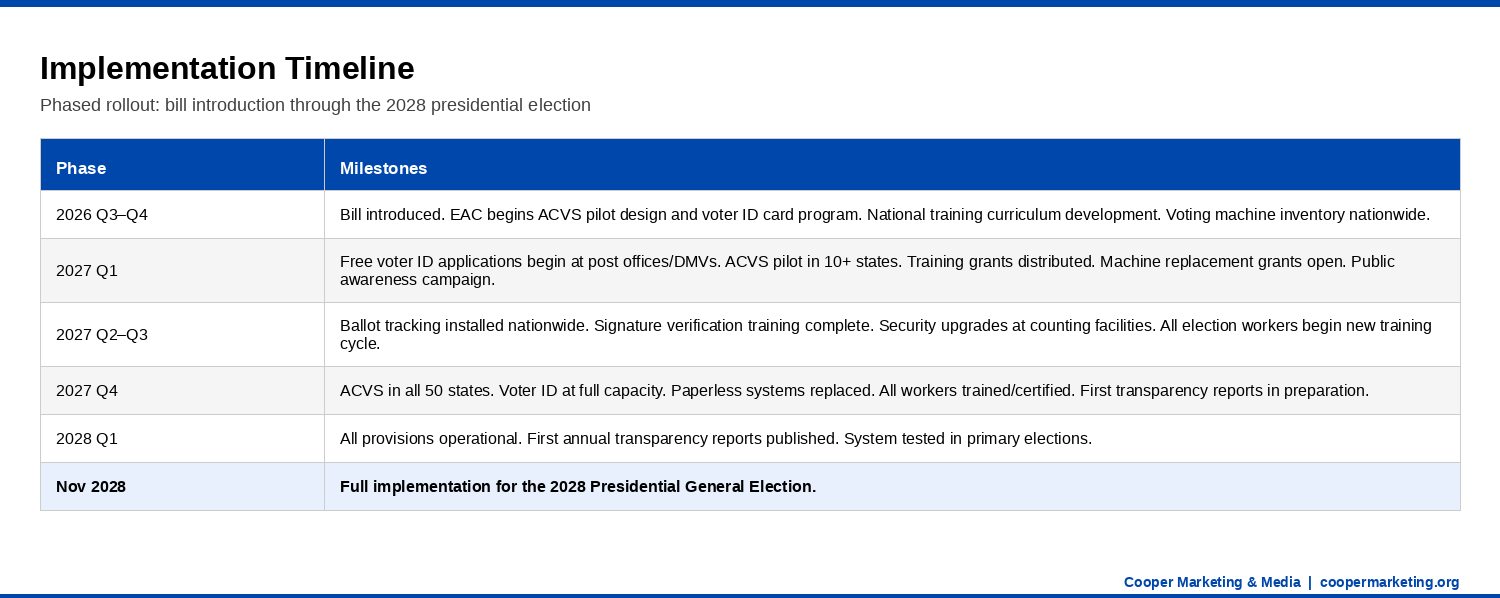
(a) PHASE 1 (Not later than 180 days after enactment). Voter ID applications begin; ACVS pilot in 10+ States; national training curriculum published; voting machine inventory completed.
(b) PHASE 2 (Not later than 18 months). ACVS in all States; voter ID at full capacity; ballot tracking operational; training grants distributed; machine replacement underway.
(c) PHASE 3 (Not later than 24 months). All provisions fully operational for the next Federal general election.
(d) All provisions shall be in full effect for the 2028 Presidential general election.
SEC. 903. Rulemaking Authority
(a) The Election Assistance Commission is authorized to promulgate such regulations as are necessary to carry out the provisions of this Act, notwithstanding any limitation on rulemaking authority under the Help America Vote Act of 2002 (52 U.S.C. § 20901 et seq.).
(b) Regulations under this section shall be issued through notice-and-comment rulemaking in accordance with section 553 of title 5, United States Code.
(c) The Commission shall issue initial regulations under this section not later than 120 days after the date of enactment of this Act.
SEC. 904. Severability
If any provision of this Act, or the application of such provision to any person or circumstance, is held to be unconstitutional, the remainder of this Act, and the application of the provisions of such to any person or circumstance, shall not be affected.
Drafted by Coop | March 2026
This legislative draft is a policy proposal prepared for public consideration and congressional submission.