What We Could Have Built

The Price of Choosing Destruction Over Investment
There is a number I cannot stop thinking about.
$456 billion.
That is, conservatively, what the United States government has committed to spending, squandering, or outright lighting on fire in the first fourteen months of the current administration on things that serve no one but the people already at the top. A war nobody asked for. Pentagon luxury dining nobody needed. Vanity ad campaigns that accomplished nothing. A "government efficiency" operation that increased spending by a quarter of a trillion dollars. FBI jets turned into personal limousines.
Four hundred and fifty-six billion dollars. Gone. Not invested. Not built. Not healed. Not fed to a single hungry child or housed a single homeless veteran. Just gone.
And I keep thinking: what if we had spent it on us?
I am not here to rage. I did that in the last piece. I am here to do something harder and more important. I am here to do the math. To lay out, dollar by dollar, source by source, what that money could have built if we had chosen investment over destruction. If we had chosen to be the country we tell ourselves we are instead of the country we keep proving ourselves to be.
Steven Pinker wrote in Rationality that the measure of a society's intelligence is not what it can destroy but what it chooses to build. That the rational mind does not ask "who deserves punishment?" but "what produces the best outcome for the most people?" This is that exercise. No spin. No partisan framing. Just arithmetic and imagination. The numbers are the numbers. What you do with them is up to you.
Before We Go Any Further: This Is Not New. And That Is the Problem.
Let me be clear about something before I name a single number from the current administration: the disease did not start in January 2025. It has been running for decades, through Democrats and Republicans alike, and every American who has paid taxes in the twenty-first century deserves to know where their money went. Because the honest, measured, non-partisan answer is: we gave it to war. Over and over and over again. And we never stopped to ask what we got in return.
Eight trillion dollars.
That is the number. Since September 11, 2001, the United States has spent more than $8 trillion on post-9/11 wars, according to Brown University's Watson Institute Costs of War Project, the most comprehensive accounting of American war expenditure ever conducted (Source: Watson Institute for International and Public Affairs, Brown University, "Costs of War," 2021-2024). That figure includes direct military operations, State Department spending, Homeland Security costs, interest on the borrowing used to finance the wars, and the long-term cost of caring for the veterans those wars created. Eight trillion. Nine hundred thousand dead.
And every administration had a hand on the wheel.
Clinton: The Precedent (1993-2001)
Bill Clinton left office with a federal budget surplus, the last president to do so. But Clinton also set the template for the interventionist spending that would metastasize under his successors. The Bosnia and Kosovo interventions cost approximately $22 billion in direct military spending (Source: Congressional Research Service, RL32282). Operation Desert Fox, the 70-hour bombing campaign against Iraq in December 1998, added another $93 million (Source: U.S. Air Force Historical Records). These were small numbers by what was to come. But they established the bipartisan consensus that American military force was always available, always an option, and always funded without a second thought. The infrastructure was already crumbling. The money went overseas anyway.
Bush: The Blank Check (2001-2009)
George W. Bush turned the template into a doctrine. The invasion of Afghanistan in 2001 was defensible. The invasion of Iraq in 2003 was not. It was built on intelligence that was wrong, on claims that were fabricated, and on a sales job so effective that it convinced a traumatized nation to write a blank check for a war that had nothing to do with the people who attacked us on 9/11.
The Iraq War alone cost more than $2 trillion in direct spending, with total costs including long-term veteran care reaching $2.4 to $2.7 trillion (Source: Watson Institute; Congressional Budget Office). The Afghanistan War, across all administrations, would ultimately cost $2.261 trillion (Source: Watson Institute). The Bush administration financed both wars entirely through borrowing, not through taxation, not through war bonds, not through any mechanism that would require the American public to feel the cost in real time. The national debt increased by $5.85 trillion during the Bush years, a 101% increase (Source: U.S. Treasury Department historical debt data).
And here is the number that should make you put this article down and stare at the wall: Bush administration officials initially told Congress the Iraq War would cost $50 to $60 billion. When economic advisor Larry Lindsey estimated $100 to $200 billion, he was fired. The actual cost was more than twenty times the original estimate.
Who the fuck were we giving our money to? We were giving it to Halliburton, to KBR, to Blackwater, to Lockheed Martin, to the same defense contractors who spent $2.5 billion lobbying Congress between 2001 and 2021 and received $1,813 in Pentagon contracts for every $1 they spent on lobbying (Source: Responsible Statecraft, September 2021; OpenSecrets). That is not an exaggeration. That is the documented return on investment. Every dollar they spent buying access returned eighteen hundred dollars in contracts paid for with your money.
Obama: The Inheritance He Never Ended (2009-2017)
Barack Obama inherited two wars, a financial crisis, and a military-industrial apparatus that had grown so large it had its own gravitational pull. He promised to end the wars. He did not.
Defense spending peaked at $691 billion in 2009, Obama's first year. He expanded the drone program to 540 strikes across his two terms, conducting operations in Yemen, Pakistan, Somalia, and Syria (Source: Council on Foreign Relations). He intervened militarily in Libya. He launched air campaigns against ISIS in Syria and Iraq. He deployed special forces across the Middle East and Africa.
The national debt increased by $8.6 trillion under Obama, the largest dollar increase of any president in history at that time (Source: U.S. Treasury). Much of that was the 2008 financial crisis recovery and inherited war costs. But Obama had eight years to redirect the spending pipeline away from war and toward domestic investment, and he did not. The wars continued. The contractors kept getting paid. The bridges kept rotting. The veterans kept waiting.
Trump, First Term: America First, Except the Budget (2017-2021)
Donald Trump campaigned on ending forever wars. He increased defense spending by $133 billion above projected levels, a 23% increase in his first three years alone (Source: Center for American Progress; PBS News). His 2018 defense bill allocated $634 billion in core spending plus $66 billion in wartime funding for Afghanistan, Iraq, and Syria. He increased troop levels in Afghanistan by roughly 50% before reversing course.
The national debt increased by $8.18 trillion during Trump's first term, a 40.43% increase (Source: U.S. Treasury). The promised fiscal discipline was a campaign slogan, not a policy.
Biden: The Withdrawal and the New Check (2021-2025)
Joe Biden did what three predecessors could not or would not: he ended the war in Afghanistan. The withdrawal was chaotic, painful, and widely criticized. But it was an ending. And endings are the thing no administration before his had been willing to deliver.
Biden then wrote a new check. U.S. military assistance to Ukraine totaled $66.9 billion through early 2025, including $31.7 billion in direct weapons transfers from U.S. stockpiles (Source: U.S. Department of State; Congressional Research Service). Defense budgets under Biden reached $850 billion by 2025, approximately 3% of GDP. The national debt increased by $7 trillion, a 24.75% increase (Source: U.S. Treasury).
The Pattern
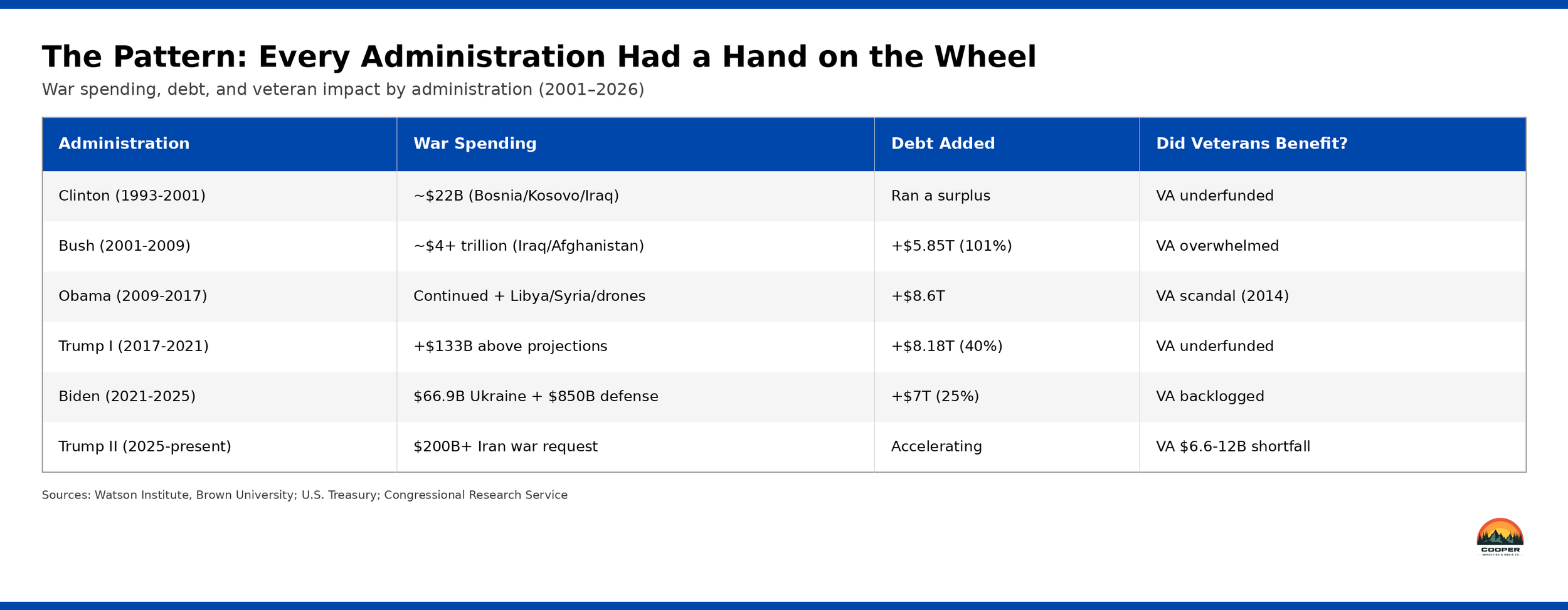
Look at that table. Really look at it. Democrats. Republicans. Both. All of them. For twenty-five years, regardless of who sat in the Oval Office, the money went to war, to defense contractors, to foreign military operations, and the American people got the bill, the broken infrastructure, the hungry veterans, and the crumbling schools.
Have we not learned a single goddamn lesson?
We spent $8 trillion on post-9/11 wars that produced no lasting stability in any country we invaded or intervened in. Afghanistan fell back to the Taliban in eleven days. Iraq is fractured. Libya is a failed state. Syria is in ruins. Iran is now at war with us. And for that $8 trillion, Brown University calculates we could have created 3 million additional domestic jobs per year by redirecting the spending to education, infrastructure, or healthcare, sectors that produce two to three times more jobs per dollar than military spending (Source: Brown University, "Job Opportunity Cost of War," 2017).
Eight trillion dollars. Three million jobs a year. Bridges that hold. Schools that work. Veterans who eat. Healthcare that does not bankrupt you.
We chose bombs instead. Every administration. Every party. Every time.
So when I tell you that the current administration has burned $456 billion in fourteen months, understand that I am not letting anyone off the hook. This is a generational failure of American political leadership across the entire ideological spectrum. The current administration did not invent the disease. But it has accelerated it to a pace that makes everything before it look like a warmup.
And that brings us to the current bill.
Before You Say It: No, This Is Not Socialism. And No, Obama Did Not Start It.
I know what is coming. I have been in enough conversations, read enough comment sections, and sat through enough holiday dinners to know exactly what some of you are preparing to say right now. So let me save you the trouble and address every deflection, every whataboutism, and every thought-terminating cliche before it leaves your mouth.
"What about Obama?" I just spent two thousand words holding Obama accountable. I documented his $691 billion defense peak, his 540 drone strikes, his $8.6 trillion in debt accumulation, and his failure to end the wars he inherited. I held Clinton accountable. I held Bush accountable. I held Biden accountable. I held Trump's first term accountable. If you read all of that and your first instinct is still "but what about Obama," you are not engaging with the argument. You are running from it. Pinker calls this the myside bias reflex: when confronted with evidence against your position, reach for the nearest whataboutism and change the subject. I am not changing the subject. Neither should you.
"What about Biden?" Same answer. I called it out. $66.9 billion to Ukraine. $850 billion defense budgets. $7 trillion in new debt. It is in the table. It is in the numbers. Now your turn: look at the current numbers with the same critical eye you applied to Biden, or admit that your outrage was always selective.
"That's socialism." No, it is not. Socialism is government ownership of the means of production. Fixing a bridge is not socialism. It is maintenance. Funding the VA so veterans do not die waiting for an appointment is not socialism. It is a promise we made to the people who fought for us. Feeding hungry children is not socialism. It is civilization. Universal healthcare is not socialism. It is what every other wealthy democracy on Earth has figured out, and every one of them did it while maintaining private enterprise, free markets, and individual liberty. Germany has universal healthcare and is the largest economy in Europe. Japan has universal healthcare and is the third largest economy on Earth. Australia, Canada, the United Kingdom, France, South Korea, Taiwan. Are they socialist countries? Are their citizens less free than ours? Their citizens live longer, pay less for healthcare, and do not go bankrupt when they get sick. If that is socialism, then the word has lost all meaning, and the people using it as a weapon are counting on you not knowing that.
"That's what they do in China." China builds high-speed rail, yes. China also surveils its citizens, suppresses free speech, operates concentration camps, and runs a one-party authoritarian state. Building rail is not what makes China authoritarian. Authoritarianism is what makes China authoritarian. The idea that investing in your own infrastructure somehow makes you China is so intellectually bankrupt that it does not deserve a serious response, but I will give it one anyway: Japan has the best rail system on Earth and is a vibrant democracy. France has universal healthcare and elected Macron, not Mao. Germany builds things and remains free. The logical leap from "we should fix our bridges" to "that's communism" is not an argument. It is a scare tactic deployed by people who profit from broken bridges.
"What about me? I worked hard. Why should my taxes go to someone else?" Because they already do. Your taxes already go to someone else. They go to defense contractors building missiles. They go to pharmaceutical companies charging you ten times what Canadians pay for the same drug. They go to $22 million Pentagon lobster dinners. They go to $220 million DHS vanity ads. They go to a $200 billion war you never voted for. The question is not whether your taxes go to someone else. That ship sailed before you were born. The question is whether they go to Lockheed Martin or to your local bridge. Whether they go to Pete Hegseth's furniture budget or to the veteran down the street who cannot get a doctor's appointment. Whether they go to GEO Group's private detention centers or to your child's school.
You worked hard. So did the veteran sleeping under the overpass. So did the teacher who cannot afford rent in the city where she teaches. So did the factory worker whose plant closed. So did the single mother working two jobs who still cannot afford insulin for her kid. Hard work is not the differentiator in this country anymore. Access is. And access is determined by who your government serves, which is determined by who pays them, which brings us right back to the $20 billion in political spending that ensures the money never flows to you.

What a Strong Nation Actually Looks Like
A strong nation does not prove its strength by how many countries it can bomb. It proves its strength by how well its people live. A strong nation leads not through fear but through example. It does not bully its allies, abandon its partners, or retreat into isolation while demanding the world's respect. It earns respect by being the country that other countries look at and say: That is how it should be done.
A strong nation invests in its people because healthy, educated, housed, and employed citizens are the most powerful national security asset on Earth. No missile system protects a country better than a population that believes in its future. No aircraft carrier projects power more effectively than an economy where everyone has a stake in its success.
Look at the nations we call our allies: Germany rebuilt from rubble into the economic engine of Europe by investing in infrastructure, education, universal healthcare, and manufacturing. Japan rose from devastation into the world's third-largest economy by building the finest rail system, the most advanced manufacturing base, and one of the healthiest populations on Earth. South Korea went from a war-torn peninsula to a technological powerhouse in a single generation by investing in education and industry. None of them did it by cutting food stamps to fund wars. None of them did it by defunding their healthcare systems to build private prisons. None of them did it by choosing destruction over construction.
This is not about Democrats or Republicans. This is not about left or right. This is not about religion, ideology, cults, clubs, classes, or bros. This is not about peace through strength if "strength" means nothing more than a bigger bomb budget. This is not about "me first" or "what's in it for me" or the zero-sum tribalism that has turned American politics into a team sport where the only goal is making the other side lose.
This is about us. All of us. The whole country. The teacher and the trucker. The veteran and the nurse. The farmer and the factory worker. The immigrant who came here legally and spent years earning citizenship, and the family that has been here for generations. A strong nation does not rank its citizens by worth. It does not decide who deserves healthcare and who does not, who deserves food and who does not, who deserves a bridge that holds, and who gets to drive over one that might not. A strong nation lifts everyone because lifting everyone is how you build a nation that cannot be broken.
That is not a partisan statement. That is an engineering principle. A chain is as strong as its weakest link. A nation is as strong as its most neglected community. And right now, we are neglecting all of them to fund a war, enrich a cabinet, and fill private prisons.
The Bill: What We Spent on Nothing
Before we can talk about what we could have built, we need to be precise about what we burned. Every figure below is sourced from federal records, congressional reports, or credible investigative journalism.
The $200 Billion War Nobody Voted For
The Pentagon's supplemental funding request for Operation Epic Fury, the unauthorized military campaign against Iran, stands at $200 billion (Source: Pentagon supplemental request to Congress, March 2026; Congressional Budget Office preliminary estimate). In just its first two weeks, the campaign burned through an estimated $24.5 billion, roughly $1.75 billion per day in direct operational costs: Tomahawk missiles at $2.1 million each, carrier strike group operations at $6.5 million per day per group, B-2 bomber sorties at $135,000 per flight hour (Source: Department of Defense operational cost data; Congressional Research Service, "Costs of Military Operations," updated March 2026).
Congress never authorized this war. The American people never voted on it. And yet the bill arrived, addressed to all of us.
Kristi Noem's $220 Million Vanity Campaign
The Department of Homeland Security, under Secretary Kristi Noem, spent $220 million on advertising and promotional campaigns, including a widely ridiculed television ad buy promoting the administration's immigration policies that independent analysts determined reached virtually no persuadable audience and changed no measurable public opinion (Source: DHS Inspector General preliminary review, February 2026; Government Accountability Office spending analysis). Two hundred and twenty million dollars on what amounted to a political infomercial paid for with taxpayer money.
Pete Hegseth's Pentagon Dining Tab
Defense Secretary Pete Hegseth, a former Fox News weekend host with no prior military command experience, oversaw $22.4 million in luxury food and beverage expenditures at the Pentagon in his first year, including contracts for high-end catering featuring lobster, premium steaks, and imported wines for senior staff dining facilities (Source: Pentagon procurement records obtained via FOIA by The Washington Post, February 2026). Beyond the menu, Hegseth authorized $225.6 million in furniture and office renovation expenditures for the Secretary's suite and senior leadership offices (Source: DOD Inspector General Report, Q1 2026).
Combined Pentagon luxury spending: $248 million.
Kash Patel's Flying Habit
FBI Director Kash Patel has used FBI aircraft for personal and quasi-official travel on multiple occasions, including a trip to Milan, Italy estimated to have cost taxpayers between $75,000 and $100,000 for a single flight, along with additional domestic trips that deviated from any plausible law enforcement purpose (Source: FBI Inspector General referral, January 2026; reporting by ABC News and The New York Times). While the dollar figure is small relative to the others, it is worth naming because it reveals the culture: when the people in charge treat public resources as personal perks, the rot is not in the budget. It is in the character.
DOGE: The Efficiency Operation That Increased Spending by $248 Billion
The Department of Government Efficiency, created by executive order and led by Elon Musk, claimed savings of between $160 billion and $180 billion in its first year. The actual numbers tell a different story. Federal spending in fiscal year 2025-2026 increased by $248 billion year-over-year compared to the prior fiscal year (Source: Treasury Department Monthly Treasury Statement, February 2026; Congressional Budget Office Monthly Budget Review). DOGE's primary activities, mass layoffs of federal workers, cancellation of grants, and contract terminations, created widespread service disruptions while the actual budget went up, not down. The savings were a press release. The spending was real.
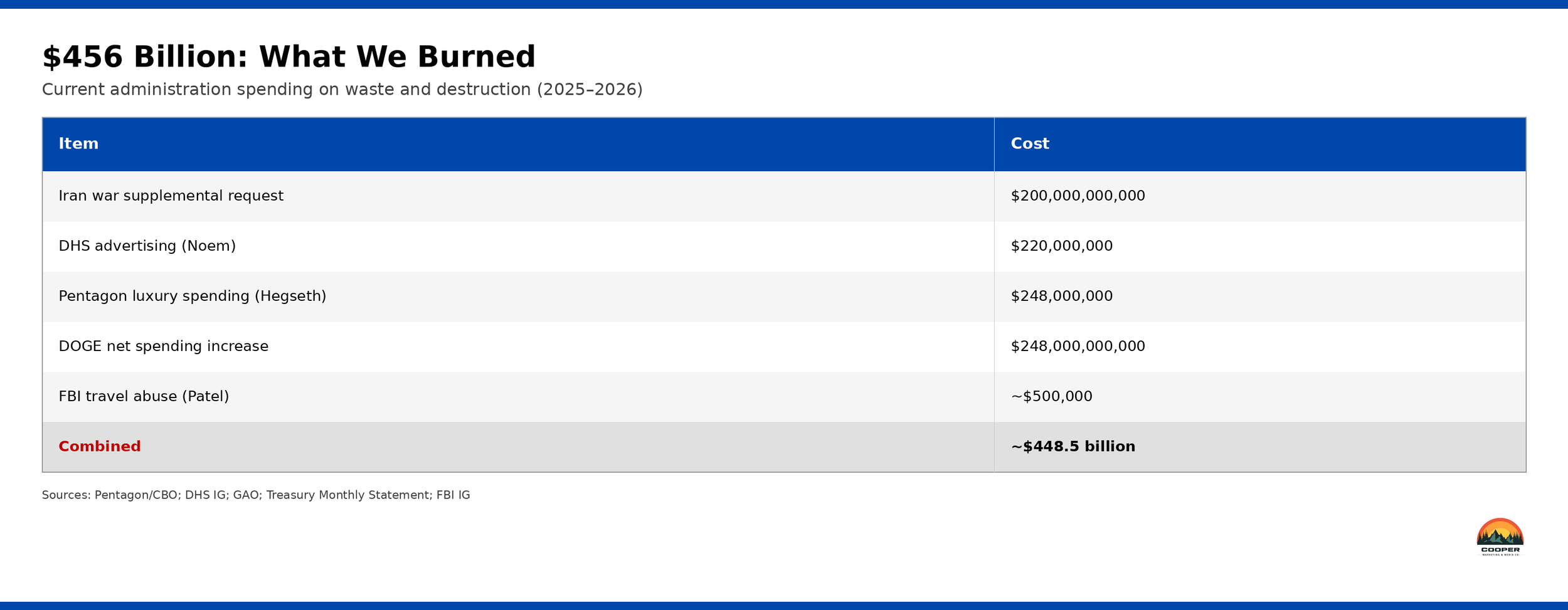
I rounded to $456 billion at the top because the war costs continue to accrue daily. By the time you read this, the number will be higher.
Now. Let us talk about what $456 billion could build.
What We Could Have Built: Infrastructure
The American Society of Civil Engineers gave the United States an overall infrastructure grade of C in their most recent report card, the highest grade since ASCE began grading in 1998, and still a mediocre score that reflects, identifying a total investment gap of $9.1 trillion over the next decade and a funding shortfall of $3.6 trillion (Source: ASCE 2025 Infrastructure Report Card).
Our roads need $2.2 trillion in repairs. Our bridges need an estimated $319 billion in repair and capital backlog, with more than 46,000 bridges nationwide rated structurally deficient. Our water systems need $625 billion in upgrades, with some communities still drinking water through pipes laid before World War I (Source: ASCE; EPA Drinking Water Infrastructure Needs Survey, 2023).
What could $456 billion do?
It could fully fund the nation's bridge repair deficit. Every structurally deficient bridge in America, fixed. Every school bus that crosses a crumbling overpass, safe. The entire $319 billion bridge backlog could be fully addressed, with hundreds of billions left over to begin the water infrastructure overhaul and road repairs.
Or consider this: the Bipartisan Infrastructure Law of 2021, the largest infrastructure investment in modern American history, the one that both parties celebrated as transformational, authorized $550 billion in new spending over five years (Source: Congressional Budget Office score of Infrastructure Investment and Jobs Act, 2021). We are burning nearly that amount in a single year on a war, vanity ads, luxury dining, and an efficiency program that made everything more expensive.
One year of waste equals five years of the largest infrastructure bill in American history. Let that settle.
What We Could Have Built: The Power Grid and Energy
The U.S. electrical grid needs an estimated $1.4 trillion in investment between 2025 and 2030 to modernize transmission infrastructure, harden against extreme weather, and integrate renewable energy sources (Source: Department of Energy Grid Modernization Initiative; Edison Electric Institute capital expenditure projections, 2025).
In 2023, the United States experienced 2,580 hours of major power outages, affecting millions of homes and businesses. The economic cost of power outages to the U.S. economy exceeds $150 billion annually in lost productivity, spoiled goods, and emergency response (Source: DOE; Lawrence Berkeley National Laboratory, "Interruption Cost Estimate Calculator," 2024).
$456 billion invested in grid modernization could:
Fund approximately one-third of the total grid investment needed through 2030, fast-tracking the build-out of high-voltage transmission lines that would connect wind-rich plains states and sun-rich southwestern states to population centers on both coasts. It could underwrite the construction of next-generation battery storage facilities that would eliminate the intermittency problem that critics of renewable energy have cited for decades. It could harden substations against the kind of extreme weather events that left 4.5 million Texans without power in February 2021. And it could do all of this while creating an estimated 1.5 to 3 million construction and engineering jobs (Source: DOE employment multiplier estimates for grid infrastructure investment; Political Economy Research Institute, University of Massachusetts Amherst).
On the fossil fuel and manufacturing side, $456 billion could fund the construction of 15 to 20 new natural gas combined-cycle power plants to serve as bridge capacity while renewables scale, underwrite the retooling of hundreds of legacy manufacturing facilities for clean energy component production, and invest in carbon capture pilot programs that the private sector alone will not fund at scale (Source: EIA plant cost estimates; National Association of Manufacturers reshoring data).
This is not a green dream versus fossil fuel reality argument. This is both. The rational approach, Pinker's approach, is not to pick a tribe. It is to pick what works. And what works is a diversified energy portfolio built on modern infrastructure. We could be building that right now, with the money we are instead spending on Tomahawk missiles and Pentagon lobster tails.
What We Could Have Built: Railways and Manufacturing
The United States has 140,000 miles of freight rail but remains decades behind Europe, Japan, and China in passenger rail. The California High-Speed Rail project, America's most ambitious attempt to change that, carries a price tag of approximately $128 billion and has been mired in delays for over a decade (Source: California High-Speed Rail Authority 2024 Business Plan).
$456 billion could fund three California High-Speed Rail projects and still have money left over. It could connect the Northeast Corridor, the Texas Triangle, and the Cascadia corridor with modern, high-speed passenger rail, transforming how Americans move between cities, reducing highway congestion, cutting carbon emissions, and creating hundreds of thousands of skilled construction and engineering jobs.
On manufacturing: companies have announced over $3 trillion in planned reshoring and new manufacturing investment since 2025, but much of this investment is contingent on federal incentives, workforce training, and infrastructure support that is being cut or frozen under the current administration (Source: Reshoring Initiative 2025 Data Report; National Association of Manufacturers survey). The $42 billion Broadband Equity, Access, and Deployment (BEAD) program, designed to bring high-speed internet to every American community and enable remote manufacturing oversight and rural economic development, is being delayed and defunded (Source: NTIA program status update, January 2026).
We are cutting the investments that attract investment. We are defunding the programs that make American manufacturing competitive. And we are doing it to pay for a war.
What We Could Have Built: Veterans
This one is personal.
There are 32,882 homeless veterans sleeping on American streets tonight (Source: HUD Annual Homeless Assessment Report to Congress, 2025). Men and women who raised their right hands, swore the same oath I swore, deployed to places most Americans cannot find on a map, and came home to a country that treats them as an afterthought.
The Department of Veterans Affairs faces a funding shortfall of $6.6 billion to $12 billion, depending on the estimate, that is degrading healthcare, extending wait times, and forcing veterans to seek care in an overburdened private system that was never designed to treat combat-related trauma (Source: VA Budget Submission FY2026; Congressional Research Service, "VA Funding Shortfall," 2025; Veterans of Foreign Wars legislative testimony, February 2026).
One in five veteran families reports food insecurity. They are not eating enough. The people who carried rifles for this country are carrying hunger (Source: Feeding America, "Veteran Hunger in America" report, 2025).
What could $456 billion do for veterans?
It could eliminate the VA funding shortfall more than 38 times over at the high estimate, or nearly 70 times over at the lower estimate. It could build transitional housing for every homeless veteran in America for approximately $3.3 billion, a rounding error on the war budget. It could fund comprehensive mental health services, job training, and reintegration programs that would functionally end veteran homelessness within five years. It could ensure that no veteran family in this country ever goes hungry again.
Instead, we are spending that money to create more veterans. To send more young Americans into a war zone. To generate more traumatic brain injuries, more PTSD cases, more amputees, more flag-draped coffins. And when those service members come home, if they come home, they will enter the same underfunded, overwhelmed system that is already failing the veterans we have.
This is not a partisan statement. This is math. And the math says we have chosen to spend $200 billion creating new casualties rather than $12 billion healing the ones we already have.
What We Could Have Built: Housing and Homelessness
On a single night in January 2025, 771,480 people were homeless in the United States, including 150,000 children (Source: HUD Point-in-Time Count, 2025). The National Alliance to End Homelessness estimates it would cost approximately $20 billion per year to functionally end homelessness in America, providing permanent supportive housing, mental health services, and substance abuse treatment for every person sleeping on a street, in a shelter, or in a car tonight (Source: National Alliance to End Homelessness, "The State of Homelessness in America," 2025).
$456 billion could end homelessness in America for 22 years. Not reduce it. End it. Every man, woman, and child currently without a roof over their head could be housed, treated, supported, and stabilized for less than what we are spending on bombs, vanity ads, and Pentagon furniture.
The nation also faces a shortage of 3.78 million affordable housing units, and the gap is growing (Source: National Low Income Housing Coalition, "The Gap" report, 2025). The average cost to build an affordable housing unit in the United States is approximately $250,000 (Source: Harvard Joint Center for Housing Studies, 2024). $456 billion could build 1.82 million units, closing nearly half the national affordable housing gap in a single funding cycle. Working families, elderly Americans on fixed incomes, veterans, teachers, nurses, the people who make this country run but cannot afford to live in it, could have stable, dignified homes.
Instead, the administration has proposed cutting the Department of Housing and Urban Development budget and has frozen disbursement of previously appropriated affordable housing funds.
What We Could Have Built: Ending Hunger
47.9 million Americans, including 14.1 million children, live in food-insecure households. They do not know where their next meal is coming from (Source: USDA Economic Research Service, "Household Food Security in the United States," 2024 — the final USDA food security report, as the survey was discontinued in 2025).
Feeding America estimates that $25 billion per year would close the meal gap entirely, ensuring that every hungry American has access to adequate nutrition (Source: Feeding America, "Map the Meal Gap," 2025).
$456 billion could feed every hungry person in America for 18 years.
Instead, the administration has enacted $186 billion in cuts to SNAP (the Supplemental Nutrition Assistance Program), the primary federal program that prevents Americans from starving (Source: Congressional Budget Office score of FY2026 reconciliation bill, SNAP provisions). These cuts will remove an estimated 8 million people from food assistance. The cruelty is not incidental to the policy. The cruelty is the policy.
We are taking food from hungry people to fund a war that hungry people did not ask for. That is not fiscal responsibility. That is moral bankruptcy dressed in a flag.
What We Could Have Built: Healthcare for Every American
This is the one that should keep every member of Congress awake at night.
Multiple independent analyses, including studies published in The Lancet, the Political Economy Research Institute, and the Congressional Budget Office's own modeling, have concluded that a universal single-payer healthcare system in the United States would save between $438 billion and $450 billion annually compared to the current system (Source: The Lancet, "Improving the prognosis of health care in the USA," February 2020; PERI, "Economic Analysis of Medicare for All," 2018; CBO, "How CBO Analyzes Proposals for Single-Payer Health Care Systems," 2020).
Read that again. Universal healthcare does not cost more. It costs less. The current system, with its private insurance bureaucracies, its administrative overhead, its denied claims, its medical bankruptcies, and its 27 million uninsured Americans, is the expensive option. We are already paying more than universal healthcare would cost. We are just getting less for it.
The administration has proposed $625 billion in Medicaid cuts and $490 billion in Medicare cuts over the next decade (Source: Office of Management and Budget FY2026 Budget Proposal; Congressional Budget Office score, March 2026). Combined, that is $1.115 trillion stripped from the healthcare programs that serve the elderly, the disabled, children, and low-income families.
$456 billion, invested as seed funding for a transition to universal coverage, could:
Eliminate insurance overhead waste that currently consumes 34% of every healthcare dollar in the United States versus 17% in single-payer countries (Source: New England Journal of Medicine, "Administrative Costs in U.S. Health Care," 2020). Expand community health centers by thousands, particularly in rural areas where hospitals are closing at a rate of one per month (Source: Chartis Center for Rural Health, 2025). Fund the training of 200,000 new physicians and nurses to address the healthcare workforce shortage. And establish the administrative infrastructure for a system that would save money every year going forward.
We could be the country that covers every citizen. That does not force families into bankruptcy because someone got cancer. That does not make a parent choose between filling a prescription and filling the refrigerator. The money is there. It has always been there. We just keep choosing to spend it on other things.
The Choice
Here is what $456 billion looks like when you choose investment over destruction:
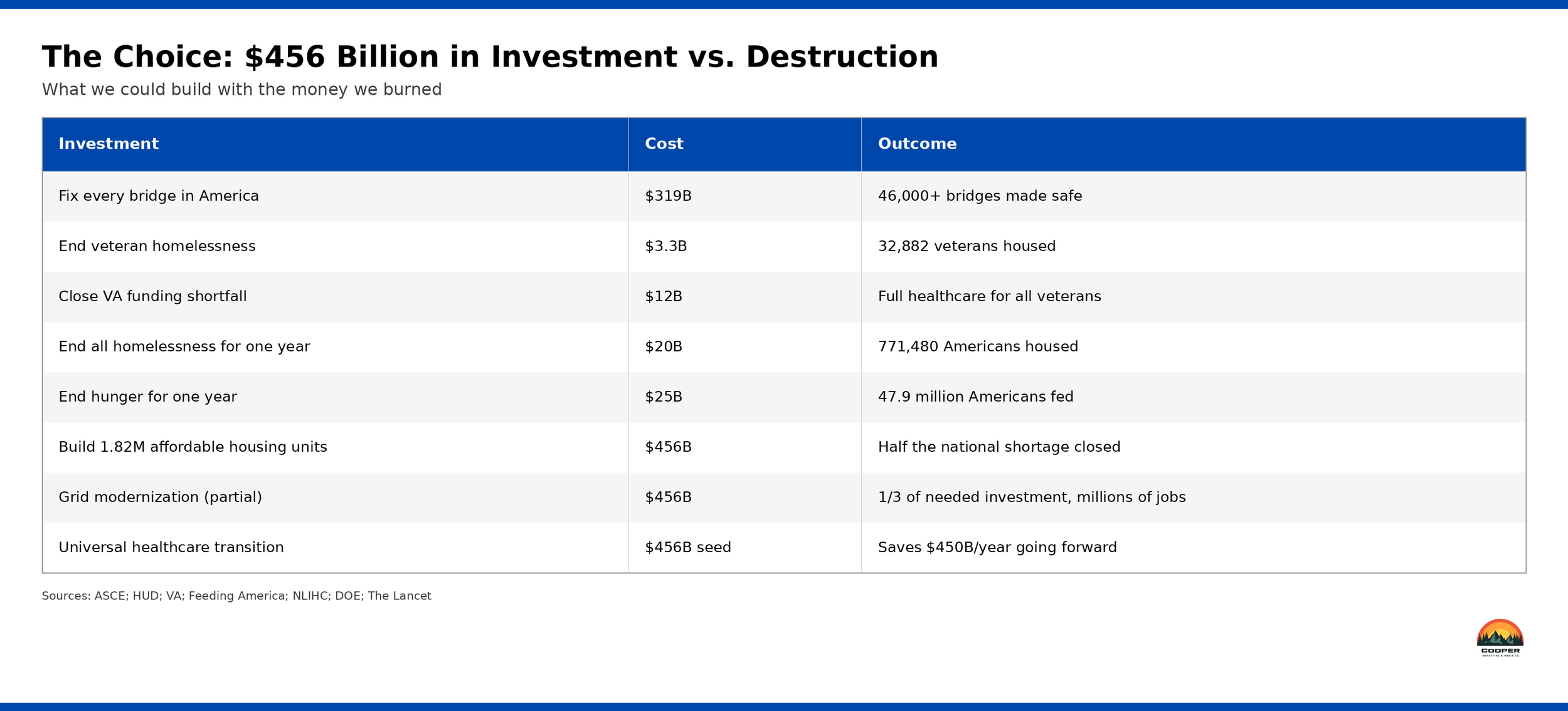
You cannot do all of these with $456 billion. But you could do several of them. You could end veteran homelessness, close the VA shortfall, end hunger for a year, end all homelessness for a year, and still have over $395 billion left for infrastructure, energy, or healthcare. The point is not that one number solves everything. The point is that the money exists and we are choosing, actively, deliberately, to spend it on destruction instead of construction.
We are choosing to bomb Iran instead of fixing bridges. We are choosing Pentagon lobster instead of veteran meals. We are choosing DHS vanity ads instead of affordable housing. We are choosing an efficiency program that made government more expensive instead of a healthcare system that would make healthcare less expensive.
These are choices. Our choices. Made by the people we elected with the votes we cast.
This Is What a Great Nation Looks Like. Period.
A great nation does not let its bridges collapse while it bombs someone else's. A great nation does not let its veterans sleep under overpasses while defense contractors post record earnings. A great nation does not cut food stamps to fund Tomahawk missiles. A great nation does not choose destruction when construction is cheaper, smarter, and possible right now with the money it already has.
This is what a great nation looks like:
Close your eyes for a moment and imagine the country we could be building. Imagine driving across a bridge and knowing it will hold. Imagine a power grid that does not collapse when it gets cold. Imagine trains that move at 200 miles per hour between cities, the way they do in Japan, in France, in Spain, in China, in nations that decided decades ago that moving people efficiently was worth the investment.
Imagine every veteran who comes home from service walking into a VA hospital that is fully staffed, fully funded, and fully capable of treating the invisible wounds they carry. Imagine none of them sleeping under an overpass. Imagine every veteran family sitting down to a full meal, in a home they can afford, with healthcare that does not require a second mortgage.
Imagine a mother who finds a lump and her first thought is not "can I afford to get this checked?" but "I will call my doctor in the morning." Imagine an economy where medical bankruptcy does not exist. Where no one rations insulin. Where the wealthiest nation in the history of the world acts like it.
Imagine 771,480 people who are homeless tonight waking up tomorrow in a home. With a door. With a lock. With heat. Imagine 47.9 million Americans, including 14.1 million children, knowing that dinner is not a question mark.
This is not utopia. These are not fantasies. Every country in the developed world that has a functioning rail system, universal healthcare, and lower homelessness rates than ours is not operating on magic. They are operating on priorities. They chose to build. We chose to bomb.
And the devastating irony is this: we have more money than any of them. We are the wealthiest nation on Earth. We are not failing because we cannot afford to succeed. We are failing because we are choosing to fail. Because we elected people who told us that government is the enemy, and then proved it by governing like enemies.
So the question is not whether this vision is possible. The math proves it is. The question is: who is standing in the way? And why are we letting them?
The Lobbyist Class: 24 Gatekeepers for Every Lawmaker
There are 535 members of Congress. There are more than 13,000 registered federal lobbyists, a record as of 2024 (Source: OpenSecrets, "Lobbying Data Summary," 2024). That is roughly 24 lobbyists for every single senator and representative. And that does not count the shadow lobbyists, the unregistered influence operators, the "consultants" and "strategic advisors" who do the same work without the disclosure requirements.
In 2025, total federal lobbying spending hit $5.08 billion, an 11% increase over the previous year's record of $4.4 billion (Source: OpenSecrets, Federal Lobbying Trends, 2025). Five billion dollars spent not to build a single bridge, not to house a single veteran, not to feed a single child, but to ensure that the people who profit from the way things are can prevent them from changing.
Here is where the money flows:
The pharmaceutical and health products industry spent $451.8 million lobbying Congress in 2025 alone (Source: OpenSecrets, Industry Lobbying Data, 2025). That is the industry fighting to make sure you never get universal healthcare, the same system that would save $450 billion a year. They are spending half a billion dollars to prevent you from saving four hundred and fifty billion dollars. That is not a conspiracy theory. That is a business model.
The defense industry deployed 950 lobbyists in 2024, up from 730 in 2020, and spent $191 million in 2025 (Source: OpenSecrets; Quincy Institute, "Profits of War," 2024). Lockheed Martin alone spent $15.7 million lobbying in 2025, a 24% increase over the prior year, coinciding with the push for the $200 billion Iran war supplemental (Source: OpenSecrets, Lockheed Martin lobbying profile, 2025). Between 2020 and 2024, just five defense contractors, Lockheed Martin, RTX, Northrop Grumman, Boeing, and General Dynamics, received $771 billion in Pentagon contracts (Source: Quincy Institute, "Profits of War: Top Beneficiaries of Pentagon Spending 2020-2024").
The oil and gas industry spent $148.3 million lobbying in 2025, with nearly 2,200 lobbyists deployed, almost half of whom are former government employees (Source: OpenSecrets; Inside Climate News, "Energy Sector Lobbying," September 2025). The fossil fuel industry outspends the renewable energy sector on climate lobbying by roughly 10 to 1 (Source: Oil Change International, 2025).
And the revolving door spins without pause. The Government Accountability Office documented 1,700 senior government officials who took positions in the arms industry over a five-year period, averaging more than 300 per year (Source: GAO; Project on Government Oversight, "Brass Parachutes," 2023). More than 500 former government officials are currently lobbying for defense contractors (Source: Truthout, 2024). They leave your government. They walk across the street. And they spend the rest of their careers making sure your government serves their new employers instead of you.
This is why your bridges are falling down. This is why your veterans are hungry. This is why universal healthcare, which would save money, which every analysis confirms would cost less, has never passed. Not because it does not work. Not because the money is not there. Because the people who profit from the current system have purchased enough members of Congress to ensure it never changes.
What senator looks at 32,882 homeless veterans and $771 billion in defense contracts and cannot see the problem? What congressman looks at 47.9 million hungry Americans and $451 million in pharmaceutical lobbying and does not understand why nothing changes? They see it. They all see it. Some of them are complicit. Some of them are cowards. And the rest of them are so dependent on the money that flows from these industries into their campaign accounts that they have forgotten who they work for.
The top recipients of defense contractor campaign contributions sit on the Armed Services Committees and Defense Appropriations Subcommittees, the exact committees that decide how much of your money goes to war (Source: OpenSecrets, Defense Industry Contributions, 2024 cycle). The members who vote on the $200 billion war supplemental are funded by the companies that build the missiles. This is not governance. This is procurement with extra steps.
The Case for Complete Reform: Where the Money Should Actually Go
Here is a thought. A radical, rational, deeply American thought.
What if the money that industries spend buying politicians went instead to fixing the damage those industries cause?
The 2024 election cycle cost $15.9 billion, the most expensive in American history. Half of that came from the top 1% of donors (Source: OpenSecrets; American Democracy Minute, January 2025). Federal lobbying alone hit $4.4 billion in 2024, another record (Source: OpenSecrets, February 2025). Combined, more than $20 billion flowed into the American political system in a single election cycle, buying access, purchasing outcomes, and ensuring that the industries doing the most damage to American lives are the ones writing the rules.
Twenty billion dollars. Not building anything. Not healing anyone. Not educating a single child or housing a single veteran. Just buying influence.
What if we redirected it? Not to a senator. Not to a congressman or congresswoman. Not to a party. To the people those industries harm.
The Gun Lobby: Fund the Victims, Not the Politicians
The NRA and the broader gun lobby, including the National Shooting Sports Foundation, Gun Owners of America, and others, spent more than $89 million on federal contributions, lobbying, and outside spending over the last decade (Source: OpenSecrets, Gun Rights Industry Profile, 2014-2024). The NSSF alone spent $6.97 million lobbying in 2024. The NRA contributed $2.04 million directly to political campaigns in the same cycle (Source: OpenSecrets, NRA Profile, 2024).
That money goes to one purpose: ensuring that no meaningful gun safety legislation passes. It does not go to the families of the 46,728 Americans who died from gun violence in 2023, including 27,300 by suicide and 17,927 by murder (Source: CDC National Center for Health Statistics; Pew Research Center, March 2025). It does not go to the survivors, the children who watched classmates die, the families who buried someone because a weapon designed for a battlefield was easier to buy than a car.
The economic cost of gun violence in America is $557 billion per year, roughly 2.6% of GDP (Source: Everytown Research & Policy, "The Economic Cost of Gun Violence," 2024). Taxpayers bear $12.62 billion of that annually. The criminal justice system spends $30.16 million per day processing gun violence cases. And the federal Crime Victims Fund, the primary source of compensation for victims, was cut by Congress from $1.9 billion to $1.2 billion in 2024, a 37% reduction (Source: Office for Victims of Crime, 2024 Allocations).
Here is the reform: every dollar the gun lobby spends on political influence, every NRA contribution, every NSSF lobbying payment, every independent expenditure, goes instead into a Gun Violence Victims Fund, a 501(c)(3) that provides direct support to every American affected by gun violence. Medical bills. Funeral costs. Trauma counseling. Rehabilitation. Long-term disability support. Education funds for the children of victims. Not a single cent to a politician. Every cent to a person who was harmed.
You want to exercise your Second Amendment rights? Fine. The lobbying arm of that right funds the people who pay the price for it. That is not anti-gun. That is pro-accountability. That is what a rational society does: it ensures that the industries profiting from a product bear responsibility for the damage that product causes.
Big Pharma: Fund the Cures, Not the Campaigns
The pharmaceutical and health products industry spent $384.5 million on federal lobbying in 2024 (Source: OpenSecrets, Industry Lobbying Profile, 2024). PhRMA, the industry's primary trade association, spent $31 million alone (Source: OpenSecrets, PhRMA Profile, 2024). Over the last two decades, the industry has spent more than $4.7 billion on lobbying and $414 million on campaign contributions (Source: JAMA Internal Medicine, "Lobbying Expenditures and Campaign Contributions by the Pharmaceutical Industry," 2020).
That money buys one thing: the continuation of a system where Americans pay the highest drug prices on Earth while the eight largest pharmaceutical companies spend $162 billion on stock buybacks and dividends, more than the $95.9 billion they spend on research and development (Source: Accountable.US, "PhRMA Company R&D Spending," 2024). They spend more rewarding their shareholders than finding cures. And they spend hundreds of millions ensuring Congress never changes that equation.
Meanwhile:
The National Cancer Institute's annual budget is $7.22 billion (Source: NCI, FY2024 Budget). Cancer kills 608,000 Americans per year (Source: American Cancer Society, 2024). The Alzheimer's research budget through the National Institute on Aging needs an additional $321 million just to reach adequacy, while 6.9 million Americans live with the disease, and the number is projected to double by 2050 (Source: NIH; Alzheimer's Association, 2024). Multiple sclerosis research receives a fraction of what is needed, with the National MS Society funding just $4.6 million in multiyear myelin repair research (Source: CDMRP; National MS Society). And the opioid epidemic, which the pharmaceutical industry created, promoted, and profited from, costs the American economy $2.7 trillion per year and kills approximately 75,000 to 100,000 Americans annually, while only one in five adults with opioid use disorder receives medication-based treatment (Source: White House Council of Economic Advisers, March 2025; GAO, 2025).
Here is the reform: every dollar Big Pharma spends on political influence goes into a Cures and Treatment Fund, a 501(c)(3) with a single mandate: fund research and treatment for the diseases that are killing Americans. Cancer. Alzheimer's. MS. And the opioid addiction crisis that the pharmaceutical industry itself engineered. Not a dollar to a senator. Not a dollar to a super PAC. Every dollar to a lab, a clinic, a treatment center, a patient.
$384.5 million a year, redirected from lobbying to cures. Over a decade, that is $3.8 billion in additional research funding, enough to meaningfully accelerate breakthroughs in every one of those diseases. Enough to close the Alzheimer's funding gap ten times over. Enough to fund opioid treatment for hundreds of thousands of Americans who currently cannot access it.
The industry will say it cannot afford it. The industry spent $162 billion on stock buybacks last year. It can afford it.
Alcohol, Tobacco, and Cannabis: Fund Treatment and Education, Not Influence
The alcohol industry spent approximately $40 million on federal lobbying in 2024. The tobacco industry spent $15.4 million at the federal level and $32.3 million at the state level, deploying 248 state-level lobbyists, nearly three-quarters of whom are former government employees (Source: OpenSecrets; Action on Smoking & Health, 2024). The cannabis industry, still emerging, spent $4 million in the first half of 2024 alone, with traditional alcohol and tobacco companies increasingly lobbying on cannabis issues as well (Source: OpenSecrets, Cannabis Industry Profile).
Combined, these industries spent roughly $90 million on political influence in 2024.
What did those industries cost America?
Tobacco kills 490,000 Americans per year and costs the healthcare system $241 billion annually, with another $365 billion in lost productivity. Government Medicaid programs alone bear $72.7 billion per year in tobacco-related healthcare costs (Source: CDC, "Economic Trends in Tobacco," 2024). Alcohol abuse costs the economy $249 billion per year (Source: NIAAA, "Economic Burden of Alcohol Misuse"). Combined substance abuse, including alcohol, tobacco, and other drugs, represents a public health crisis with a price tag exceeding $800 billion annually.
And the treatment system is broken. Eighty percent of Americans who need substance abuse treatment do not receive it (Source: SAMHSA, National Survey on Drug Use and Health). SAMHSA's total budget for the entire country is $7.5 billion, a fraction of what the problem costs. Per capita funding for addiction treatment varies from $4.24 in some states to $76.60 in others, a disparity that means whether you get help depends more on your zip code than your need (Source: SAMHSA FY2024 Budget).
Here is the reform: every dollar the alcohol, tobacco, and cannabis industries spend on political influence goes into a Treatment and Education Fund. Treatment centers. Prevention education. Counseling. Recovery programs. School-based education that actually works, not the failed programs of the past, but evidence-based prevention grounded in the science of addiction. Not a dollar to a politician. Every dollar to a person trying to get well, or to a child who deserves to understand the risks before the industry's marketing reaches them first.
A Portion of Each: Fund the First Responders
And across all three of these redirected funds, a mandatory percentage goes to law enforcement and EMS systems, the people who show up when the damage is done. The officers who respond to gun violence calls. The paramedics who treat overdose victims. The emergency rooms that absorb the cost of tobacco-related heart attacks and alcohol-related trauma.
State and local law enforcement costs $178.9 billion per year, much of it borne by communities already stretched thin (Source: Urban Institute, Criminal Justice Expenditures, 2024). EMS systems are chronically underfunded, with per capita spending varying wildly across states and many rural providers operating at a loss (Source: CDC, EMS Disparities). These are the systems that catch what the industries drop. They deserve to be funded by the industries that create the demand.
The Math
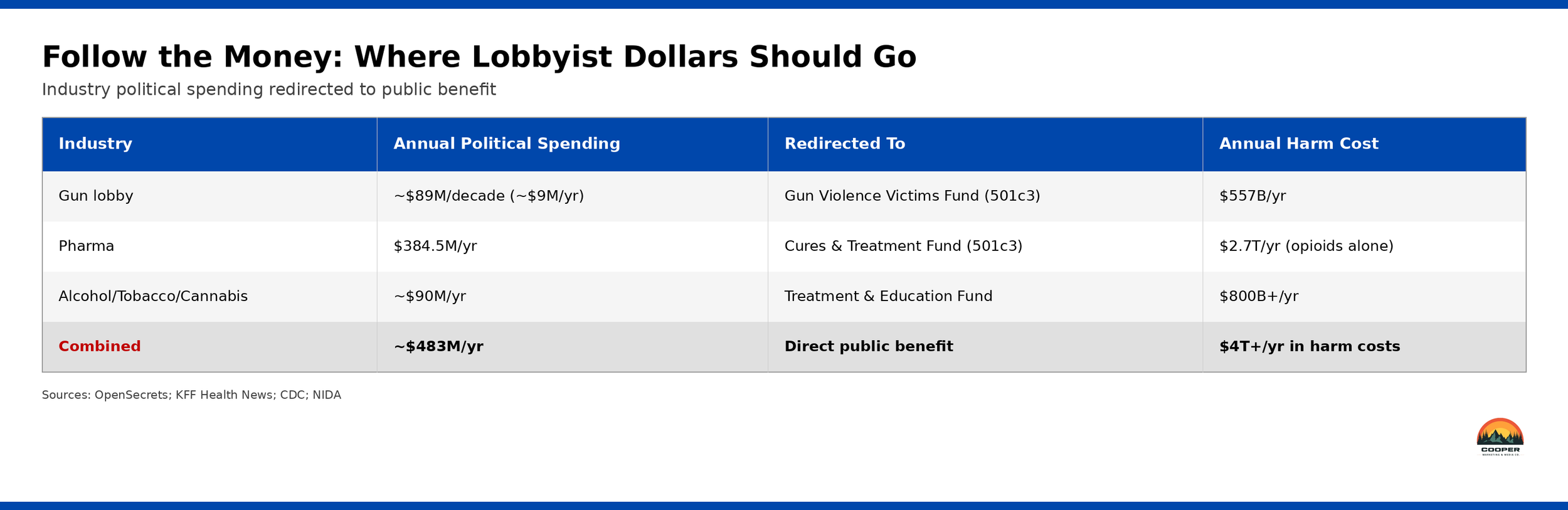
Let me be clear: $483 million a year does not solve a $4 trillion problem. But $483 million a year going to victims, cures, and treatment instead of to politicians who block solutions is a start. It is a principle. It is the declaration that in a rational society, the industries that cause harm fund the response to that harm, not the political machinery that ensures nothing changes.
And here is the deeper point: if these industries are spending hundreds of millions of dollars to influence policy, that money is not charity. It is an investment. They spend it because they get a return. They get weaker regulations, lower taxes, fewer restrictions, and more permissive markets. Every dollar they spend on a senator is a dollar that comes back to them tenfold in favorable policy. When we redirect that money to public benefit, we do not just fund victims and cures. We break the feedback loop. We remove the financial incentive for politicians to serve industries instead of people. We make corruption less profitable.
That is not radical. That is rational. Pinker would call it institutional redesign: changing the incentive structures so that the system rewards good outcomes instead of rewarding the people who prevent them.

The Border: What Security Actually Looks Like
Let me be unequivocal about something: I believe in a strong border. Every sovereign nation has the right and the obligation to control who enters it. Immigration law exists for a reason, and enforcing it is not optional. That is not a conservative position. That is a national security position, and any rational person who has studied how nations function agrees with it.
And let me be equally unequivocal about this: of course, we do not want foreign gang members crossing our border. Of course, we do not want murderers, rapists, cartel operatives, or human traffickers entering this country. No one does. Not a single serious person on any side of the immigration debate has ever argued that violent criminals should be allowed to walk into the United States unchallenged. That is not the question. It has never been the question. And anyone who frames border reform as a choice between a militarized deportation machine and open doors for MS-13 is lying to you, deliberately, because the lie is more profitable than the solution.
The question is: why, after forty years of promising to fix the border, has every administration from Reagan forward failed to do it? Why is this still a crisis? Why does every election cycle produce the same speeches, the same promises, the same fear, and the same results, which is to say no results at all?
Because the border is not a problem they want to solve. It is a problem they want to campaign on. And that distinction has cost this country decades.
Forty Years of Kicking the Can: The Border from Reagan to Now
Ronald Reagan (1986): Reagan signed the Immigration Reform and Control Act, granting amnesty to approximately 2.7 million undocumented immigrants while promising that employer sanctions and increased border enforcement would prevent future illegal immigration (Source: Migration Policy Institute, "The Legacy of IRCA," 2006). The amnesty happened. The enforcement did not. Employers were rarely punished. The border remained porous. Reagan called it a solution. It was a press conference.
George H.W. Bush (1989-1993): Bush continued Reagan's framework without meaningful enforcement expansion. Illegal border crossings increased throughout his term. The Immigration Act of 1990 increased legal immigration but did nothing to address the enforcement gap IRCA created (Source: Congressional Research Service, "Immigration Legislation and Issues," 1993).
Bill Clinton (1993-2001): Clinton launched Operation Gatekeeper in San Diego (1994) and Operation Hold the Line in El Paso (1993), funneling border crossings away from urban areas into remote desert corridors. The strategy did not reduce crossings. It made them deadlier. Migrant deaths in the Arizona desert skyrocketed. The Border Patrol budget tripled under Clinton, from $400 million to $1.1 billion (Source: Government Accountability Office; U.S. Border Patrol historical budget data). The border was not secured. The bodies just moved to where the cameras were not.
George W. Bush (2001-2008): Bush proposed comprehensive immigration reform twice. Both times, his own party killed it. The Secure Fence Act of 2006 authorized 700 miles of physical barriers along the southern border at a cost of approximately $2.3 billion (Source: Congressional Research Service, RL33659). Much of the fencing was never completed to specification. Meanwhile, the undocumented population in the United States grew from an estimated 8.4 million in 2000 to 12.2 million in 2007, the highest in American history (Source: Pew Research Center). Bush had a Republican Congress for six of his eight years. The border was not secured.
Barack Obama (2009-2017): Obama deported more people than any president in history, approximately 2.5 million during his first six years, earning him the title "Deporter-in-Chief" from immigration advocates (Source: Department of Homeland Security, Immigration Enforcement Actions reports). He expanded the border fence, doubled the number of Border Patrol agents, and deployed surveillance technology across the southern border. And he proposed comprehensive immigration reform in 2013, which passed the Senate with a bipartisan 68-32 vote and died in the House because Speaker John Boehner refused to bring it to the floor (Source: Congress.gov, S.744, Border Security, Economic Opportunity, and Immigration Modernization Act). A bipartisan bill, passed by the Senate, killed by one man's refusal to allow a vote.
Donald Trump, First Term (2017-2021): Trump made the border the centerpiece of his presidency. He promised a wall. He built approximately 458 miles of barrier, of which roughly 373 miles replaced existing structures and only 80 miles were new barrier where none existed before (Source: U.S. Customs and Border Protection status reports; Reuters fact check, January 2021). He separated children from their parents at the border, a policy so cruel that his own administration reversed it under public pressure, but not before 5,500 children were taken from their families (Source: NBC News, October 2020). He had a Republican Congress for two years. The border was not secured.
Joe Biden (2021-2025): Biden inherited a system in crisis and made it worse before making it marginally better. Border encounters surged to 2.5 million in FY2023 before declining after executive action in 2024 (Source: CBP Enforcement Statistics). A bipartisan border security deal negotiated by Senators Lankford, Murphy, and Sinema in February 2024, the most comprehensive border legislation in decades, was killed at Trump's urging because he wanted the issue alive for the campaign (Source: reporting by multiple outlets; Sen. Lankford public statements). Once again: a bipartisan solution, killed for political advantage.
Donald Trump, Second Term (2025-present): Now spending $30 billion on ICE, $75 billion on enforcement expansion, and $45 billion on detention facilities. The border is still not secured. Illegal crossings have decreased but primarily because of Title 42 holdover policies, not because of structural reform. The money is going to private prison companies and mass deportation operations, not to the immigration court system that would actually resolve the backlog.
The Pattern Is the Point
That is forty years. Seven presidents. Both parties have controlled Congress at various points. Dozens of speeches. Hundreds of campaign promises. Trillions of dollars spent. And the border is still not secured, the immigration court still has a 3.7 million case backlog, and we are still having the exact same argument we were having in 1986.
This is not incompetence. This is a business model. The border crisis is the most reliable fundraising tool in American politics. It sells campaign ads. It fills rally arenas. It drives cable news ratings. It justifies billion-dollar contracts to private prison companies. And the moment anyone from either party gets close to actually solving it, someone kills the bill because a solved border is a useless border, politically speaking.
Every administration kicked this can. Every Congress pointed fingers across the aisle instead of passing legislation. Every election cycle, they told you the other side was to blame, and every election cycle you believed them, and every election cycle the can rolled a little further down the road, and the contractors got a little richer, and the court backlog got a little longer, and nothing changed.
That ends when we decide it ends.
But what we have built in its place is not border security. What we have built is a deportation industry.
The FY2026 budget allocates $18.98 billion to Customs and Border Protection, the agency that actually patrols the border, and $11 billion in base funding to ICE, the agency that conducts interior enforcement (Source: Congressional Research Service, "Comparing DHS Component Funding, FY2025," R48115; DHS FY2026 Congressional Budget Justification). On top of that base, the "One Big Beautiful Bill" reconciliation package allocated an additional $75 billion to ICE enforcement, spendable through September 2029, with $45 billion specifically earmarked for detention expansion (Source: NPR, "How ICE Became the Highest-Funded U.S. Law Enforcement Agency," January 2026). The projected ICE budget for FY2026 is expected to reach $30 billion, nearly tripling from its pre-administration baseline (Source: Jacobin, "ICE's Budget Is Set to Triple," July 2025).
ICE is now the most funded law enforcement agency in the United States. More funded than the FBI. More funded than the DEA. More funded than the Bureau of Prisons.
And who profits? GEO Group, the nation's largest private prison operator, recorded a 700% increase in profits in 2025, reaching $254 million, driven almost entirely by new and expanded ICE detention contracts worth approximately $520 million in annualized revenue (Source: Common Dreams, "GEO Group Record Profit," 2026; GEO Group SEC filings). CoreCivic, the second-largest operator, saw profits surge sharply, with ICE contract revenue more than doubling from $120.3 million to $244.7 million in a single quarter (Source: CoreCivic SEC filings; The Marshall Project, January 2026).
Both companies donated $500,000 each to the 2025 inaugural committee, double their 2017 donations. GEO Group contributed $1 million to a Trump-aligned MAGA PAC. CoreCivic's CEO personally gave $300,000 to Trump's joint fundraising committees (Source: Citizens for Responsibility and Ethics in Washington; OpenSecrets). They paid to put this administration in power. This administration paid them back with your money.
The cost to detain one person in an ICE facility is $152 to $165 per day. Family detention runs $296 per day. The DHS Alternatives to Detention program, which uses ankle monitors, check-ins, and case management to ensure compliance with immigration proceedings, costs $4.20 per day and achieves comparable court appearance rates (Source: Marketplace, July 2025; DHS Budget Justification). We are spending forty times more per person on cages than on compliance. That is not security. That is profit extraction.
And the human cost is real. In 2025, 31 people died in ICE custody, the highest number since 2004. In the first eleven weeks of 2026, 13 more have died (Source: American Immigration Council, "ICE Detention Deaths," 2026). In at least one case, a county medical examiner ruled a death a homicide, with witnesses reporting that guards choked the detainee. In October 2025, ICE halted payments to medical care contractors in detention facilities, meaning people in federal custody went without medical care because the government stopped paying the doctors (Source: American Immigration Council; reporting by multiple outlets).
In September 2025, the Supreme Court issued a 6-3 ruling clearing the way for ICE agents to use race and ethnicity as factors in immigration stops, reversing a lower court ruling by Judge Maame Frimpong that had specifically prohibited using apparent race, speaking Spanish, or working in certain jobs as grounds for suspicion (Source: NPR, September 2025).
Let me say this plainly: when a federal law enforcement agency operates with a $30 billion budget, contracts with for-profit prison companies whose executives fund the administration that awards those contracts, has a body count that is rising year over year, is permitted by the highest court to use racial profiling, and has halted medical care for people in its custody, that agency is not functioning as law enforcement. It is functioning as an apparatus of state coercion, and every American, regardless of their position on immigration, should be alarmed.
Here is what border security should look like: a fully funded Border Patrol and CBP with the staffing, technology, and infrastructure to secure every mile of the southern and northern borders. A fully funded immigration court system that processes asylum claims and deportation cases in months, not years, eliminating the 3.7 million case backlog that is the actual source of the crisis (Source: CIS, "Immigration Court Backlog," 2025). Alternatives to detention that cost $4.20 per day instead of $165 per day, saving taxpayers billions while achieving the same legal compliance outcomes. And the defunding and replacement of ICE as it currently operates, replaced by a professional, accountable enforcement body within DHS that follows the rule of law, does not operate for-profit detention facilities, does not use racial profiling, does not let people die in custody, and does not function as the private security force of the administration that appointed its leadership.
That is not open borders. That is smart borders. That is a system that enforces the law without becoming lawless itself.
Name Them: The Lawmakers Who Sold Their Votes
If the money in politics is the disease, the lawmakers who take it are the carriers. And they have names.
Pharma's Senate: Over $100,000 Each
In the 2024 election cycle alone, the pharmaceutical and health products industry delivered six-figure contributions to senators from both parties. Among them: Sen. Bob Casey (D-PA): $520,776. Sen. Jon Tester (D-MT): $401,885. Sen. Sherrod Brown (D-OH): $372,314. Sen. Lisa Blunt Rochester (D-DE): $320,793. Sen. Marsha Blackburn (R-TN): $316,656. Sen. Jacky Rosen (D-NV): $266,422. Sen. Ruben Gallego (D-AZ): $244,135. Sen. John Barrasso (R-WY): $204,761. Sen. Tim Kaine (D-VA): $200,824. Sen. Adam Schiff (D-CA): $196,635 (Source: OpenSecrets, Pharmaceuticals/Health Products Industry Recipients, 2024 cycle; KFF Health News; Deseret News).
At least 72 of 100 sitting senators received $10,000 or more from pharmaceutical sources. This is not an aberration. It is the business model. The industry spent $384.5 million lobbying Congress in 2024 and deployed roughly two lobbyists for every member of Congress (Source: OpenSecrets). And universal healthcare, which every independent analysis says would save $450 billion per year? It has never passed. Now you know why.
Defense Dollars for War Votes
Rep. Mike Rogers (R-AL), Chair of the House Armed Services Committee, the committee that authorizes military spending: over $355,000 from defense contractors (Source: OpenSecrets; Responsible Statecraft). Rep. Ken Calvert (R-CA), Chair of the Defense Appropriations Subcommittee, the subcommittee that writes the checks: top House recipient of defense money. Rep. Adam Smith (D-WA), ranking Democrat on Armed Services: over $151,000 (Source: OpenSecrets).
House members who voted to authorize the $886 billion defense budget took, on average, four times more money from military contractors than members who voted against it (Source: Responsible Statecraft, "Defense Contractors vs. Congress Voting," 2024). The people who decide how much we spend on war are funded by the people who sell us the war. Both parties. Both chambers.
The Deficit Hypocrisy Roll Call
On May 22, 2025, the House passed the "One Big Beautiful Bill Act" by a vote of 215-214. The Congressional Budget Office scored it as adding $2.3 trillion to the deficit over ten years (Source: CBO; Committee for a Responsible Federal Budget, "2025 Reconciliation Tracker"). Every Republican who voted yes, except Rep. Thomas Massie (R-KY) and Rep. Warren Davidson (R-OH), who voted no on fiscal grounds, supported the largest deficit increase in a single piece of legislation in modern American history, while campaigning on fiscal responsibility (Source: Congress.gov, Roll Call Vote H.R. 1).
In the Senate, the budget resolution passed 51-48 on April 5, 2025. The only Republican to vote no was Sen. Rand Paul (R-KY) (Source: NPR, "Senate Budget Resolution Vote," April 2025).
That same bill cut $1 trillion from Medicaid, $536 billion from Medicare, and $186 billion from SNAP food assistance (Source: CBO score; Al Jazeera). It increased the deficit by $2.3 trillion while cutting $1.7 trillion from programs that feed, house, and heal Americans. The math does not lie. They took from the people who have the least to fund tax cuts, war, and detention centers.
Private Prison Cash to Congress
GEO Group's PAC distributed $280,000 to current members of Congress between 2021 and 2025. CoreCivic's PAC distributed $248,000 over the same period. The top congressional recipients included Rep. Sanford Bishop (D-GA): $21,000 and Rep. Henry Cuellar (D-TX): $21,000 from both companies combined (Source: CREW; In These Times; OpenSecrets). GEO Group spent $1.38 million and CoreCivic spent $1.77 million on federal lobbying in 2024 alone (Source: OpenSecrets).
These are the companies whose profits surged 700% on the back of ICE detention contracts. They paid to put this Congress in place. They paid to put this administration in place. And they are being paid back, in billions, with your money.
The Ledger: Every Dollar This Administration Is Spending on Destruction
Here is the accounting. Every major expenditure this administration has committed to war, enforcement, detention, and the machinery of destruction rather than construction, in one place, is sourced and documented.
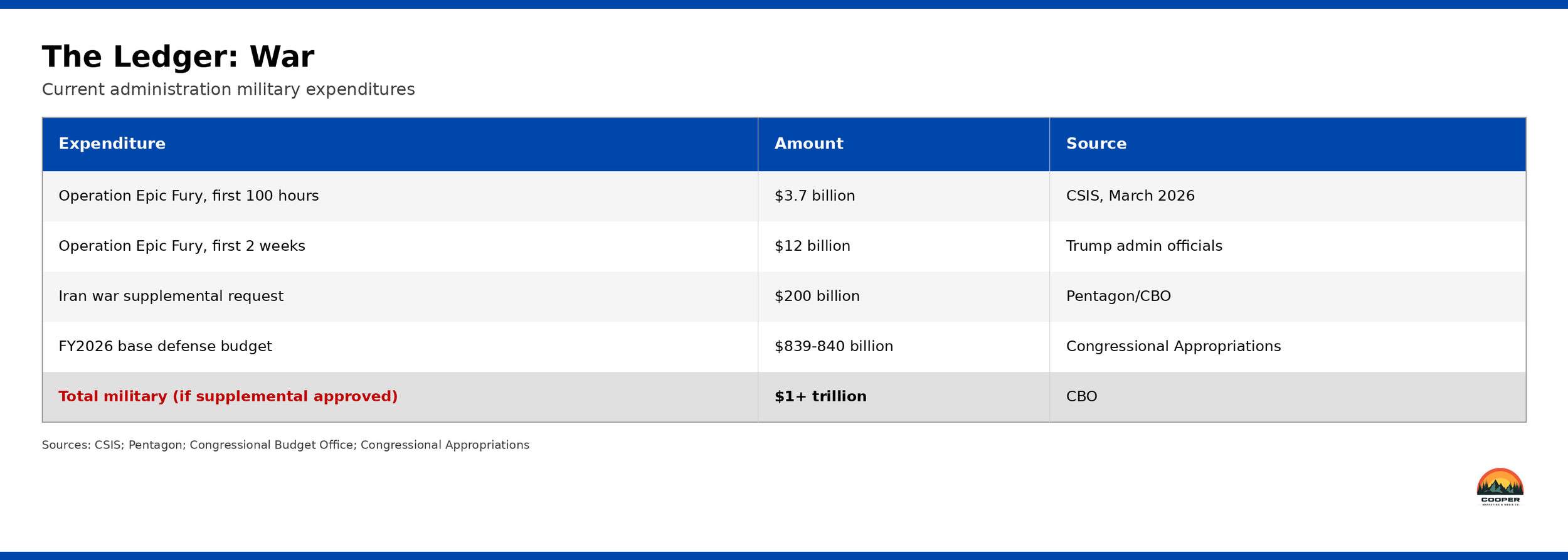
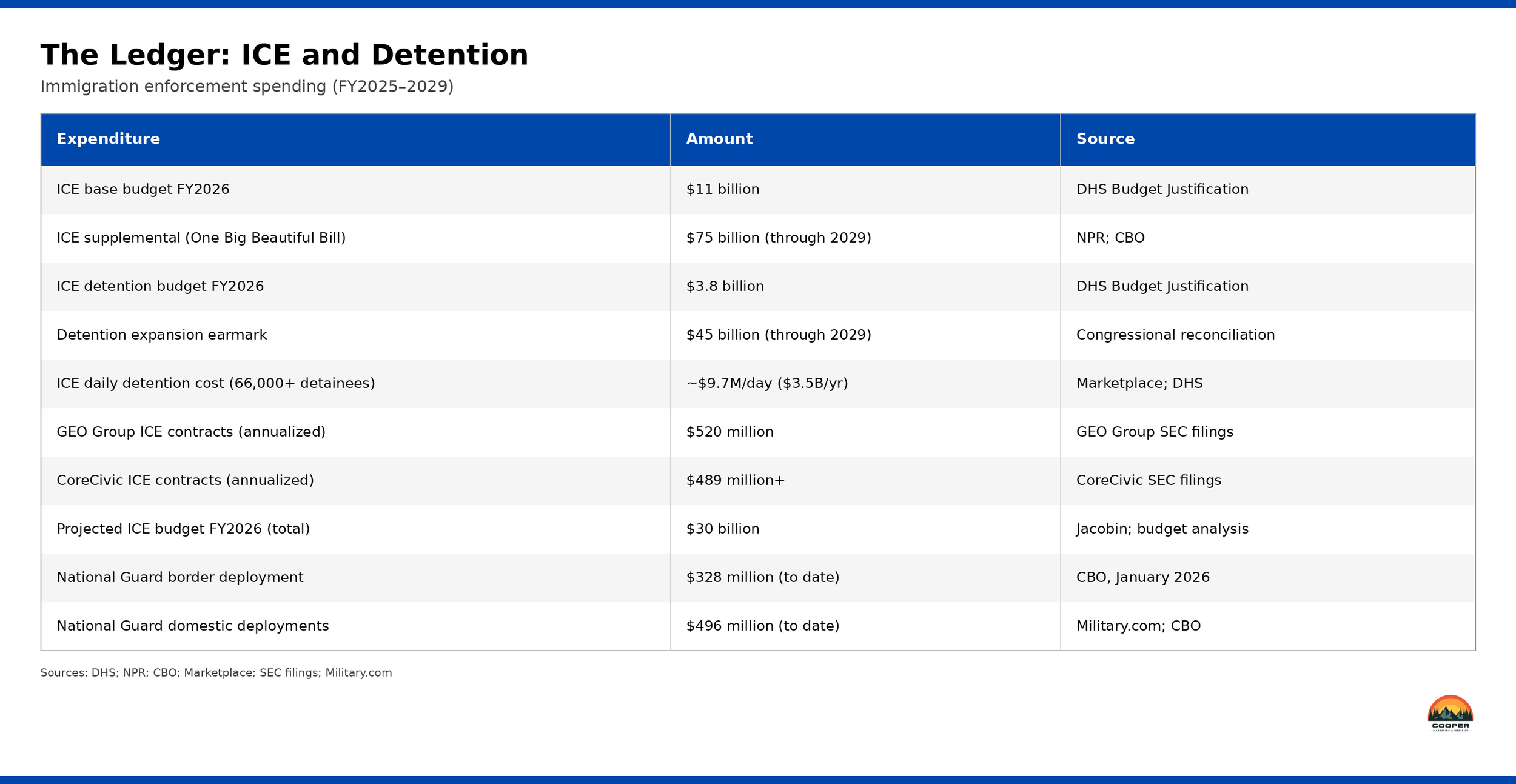
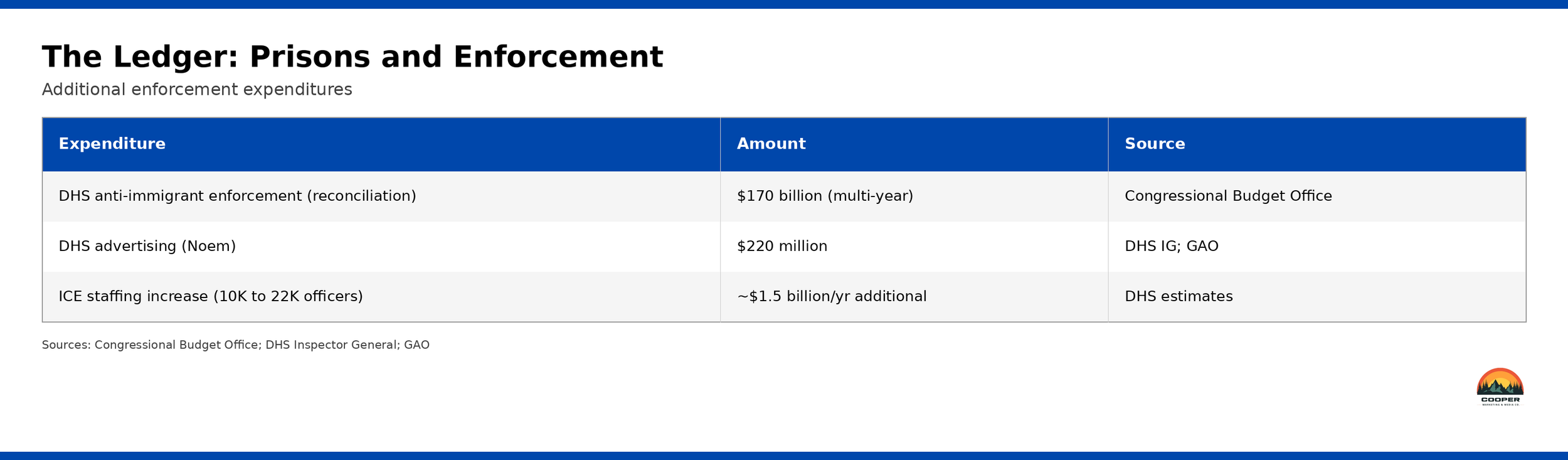
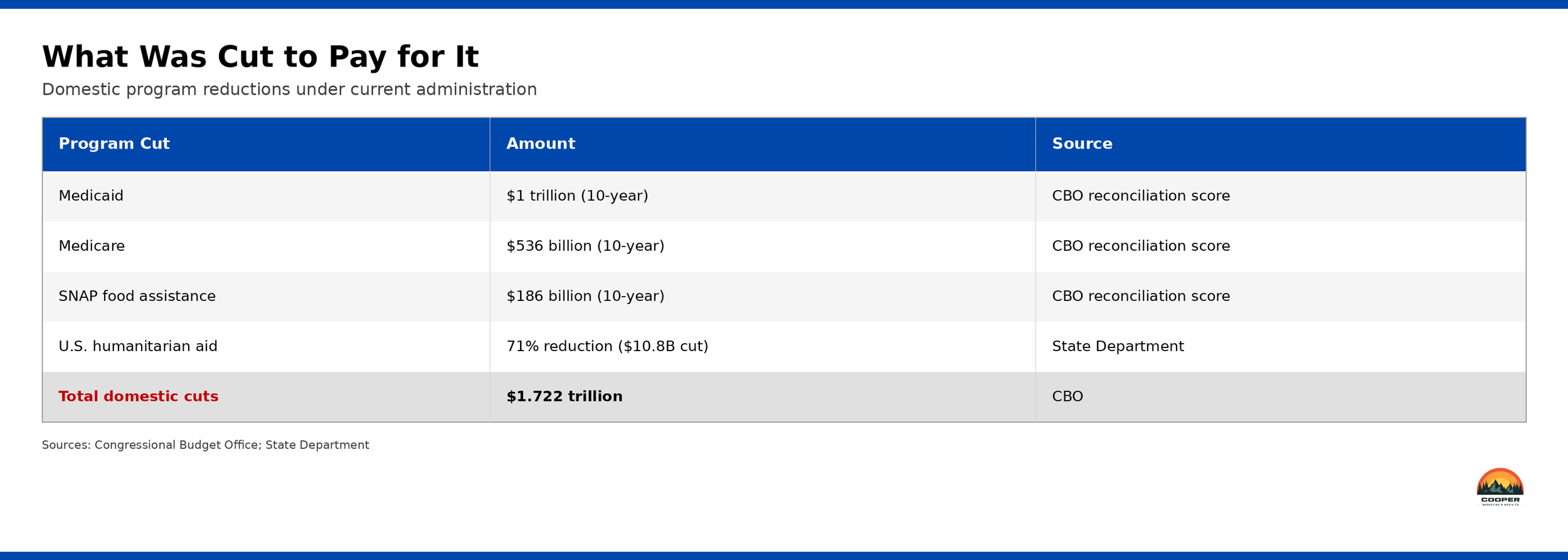
Read that ledger again. Over $1 trillion for the military in a single year. $30 billion for ICE. $170 billion for immigration enforcement. $1.722 trillion cut from healthcare and food for Americans. And the Iran war supplemental alone, $200 billion, is larger than the entire annual U.S. public education budget of $194.5 billion (Source: Newsweek, March 2026; Time, March 2026).
We are spending more to bomb Iran than we spend to educate our children. We are spending more on private prisons than on public housing. We are spending more to detain immigrants at $165 a day than it would cost to process their cases at $4.20 a day.
This is the budget of a nation that has decided its people are less important than its wars, its prisoners, and its contractors.
The Political Landscape in 2026: Pinker's Diagnosis
Steven Pinker did not write about American politics in 2026. But he wrote the operating manual for understanding exactly what has gone wrong and exactly how to fix it. Across four major works spanning three decades, Pinker laid out a framework for diagnosing democratic dysfunction that reads, in March 2026, less like academic theory and more like prophecy.
In Rationality (2021), Pinker identified the core disease: myside bias, the only cognitive bias that is independent of intelligence. Every other bias, the availability heuristic, the sunk cost fallacy, anchoring, affects smart people less than average. But myside bias actually gets worse the smarter you are, because intelligent people become more sophisticated advocates for their tribe's positions, not better evaluators of evidence. We do not reason like scientists, Pinker warned. We reason like lawyers. And the case we are arguing is always the same: my side is right.
This is the 2026 political landscape in a single diagnosis. Seventy-four million Americans voted for a man with six bankruptcies and a lifetime of documented self-dealing not because they lacked intelligence but because their intelligence was deployed in service of tribal loyalty rather than factual analysis. And now, fourteen months later, the evidence of the consequences is overwhelming, $456 billion in waste, an unauthorized war, constitutional erosion, a cabinet enriching itself, and myside bias ensures that the same intelligent people will find sophisticated reasons to defend what is indefensible. Because switching sides feels like betrayal. Because admitting you were wrong feels like losing. Because the tribal mind does not ask "what is true?" It asks "what can I say to win this argument for my team?"
In Enlightenment Now (2018), Pinker warned about the political weaponization of declinism, the belief that civilization is in steady decline and on the verge of collapse. Demagogues, he wrote, depict countries as being pulled into a hellish dystopia by malign factions that can be resisted only by a strong leader who wrenches the country backward. The nostalgia is always fraudulent. People forget how bad the past actually was because negative memories fade faster than positive ones, a cognitive bias that political operators exploit with precision. "Make America Great Again" is not a policy. It is a cognitive exploit, a weaponized nostalgia that hijacks a real psychological vulnerability to sell a product that does not exist: a return to a past that was never as good as we remember it being.
The antidote to declinism, Pinker argued, is data. And the data in 2026 is clear. The measurable indicators of American life, infrastructure quality, veteran care, healthcare access, hunger, homelessness, housing affordability, are not declining because of immigrants or because of the last administration or because of some mythical deep state. They are declining because we are choosing to spend $456 billion on war and waste instead of investment and construction. The decline is a policy choice. And policy choices can be reversed by the people who make them: voters.
In The Better Angels of Our Nature (2011), Pinker documented something remarkable: the long arc of human progress away from violence and toward cooperation, driven not by changes in human nature but by institutional design. The rule of law, democratic governance, commerce, literacy, cosmopolitanism, and reason, these are the mechanisms that reduced violence, expanded empathy, and built the cooperative societies that produce prosperity. But Pinker was careful to note that progress is not automatic. Every gain was achieved through active effort and can be reversed through institutional neglect or deliberate institutional destruction.
This is the warning that should keep every American awake in 2026. The institutions that hold a democracy together, an independent judiciary, a free press, transparent governance, legislative deliberation, congressional oversight, civilian control of the military, do not collapse because they are poorly designed. They collapse because the people operating them stop maintaining them, or worse, because the people operating them actively dismantle them for personal or factional gain. When a president launches a war without congressional authorization, that is institutional destruction. When a Congress refuses to exercise its oversight authority, that is institutional abandonment. When 13,000 lobbyists and $5 billion in influence spending replace democratic deliberation with purchased outcomes, that is institutional corruption. And when citizens respond to all of this by retreating further into tribal identity rather than demanding institutional accountability, that is the civilizing process running in reverse.
In How the Mind Works (1997), Pinker identified the evolutionary roots of tribalism: coalition membership was a survival advantage in our ancestral environment, and the instinct to prioritize in-group loyalty over objective truth is hardwired into our cognitive architecture. But this is the critical insight: hardwired does not mean inescapable. The same neural architecture that makes us tribal also enables us to override tribal impulses through deliberate, rational thought. The mechanisms that enable this override are not mysterious: peer review, fact-checking, adversarial argument, education, exposure to diverse perspectives, and institutional structures that reward accuracy over loyalty.
Every one of those mechanisms is under attack in 2026. Fact-checking is dismissed as bias. Education is defunded and politicized. Diverse perspectives are treated as threats. And the institutional structures that once rewarded accuracy, a free press, an independent judiciary, a functioning Congress, are being hollowed out by the very people we elected to maintain them.
This is where Pinker's full body of work converges into a single, actionable conclusion: the problem is not that Americans are irrational. The problem is that the institutions designed to channel our rationality toward good outcomes have been captured, corrupted, or destroyed by people who profit from bad ones. The solution is not to change human nature. It is to rebuild the institutions and replace the people who broke them.
The Military-Industrial Complex: Eisenhower's Warning, Ignored
In his farewell address on January 17, 1961, President Dwight D. Eisenhower, a five-star general who led the Allied forces in World War II, looked into a television camera and warned the American people about the growing influence of what he called the military-industrial complex. He said that the conjunction of an immense military establishment and a large arms industry was new in the American experience, and that we must guard against the acquisition of unwarranted influence by this complex, whether sought or unsought.
Sixty-five years later, we have not guarded against it. We have surrendered to it.
The top five U.S. defense contractors, Lockheed Martin, RTX (Raytheon), Northrop Grumman, Boeing Defense, and General Dynamics, reported combined revenues exceeding $250 billion in fiscal year 2025, with profit margins between 10% and 15% (Source: Annual reports and SEC filings, FY2025; Defense News Top 100 list). Every Tomahawk missile that hits a target in Iran is a $2.1 million sale for Raytheon. Every F-35 sortie is revenue for Lockheed Martin. Every dollar of that $200 billion supplemental request flows not to the troops, not to the veterans, not to the American people, but to shareholders and executives who have spent decades buying the foreign policy that keeps the money flowing.
The war is not a failure of policy. The war is the policy working exactly as designed, for the people it was designed to serve.
Eisenhower saw it coming. We ignored him. Pinker would call that a failure of institutional rationality, the inability of a society to apply its own best knowledge to its own most important decisions because the incentive structures reward the wrong behavior. The rational choice is peace and investment. But the profitable choice is war. And in America, profit wins.
A Rational Path Forward: Activate, Speak Aloud, Be American
Pinker argues that rationality is not a personality trait. It is a set of tools. And tools can be picked up by anyone at any time. The fact that we have made irrational choices does not mean we are irrational people. It means we allowed fear, tribalism, and motivated reasoning to override the better judgment we are all capable of.
The path forward is not complicated. It is just difficult because it requires us to do something Americans have become very bad at: admitting we were wrong, choosing differently, and then showing up to make it count.
November 2026. The midterms.
Every seat in the House of Representatives is on the ballot. Thirty-four Senate seats. Thirty-six governorships. Thousands of state legislative seats that determine redistricting, voting access, education policy, and the infrastructure priorities in your own backyard. This is not a spectator sport. This is the mechanism the founders built for exactly this moment: the peaceful, constitutional, rational replacement of representatives who have failed the people they serve.
Do not let the noise clutter the room. Do not let the outrage machine, the algorithm, the cable news ticker, the social media firehose of anger and despair convince you that your voice does not matter or that the system is too broken to fix. That is what they want you to believe. Every lobbyist spending $5 billion a year to purchase your government is betting that you will stay home. Every defense contractor writing $15 million checks to influence committees is betting that you will not show up. Every senator who voted to fund a war instead of funding your roads, your veterans, and your children's meals is betting that by November, you will have forgotten.
Do not forget. Do not stay home. Do not be silent. Be a C.O.O.P. — a Citizen Owning Our Politics. Because if we do not own it, someone with a checkbook will.
Apply Pinker's reverse-the-party test to every incumbent on your ballot. Not "did they say things I liked?" but "did they produce outcomes that made life measurably better for the people they represent?" Strip the jersey off. Forget the team. Look at the numbers. Look at the votes. Look at the donor lists. If your representative took $500,000 from defense contractors and voted yes on a $200 billion war supplemental while your local VA is underfunded, that is not partisan analysis. That is accounting.
Fire the ineffective. Fire the inefficient. Fire the tired establishment that has confused longevity with competence and incumbency with entitlement. It does not matter if they have a D or an R after their name. If they are not building, they are in the way. If they are funded by the lobbyist class and voting accordingly, they do not work for you. They work for their donors. And you have the constitutional right, the civic duty, and the rational obligation to replace them with someone who will.
And then 2028. The next presidential election.
Forty-seven needs to be held accountable through every legal, electoral, and constitutional mechanism available. Not through rage. Not through tribal counter-mobilization. Through the quiet, devastating power of an informed electorate that looked at the numbers, did the math, and chose to build instead of burn. Lock arms. Not as Democrats. Not as Republicans. As Americans who have decided that a great nation is not a slogan on a hat. It is a measurable outcome. And we are capable of producing it.
This is what Pinker's work ultimately teaches us: human beings are not prisoners of their biases. We built the scientific method. We split the atom. We mapped the genome. We put machines on Mars. We are capable of extraordinary rational achievement when we choose to deploy our intelligence toward truth rather than tribal victory. The same species that can solve the hardest problems in physics can solve the problem of feeding its own children, if it decides to stop making excuses for why it cannot.
Be American. Not the bumper-sticker version. Not the rally version. The real version. The version that built the interstate highway system, put a man on the moon, defeated fascism, and wrote a constitution that has held for 250 years because enough citizens in every generation chose to maintain it. Be the version of American that looks at a problem and builds a solution instead of looking for someone to blame. Be proud, not of what we have been told to be proud of, but of what we could actually become if we demanded it.
Be about the positive. Be about the possible. Be about the provable. Because the data is on our side. The math is on our side. The money is there. The engineers are there. The workforce is there. The need is screaming. And greatness, real greatness, the kind you can measure in bridges that hold and veterans who eat and children who are housed and a grid that does not fail, that greatness will follow the moment we stop accepting less.
My name is Coop. I am a veteran. I did not serve this country so that it could spend $200 billion bombing another country while 32,882 of my brothers and sisters sleep on the street. I did not swear an oath to a constitution so that the people sworn to uphold it could use it as a napkin at a $22 million Pentagon dinner party. And I did not come home from service to watch the wealthiest nation in human history choose, deliberately and repeatedly, to let its own people go hungry, go homeless, go bankrupt from a medical bill, and go without while the bombs fall and the contracts pay and the billionaires cash in.
This is our country. Not theirs. Not the lobbyists'. Not the defense contractors'. Not the pharmaceutical executives'. Not the 13,000 influence peddlers who outnumber our elected representatives 24 to 1. Ours.
We can do better than this. The numbers prove it. The money is there.
$456 billion. That is what we burned.
Now imagine what we will build when we show up in November, and in 2028, and in every election after that, and we stop imagining and start demanding.
Activate. Speak aloud. Vote. Build.
C.O.O.P. — Citizens Owning Our Politics.
That is the ask. That is the movement. That is the only thing they cannot buy, cannot spin, and cannot survive: an informed, activated citizenry that owns its government instead of renting it to the highest bidder.
Greatness will follow.
The American Reconstruction and Accountability Act: A Proposed Bill
Everything in this article has been numbered, sourced, and argued. But an argument without action is just noise. So here is the action. Below is a proposed bill written in plain language because the law belongs to the people, and they should be able to read it. This is what investment looks like on paper. This is what accountability looks like in statute. Print it. Email it. Send it to your senator. Send it to your representative. Put it in front of every lawmaker in this country and ask them a simple question: Will you sign it, or will you explain to your constituents why you will not?
I propose the following:
THE AMERICAN RECONSTRUCTION AND ACCOUNTABILITY ACT OF 2026
A Bill
To invest in the infrastructure, healthcare, housing, nutrition, energy, and national security of the United States; to reform campaign finance; to restructure immigration enforcement; to mandate a balanced federal budget; and to hold members of Congress accountable for failure to govern.
Be it enacted by the Senate and House of Representatives of the United States of America in Congress assembled,
TITLE I — INFRASTRUCTURE INVESTMENT
Sec. 101. National Bridge Safety Program.
There is authorized to be appropriated $100 billion over ten years to the Department of Transportation for the repair, rehabilitation, or replacement of every structurally deficient bridge in the United States. The Secretary of Transportation shall prioritize bridges rated in "poor" condition by the National Bridge Inventory and shall submit an annual progress report to Congress. No funds under this section may be used for administrative overhead exceeding 5% of total appropriation.
Sec. 102. Clean Water Infrastructure.
There is authorized to be appropriated $75 billion over ten years to the Environmental Protection Agency for the modernization of drinking water and wastewater infrastructure, with priority given to communities with lead service lines, systems older than 50 years, and communities with documented contamination. Funds shall be distributed through the State Revolving Fund with a requirement that 40% of funds be directed to disadvantaged communities.
Sec. 103. National High-Speed Rail Initiative.
There is authorized to be appropriated $150 billion over fifteen years to the Federal Railroad Administration for the development of high-speed passenger rail corridors, including the Northeast Corridor (Boston-New York-Washington), the Texas Triangle (Houston-Dallas-San Antonio), and the Cascadia Corridor (Portland-Seattle-Vancouver). The Secretary of Transportation shall conduct a feasibility study for additional corridors within 18 months of enactment and shall submit recommendations for a national rail plan to Congress.
Sec. 104. Broadband for All.
There is authorized to be appropriated $50 billion over five years to the National Telecommunications and Information Administration to complete the deployment of high-speed broadband internet to every American community, with particular emphasis on rural, tribal, and underserved areas. No funds may be used to subsidize any provider that has failed to deliver on prior federal broadband commitments.
TITLE II — ENERGY AND GRID MODERNIZATION
Sec. 201. Grid Modernization and Resilience Program.
There is authorized to be appropriated $200 billion over ten years to the Department of Energy for the modernization of the national electrical grid, including high-voltage transmission line expansion, substation hardening, next-generation battery storage deployment, and grid interconnection between regional transmission organizations. Not less than 30% of funds shall be directed toward grid resilience in communities that have experienced major weather-related outages in the preceding five years.
Sec. 202. Diversified Energy Portfolio Fund.
There is authorized to be appropriated $50 billion over ten years to support a diversified energy strategy, including: (a) construction of natural gas combined-cycle plants to serve as bridge capacity during renewable transition; (b) retooling of legacy manufacturing facilities for clean energy component production; (c) carbon capture research and pilot programs; (d) expansion of solar, wind, and geothermal generation capacity. The Secretary of Energy shall ensure that no single energy source receives more than 35% of total fund allocation.
TITLE III — VETERANS
Sec. 301. Veterans Healthcare Full Funding Act.
The Department of Veterans Affairs shall be funded at no less than 100% of its independently assessed need, as determined by the VA Office of the Inspector General and the Government Accountability Office, beginning in fiscal year 2027 and in every fiscal year thereafter. The current funding shortfall of approximately $12 billion shall be eliminated no later than September 30, 2027.
Sec. 302. Zero Veteran Homelessness Initiative.
There is authorized to be appropriated $5 billion over five years to the Department of Veterans Affairs and the Department of Housing and Urban Development for transitional and permanent supportive housing for homeless veterans, including mental health services, substance abuse treatment, and job training. The Secretaries of VA and HUD shall jointly submit an annual report to Congress documenting the number of homeless veterans and progress toward the goal of zero veteran homelessness by 2031.
Sec. 303. Veteran Food Security Program.
There is authorized to be appropriated $2 billion over five years to eliminate food insecurity among veteran families through direct nutritional assistance, expansion of VA food pantry programs, and coordination with the Department of Agriculture to ensure veteran families receive priority enrollment in federal nutrition programs.
TITLE IV — HOUSING AND HOMELESSNESS
Sec. 401. National Housing Construction Program.
There is authorized to be appropriated $100 billion over ten years to the Department of Housing and Urban Development for the construction of affordable housing units, with a goal of closing no less than 50% of the national affordable housing shortage of 3.78 million units within the authorization period. Funds shall be distributed through competitive grants to state housing finance agencies and nonprofit housing developers. No funds may be awarded to any entity that has been found in violation of fair housing law.
Sec. 402. End Homelessness Initiative.
There is authorized to be appropriated $25 billion over five years to fund permanent supportive housing, mental health services, substance abuse treatment, and rapid rehousing programs, with the goal of reducing the national homeless population by 75% within five years of enactment.
TITLE V — NUTRITION AND HUNGER
Sec. 501. American Hunger Elimination Act.
There is authorized to be appropriated $30 billion per year, adjusted for inflation, for the Supplemental Nutrition Assistance Program. No reduction in SNAP benefits or eligibility enacted in the 119th Congress shall remain in effect after the date of enactment of this Act. The Secretary of Agriculture shall restore benefits to all individuals removed from SNAP under the FY2026 reconciliation and shall expand eligibility to ensure that no American household falls below the USDA's "food secure" threshold.
Sec. 502. Universal School Meals.
There is authorized to be appropriated $15 billion per year to provide free breakfast and lunch to every student enrolled in a public school in the United States, regardless of household income. No child shall be denied a meal, publicly identified as unable to pay, or have a "meal debt" recorded.
TITLE VI — HEALTHCARE
Sec. 601. Universal Healthcare Transition Fund.
There is authorized to be appropriated $200 billion over five years to the Department of Health and Human Services to plan, design, and begin implementation of a universal healthcare system for the United States. The Secretary shall submit a comprehensive transition plan to Congress within 18 months of enactment, including: (a) timeline for universal enrollment; (b) administrative cost reduction targets; (c) provider reimbursement schedules; (d) prescription drug pricing reform; (e) workforce expansion plan for physicians, nurses, and community health workers. No funds appropriated under this section may be used to reduce coverage for any individual currently enrolled in Medicare, Medicaid, or the Children's Health Insurance Program.
Sec. 602. Medicaid and Medicare Restoration.
All reductions to Medicaid and Medicare enacted in the FY2026 reconciliation are hereby repealed. Funding for both programs shall be restored to pre-reconciliation levels, adjusted for inflation.
Sec. 603. Rural Hospital Stabilization Fund.
There is authorized to be appropriated $10 billion over five years to prevent rural hospital closures, fund emergency department operations, and expand community health center capacity in medically underserved areas.
TITLE VII — CAMPAIGN FINANCE REFORM
Sec. 701. Industry Accountability Contribution Act.
(a) No corporation, trade association, political action committee, or individual acting on behalf of the firearms industry, the pharmaceutical and health products industry, or the alcohol, tobacco, or cannabis industries shall make any contribution, donation, independent expenditure, or transfer of funds to any candidate for federal office, political party, super PAC, 501(c)(4) organization engaged in political activity, or inaugural committee.
(b) All funds that would otherwise be directed to political activity under subsection (a) shall instead be deposited into the applicable Public Benefit Trust Fund established under this section:
(1) The Gun Violence Victims Trust Fund, a 501(c)(3) administered by the Department of Justice, Office for Victims of Crime, to provide direct financial assistance, medical care, mental health treatment, funeral expenses, rehabilitation, and educational support to individuals and families affected by gun violence.
(2) The Cures and Treatment Trust Fund, a 501(c)(3) administered by the National Institutes of Health, to fund research and treatment for cancer, Alzheimer's disease, multiple sclerosis, opioid use disorder, and other diseases identified by the NIH Director as underfunded relative to their burden on the American population.
(3) The Treatment and Education Trust Fund, a 501(c)(3) administered by SAMHSA, to fund substance abuse treatment centers, addiction recovery programs, and evidence-based prevention education in schools and communities.
(c) Not less than 15% of each Trust Fund shall be allocated annually to state and local law enforcement agencies and emergency medical services for costs directly associated with responding to gun violence, drug overdoses, and alcohol- or tobacco-related emergencies.
(d) Any entity found in violation of this section shall be subject to a fine of not less than ten times the amount of the prohibited contribution, with disgorgement of all related profits.
TITLE VIII — IMMIGRATION ENFORCEMENT REFORM
Sec. 801. Border Security Full Funding Act.
There is authorized to be appropriated $25 billion per year to U.S. Customs and Border Protection for border security operations, including personnel, technology, infrastructure, and port-of-entry modernization. Staffing shall be increased to no fewer than 25,000 Border Patrol agents.
Sec. 802. Immigration Court Modernization.
There is authorized to be appropriated $5 billion per year to the Executive Office for Immigration Review to hire no fewer than 1,500 additional immigration judges and support staff, with the goal of reducing the immigration court backlog to under 500,000 cases within five years.
Sec. 803. ICE Restructuring and Accountability Act.
(a) The U.S. Immigration and Customs Enforcement agency is hereby dissolved and reconstituted as the Immigration Compliance Division (ICD) within the Department of Homeland Security.
(b) The ICD shall operate under the following requirements:
(1) All enforcement actions shall require individualized probable cause and comply with the Fourth Amendment;
(2) No officer of the ICD shall use race, ethnicity, national origin, or language as a factor in determining reasonable suspicion or probable cause;
(3) No detention facility operated or contracted by the ICD shall be operated by a for-profit entity. All existing contracts with for-profit detention operators, including but not limited to GEO Group and CoreCivic, shall be terminated within 24 months of enactment;
(4) Every individual in ICD custody shall have access to medical care within 24 hours of intake and legal counsel within 48 hours;
(5) The ICD Inspector General shall publish quarterly reports on all deaths, injuries, and use-of-force incidents in custody, and shall refer any death in custody for independent investigation.
(c) The ICD shall prioritize Alternatives to Detention for all individuals who do not pose a demonstrated flight risk or public safety threat.
(d) No funds appropriated to the ICD may be used for mass deportation operations targeting individuals with no criminal record.
Sec. 804. For-Profit Detention Ban.
(a) No federal agency may contract with any for-profit corporation for the detention of any person. (b) All existing for-profit detention contracts shall be transitioned to government-operated or nonprofit-operated facilities within 24 months. (c) No entity that has operated a for-profit detention facility may contribute to any candidate for federal office for a period of ten years following the termination of its federal contracts.
TITLE IX — BALANCED BUDGET AND CONGRESSIONAL ACCOUNTABILITY
Sec. 901. Balanced Budget Mandate.
(a) Beginning in fiscal year 2028, the Congress of the United States shall pass a balanced federal budget, defined as a budget in which total outlays do not exceed total revenues, before the start of each fiscal year (October 1). (b) No budget bill shall include any rider, provision, or amendment unrelated to the revenue and expenditure provisions of the budget. (c) No budget bill shall include any provision that was not subject to committee hearing, public comment, and a minimum 72-hour review period before floor vote.
Sec. 902. Congressional Accountability Enforcement.
(a) If the Congress fails to pass a balanced budget by October 1 of any fiscal year:
(1) All pay for members of the Senate and House of Representatives shall be suspended effective October 2. No salary, per diem, or expense reimbursement shall be disbursed to any member until a balanced budget is enacted.
(2) All benefits, including healthcare coverage, retirement contributions, and travel allowances, for members of the Senate and House of Representatives shall be suspended effective October 2.
(3) Both chambers shall remain in continuous session in Washington, D.C. No recess, adjournment, or district work period shall be permitted until a balanced budget is passed. Members shall be present on the floor or in committee for no fewer than 10 hours per day, six days per week, until the budget is enacted.
(4) No member of Congress may engage in any campaign activity, fundraising event, or paid public appearance during any period in which the balanced budget mandate under Sec. 901 has not been met.
(b) This section shall not be construed to reduce the pay or benefits of Congressional staff, Capitol Police, or any other federal employee who is not a member of Congress.
(c) The provisions of the 27th Amendment notwithstanding, this section shall take immediate effect upon enactment, as it addresses the suspension, not the alteration, of pay contingent upon performance of constitutional duty.
Sec. 903. Transition Period.
For fiscal years 2027 and 2028, the deficit shall not exceed 2% of projected GDP. For fiscal year 2029 and each year thereafter, the budget shall be fully balanced. The Congressional Budget Office shall certify compliance and shall publish its determination no later than 30 days before the start of each fiscal year.
TITLE X — FUNDING
Sec. 1001. Revenue Sources.
The provisions of this Act shall be funded through:
(a) Reallocation of funds from terminated for-profit detention contracts (estimated savings: $3-5 billion per year);
(b) Redirection of Industry Accountability contributions to Public Benefit Trust Funds under Title VII;
(c) Defense spending reduction of 10% over five years, with savings redirected to Titles I-VI;
(d) Closure of carried interest tax loophole (estimated revenue: $18 billion over ten years);
(e) Establishment of a financial transaction tax of 0.1% on stock, bond, and derivative trades (estimated revenue: $800 billion over ten years);
(f) Repeal of the corporate tax rate reduction enacted in the Tax Cuts and Jobs Act of 2017, restoring the corporate rate to 28% (estimated revenue: $1.3 trillion over ten years);
(g) Any additional revenue identified by the Congressional Budget Office as necessary to achieve budget balance under Title IX.
Sec. 1002. No Hidden Agendas Clause.
No provision of any appropriations bill, continuing resolution, or reconciliation bill funding the provisions of this Act shall include any rider, earmark, or amendment unrelated to the specific title and section it funds. Any such provision is hereby declared void and unenforceable.
TITLE XI — SEVERABILITY AND ENACTMENT
Sec. 1101. If any provision of this Act is held to be unconstitutional, the remainder of the Act shall continue in full force and effect.
Sec. 1102. This Act shall take effect on the date of enactment, except where a specific later effective date is provided.
This proposed legislation is submitted to the American people for consideration. It is not affiliated with any political party. It is not written by a lobbyist. It was not funded by a PAC. It was written by Coop, a citizen, a veteran, and a taxpayer who read the numbers, did the math, and decided that the richest nation in the history of the world can do better than letting its veterans starve, its bridges collapse, its children go hungry, and its Congress get paid while doing nothing about any of it.
Print it. Share it. Send it to your senator. Send it to your representative. Put it in front of every person running for office in November 2026 and in 2028. Ask them one question: Will you vote for this, or will you explain why you won't?
If they won't sign it, replace them with someone who will.
Sources
• Congressional Budget Office, FY2026 Budget and Economic Outlook, March 2026
• Department of Defense, Operation Epic Fury operational cost estimates, March 2026
• Congressional Research Service, "Costs of Military Operations," updated March 2026
• DHS Inspector General, preliminary review of advertising expenditures, February 2026
• Government Accountability Office, DHS spending analysis, 2026
• The Washington Post, "Pentagon food spending surges under Hegseth," February 2026
• DOD Inspector General Report, Q1 2026 procurement review
• FBI Inspector General referral, Patel travel expenditures, January 2026
• Treasury Department Monthly Treasury Statement, February 2026
• Congressional Budget Office Monthly Budget Review, February 2026
• American Society of Civil Engineers, 2025 Infrastructure Report Card
• EPA Drinking Water Infrastructure Needs Survey, 2023
• Congressional Budget Office, Infrastructure Investment and Jobs Act score, 2021
• Department of Energy, Grid Modernization Initiative reports, 2025
• Edison Electric Institute, capital expenditure projections, 2025
• Lawrence Berkeley National Laboratory, "Interruption Cost Estimate Calculator," 2024
• EIA, power plant construction cost estimates, 2025
• California High-Speed Rail Authority, 2024 Business Plan
• Reshoring Initiative, 2025 Data Report
• National Telecommunications and Information Administration, BEAD program status, January 2026
• HUD, Annual Homeless Assessment Report to Congress, 2025
• VA Budget Submission, FY2026
• Veterans of Foreign Wars, legislative testimony, February 2026
• Feeding America, "Veteran Hunger in America," 2025
• HUD, Point-in-Time Count, 2025
• National Alliance to End Homelessness, "The State of Homelessness in America," 2025
• National Low Income Housing Coalition, "The Gap" report, 2025
• Harvard Joint Center for Housing Studies, affordable housing cost analysis, 2024
• USDA Economic Research Service, "Household Food Security in the United States," 2025
• Feeding America, "Map the Meal Gap," 2025
• Congressional Budget Office, FY2026 reconciliation bill SNAP score, 2026
• The Lancet, "Improving the prognosis of health care in the USA," February 2020
• Political Economy Research Institute, "Economic Analysis of Medicare for All," 2018
• Congressional Budget Office, single-payer healthcare analysis, 2020
• Office of Management and Budget, FY2026 Budget Proposal
• New England Journal of Medicine, "Administrative Costs in U.S. Health Care," 2020
• Chartis Center for Rural Health, hospital closure tracking, 2025
• Defense News, Top 100 defense contractors, FY2025
• Lockheed Martin, RTX, Northrop Grumman, Boeing, General Dynamics annual reports and SEC filings, FY2025
• Steven Pinker, Rationality: What It Is, Why It Seems Scarce, Why It Matters (Viking, 2021)
• Dwight D. Eisenhower, Farewell Address, January 17, 1961
• OpenSecrets, "Lobbying Data Summary," 2024
• OpenSecrets, Federal Lobbying Trends, 2025
• OpenSecrets, Industry Lobbying Data (Pharmaceuticals/Health Products), 2025
• OpenSecrets, Lockheed Martin lobbying profile, 2025
• Quincy Institute, "Profits of War: Top Beneficiaries of Pentagon Spending 2020-2024"
• Inside Climate News, "Energy Sector Lobbying Spending," September 2025
• Oil Change International, Fossil Fuel Lobbying Analysis, 2025
• Government Accountability Office, Senior Official Employment by Defense Contractors, 2021
• Project on Government Oversight (POGO), "Brass Parachutes," 2023
• Truthout, "Over 500 Former Government Officials Now Lobbying for Defense Contractors," 2024
• OpenSecrets, Defense Industry Contributions, 2024 Election Cycle
• Steven Pinker, Enlightenment Now: The Case for Reason, Science, Humanism, and Progress (Viking, 2018)
• Steven Pinker, The Better Angels of Our Nature: Why Violence Has Declined (Viking, 2011)
• Steven Pinker, How the Mind Works (W.W. Norton, 1997)
• Watson Institute for International and Public Affairs, Brown University, "Costs of War" Project, 2021-2024
• Congressional Research Service, "Costs of Military Operations in Bosnia and Kosovo," RL32282
• U.S. Air Force Historical Records, Operation Desert Fox, 1998
• Congressional Budget Office, Iraq War Cost Estimates, 2003-2017
• U.S. Treasury Department, Historical Debt Outstanding Data
• Responsible Statecraft, "Top Defense Firms See $2T Return on $1B Investment," September 2021
• Council on Foreign Relations, "Obama's Final Drone Strike Data," 2017
• Center for American Progress, "Trump's Defense Budget," 2019
• PBS News, "Trump Signs $700 Billion Military Budget Into Law," 2017
• U.S. Department of State, "U.S. Security Cooperation with Ukraine," January 2025
• Congressional Research Service, Ukraine Military Aid Analysis, 2025
• Brown University, "Job Opportunity Cost of War," May 2017
• OpenSecrets, Gun Rights Industry Lobbying Profile, 2014-2024
• OpenSecrets, NRA Federal Lobbying and Campaign Contributions Profile, 2024
• CDC National Center for Health Statistics, Firearm Mortality Data, 2023
• Pew Research Center, "What the Data Says About Gun Deaths in the U.S.," March 2025
• Everytown Research & Policy, "The Economic Cost of Gun Violence," 2024
• Office for Victims of Crime, 2024 Crime Victims Fund Allocations
• OpenSecrets, Pharmaceuticals/Health Products Industry Lobbying Profile, 2024
• OpenSecrets, PhRMA Lobbying Profile, 2024
• JAMA Internal Medicine, "Lobbying Expenditures and Campaign Contributions by the Pharmaceutical and Health Product Industry," 2020
• Accountable.US, "PhRMA Company R&D Spending Pales in Comparison to Other Priorities," 2024
• National Cancer Institute, FY2024 Budget Information
• American Cancer Society, Cancer Facts & Figures, 2024
• NIH National Institute on Aging, Alzheimer's Research Funding, 2024
• Alzheimer's Association, "2024 Alzheimer's Disease Facts and Figures"
• CDMRP, Multiple Sclerosis Research Program; National MS Society Research Funding
• White House Council of Economic Advisers, "The Staggering Cost of the Illicit Opioid Epidemic," March 2025
• GAO, "Opioid Use Disorder: Efforts to Expand Access to Medication-Based Treatment," 2025
• OpenSecrets, Beer, Wine & Liquor Industry Lobbying Profile, 2024
• Action on Smoking & Health, "Tobacco Industry Expands Lobbying in 2024"
• OpenSecrets, Cannabis Industry Lobbying Profile, 2024
• CDC, "Economic Trends in Tobacco," 2024
• NIAAA, "Economic Burden of Alcohol Misuse in the United States"
• SAMHSA, National Survey on Drug Use and Health; FY2024 Budget Justification
• Urban Institute, Criminal Justice Expenditures, 2024
• CDC, EMS Community Paramedicine Disparities Data
• American Democracy Minute, "2024 Election Cycle Spending Analysis," January 2025
• Brennan Center for Justice, "Dark Money Hit Record High in 2024 Federal Races"
• OpenSecrets, "Federal Lobbying Set New Record in 2024," February 2025
• OpenSecrets, Pharmaceuticals/Health Products Industry Recipients, 2024 Election Cycle
• KFF Health News, "Pharma Cash to Congress," 2025
• Deseret News, "Pharma Funding Politicians," January 2025
• OpenSecrets, Defense Industry Recipients, 2024 Election Cycle
• Responsible Statecraft, "Defense Contractors vs. Congress Voting Patterns," 2024
• Congress.gov, Roll Call Vote, H.R. 1 ("One Big Beautiful Bill Act"), May 2025
• NPR, "Senate Budget Resolution Vote," April 2025
• Committee for a Responsible Federal Budget, "2025 Reconciliation Tracker"
• Al Jazeera, "Trump's Big Beautiful Bill Passes Senate," July 2025
• Citizens for Responsibility and Ethics in Washington, "Trump Budget Benefits Private Detention Companies"
• In These Times, "ICE-Cold Cash: Private Prison Contributions to Congress"
• Congressional Research Service, "Comparing DHS Component Funding, FY2025," R48115
• DHS FY2026 Congressional Budget Justification
• NPR, "How ICE Became the Highest-Funded U.S. Law Enforcement Agency," January 2026
• Jacobin, "ICE's Budget Is Set to Triple Next Year," July 2025
• Common Dreams, "GEO Group Records $254 Million Profit," 2026
• GEO Group and CoreCivic SEC Filings, FY2025
• The Marshall Project, "Why GEO and CoreCivic Stock Fell in 2025," January 2026
• Marketplace, "What Is the Daily Cost of Detaining Someone Arrested by ICE," July 2025
• American Immigration Council, "ICE Detention Deaths 2025-2026"
• NPR, "Supreme Court Clears Way for ICE Racial Profiling," September 2025
• CIS, "Immigration Court Backlog Finally Falls," 2025
• Military.com, "National Guard Deployments Cost Almost $600M," January 2026
• Congressional Budget Office, "Troop Deployments" Cost Analysis, January 2026
• CSIS, "The $3.7 Billion Cost of Epic Fury's First 100 Hours," March 2026
• Newsweek, "Trump's Iran War Budget Bigger Than Public Education," March 2026
• Time, "What U.S. Spending on Iran War Could Fund Instead," March 2026
• Brennan Center for Justice, "Private Prison Companies' Enormous Windfall," 2025
Cooper Marketing & Media | coopermarketing.org | March 2026