The Federal Workers Accountability Act
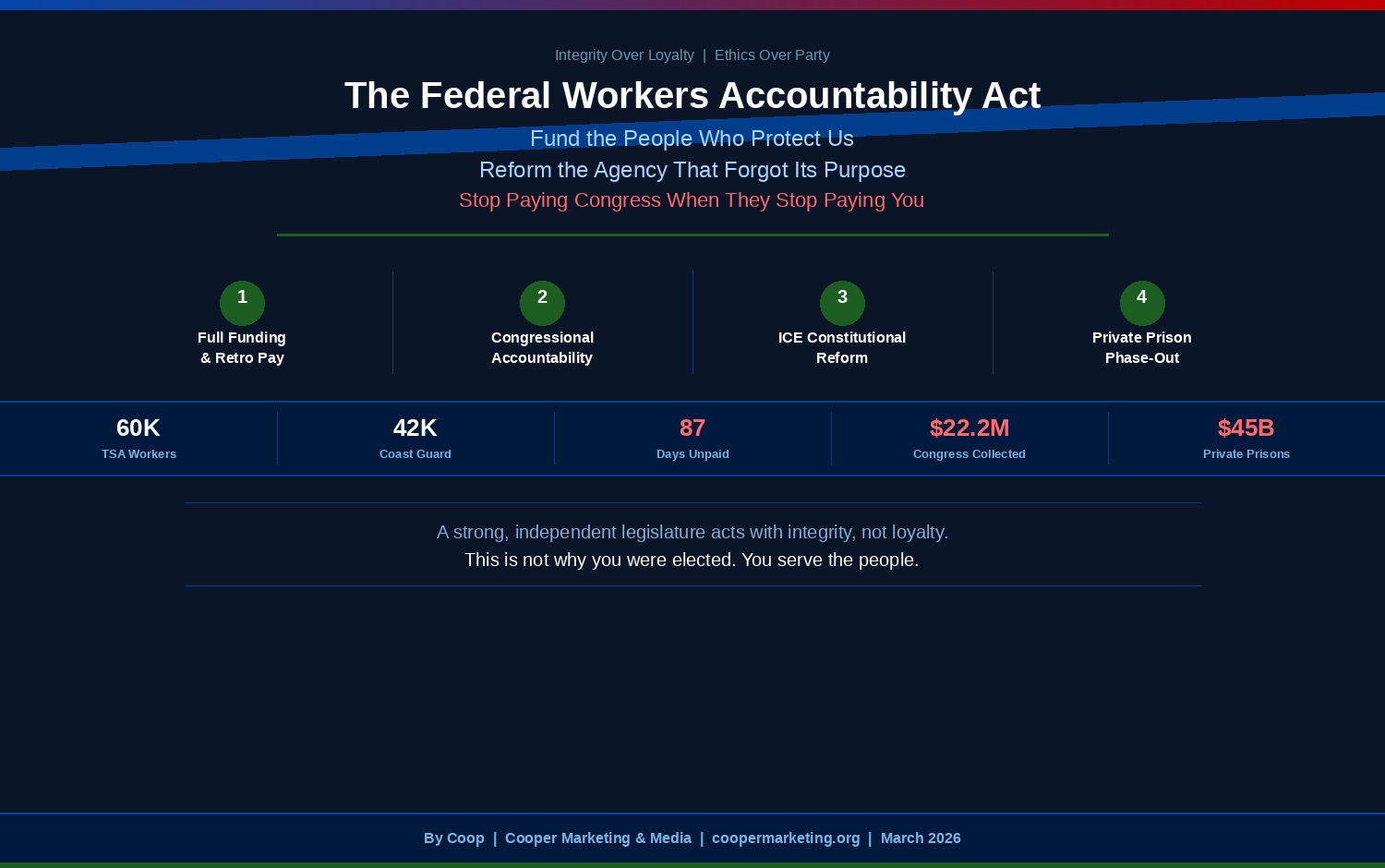
Fund the People Who Protect Us. Reform the Agency That Forgot Its Purpose.
Stop Paying Congress When They Stop Paying You.
What We Elected Them For
Every member of the United States House and Senate takes the same oath. They swear to support and defend the Constitution. Not their party. Not their donors. Not their reelection prospects. The Constitution.
That oath is not a formality. It is a covenant between the people who govern and the people who are governed. It carries two obligations that should be non-negotiable for anyone who claims to serve in a democratic republic: integrity and ethics.
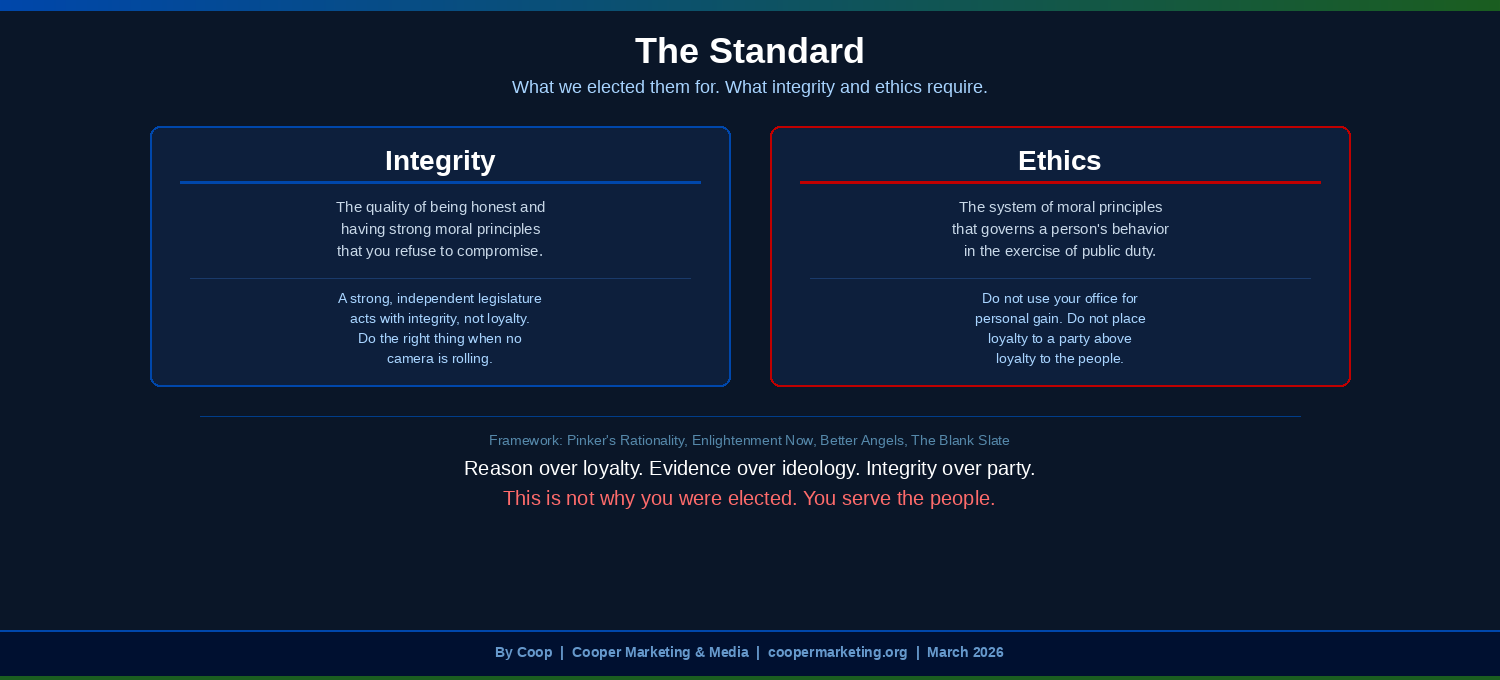
Integrity is the quality of being honest and having strong moral principles that you refuse to compromise. In the context of a legislator, it means doing the right thing when no camera is rolling, when no lobbyist is watching, when no constituent is tracking your vote. It means that your public statements and your private actions point in the same direction. It means that when 60,000 TSA officers go unpaid, you do not board a transatlantic flight to a security conference. A strong and independent legislative branch acts with integrity, not loyalty.
Ethics is the system of moral principles that governs a person's behavior. Congressional ethics are codified in the rules of both chambers: do not use your office for personal gain, do not accept gifts that compromise your judgment, do not place loyalty to a party above loyalty to the people. These are not abstract ideals. They are the published, written standards that every member agrees to uphold. The question this article asks is simple: are they upholding them?
A legislature that operates with integrity does not allow 102,000 federal workers to go unpaid while its members collect guaranteed salaries. A legislature that operates ethically does not accept lobbying dollars from the same private prison companies it funds with $45 billion in taxpayer money. A legislature that is truly independent does not take orders from the Executive Branch, or from donors, or from party leadership at the expense of the people it swore to serve.
That is the standard. Everything that follows measures our current Congress against it.
A Note on the Framework
I want to be transparent about how I process information, because I think it matters. Steven Pinker's work on rational thought shaped the way I approach policy. His concept of myside bias, the tendency we all have to evaluate evidence like a lawyer defending a client rather than a scientist testing a hypothesis, is something I actively work against in everything I write. His four pillars from Enlightenment Now (reason, science, humanism, and progress) are the standard I measure policy against. Not ideology. Not party loyalty. Measurable improvement in human outcomes.
If you want to go deeper, the books are Rationality (2021), Enlightenment Now (2018), The Better Angels of Our Nature (2011), and The Blank Slate (2002). They will not tell you what to think. They will change how you think. And that distinction matters more than any single policy position in this article.
If you are a Democrat reading this, your instinct will be to defend the left when I criticize it. If you are a Republican, you will defend the right. If you are wearing the MAGA label, that instinct will fire early and often. Notice it. That instinct is not evidence that I am wrong. It is evidence that your brain is doing what brains do. The question is whether you let loyalty decide for you or let integrity and evidence lead.
My Bias, Stated Plainly
I am going to name my biases before I name the bad actors, because that is the standard I set in everything I write.
I believe the people who do the work should get paid for doing it. Period. I believe that if you vote to fund a war but not the Coast Guard, your priorities are broken. I believe that private corporations should not profit from caging human beings. And I believe that any agency carrying a badge and a gun on American soil should answer to the Constitution, not to a political agenda.
Those are my priors. They lean libertarian on civil liberties, progressive on worker protections, and conservative on fiscal accountability. They do not fit neatly into any party. That is the point.
If you are looking for someone who will only criticize the other team, I am not your guy. Both sides built this mess. Both sides profit from it. And both sides have failed the people they swore to serve.
PART I: THE TSA
60,000 Workers. Zero Guarantees.
The Transportation Security Administration employs approximately 60,000 people. Roughly 50,000 of them are Transportation Security Officers, the frontline workers who screen 2.5 million passengers every single day. They are the largest federal law enforcement workforce in the country.
And for most of the agency's existence, they have been treated as disposable.
The Pay Problem
TSA officers started with a base salary as low as $34,454 at Band D, Step 1. For years, they were excluded from the General Schedule pay system that covers nearly every other federal employee. They had limited collective bargaining rights. Their turnover rate was catastrophic.
In July 2023, DHS implemented a new compensation plan aligning TSA with the federal GS scale. In May 2024, TSA and AFGE reached a historic seven-year collective bargaining agreement. The average pay increase was 31%. Attrition dropped by 7.3%. Job applications surged past 328,000 in 2024. For the first time, TSA was becoming a career, not a rest stop.
Then came the shutdowns.
The Shutdown Tax
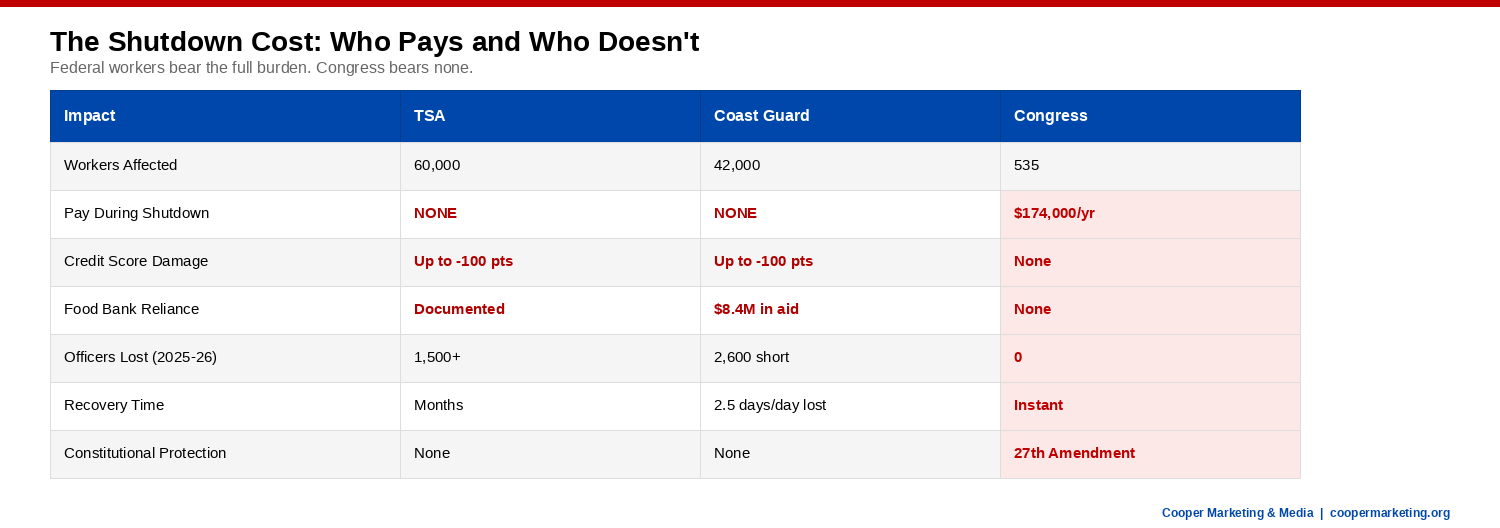
During the 2018-2019 shutdown, 35 days, the longest in American history, TSA officers worked without pay. Unscheduled absences climbed to nearly 10% on some days. Officers could not pay rent. Could not buy groceries. Could not make car payments. They showed up anyway, because that is what the job requires.
In November 2025, a 43-day shutdown cost TSA more than 1,100 officers who simply quit. A brief shutdown in late January 2026 hit again. Then, on February 14, 2026, the current DHS shutdown began. As of this writing, it has exceeded 40 days. More than 400 additional officers have resigned since it started.
These are not abstract numbers. These are people who chose to serve and were punished for it by the institution they serve.
The Credit Score Scar
Here is what nobody in Congress talks about: the long-term financial damage. Missing even one payment can drop a credit score by up to 100 points. Recovery takes years. During shutdowns, federal workers face mortgage denials, loan application rejections, and increased borrowing costs that follow them long after the back pay arrives.
Congress passed the Government Employee Fair Treatment Act in 2019, guaranteeing back pay after shutdowns. But back pay does not fix the late payment that has already hit your credit report. Back pay does not cover the overdraft fees, the late charges, or the interest that compounded while Congress was arguing about a wall.
This framework proposes a complete credit remediation program: mandatory reporting to all three credit bureaus that any negative marks incurred during a funding lapse are to be removed, permanently, within 30 days of funding restoration.
PART II: THE U.S. COAST GUARD
The Only Military Branch That Goes Unpaid
The United States Coast Guard is a branch of the armed forces. Its members deploy overseas. They conduct search and rescue operations. They interdict drug shipments. They patrol active combat zones alongside Navy and Marine Corps personnel.
But because the Coast Guard falls under the Department of Homeland Security rather than the Department of Defense, its funding is subject to DHS appropriations. When DHS shuts down, the Coast Guard stops getting paid. The Army does not. The Navy does not. The Air Force does not. The Marines do not. Only the Coast Guard.
Let that settle in. We have a military branch where members in active service, performing the same missions as DoD personnel, go unpaid because of a bureaucratic org chart.
The 2018-2019 Betrayal
During the 35-day shutdown, 42,000 Coast Guard members worked without pay. The Coast Guard Mutual Assistance program delivered $8.4 million in emergency aid to more than 6,200 members and families. Service members stationed overseas, in combat zones, watched their DoD counterparts receive regular paychecks while their own bank accounts hit zero.
Coast Guard families went to food banks. Active duty military families in the United States of America stood in line for free groceries because Congress could not do its job.
March 2026: It Is Happening Again
The current DHS shutdown, now past 40 days, has left the Coast Guard unable to pay more than 5,000 utility accounts. Critical infrastructure faces utility shutoffs. The service has accumulated over $200 million in unpaid bills to contractors and vendors. A processing backlog of 16,000+ merchant marine credentials is growing by 300 per day.
The Coast Guard has ceased routine patrols and fisheries enforcement. Recovery will take 2.5 days for every day in shutdown. If funding is restored today, the service will not be fully operational until July.
The Coast Guard's annual budget request for FY2026 is $14.5 billion. The Navy's budget is $292.2 billion. The Air Force: $249.5 billion. The Coast Guard represents roughly 5% of Navy spending. This is not a money problem. This is a priorities problem.
PART III: THE PEOPLE WHO CAUSED THIS
$174,000 a Year, Rain or Shine
Members of Congress earn $174,000 annually. The Speaker earns $223,500. Majority and Minority Leaders earn $193,400. These salaries are paid through a permanent appropriation enacted in 1983 that does not require annual renewal.
Translation: Congress does not need to pass a budget in order to pay itself.
The Math Congress Hopes You Never Do
Since October 1, 2025, the federal government has experienced three DHS funding lapses: a 43-day shutdown in November, a 4-day lapse in late January 2026, and the current shutdown that began February 14, now past 40 days. That is 87 days, and counting, in which TSA officers and Coast Guard members have received no regular paychecks.
During those same 87 days, 535 members of Congress have collected every dollar owed to them. At $174,000 per year, that is $476.71 per member, per day. Multiply by 535 members, by 87 days: $22,188,575. That is how much Congress has taken home while the people who protect you went unpaid.
The Munich Conference: A Case Study in Priorities
On February 13, 2026, one day before the current DHS shutdown began, a bipartisan delegation of more than 15 United States Senators departed for the Munich Security Conference in Germany. Co-led by Senator Sheldon Whitehouse (D-RI) and Senator Lindsey Graham (R-SC), the delegation included:
• Democrats: Mark Warner (VA), Chris Coons (DE), Richard Blumenthal (CT), Jacky Rosen (NV), Peter Welch (VT), Andy Kim (NJ), Elissa Slotkin (MI), Jeanne Shaheen (NH)
• Republicans: Lisa Murkowski (AK), Joni Ernst (IA), Steve Daines (MT), Thom Tillis (NC), Roger Wicker (MS)
While these senators attended panels in Munich, TSA officers in their home states reported for duty knowing their next paycheck was not coming. The House delegation, to its credit, canceled its Munich trip. The Senate did not.
This is not about whether the Munich Security Conference matters. It does. It is about what it says when your elected representatives board a transatlantic flight while the people who screened their bags at the airport are working for free.
The No Budget No Pay Graveyard
Multiple bills have been introduced to tie congressional pay to budget performance. The No Budget No Pay Act. The No Work No Pay Act. The Government Shutdown Salary Suspension Act. Senator Rick Scott introduced one. Senator John Kennedy introduced another. Senator Lindsey Graham proposed a constitutional amendment. None have passed. Every single one has been blocked, bottled up in committee, or killed by procedural objection.
Let me be specific: Senator Ed Markey, a Democrat, blocked Senator Rick Scott's No Budget No Pay Act by objection, preventing a unanimous consent vote. That is a Democrat protecting congressional paychecks while federal workers go hungry. Both sides do this. The blocking mechanisms rotate, but the result is the same: Congress protects itself first.
The Lobbying Receipts
While TSA officers relied on food banks and Coast Guard families applied for emergency assistance, the private prison industry was writing checks to members of Congress. Here is what the public filings show:
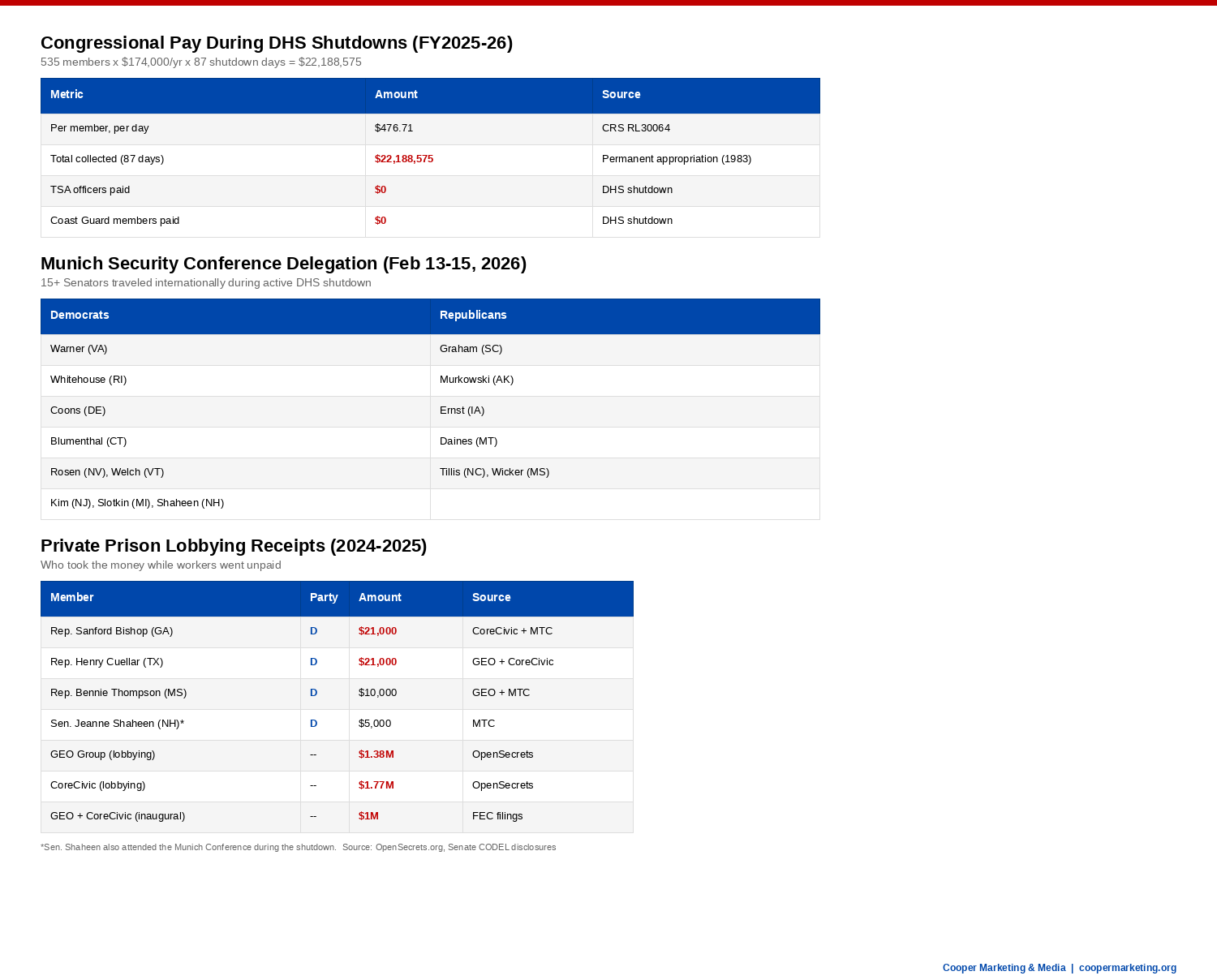
• GEO Group spent $1.38 million on federal lobbying in 2024. CoreCivic spent $1.77 million. Combined: $3.15 million.
• GEO Group and CoreCivic each donated $500,000 to the 2025 Presidential Inaugural Committee. Combined: $1 million.
• Rep. Sanford Bishop (D-GA) received $21,000 from private prison interests, including $2,500 from CoreCivic in 2024.
• Rep. Henry Cuellar (D-TX) received more than $32,000 from GEO Group and CoreCivic PACs combined. Both companies operate detention facilities in his district.
• Rep. Bennie Thompson (D-MS) received $10,000 from GEO Group and MTC.
• Sen. Jeanne Shaheen (D-NH), who attended the Munich conference during the shutdown, received $5,000 from MTC.
Notice the pattern. These are Democrats. Not because Republicans are clean, but because the narrative that private prison money only flows to one party is a comfortable fiction. It flows to whoever holds the relevant committee seats, regardless of the letter next to their name.
That is what myside bias looks like in practice. You expected Republican names. Your brain wanted to confirm that the other team is the problem. The money does not care about your team.
The Accountability Trigger
This framework proposes a mechanism that does not rely on Congress volunteering to sacrifice its own pay. It proposes a statutory trigger:
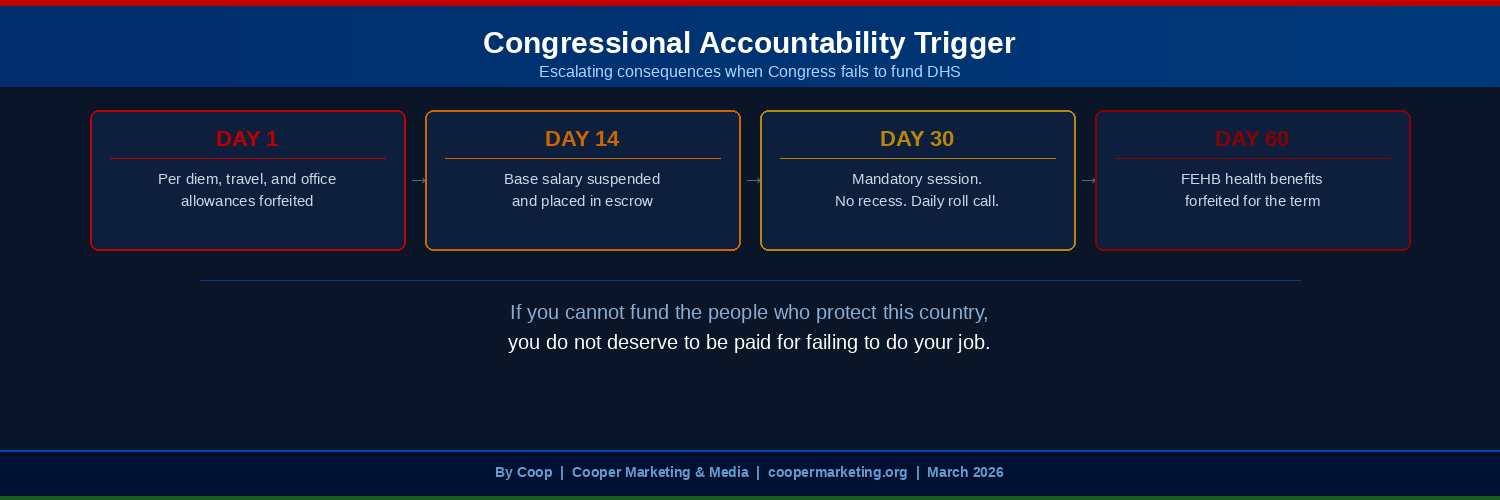
• If any appropriations bill funding DHS (including TSA and the Coast Guard) is not enacted by the start of the fiscal year, all members of the House and Senate forfeit per diem allowances, travel reimbursements, and office expense allocations effective on the first day of the funding lapse.
• If the lapse exceeds 14 days, base salary payments are suspended and placed in escrow. Members may not access escrowed salary until a funding mechanism is enacted.
• If the lapse exceeds 30 days, all congressional recess is cancelled. Members must remain in session, in Washington, with daily roll-call votes recorded, until funding is restored.
• If the lapse exceeds 60 days, all members of Congress forfeit eligibility for the Federal Employees Health Benefits Program for the remainder of the term.
The 27th Amendment prohibits changes to compensation that take effect before the next election. This trigger is structured as a prospective condition of service that takes effect at the start of each new Congress, compliant with the amendment's requirements.
Will Congress pass this? No. Not voluntarily. But every independent voter in this country should demand it as a condition of their support.
PART IV: ICE REFORM
The Agency That Lost Its Way
Let me be clear about what I am not proposing. I am not proposing the abolition of ICE. I am not proposing open borders. I am not proposing that immigration law should not be enforced.
I am proposing that it should be enforced constitutionally, professionally, and within the legal authority Congress actually granted the agency. Because right now, it is not.
The Constitutional Problem
ICE uses administrative warrants, signed by internal officials, not judges, to conduct arrests and enter homes. A federal appeals court has ruled that the Fourth Amendment requires a neutral decisionmaker to review ICE detainer-based detention. ICE has continued to issue detainers based on foreign birthplace and database absence alone, practices that multiple courts have found violate the Fourth Amendment.
In May 2025, ICE's acting director issued a memo claiming the Constitution does not prohibit relying on administrative warrants for home arrests. This represents a radical departure from settled case law and the foundational understanding of the Fourth Amendment.
Between January 19 and March 20, 2025, ICE filed 67 use-of-force reports, a nearly 300% increase from the comparable period. DHS eliminated the Office of Civil Rights and Civil Liberties in March 2025, abandoning more than 500 pending complaints. At least 17 open-fire incidents involving federal immigration agents have been documented since July 2025.
ICE has wrongfully detained at least 170 confirmed U.S. citizens. TRAC found that between 2002 and 2017, ICE wrongly identified at least 2,840 U.S. citizens as potentially deportable. At least 214 were taken into custody. The agency does not systematically track these encounters.
The Private Prison Machine
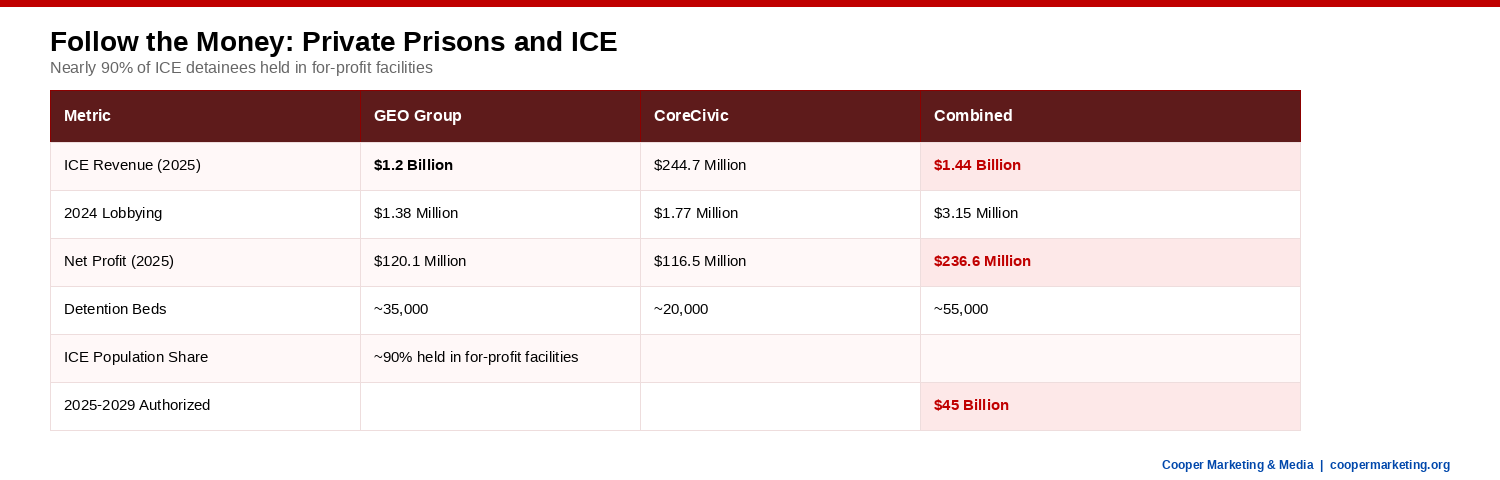
Nearly 90% of people in ICE custody are held in for-profit facilities operated by two companies: GEO Group and CoreCivic.
In 2024, GEO Group's ICE revenue reached $1 billion. CoreCivic's ICE revenue was $120.3 million, a number that more than doubled to $244.7 million by Q4 2025. GEO Group's projected 2026 revenue is $3 billion. CoreCivic's profits rose 70% in 2025 to $116.5 million.
Congress authorized $45 billion for ICE detention through fiscal year 2029, enough to operate 135,000 detention beds. ICE's detained population grew 75% in 11 months, from 40,000 in January 2025 to nearly 66,000 by December, the highest level since the agency was created.
These companies spent a combined $3.15 million on federal lobbying in 2024 alone. The expansion is being conducted through emergency declarations that largely bypass competitive bidding. New facilities include a $1 billion, 15-year contract for a single 1,000-person facility in Newark, and reactivation of closed facilities across Texas, California, and the Southwest.
Sexual assault allegations in ICE detention increased 134% between 2019 and 2021. Officials at immigration facilities failed to report 40% of sexual abuse allegations to ICE headquarters. Fewer than 13% of allegations were substantiated. At one CoreCivic facility, the warden had the authority to decide whether to investigate rape allegations. Private companies are investigating crimes committed in their own facilities.
This is not immigration enforcement. This is an industry.
What ICE Reform Looks Like
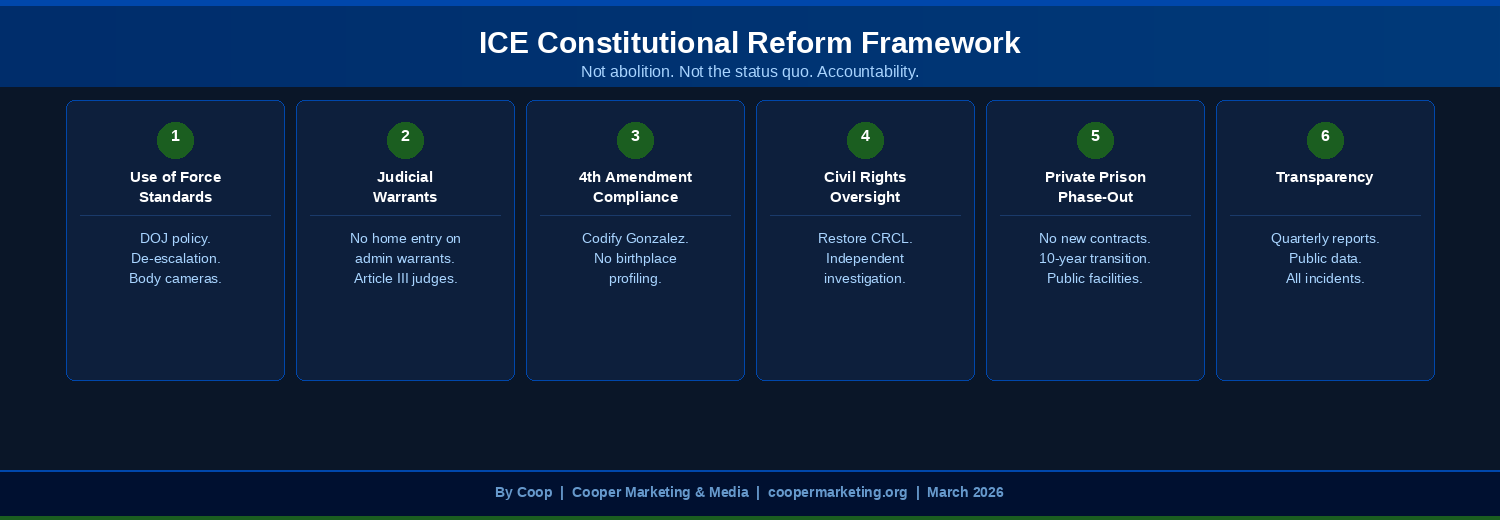
This framework does not defund ICE. It refocuses the agency on its actual statutory mission and imposes constitutional guardrails
• Use of Force Standards: Adopt DOJ use-of-force policy requiring de-escalation as default, prohibiting deadly force except to prevent imminent threat of death or serious injury, and mandating body cameras on all enforcement operations.
• Warrant Reform: Prohibit home entry or arrest based on administrative warrants alone. Require judicial warrants, signed by an Article III judge or magistrate, for any non-consensual entry into a residence.
• Fourth Amendment Compliance: Codify the holding in Gonzalez v. ICE: no detainer, arrest, or removal action may be initiated based solely on foreign birthplace, language, or absence of citizenship information in a database.
• Restore Civil Rights Oversight: Re-establish the DHS Office of Civil Rights and Civil Liberties with independent investigative authority and mandatory reporting to Congress.
• Private Detention Phase-Out: No new contracts with for-profit detention operators. Existing contracts honored through their terms but not renewed. Transition to government-operated or nonprofit-managed facilities within 10 years.
• Transparency: Require ICE to publish quarterly reports on use-of-force incidents, detention conditions, citizen detention errors, and complaint resolution. All data public.
• Posse Comitatus Enforcement: Prohibit the use of ICE personnel as a domestic enforcement arm for the Executive Branch outside the agency's immigration enforcement mandate. Codify that ICE officers may not be deployed in support of non-immigration executive directives.
PART V: THE HYPOCRISY LEDGER
This is the section where integrity demands I be equally uncomfortable with both sides. The temptation is to build a case against the team you already dislike and go easy on the one you lean toward. A strong, independent legislative branch would not tolerate that from its members, and I will not tolerate it from myself. So I am going to be specific.
The Right
You cannot claim to support the military while allowing the Coast Guard to go unpaid. You cannot claim to back law enforcement while TSA officers quit because they cannot feed their families. You cannot wave a thin blue line flag on Monday and vote against funding on Tuesday.
The Republican caucus has blocked continuing resolutions, used DHS funding as leverage for border wall negotiations, and forced shutdowns that directly harm the uniformed personnel they claim to champion. During the 2018-2019 shutdown, Republican leadership held the entire DHS hostage for 35 days over $5.7 billion in wall funding while 42,000 Coast Guard members went to food banks.
And the private prison expansion? $45 billion in taxpayer money funneled to for-profit corporations through emergency declarations that bypass competitive bidding, while the party of fiscal responsibility looks the other way. GEO Group and CoreCivic spent $3.15 million on lobbying in 2024. Their combined ICE revenue exceeded $1.2 billion in 2025. Follow the money.
The Left
You cannot claim to be the party of workers while using federal employee paychecks as political leverage. You cannot demand immigration reform and then fail to pass it when you have the votes.
Democrats controlled the House, Senate, and White House from 2009 to 2010. Comprehensive immigration reform did not happen. The Obama administration deported more people than any administration in history, earning the president the label of Deporter in Chief from immigration advocates within his own party. Yet the rhetoric never matched the record.
Senator Ed Markey blocked the No Budget No Pay Act. Democratic leadership has used shutdown crises as messaging opportunities rather than forcing clean funding votes. TSA pay equity was achievable years before 2023. The party that calls itself the champion of organized labor let TSA officers languish without full collective bargaining rights for two decades.
And private prisons? The money flows both ways. Rep. Sanford Bishop (D-GA), $21,000. Rep. Henry Cuellar (D-TX), more than $32,000, with GEO Group and CoreCivic facilities in his own district. Rep. Bennie Thompson (D-MS), $10,000. Before the Democratic Party officially turned against for-profit detention, its members took the checks. The pivot was real, but the history is there.
The Common Thread
Both parties treat federal workers as acceptable collateral damage. Both parties use immigration as a wedge issue rather than solving it. Both parties have members who vote against funding the people who protect this country while collecting their own guaranteed paychecks.
The difference between the parties on these issues is largely one of messaging, not outcomes. And the people who pay the price are the ones who wear the uniform.
PART VI: THE FRAMEWORK
What This Proposes
This is not a bill. It is a framework: a set of principles and mechanisms that any member of Congress, from any party, could pick up and introduce tomorrow. It has four pillars:
Pillar 1: Full Funding and Retro Pay
• Mandatory full-year funding for TSA and the U.S. Coast Guard through permanent appropriation, removing both agencies from the annual budget hostage cycle.
• Retroactive pay for all shutdown-affected workers, including differential pay for officers who worked additional shifts during understaffed periods.
• Complete credit remediation: mandatory removal of all negative credit reporting caused by funding lapses within 30 days of restoration, with verification letters issued to all three bureaus.
• Service Credit Review: an audit of all active and former TSA/Coast Guard members' personnel files. Any negative performance, attendance, or disciplinary marks attributable to shutdown-related financial hardship shall be expunged.
Pillar 2: Congressional Accountability Trigger
• Prospective condition of service: forfeiture of per diem, travel, and office allowances on Day 1 of any DHS funding lapse.
• Salary escrow after 14 days.
• Mandatory session with daily roll call after 30 days. No recess, no travel, no fundraising.
• FEHB eligibility forfeiture after 60 days.
• Structured as a prospective condition taking effect at the start of each new Congress, compliant with the 27th Amendment.
Pillar 3: ICE Constitutional Reform
• DOJ use-of-force standards with de-escalation mandate and body cameras.
• Judicial warrant requirement for home entry.
• Fourth Amendment codification (Gonzalez v. ICE standard).
• Restored independent civil rights oversight with reporting to Congress.
• 10-year phase-out of for-profit detention contracts.
• Quarterly public transparency reports on force, detention, errors, and complaints.
• Posse Comitatus codification: no deployment outside immigration mandate.
Pillar 4: Private Prison Defunding
• No new contracts with for-profit detention operators.
• Existing contracts honored through their terms, not renewed.
• Transition to government-operated or nonprofit-managed facilities.
• Prohibition on emergency declarations to bypass competitive bidding for detention contracts.
• Annual public audit of all detention spending, facility conditions, and incident reports.
The Invitation
I did not write this to convince you I am right about everything. I wrote it to show you that it is possible to think about policy without a jersey on. To evaluate your representatives not by the letter next to their name, but by the integrity of their actions and the ethics of their decisions. A strong, independent legislature does not govern by loyalty. It governs by principle.
You do not have to be a Democrat, a Republican, or MAGA. You do not have to be anything except willing to hold your elected officials to the oath they took: to support and defend the Constitution, and to serve the people who sent them there.
The people who screen your bags at the airport deserve to be paid. The people who patrol the coastline deserve to be paid. The people who cage human beings for profit deserve to be investigated. And the people who caused all of this while collecting $174,000 a year deserve to feel what it is like when the paycheck stops.
That is not a left idea or a right idea. That is what integrity looks like when it is actually practiced.
Data Sources
Steven Pinker
• Rationality: What It Is, Why It Seems Scarce, Why It Matters (2021)
• Enlightenment Now: The Case for Reason, Science, Humanism, and Progress (2018)
• The Better Angels of Our Nature: Why Violence Has Declined (2011)
• The Blank Slate: The Modern Denial of Human Nature (2002)
TSA Workforce and Pay
• DHS Implementation of Transportation Security Compensation Plan (July 2023); AFGE-TSA Collective Bargaining Agreement (May 2024); OPM Salaries and Wages
Coast Guard Funding
• Stars and Stripes (March 2026); GAO Report on Coast Guard Staffing Challenges; Coast Guard Mutual Assistance (CGMA) Shutdown Data
Government Shutdowns
• Congressional Budget Office (2019 Effects Report); Congressional Research Service; Federal News Network
Congressional Pay and Travel
• CRS Report RL30064 (Congressional Salaries and Allowances); Constitution Center (27th Amendment Analysis); AJC (March 2026); Senate CODEL disclosures
Lobbying and Private Prison Donations
• OpenSecrets.org: GEO Group profile, CoreCivic profile, 2024 lobbying data; In These Times; The Appeal
ICE Use of Force and Constitutional Issues
• American Oversight FOIA (March 2025 data); CS Monitor (February 2026); NBC Washington Investigation; Gonzalez v. ICE (C.D. Cal. 2019); Brennan Center for Justice
Private Prisons
• Brennan Center for Justice; TRAC Reports (Detention Capacity); American Immigration Council; OpenSecrets (2024 Lobbying Data)
Wrongful Citizen Detention
• ProPublica (170 Confirmed Cases, October 2025); TRAC (2,840 Citizens Flagged, 2002-2017); GAO Report GAO-21-487
Debate it. Amend it. Improve it.
That is what the process is for.