What a $7.46 settlement offer tells us about wages, dignity, and the true cost of doing business on the mountain
Let me tell you about a ski instructor named Bryan Griffith.
Bryan worked at Beaver Creek, one of the jewels in the Vail Resorts crown. On any given day, he was required to be present at the resort for four to seven hours. He wore the uniform. He rode the bus. He put on the gear. He stood in the cold and taught people to ski, which is the actual reason families save thousands of dollars and make the drive to Beaver Creek in the first place.
Sometimes he was in a lesson for one hour. One hour of pay for a seven-hour day.
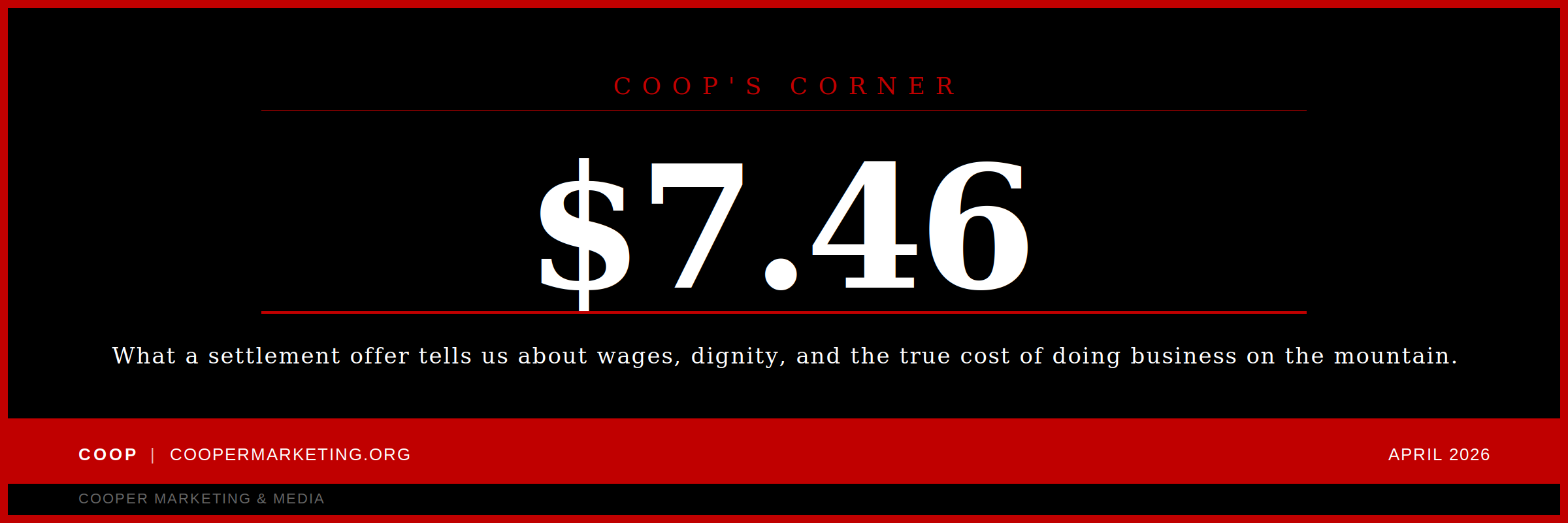
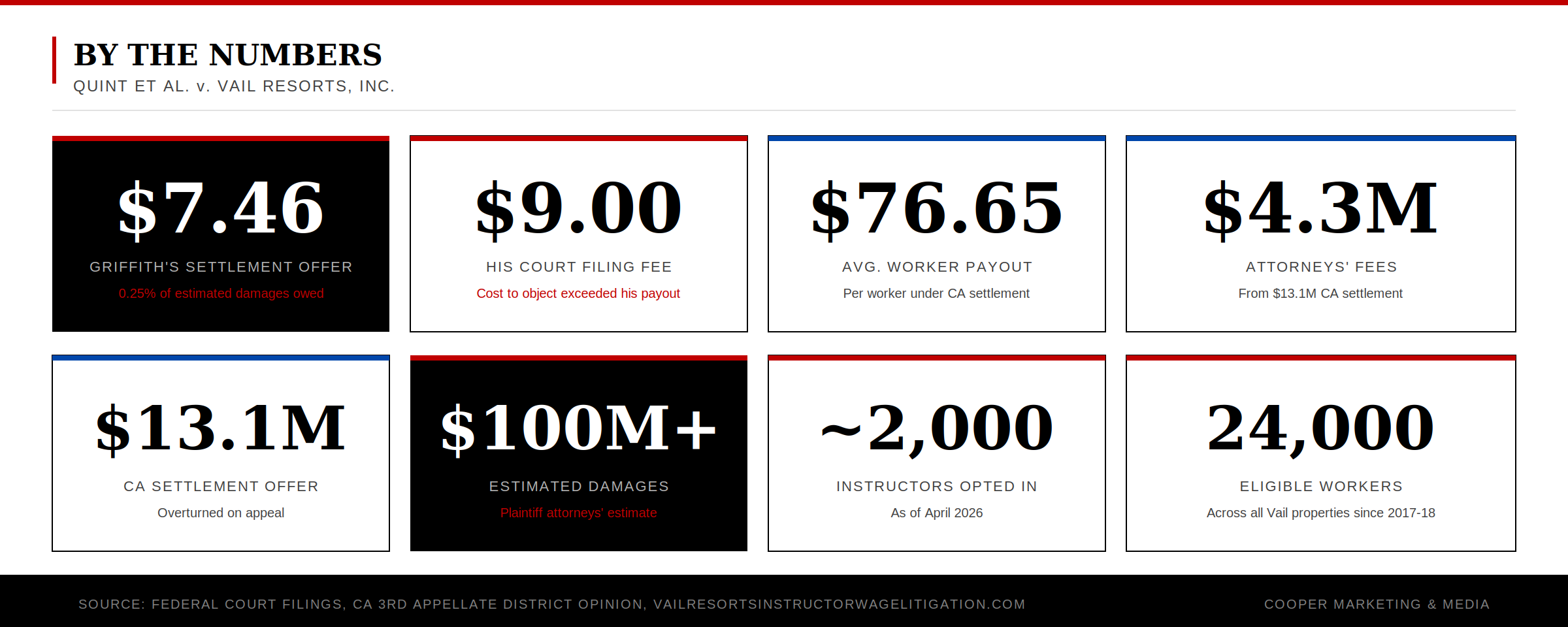
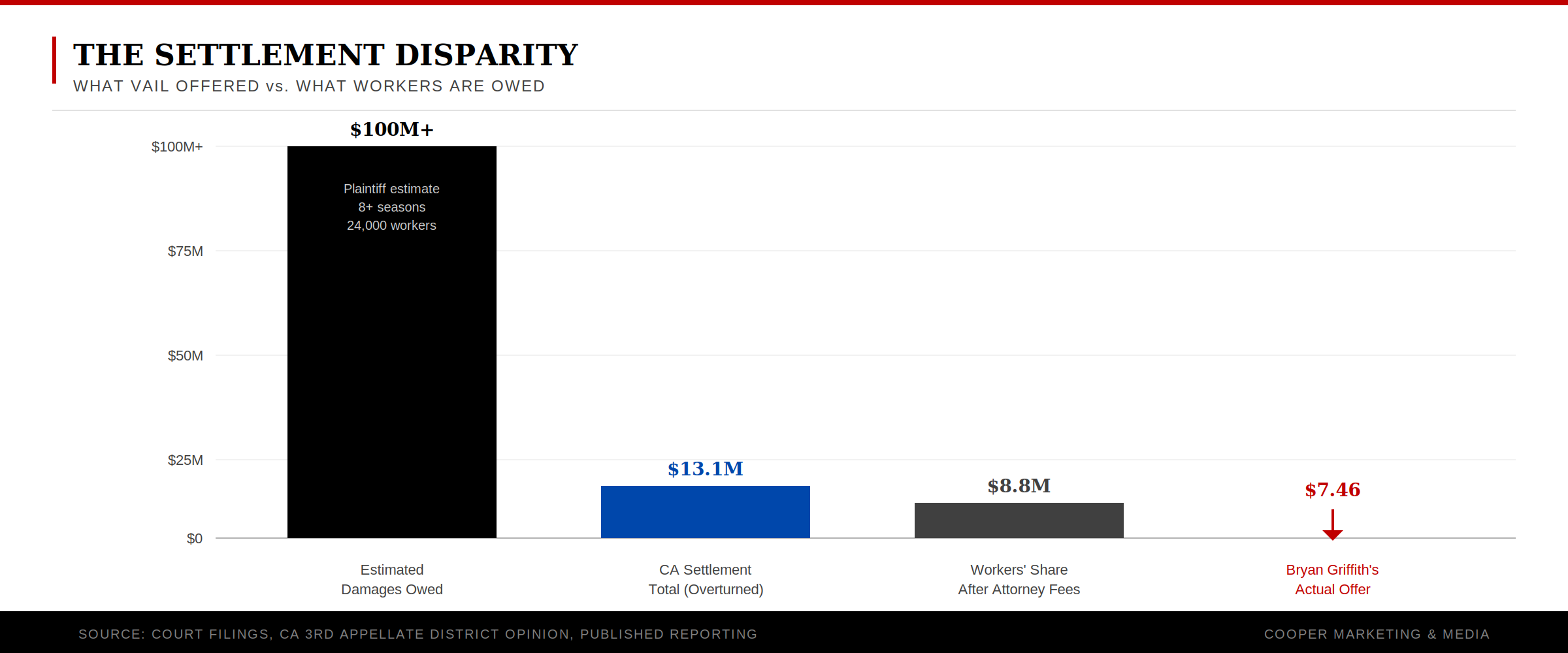
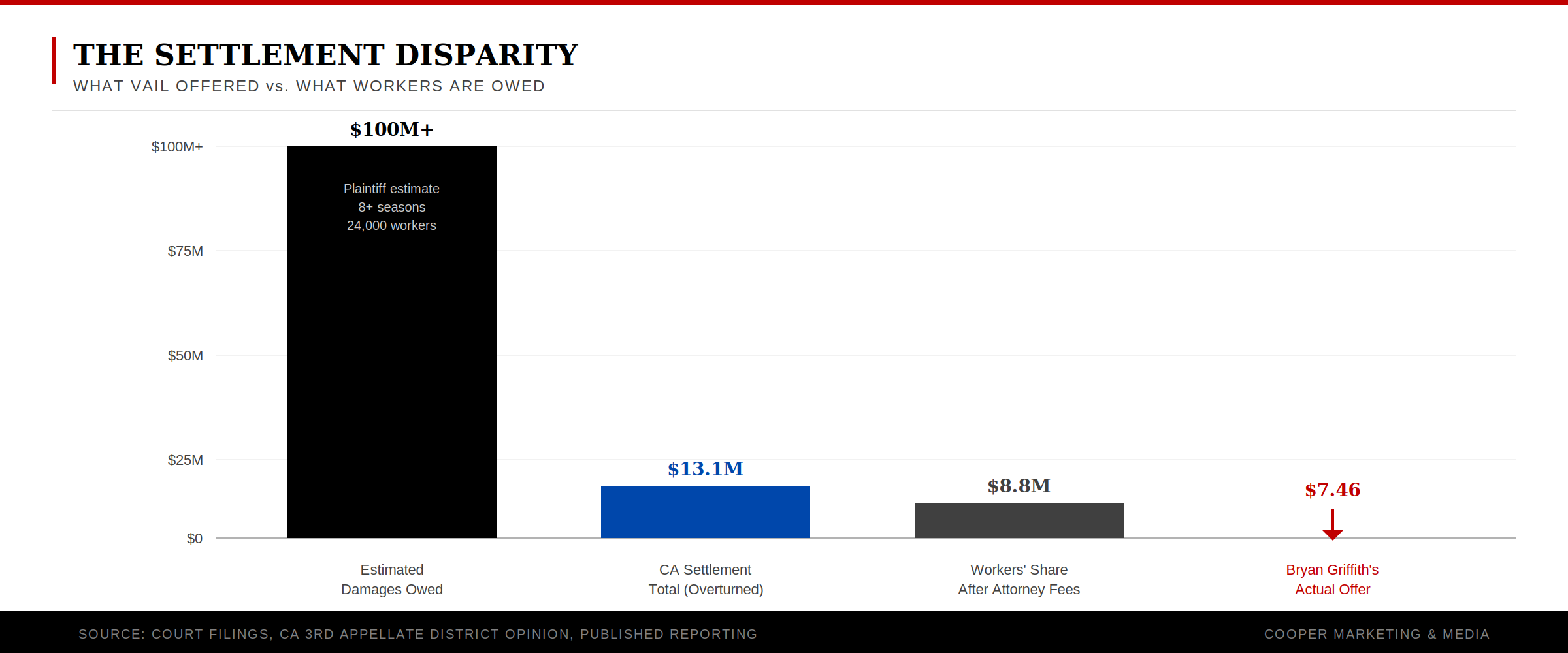
When a collective action lawsuit was filed on behalf of instructors like Bryan, a settlement was negotiated in California state court. His share of the $13.1 million deal: $7.46.
Less than the $9 filing fee he paid to object to it.
His estimated actual damages: thousands of dollars. That $7.46 offer represented roughly 0.25 percent of what he was likely owed.
Seven forty-six. That number is not a rounding error. It is a policy position.
The Case, Plainly Stated
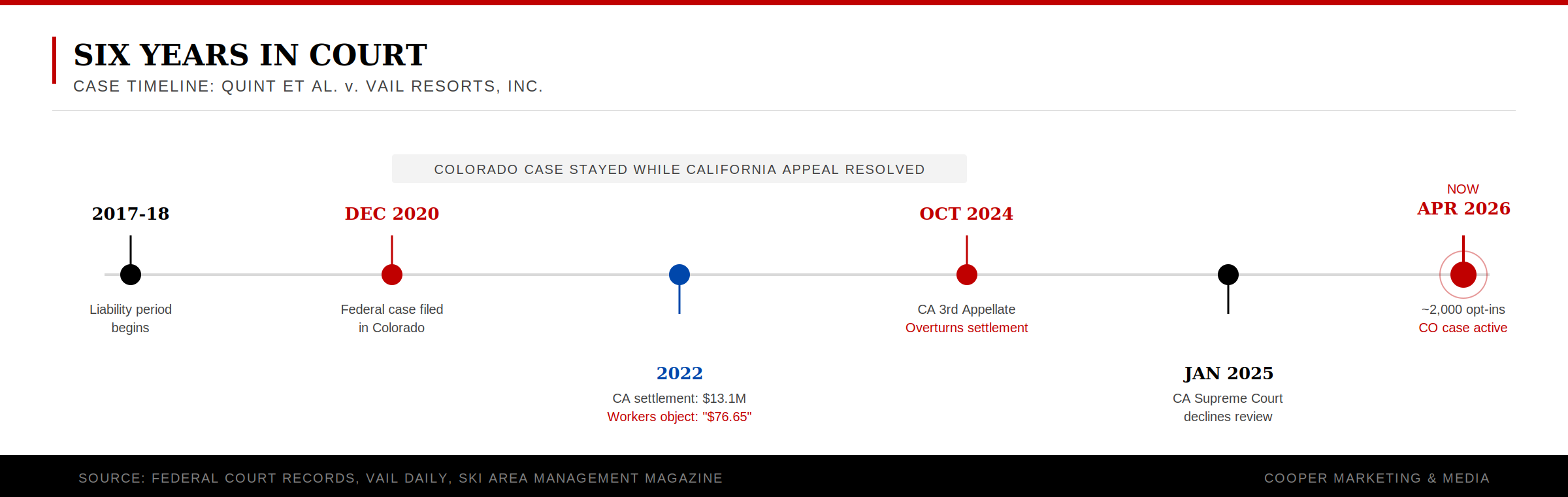
The lawsuit is Quint et al. v. Vail Resorts, Inc., filed in December 2020 in federal court in Colorado, where Vail Resorts is headquartered. It is a Fair Labor Standards Act collective action, meaning eligible workers must actively opt in to participate. As of this week, nearly 2,000 current and former ski and snowboard instructors have submitted consent forms. The eligible pool is roughly 24,000 people, covering anyone who worked at a Vail-owned mountain from the 2017-18 season through today.
Three of those mountains sit right here at Lake Tahoe: Heavenly, Northstar, and Kirkwood.
• The allegations are specific. Instructors claim they were not compensated for:
• Travel time between designated employee parking lots and worksites, via company-directed transportation
• Time spent putting on and removing required uniforms and equipment, what the law calls "donning and doffing."
• Mandatory training sessions
• Personal snowsports equipment required to perform the job
• Work-related cell phone costs
The plaintiffs allege that Vail scheduled instructors for shifts of 6.5 to 7.25 hours, while supervisors knew the actual workday ran closer to 9 hours. Multiply that gap by thousands of workers across eight seasons, and you arrive at where plaintiffs estimate damages exceeding $100 million.
Vail Resorts denies all of it. The company maintains that it has paid, and continues to pay, all snowsports instructors in full compliance with the law.
Is This Solid Law, or a Fishing Expedition?
Worth asking. Worth answering.
The Fair Labor Standards Act was signed in 1938. It is not a radical instrument. It establishes that when an employer requires you to be somewhere or do something on their behalf, that time belongs to you. The Supreme Court sharpened the specific issue of donning, doffing, and required travel between work areas in IBP, Inc. v. Alvarez in 2005, ruling unanimously that time spent walking from changing areas to production floors after putting on required gear is compensable work time. The principle is settled. The only remaining question in this case is whether the facts at Vail's mountains fit the standard.
They appear to.
Vail required instructors to park in designated lots. Vail ran the buses. Vail mandated the uniform and gear. Vail scheduled the training. The instructors did not choose any of those requirements. They were conditions of employment. Conditions of employment, imposed by the employer, are compensable time.
The company that set those conditions pulled $1.44 billion in lift revenue in fiscal year 2024 and expected more than $975 million from Epic Pass sales in the 2024-25 season alone. The damages being sought, estimated at over $100 million, are a proportional response to a documented gap between hours worked and hours paid, not a shake-down of a struggling small business.
The legal action is solid. The compensation being sought is not audacious. It is arithmetic.
The California Play: Where It Gets Uncomfortable
While the Colorado federal case was working its way through the system as the proper, first-filed venue, something else was happening simultaneously in California state court. A separate group of plaintiffs negotiated a $13.1 million settlement with Vail Resorts. That deal was structured to apply nationwide, covering a class of potentially more than 100,000 workers. After plaintiffs' attorneys collected approximately $4.3 million in fees, the remainder would be divided among the full group.
Average payout per worker: $76.65.
The Colorado plaintiffs objected. They argued in filings that class members were owed "thousands of, if not tens of thousands of dollars, in back wages and expenses" and that the $76.65 figure amounted to "literally pennies on the dollar, or less." They described the process as a "reverse auction," a recognized legal concept in which a defendant selects the weakest available adversary in a series of parallel lawsuits, negotiates the cheapest possible settlement, and seeks court approval, which would extinguish all other claims.
California's Third Appellate District agreed. The settlement was overturned. The court found the trial judge had improperly presumed the settlement was fair without adequately scrutinizing it. It also found California state court lacked general jurisdiction over a case involving workers in 16 states against a company headquartered in Colorado. The settlement was vacated. The Colorado federal case moved forward.
Vail appealed to the California Supreme Court. The California Supreme Court declined to hear it.
Here is what the record shows, without editorializing: Vail attempted to resolve a potential $100 million exposure for $13 million in a venue that a higher court later said lacked jurisdiction. The average worker's share of that deal was $76.65. Bryan Griffith's share was $7.46, a man who spent seven hours on company property, sometimes teaching only one hour of lessons. Every available legal avenue to preserve that outcome was pursued by Vail's legal team. None of them held.
The California appeals court went out of its way to note it was not accusing either party of collusion. That is worth noting here as well.
What those facts mean about the decision-making behind them is something each reader will have to work out for themselves.
What This Means for the Industry, Including the Operators Doing It Right
This story does not end with Vail Resorts, and that matters.
If the Colorado federal court rules in favor of the instructors, it will almost certainly force a wage compliance review across the entire ski resort industry. The pre- and post-shift labor practices of snowsports instructors have existed in a legal gray zone at resorts well beyond the ones flying the Vail flag. A ruling that these hours are compensable will require operators of every size and structure to audit how they clock their people.
That is not automatically a bad outcome for the industry.
There are operators running their programs correctly right now. Independent resorts, family-owned mountains, smaller operators who pay their instructors fairly, clock their time accurately, and treat their staff as the skilled professionals they are. For those businesses, a ruling that raises the floor is not a competitive threat. It is a long-overdue correction to the uneven playing field they have absorbed for years against operations that cut corners on wage compliance and priced their labor accordingly.
Fair wages and sound business are not competing values. They have to coexist in an industry that depends on seasonal, specialized, genuinely passionate workers. The instructor workforce is not a commodity. These are people who chose a low-margin, weather-dependent career because they love the mountain and what it does for people. When they have options, they exercise them. When the pay and the respect are not there, they leave. And when they leave, the guest experience, the product that justifies a $250 lift ticket and nearly a billion dollars in pass revenue, decays with them.
The instructors who taught your kids to ski at Heavenly or Kirkwood were the brand. Not the lift infrastructure. Not the app. Not the base lodge renovation. The person who stood at the top of a beginner run in January, in the cold, and made a seven-year-old feel like they owned the mountain for the first time. That person deserved to be paid for the bus ride to get there.
The Tahoe Dimension
Kirkwood. Heavenly. Northstar. All Vail properties. All are named in the eligible class. All part of the community where we live and work.
I have spent years watching the Tahoe ski experience reshape itself under corporate consolidation, and I have written in this space about what I called the Gravity Problem, the structural tension between the Epic Pass revenue model and the on-snow experience that model is supposed to fund. I have watched lift ticket prices rise while deferred maintenance queues grow and seasonal staff rosters contract.
I do not lay every problem at the door of corporate ownership. Running a mountain resort is expensive, weather-dependent, and operationally complex in ways that casual observers do not fully appreciate. There are good people inside these organizations doing hard work.
But I know what a ski instructor's workday looks like from the inside. The parking lot walk in the dark. The locker room, the gear check, the radio briefing, the training clinic. All of it before a single student shows up. All of it required by the employer. None of it on the clock.
If you worked as a ski or snowboard instructor at any Vail Resorts property between the 2017-18 season and this season, you were eligible to join this lawsuit. The April 15 opt-in deadline passed this week, but Magistrate Judge N. Reid Neureiter ordered a discovery hearing after it became clear that fewer than 2,000 of the 24,000 eligible workers had received adequate notice. A deadline extension is possible. The litigation website is vailresortsinstructorwagelitigation.com.
Your time was worth something. The court is being asked to confirm that. It still is.
The Rational Bottom Line
I came in with Bryan Griffith, and I will go out with him, because that is where the rational case rests.
A company generating over $1.44 billion annually in lift revenue offered a ski instructor $7.46 to settle a wage claim estimated in the thousands. That is not a calculation error buried in a complex financial model. That is a number that came out of a deliberate legal process, reviewed by attorneys, approved by decision-makers, and offered to a man who asked for nothing more than to be paid for the hours he worked.
The law is not ambiguous. Employer-required time is compensable time. The facts are not seriously in dispute. Instructors traveled on company buses, wore company-mandated gear, attended company-required training, and used their own equipment to deliver the service the company sold. The only question left before the Colorado federal court is the one that has been pending since December 2020: what does that time cost?
Bryan Griffith already gave Vail Resorts his answer. He filed a $9 objection to a $7.46 offer and stood up in court to explain why.
The court deserves the chance to give its own.
That is not politics. That is not activism. That is a man who worked seven hours and got paid for one, and a legal system being asked to do the math.
Coop