From the First Ride to the Last Sellout: How the Soul of Action Sports Was Built
This Morning. Rattled to the Core.
A piece went out yesterday in response to Britta Winans.
Britta, a Truckee-born freeskier called down competition lines at the Tahoe Junior Freeride Series before most people outside this community knew her name, published a piece in Powder Magazine asking whether freeride skiing can stay wild. The response covered the FWT entry fee structure, the FIS takeover, the Olympification pattern, the TJFS as the countermodel. Every word meant.
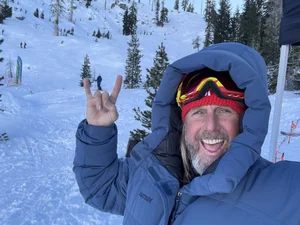
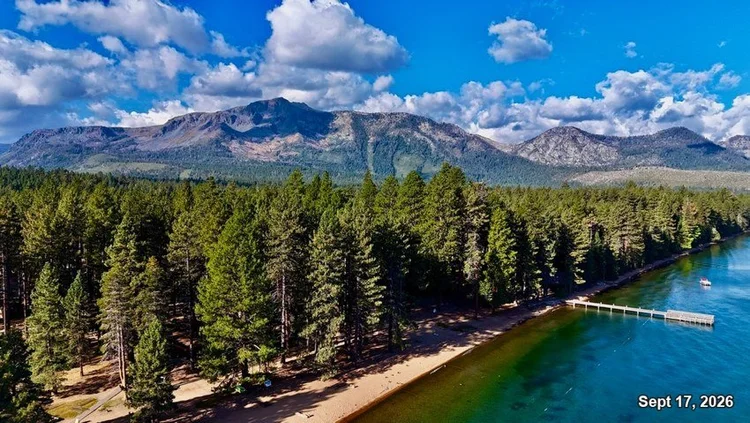
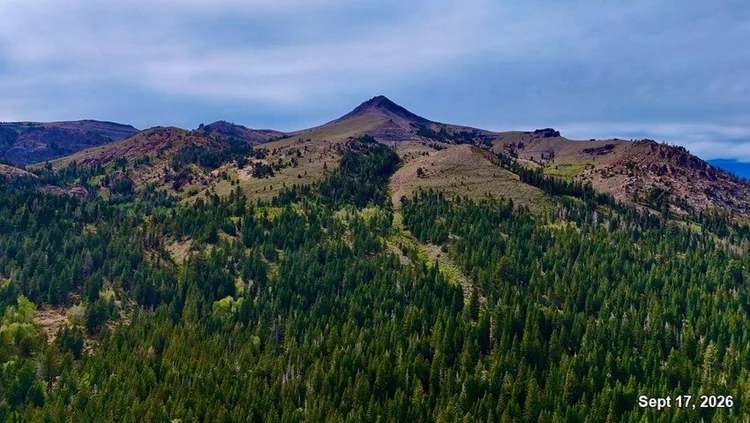
And then this morning, at the desk here at the #HippieHaus, looking out at Angora Ridge in the early light, the weight of thirty-three years in this business landed with a force that was not expected.
Not in a heavy way. In the way that things land when the ride has been moving so fast, for so long, that stopping to look back at it feels like a different sport entirely.
What started as a response to one question became something else. The question of whether freeride can stay wild cracked open a larger one: can any of these sports stay wild? Can the culture that built them survive the machine that bought them? And what does it mean that the people who were there at the beginning are now standing at the base of mountains with microphones, calling the next generation down lines, watching the same forces that built the sport try to buy the soul out of it?
The answer is complicated. The answer is both. This is Part I of a two-part series.
“Thirty-three years in this industry. Still standing. Still stoked. Soul intact. Chief bottle washer and cook, thoroughly and completely blessed beyond any reasonable expectation.”
So let us start at the real beginning. And let us be honest about all of it, the heyday and the heartbreak, the soul and the sellout.
Lap Sixty-Two. Still Dropping In.
Somewhere between 2200 and midnight on a wild evening in Berkeley, California, in the year of reckoning that was 1964, the journey began.
Nineteen sixty-four. The Civil Rights Act signed into law. The Beatles landing at JFK and changing the frequency of everything. The Free Speech Movement igniting right there on the Berkeley campus, blocks from where this particular story started. The whole American experiment cracking open at the seams and reassembling into something nobody had a map for. It was, by any reasonable measure, the correct year to arrive. The world was not playing it safe, and neither, it turned out, was the kid who arrived in it.
Sixty-two laps around the sun later: what a ride. A ride that the most seasoned chroniclers of the American edge would recognize. Not quite used up. Not quite on the side of the road. A few more years in the locker, and the intention is to ensure that when the final chapter gets written, it is executed with the same precision and commitment every other chapter demanded. Sideways. Thoroughly used up. Loudly proclaiming.
Soul intact. Still riding. Still stoked. Still independent, even after a few years on the Vail Resorts mothership train (or in the Borg, your choice of terminology), which is a story for another day, except to say the exit came with a compass pointed exactly where it has always pointed and a considerably sharper appreciation for what the word independent actually means when the alternative has been seen from the inside.
The progression of boards and planks tells the story better than most resumes could. A Black Knight deck first, solid clay wheels, the kind that would send you over the bars on a sidewalk crack if you were not paying attention, and attention was never the strong suit. Then an Aluminum Bahne with the first urethanes, and the world changed permanently. The wheels rolled differently. The feeling had a new dimension. Then the Cadillac wheels arrived, and the Logan Earth Ski, built in 1975 by the Logan family in their backyard, solid oak, a team that included Jay Adams and Tony Alva before those names meant what they came to mean. Then Kastles, a brand founded in 1924 in Hohenems, Austria, later swallowed by Benetton, killed off entirely by 1998, eventually resurrected under Czech ownership. The skis in those bindings were already carrying a story bigger than anyone knew.
But before all of that gear list, there was Huntington Beach.
Standing on the sand as a hell-raising yout, watching a #SoCalSoulSurfer thread a wave with the kind of ease that looked impossible from the shoreline. Something cracked open in the chest. Not a metaphor. An actual physical event. No word for it then. Sixty-two years spent trying to live up to what it was.
The understanding arrived fully and permanently on that beach: the mission was to slide on water, snow, earth, and in the sky. All of it. Every surface the planet offered. Born with a purpose. The purpose was this.
What can be said now is that every stop on that road pointed in the same direction. Every wave, every mountain, every stage, every deck, every line. All of it was the same thing in a different form. The search. Always the search.
“#NeverAnAngel — the full, unfiltered, and thoroughly unrepeatable story of how what started on that Huntington Beach sand became a life worth every scar. From Campo/Del Oro Led Zeppelin-fueled orchard Lowenbrau kegs to Santa Cruz, the United States Coast Guard to Rock'n'roll to the snow. Coming to Coop's Corner. Stay tuned.”
MJ and Al.
None of it, not a single lap, not a single drop, not one morning at the base of a mountain with a microphone in hand, none of it happens without MJ and Al.
The two human beings who watched a level of pure, unfiltered, occasionally spectacular insanity get brought to a life that most people would have quietly suggested reconsidering, and who never, not once, let go of the rope. They lived it. They breathed it. They held on through the good and the bad and the genuinely gnarly, through the ups that felt like flight and the downs that felt like massive turbulence into free fall, and they were there at the bottom of both.
Tolerance. Unconditional love. Not the greeting card version. The real version. The version that shows up at 0300 when the call comes, the version that does not require the right choices to have been made, only that the person making them is yours. That is what they gave. Every single day of this ride.
MJ. Al. Thank you. Love you. Sorry for the parts that aged you. Not sorry for any of it.

1989. The Squaw Valley Sport Shop. The Rooms.
The first real winter as a skier was 1989. Squaw Valley. That is what it was called then, and that is what it gets called here, because intellectual honesty is the standard this column runs on. The resort has since been rechristened Palisades Tahoe, a decision made in 2021 that is correct and appropriate. But in 1989, it was Squaw Valley, one awesome mountain, and the gig was at the Squaw Valley Sport Shop, one of two core shops in the Valley. The other was Granite Chief, both run by locals, all-out amazing people. Massive shout to Dennis and Chris, Herb, and Treas Manning. Two shops. One mountain. Chris and Dennis Willard ran the Sport Shop, Herb and Treas ran Granite Chief, and they ran it right. Those who know, know.
"Buy the ticket, take the ride. If it occasionally gets heavier than what you had in mind, well, maybe chalk it up to forced consciousness expansion."
The industry years that followed were never spent as an employee of the brands that defined them. The access was different from that. Invited into rooms. Think tank participant. Someone handed a prototype and asked the only question that actually matters: is this cool? How does it ski? How does it ride? Does it feel the way it should feel? The kind of conversation that only happens when a brand still trusts the instincts of people who live the sport over the projections of people who manage it from a spreadsheet.
The factory floor at Mittersill, Austria. The Blizzard crew at 0300 in the metal bar, hammering nails into a log because that is what you do after a long day building skis in a village of 5,400 people, where the factory is the biggest employer and skiing is not a lifestyle segment but a way of life. (The Red Bull whiskey shot fest is a separate story entirely.) The Tecnica and Nordica headquarters in Giavera del Montello, a small town in the Veneto, where the brands that make the boots are managed by people who understand what feet do on snow. The peaks of Whistler with the Sapient and O'Neill clan, deep in the trees, where the product either worked or the mountain told you so immediately. Deep in Revelstoke with the Rip Curl family, which is its own category of committed, the kind of riding that separates the people who say they love the mountains from the people who mean it. South-bound first -class, and flossy on a train out of Santiago toward Termas de Chillan, which would have been a perfectly straightforward journey if not for a small but consequential amount of missing copper in the track, a detail that is funnier now than it was at the time. The Schnitzel bender tour across the EU, which covered more borders, more brand conversations, and more late-night tables than any reasonable itinerary would suggest, was possible. Athletes, prototype sessions, factory floors, think tanks, each of them still believing, at that moment, that the answer to "is this cool?" could not be found in a focus group.
For fifteen years beyond those rooms, the privilege of telling these mountains' stories to audiences far outside the community that lives inside them. A different kind of small and insignificant. An honor never taken lightly.
And across those same thirty-three years, the slow, grinding observation of one by one the brands built from genuine connection being acquired, restructured, sold, resold, and absorbed into holding companies whose orientation toward the sports that created them is, at best, curatorial.
Sixty-two laps. Still dropping in. A lot of ground to cover.
The Ocean Started Everything
Before there were boardshorts, before there were sponsors, before there was a surf industry or a World Surf League, there was a Hawaiian named Duke Paoa Kahanamoku standing on a wooden plank in Waikiki with the Pacific at his back.
Duke Kahanamoku was born in 1890. He grew up on the beaches of Oahu at a time when surfing was ancient, sacred, and nearly extinct, buried by nineteenth-century missionaries who found the act of riding waves insufficiently civilized. Duke brought it back. On December 23, 1914, he surfed Freshwater Beach in Sydney on a board he cut from local pine himself. Australian surf culture traces a direct, unbroken line to that single afternoon.
He was a five-time Olympic swimming medalist, Hollywood actor, and Sheriff of Honolulu for 26 consecutive years. He died in 1968. By then, surfing had gone from sacred Hawaiian tradition to global cultural phenomenon.
The men who carried it forward. Phil Edwards, the first to ride Pipeline on the North Shore. Mickey Dora, Da Cat, the dark prince of Malibu, who surfed with a contempt for the mainstream that was itself a form of art. Gerry Lopez, smooth and meditative, redefining what it meant to ride the barrel. Nat Young, who blew open the shortboard revolution. Tom Curren, whose style was so complete it made other surfers want to quit. Kelly Slater, eleven world titles, who made excellence look like a natural state. Laird Hamilton, who decided the ocean was not big enough in its standard form and invented tow-in surfing to access waves no human being had any business attempting.
And the women who carried it equally far. Joyce Hoffman, multiple world titles in the 1960s. Margo Oberg, seven-time world champion. Rell Sunn, the Queen of Makaha, who surfed with a grace and generosity of spirit the sport has never quite replicated, and who fought cancer for fourteen years without ever leaving the water. Frieda Zamba and Wendy Botha, four world titles each. Lisa Andersen, four consecutive world titles in the 1990s. Layne Beachley, seven world titles, who simply refused to accept the ceiling. Steph Gilmore, eight world titles, the most of any woman in the history of the sport. Carissa Moore, five world titles and Olympic gold in Tokyo. Bethany Hamilton, who lost her arm to a shark attack at thirteen years old and was back in the water within a month, because the ocean was not optional.
On the morning of December 23, 1914, the water at Freshwater Beach in Sydney was cold, and the crowd on the sand had no frame of reference for what they were about to see. Duke Kahanamoku paddled out on a board he had shaped from local pine. When he stood, the crowd went silent. When he rode the wave all the way to the sand, something transferred in that silence that has never fully stopped moving. Every surf shop on the California coast traces a line back to that morning.
These people were not built by brands. They built themselves, in the ocean, before anyone was watching.
Asphalt Surfers: The Birth of Skateboarding
Skateboarding began because the waves were flat and the young guns of Southern California needed somewhere to put their energy. The revolution had a specific address: Dogtown, the intersection of Santa Monica and Venice Beach. In 1973, Jeff Ho and Skip Engblom opened Jeff Ho Surfboards and Zephyr Productions. Their team included Jay Adams and Tony Alva. In 1975 at Del Mar, the Zephyr Competition Team surfed the asphalt in a way the existing format had no language for. Peggy Oki took first in women's freestyle that day, a result as important as anything the men did and far less celebrated in the decades since. Tony Alva pulled the first documented frontside air in a drained backyard pool. That image marks the birth of modern skateboarding.
Patti McGee became the first female professional skateboarder in 1965. Laura Thornhill rode for Logan Earth Ski and was one of the most technically advanced skaters of the 1970s, male or female. Cara-Beth Burnside crossed over from skate to snowboard and back with a fluency the sport had never seen from anyone. Elissa Steamer became the first female professional street skater sponsored at the highest level.
Alva walked away from the major skate companies at nineteen and started Alva Skates. First company ever owned and operated by a skateboarder. That matters. George Powell and Stacy Peralta built Powell-Peralta in 1978 and assembled the Bones Brigade: Tony Hawk, Steve Caballero, Rodney Mullen, Mike McGill, Lance Mountain, Tommy Guerrero. Mullen invented the flatground ollie, the kickflip, the heelflip, and the impossible in his own head and taught them to a sport. Mark Gonzales, the Gonz, approached skateboarding as pure art. Christian Hosoi, whose style was so cinematic the sport felt like it belonged in a museum.
Jay Adams, the most naturally gifted of the Z-Boys by nearly every account, died of a heart attack in August 2014 at 53 years old. His memorial paddle-out at Venice Beach drew hundreds of surfers, skaters, and riders. That kind of send-off cannot be manufactured. It is earned.
The Mountain Called: The Soul of Slide
Warren Miller started filming ski movies in 1948, driving a truck and sleeping on snow to save money. His films are dispatches from a world where skiing was its own justification. Stein Eriksen, Olympic gold at Oslo in 1952, planted the seeds of freestyle long before anyone called it that. The hot dog era of the 1970s pushed it further: moguls, ballet, aerials. And then the extreme skiing movement of the 1980s arrived.
There is footage from the early Warren Miller films that looks like someone pointed a camera at a dream. The mountains are larger than they should be. The skiers are smaller than they should be. And somewhere in the space between those two facts is exactly where this culture was born, and why it never fully let anyone go who found it.
Scott Schmidt in Warren Miller films, redefining big terrain. Glen Plake and his Mohawk, charging lines in Chamonix. Shane McConkey, who invented rockered skis, pioneered ski BASE jumping, and built his career on the idea that skiing should be funny, dangerous, joyful, and free all at the same time. McConkey died doing what he loved in the Dolomites in 2009. The sport is different because he was in it.
The Tahoe and Sierra Nevada roster that never got full recognition outside the community: Tonto, Befu, Daiek, Garbones, Boucher, Tele-Rob, A-Bomb, Tele-Doug, DJohnson, and so many more. Names the mainstream ski world never fully cataloged, but that the people who were there know by heart.
Candide Thovex approaches freestyle skiing the way a jazz musician approaches a standard, never the same twice, always ahead of the audience. His One of Those Days film series has been viewed hundreds of millions of times. Seth Morrison, the quiet legend, who charged terrain other elite skiers described as impossible.
And the women of skiing, who never asked for separate billing. Tamara McKinney became the first American to win the overall Alpine World Cup in 1983. Picabo Street, World Cup downhill champion and Olympic gold medalist, who crashed and rebuilt and kept going. Kristen Ulmer, the first woman to ski the Grand Teton's North Face. Wendy Fisher, who pioneered big mountain skiing in the early 1990s and helped build the competitive freeride circuit that Britta Winans is now asking the right questions about. Ingrid Backstrom. Angel Collinson. Michelle Parker. Jaclyn Paaso. A generation of women who took big mountain skiing into terrain their male counterparts had been calling exclusive territory. These women are not a separate chapter in skiing history. They are the chapter.
The Outcast with a Plank: The Birth of Snowboarding
On Christmas Day, 1965, in Muskegon, Michigan, Sherman Poppen nailed two skis together for his daughter. Jake Burton Carpenter took that idea seriously in 1977, moved to Londonderry, Vermont, with $20,000, built his first board by hand in a garage, and spent years being told no by every ski resort in the country. He was $130,000 in debt by 1981. He did not quit.
Tom Sims built a skateboard on skis in his school woodshop in New Jersey in 1963, at age thirteen, and became the first rider to take a snowboard down Mammoth, Squaw Valley, Mt. Waterman, and Mt. High. Craig Kelly helped define what Burton riders could be. Terry Kidwell invented halfpipe snowboarding in a drainage ditch near Lake Tahoe. Terje Haakonsen boycotted the 1998 Olympics on principle, refusing to let the IOC own what he had helped build. Mike Olson built his first snowboard prototype in 1983 in a borrowed barn in Washington state. He wrote a joke name on an early experimental skateboard, Liberace Technologies, because the shimmer of the aerospace fabric reminded him of Liberace's jacket. He laughed. The name stayed. Lib Tech became one of the most technically innovative snowboard companies in history.
And the women who built the sport alongside the men. Cara-Beth Burnside pioneered technical riding on both skate and snow surfaces. Tina Basich co-founded Boarding for Breast Cancer and set big air records. Shannon Dunn won the bronze medal in halfpipe at the 1998 Nagano Olympics, the first women's Olympic snowboard medal ever awarded. Barrett Christy, multiple X Games medals, defined women's snowboarding in the late 1990s. Tara Dakides charged the same terrain as the men with the same consequence and a fraction of the recognition. Victoria Jealouse took women's backcountry snowboarding into terrain most male riders were still scouting from a distance.
Then the generation that took it global. Kelly Clark, Olympic gold in 2002 and still winning X Games medals twenty years later, the most decorated women's halfpipe rider in the history of the sport. Gretchen Bleiler, X Games champion, whose technical precision set the standard for a decade. Torah Bright, Olympic gold in 2010. Jamie Anderson, slopestyle champion and Olympic gold. And Chloe Kim, who entered the halfpipe at the 2018 PyeongChang Olympics at seventeen years old and performed runs so far above the existing competitive standard that the rest of the field was essentially competing for second place.
These women did not inherit the sport. They built it.
KirkwoodMtn, The North & #TheDirtySouth: My Ground Zero
The history of snowboarding cannot be told honestly without time spent on the #DirtySouth Side of Tahoe and the Sierra Nevada.
Chris and Bev Sanders ran Avalanche Snowboards out of South Lake Tahoe. Chris and Earl built the first Avalanche boards in their woodshop and gave one to Chris's younger brother Damian on Christmas when Damian was thirteen. That board launched a career and a cultural moment that still echoes through the sport today. Damian Sanders became one of snowboarding's most electrifying freestyle pioneers, backflipping off thirty-foot drops and railsliding trees in the Tahoe backcountry with a fluidity that defied what anyone thought possible. He graced the first cover of Snowboarder Magazine. His mantra: More Air.
Tom Burt, Jim, and Bonnie Zellers fathered backcountry snowboarding in early media. They met at the University of Nevada, Reno, scheduling their classes around riding Slide Mountain six days a week. Nick Perata, Dave Seoane, Steve Graham, the Hatchett brothers, Dave and Mike, Shawn Farmer, and Terry Kidwell, the same Kidwell who built halfpipe snowboarding in a Tahoe drainage ditch, which tells you everything about the density of talent in one place at one time. The original Tahoe rat pack. Mike Hatchett went on to co-found Standard Films. Dave Seoane became one of the defining filmmakers of the snowboard era. These were not hobbyists who got lucky. They were architects.
Shaun Palmer grew up in South Lake Tahoe, rode Echo Summit and Donner Quarterpipe with this crew, and became the most decorated multi-sport action sports athlete of his generation. Nine X Games gold medals. Named World's Greatest Athlete by USA Today in 1998. He founded Palmer Snowboards and Skis in 1995, producing the first tip-to-tail honeycomb snowboard and the first ECO inlaid bases. Shaun Palmer was not a brand ambassador. He was the brand, the sport, the personality, and the product, all at once.
Dana Nicholson, who went on to co-found Fleshwound Films and produce Crusty Demons of Dirt, came from this same community. The snowboard world and the moto world shared the same rooms, the same mountains, and the same people. That is not a coincidence. That is what a culture looks like when it is real.
The Nor-Cal Founders: The Godfathers, the OGs, and the Krew That Built This World
There is a section of this story that does not get told often enough. These are the people who were there. The ones history tends to flatten into footnotes. Not on this page.
Laurent Vrignaud. LV. The Godfather of the NorCal snowboard scene. Fingerprints on more of what this culture became than most people will ever know or properly credit. The builder who did the actual structural work: present at the creation, essential to the foundation, the kind of person you call when the thing you are building is about to collapse, and you need someone who actually understands what it is supposed to be.
Chuck Barefoot. Tom Sims, named again here because their work in Northern California was specific and consequential. Joel Gomez, who founded the Sessions snowboard brand in 1983 in Portland, Oregon, built something that reflected the culture rather than trying to sell it back to itself. Bud Klein. Don Bostick. Scooter (CalSeries). Not household names outside the community. Inside the community, the people who kept the lights on when nobody else was watching.
Jeff Clark. If you know surf history, you know what that name means in Northern California. Clark discovered Mavericks, the legendary big wave break at Pillar Point Harbor in Half Moon Bay, and surfed it alone for approximately fifteen years before any other surfer joined him. Alone. On waves that could kill him. Because the wave was there, and he was the kind of person who answers. That is the purest possible expression of the soul of this culture: no audience required, no sponsorship required, no content strategy required. Just a person, a wave, and the commitment to show up. Skindog. Flea. Shawn Dollar. Jay Morarity. And Peter Mel, whose story is the story of the NorCal core in one family and one address.
John Mel arrived in Santa Cruz in 1968 in a VW bus with his wife, Kim, fell in love with Pleasure Point, and opened Freeline Design Surf Shop in 1969. The same year the shop opened, Peter Mel was born. He grew up literally on the shop floor, rinsing rental wetsuits, watching his father shape boards from foam and resin in the back room, absorbing the culture the way you do when there is no separation between home, community, and sport. Peter Mel went on to become one of the most decorated big wave surfers in history, a Mavericks legend, a Surfers' Hall of Fame inductee in 2022, and the voice behind the microphone for the World Surf League. His son John is now a WSL athlete on tour. Three generations, one shop, one address on 41st Avenue in Santa Cruz. That is not a brand story. That is what a culture looks like when it takes root and refuses to leave.
TC from DC, Terry Campion, NHS, and the Santa Cruz Boardroom. Terry Campion has been in the Santa Cruz surf community since the founding era, part of the fabric that NHS represents at its best. NHS Inc., parent company of Santa Cruz Skateboards, Independent Trucks, Bones Wheels, and Creature Skateboards, built the Santa Cruz Boardroom as a flagship retail concept, a physical institution that carries the values of the brand into the community in the way that only a real shop can. TC understood what a shop means to a culture. Not a point of distribution. A point of identity. A place where the community recognizes itself.
And here in Tahoe and the extended Nor-Cal family: TC from DC. The Depps. Ian Tosh. Ken Reid. Trevor Brown. Andrew Boucher, whose presence in a room was its own gravitational field. Kenny ‘Skindog’ Collins. Adam ‘Stokie’ Stone. Shannon Carey. Steve Baugh. Chris Tiller. Mr. Michael Rosen. Rob Furtney. Johnny Lyons. Clem the ‘Carvemeister’ Smith. Dana Green. Andy Miller. Uncle Doug. Uncle E. Chris Wilmouth. Todd Mayte. Big C. Big B. and Mr. Heckler Hilken, the OG behind HecklerBraü and a genuine keeper of the culture. Greg Murtha. Mike Dunn. Derek Appleton, RIP, mi amigo, gone too soon, remembered every single time a mic comes up at the base of a mountain. And so, so many more, known and loved, who have supported, helped, and kept the soul alive through the seasons when keeping it alive was not guaranteed.
These were not casual relationships built at trade shows and maintained through email. The real ones. Built on shared terrain, shared seasons, and a shared commitment to a culture that most of the mainstream world did not yet understand was worth protecting. The heyday was real. The stoke was real. The community was real.
If you were not there, find the people in your community who were. Every mountain town has a version of this crew. Every beach, every skatepark, every trailhead. They are still there, or they left a mark on the people who are. Honor them.
One moment keeps coming back. Standing at the base of Kirkwood Mountain after a comp day with the crew, looking up at the Cirque in the last light, everyone quiet. Not because there was nothing to say. Because everything that needed to be said was already written on the mountain. The runs, the lines, the snow still holding the shapes of what had been watched that day. Nobody moved for a while. Nobody wanted to be the one to end it. You cannot manufacture that. You cannot license it. It just is, or it is not.
The Films: All Along the Western Front
Before the reel existed, before the algorithm existed, before anyone was monetizing engagement rates on content about people doing things on snow, the films existed. And the films were everything.
Jerry and Artie were out there, all along the western front, documenting what was happening in the Sierra and the NorCal snow world before the rest of the industry understood what it was looking at. The grassroots film tradition that Standard Films, Fleshwound Films, and the others grew out of: people with cameras who cared enough about what was happening to point a lens at it and put it on tape.
And then there was MSP.
Steve Winter was in line to pay his tuition at the Seattle Art Institute Film School in 1992, walked out, and spent the tuition money on a used Bolex 16mm camera instead. He made a fifteen-minute skiing video called Nachos and Fear. He called his childhood friend Murray Wais. Together they became Matchstick Productions, which has been saving skiing, their words, since 1992. Steve Winter nearly died in a helicopter crash while filming in the Andes in 1997. He was told in the hospital he would never walk again. Murray took over the production. They kept making films. The most award-winning ski film company in the history of the sport: eight Movie of the Year awards, three Emmy nominations for cinematography, and an unbroken run of annual releases.
Scott Gaffney completed the MSP trio from his base in Tahoe, and his role deserves more than a footnote. A producer and cinematographer whose visual language helped define what ski film looked like for a generation, Gaffney brought the Sierra Nevada perspective to MSP's canon in a way that made the work feel local even when it was global. He understood that a mountain is not just a backdrop. It is a character. And the way he put the Sierra on screen reflected a relationship with this terrain that only comes from living inside it, season after season, not just arriving to film it. His work at MSP is the reason those films felt like documents of a real place and a real culture rather than promotional content dressed up with good cinematography.
Brad Holmes, ‘RadBad, Bumpin’ Brad. JT Holmes, the big mountain skier and BASE jumper who made Squaw Valley his personal proving ground. Heckler Hilken, already named in these pages, whose reach extended from the community into every room the culture occupied. Ken Kreitler, a name that belongs in the same conversation as every other person in this piece who showed up, stayed, and kept the culture alive, because the same people were in every room, on every mountain, behind every camera. And the full Krew. All so completely lit, in every sense that word carries, long before "fire" and "lit" were even on the scene as vocabulary.
And Steven Siig. A Tahoe local in the fullest sense of what that means: not someone who arrived to find the culture but someone who grew up inside it and then turned around to document it for everyone who came after. His film Buried, released in 2021, covers the March 31, 1982, avalanche at Alpine Meadows that killed seven people. That disaster is part of the DNA of this mountain community, part of what the Sierra Nevada winter means when it decides to remind you who is in charge. The Push and Disrupted followed, each a film that took the internal language of this community and made it legible to audiences who had never stood at the top of anything resembling these mountains. Siig understood something that the content economy has largely forgotten: the mountain has stories that are not about performance. They are about consequence. Survival. Loss. What the terrain costs, and what it gives back.
Who does not remember their first MSP film? Their first Warren Miller? Their first Standard Films video? The first time footage appeared of someone doing something on snow that seemed physically impossible, and the feeling that followed, which was not "that is impossible" but "when can we ride"?
That is what the films did. That is what the reel cannot do. That is what was lost when the brands that used to fund those films became portfolio assets managed by teams whose orientation toward the culture was extractive rather than generative.
The Garage Brands: Born in Stoke
Every sport in these pages had its brands built the same way. From the inside out. By people who were the sport before they were businesspeople.
In Torquay, Australia, in 1969, Alan Green and John Law sewed boardshorts in a garage. That became Quiksilver. That same year, Doug Warbrick and Brian Singer started making wetsuits nearby. That became Rip Curl. Four years later, on the Gold Coast, Gordon and Rena Merchant sat at their kitchen table and sewed boardshorts by hand, selling on consignment for AU$4.50 a pair. That became Billabong. Jack O'Neill opened one of the first surf shops in America in a San Francisco garage in 1952. He lost his left eye in a surfing accident in 1971. He died in 2017 at 94 years old. The brand he built was sold to a Luxembourg textile company a decade before he died.
Paul Van Doren opened The Van Doren Rubber Company at 704 East Broadway in Anaheim on March 16, 1966. First pair cost $2.49. That became Vans. Jim Jannard started Oakley with $300 and a motorcycle grip in 1975. Named the brand after his English Setter. Sold to Luxottica in 2007 for $2.1 billion. Richard Woolcott and Tucker Hall launched Volcom in 1991 under the banner of youth against establishment. Not a slogan. A description.
Geoff Fox was a physics professor at the University of Santa Clara who loved motocross. He started Moto-X Fox in 1974, built a racing team to prove his products were better, and that became Fox Racing. Troy Lee painted helmets in his mother's garage in Corona, California in 1981, vacuum-formed custom visors in the kitchen oven, and built Troy Lee Designs from those two rooms. TLD was acquired by a French holding company in March 2022.
Erik Sandin of NOFX and Jordan Burns of Strung Out built Moto XXX from nothing in the early 1990s because motocross needed their energy. Brian Deegan rode for them. Jon Freeman and Dana Nicholson of Fleshwound Films produced the first Crusty Demons of Dirt in 1994 for roughly $80,000, sold 100,000 VHS tapes within a year, and invented freestyle motocross as a competitive discipline. When X Games added FMX in 1999, every single competitor came from the Crusty ecosystem. Travis Pastrana won gold, then jumped his motorcycle into San Francisco Bay. Jack Martinez started Black Flys sunglasses in Costa Mesa in 1991, selling out of car trunks. Dennis Rodman wore them. Brad Nowell of Sublime played their warehouse parties before Sublime made it. Bono wore a pair in U2's Beautiful Day video. Under Japanese ownership now. Still notoriously badass.
Dirt, Danger, and the Moment Everything Changed: The Moto X Progression
Motocross came to America from European scrambles racing, and filmmaker Bruce Brown directed On Any Sunday in 1971. Malcolm Smith. Steve McQueen. A sport built on the premise that you would fly through the air on a motorcycle and land it on purpose, then do it again, go faster, until the thing once described as physically impossible became the standard opening of a freestyle run.
Roger De Coster, the Belgian who dominated the first decade of professional motocross. Bob Hannah, the Hurricane. Rick Johnson, who redefined the 250. Jeremy McGrath, the King of Supercross, seven championships. Ricky Carmichael, the GOAT. And then the moment everything changed: the backflip.
Carey Hart tried to land it in competition at the Gravity Games in 2000 and crashed, breaking bones and raising the stakes for everyone watching. In 2002, Caleb Wyatt became the first person to successfully land a backflip on a full-size motorcycle, doing it at a track in Oregon in April. Two weeks later at the Gravity Games, both Travis Pastrana and Mike Metzger landed it in competition for the first time. Pastrana was first. Metzger was second. And then X Games Philadelphia 2002 arrived, and Metzger, the Huntington Beach native known as the Godfather of Freestyle Motocross, landed back-to-back backflips on two consecutive jumps at the X Games. He won Freestyle and Big Air that year. On May 4, 2006, he backflipped over the fountains at Caesars Palace in Las Vegas, setting the Guinness World Record for the longest motorcycle backflip at 125 feet. Travis Pastrana landed the first double backflip in X Games competition in 2006, then told everyone he was never doing it again. He meant it for about a week.
Seth Enslow was the long jump specialist of this era. In 1999, at Apple Valley, California, Enslow attempted a distance jump that went wrong in the most catastrophic possible way, breaking bones in his face and skull with such severity that doctors had to surgically separate his face from its underlying structure to repair the damage, then reattach it. Four weeks later, Seth Enslow was jumping again. That is not a sentence that requires additional commentary.
Brian Deegan. Born in Omaha, Nebraska. Turned professional at seventeen, riding for Moto XXX. At the 1997 Los Angeles Coliseum supercross, he won the 125cc main and ghost-rode his bike across the finish line in a gesture that had never been seen in professional competition. He co-founded Metal Mulisha in 1997 with Larry Linkogle. Metal Mulisha was not a company first. It was a group of riders doing things during practice that nobody thought belonged in practice, and it became a movement, and the movement became a brand, and the brand became one of the most recognized names in action sports. Deegan was the first to land a 360, which he named the Mulisha Twist, in freestyle motocross competition. He accumulated 16 X Games medals across motocross and rally car racing, making him one of the most decorated athletes in X Games history. Nate Adams. Ronnie Faisst. Jeremy Twitch Stenberg. The riders who carried FMX from the wild-west era of the Crusty Demons VHS into the X Games broadcast era, each of them extending what was considered possible by another degree every single season.
This was not performance art. This was people risking their lives because the sport demanded commitment, and they were the kind of people who answered. The dirt does not care about your sponsorship deal. The backflip either rotates or it does not, and the consequence of the difference is not a deduction of style points.
Who Is the Core, and What Are They Missing in 2026?

All of the people named in this piece, the athletes, the founders, the filmmakers, the shop owners, the community builders, they were not speaking into a void. They were speaking to someone. They were building something for someone. The soul of these sports lives in the athlete and the pioneer, but it is sustained by the community that shows up for it. And that community has a face, a profile, and a story of its own that the mainstream industry narrative almost never tells.
The core rider is not defined by income. Not by geography. Not by the brands on their gear or the size of their following. The core is defined by commitment. The person who drove four hours to a powder day and slept in the car because the hotel was $200 and the session was free. The person who worked at the local shop for $12 an hour because the culture was worth more than the paycheck, and the discount on gear was a form of compensation that the corporate world cannot replicate. The person who knew the rep by name, because the rep knew them by name, because the rep came in twice a year and actually understood what they were selling and who they were selling it to.
That rep relationship is one of the most underacknowledged losses of the consolidation era. The rep was not a sales function. The rep was a community function. They carried the brand into the shop and into the conversation in the way that no digital catalog, no direct-to-consumer website, no targeted social ad can replicate. They knew which product would work for this specific terrain, this specific rider, this specific community. They knew because they were in the sport. That knowledge was institutional, human, and irreplaceable, and it was eliminated, line item by line item, from the P&L as the holding companies optimized their distribution models.
The core brick-and-mortar shop was not a retail format. It was a community center. Freeline Surf Shop in Santa Cruz, on 41st Avenue, was not just a place to buy a wetsuit. It was the place where the culture recognized itself, where the rep came to show the new line, where the conversation about what the sport was and where it was going happened in person, between people who had earned the right to have that conversation. The Santa Cruz Boardroom. The Squaw Valley Sport Shop. Granite Chief. A thousand versions of these institutions across every mountain town and beach community in the country, each of them a physical anchor for a culture that needed somewhere to exist in three dimensions.
What is missing in 2026, at the height of consolidation? The rep. The shop. The brand with a soul connected to the sport it serves. The film at full length that tells the story back to the community that lived it. The show floor where the industry checked itself against itself. The human being on the other end of the transaction who understood why any of it mattered.
Across the NorCal and Tahoe shop landscape, those institutions had names, faces, and families behind them. The Squaw Valley Sport Shop, Chris and Dennis Willard, and Dax. Granite Chief, Herb, and Treas Manning and Chief’s family. Porters, John Chapman. Start Haus, Jim Shafner. Sports Ltd, Mark Gandt, and the shop crew. The Village, Dick Yost. Shoreline, Bob Daly. Powder Haus, Ronnie, and Jim. Mountain Surf, Harpo. And two on the South Shore that carry a personal weight beyond the others: Cutting Edge and Kirkwood Mountain Sports, both operated under the guidance of Carolyn Reuter and, in a small way, this column's author. The Mountain's Shadow, in every sense of that phrase.
Every one of these shops was a community institution. A place where a young gun could walk in and get educated, equipped, challenged, and welcomed into a culture that the corporate world had not yet figured out how to replicate with a website. The people who ran them loved the sport, loved the community, and in most cases sacrificed considerably to keep the doors open in seasons when the mountain did not cooperate, and the margins were already paper-thin. They set the stage. They laid the foundation. They kept the stoke level high and nurtured a generation of true-to-the-core big-mountain riders who went on to push the sport in every direction it has since traveled. There are more shops and more names than any single column can hold. Every one of them mattered. Every one of them is missed.
These are not nostalgic losses. They are structural losses. The community that sustained these sports for fifty years is still here. It is still riding, still paddling, still sliding on every surface the planet offers. What it is missing is the infrastructure that allowed it to recognize itself, to transmit its values to the next generation, and to hold the brands it supported accountable to the culture that created them.
That is the argument this piece is making. Not that the past was perfect. Not that nothing should change. But that what was lost was not inevitable, and that the choices that produced these losses were made by specific people with specific incentives, and that they can be made differently.
The core is still here. The culture is still here. The soul is still here. What is missing is the infrastructure that connected them to each other.
When the Suits Arrived: The Math Is Not Editorial
Before naming what happened, acknowledge what was true: the people who made these decisions were not villains. They were operators following the logic of the systems they worked inside, the same way water follows a slope. The incentive structure rewarded growth, quarterly return, and shareholder value. That is what they optimized for. The tragedy is not that they were wrong as businesspeople. The tragedy is that optimizing for those things and optimizing for culture are two different operations that produce two different results, and the brands that built these sports required the latter.
Quiksilver listed on the New York Stock Exchange in 1998. Billabong listed on the Australian Securities Exchange in 2000. The logic was sound: global reach, loyal customer bases, growth potential requiring more capital than private ownership could provide. What the logic did not account for was what happens to a counterculture brand when it becomes accountable to a quarterly earnings cycle.
Quiksilver acquired Rossignol in 2005 for $560 million, a brand representing over a century of alpine skiing history. Three years later, they sold it for $37.5 million in cash plus a $12.5 million note. That is a $510 million loss in three years. Quiksilver filed for Chapter 11 bankruptcy in September 2015. Billabong bought DaKine for $100 million in 2008 and sold it five years later for $70 million. In September 2023, Authentic Brands Group acquired Boardriders for $1.25 billion, putting Quiksilver, Billabong, Roxy, DC Shoes, RVCA, Element, and VonZipper under the same corporate roof as Marilyn Monroe, Elvis Presley, Sports Illustrated, and Brooks Brothers.
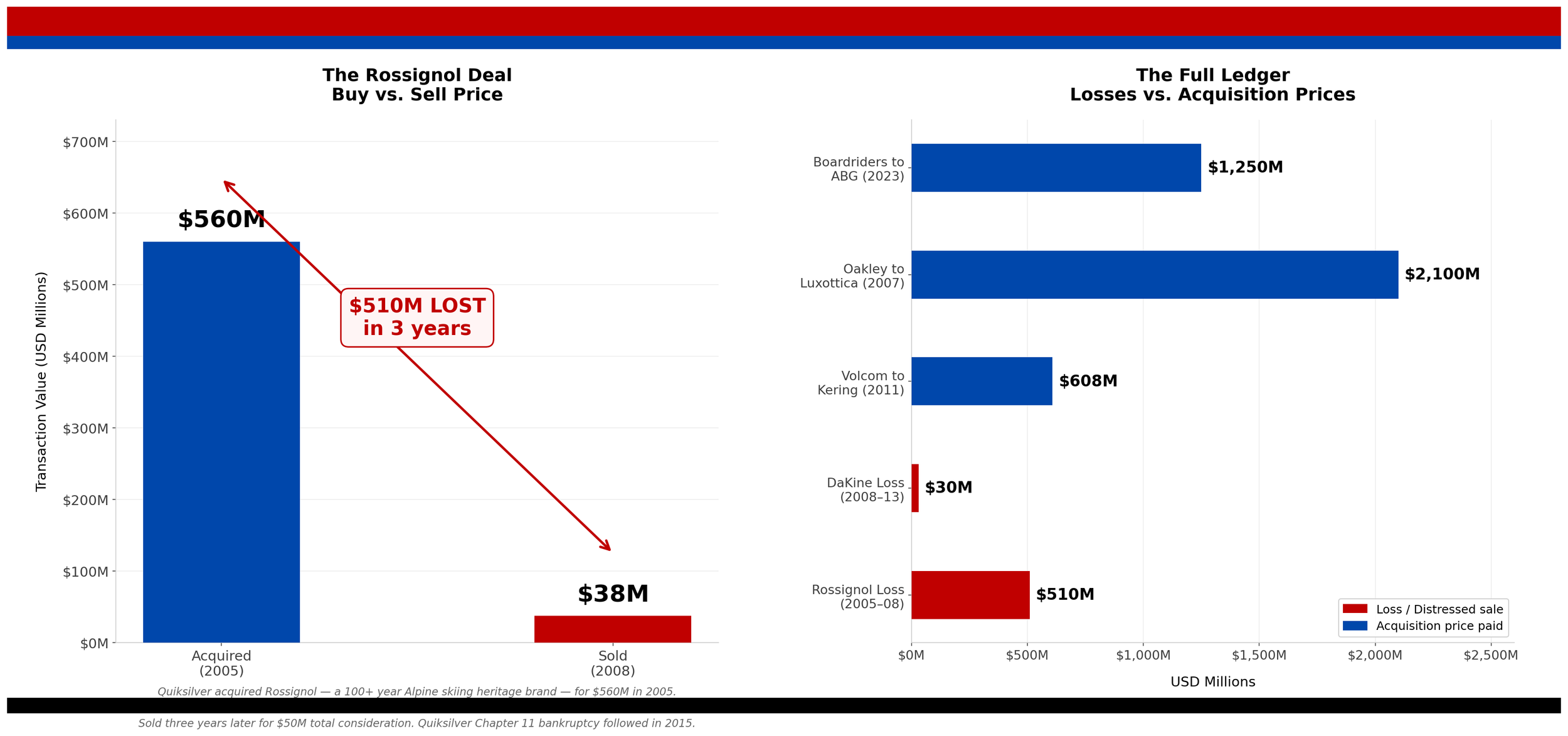
Volcom sold to Kering in 2011 for approximately $608 million. In 2019, Kering sold Volcom to Authentic Brands Group. The brand whose founders described themselves as youth against establishment when they launched it in 1991 is now a licensed property managed by a global IP aggregator in New York. Vans is owned by VF Corporation in Denver. Salomon and Atomic sit inside Amer Sports, majority-owned by Anta Sports of China. Oakley belongs to EssilorLuxottica in Paris. Rip Curl went to Kathmandu Holdings in Auckland in 2019. K2 is owned by Newell Brands of Atlanta, the same corporation that manufactures Rubbermaid, Sharpie markers, and Coleman camping gear.
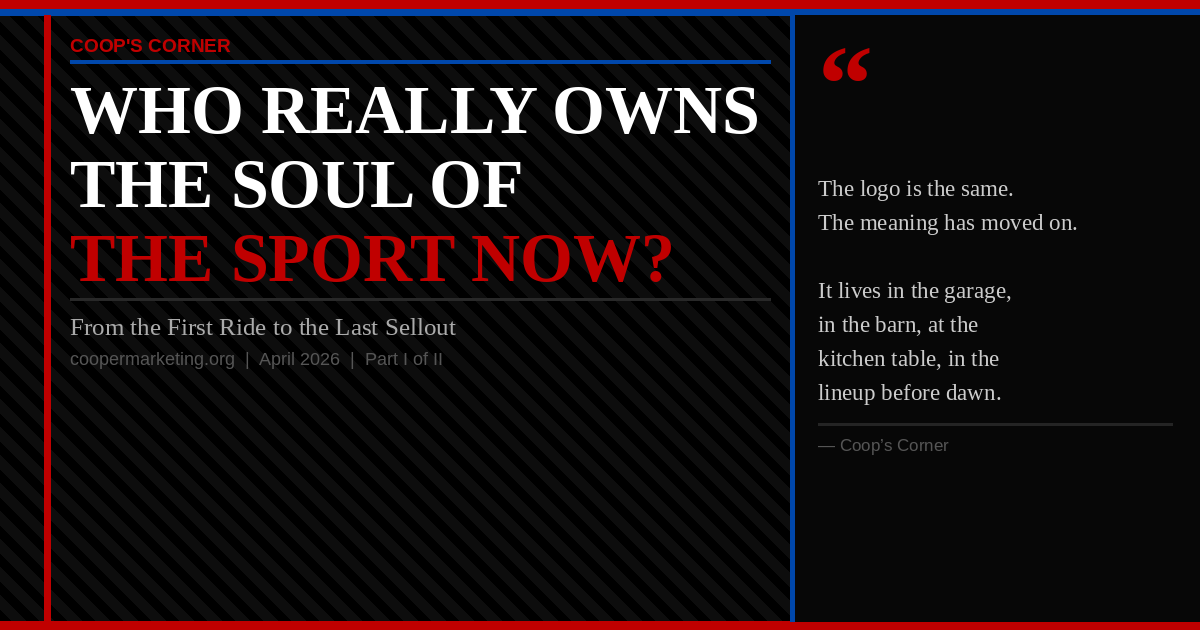
The logo is the same. The meaning has moved on. It lives in the garage, in the barn, at the kitchen table, in the lineup before dawn when nobody is watching.
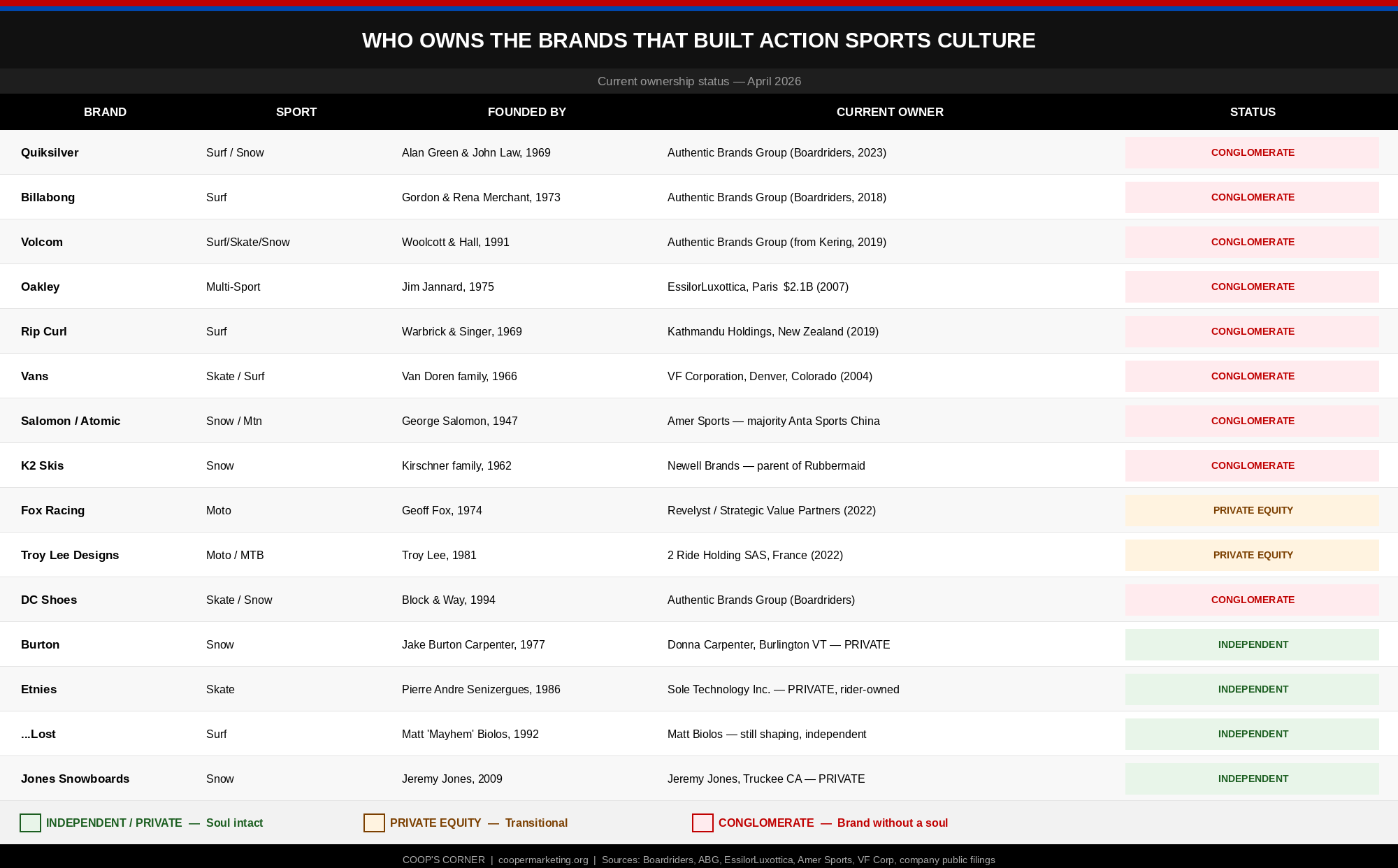
What remains privately held and rider-connected: Burton Snowboards under Donna Carpenter. Etnies and ThirtyTwo under Pierre Andre Senizergues at Sole Technology, one former professional skateboarder who has declined acquisition offers for nearly four decades. Matt Mayhem Biolos still shaping at Lost. Jeremy Jones at Jones Snowboards in Truckee, private, rider-first. Osiris, still independent. Moto XXX, still punk. Crusty Demons, still making films. These are not relics. They are evidence that the original model survives when the people running it are willing to protect it.
If you close this page right now, something will stay with you. A name. A shop you drove past once and knew mattered. A film you watched in someone's basement at nineteen and felt something shift that has never quite shifted back. That is the soul of the sport working exactly as it was designed to work. Part II is about what happened to it.
Picture the SIA show floor in Las Vegas, the well-advertised secret-brand party at 0200. The industry in one room. Handshakes that shaped seasons. The smell of carpet that had absorbed thirty years of stoke and hustle and negotiation. The morning COVID arrived, and that floor went dark, and the handshakes became Zoom calls, and the culture lost a room it has never recovered. The algorithm filled the silence. The ninety-second reel replaced the two-hour film. The CFO replaced the founder. The rep line got cut.
Part II tells the full story of what the machine did to what these people built, and it ends with the only question that matters now: who comes next? If something in Part I left a feeling unfinished in your chest, that is intentional. Part II is where it resolves. coopermarketing.org. Do not wait.