THE SAME DAMN PLAYBOOK - Different Desert, Same Lies
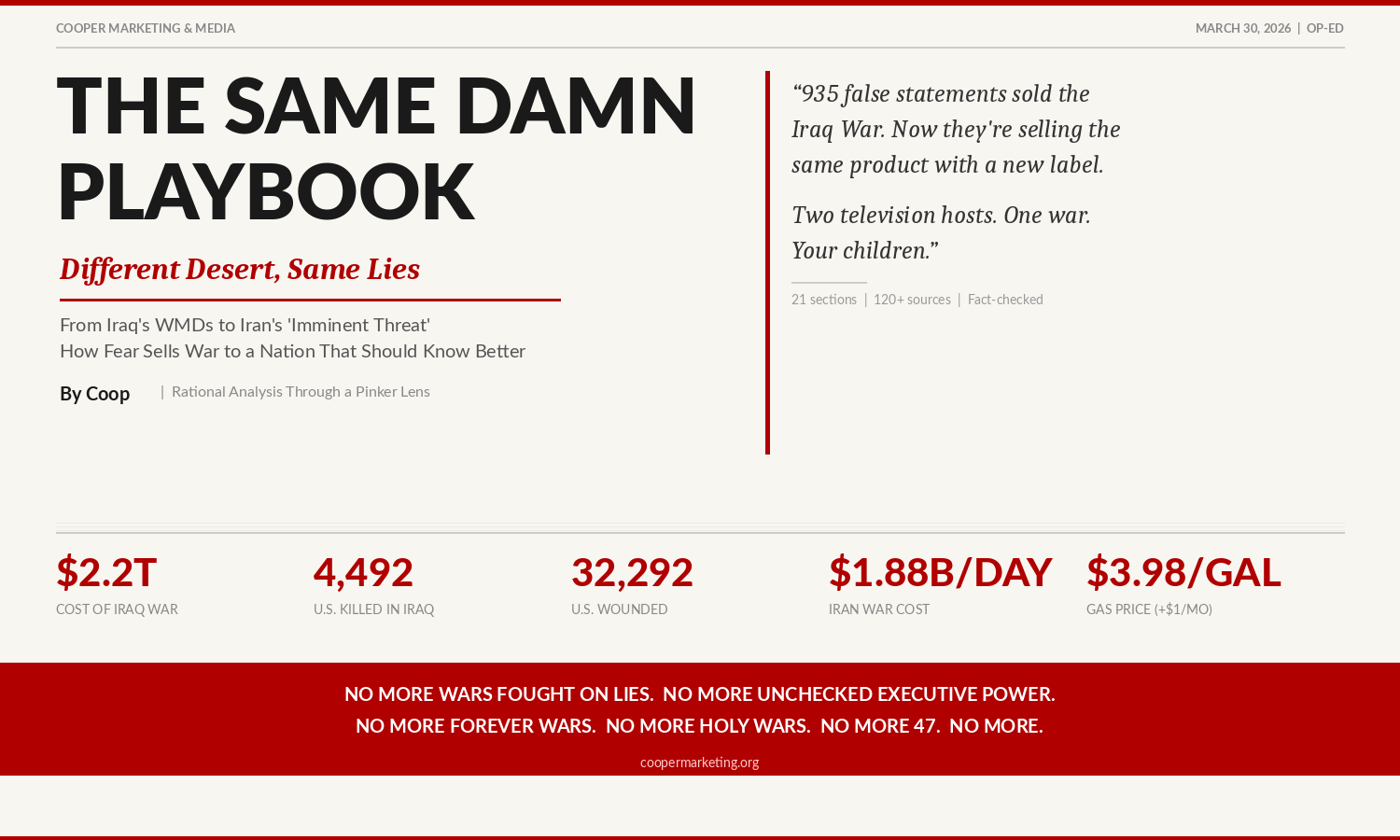
From Iraq’s WMDs to Iran’s ‘Imminent Threat’ — How Fear Sells War to a Nation That Should Know Better
By Coop | March 30, 2026
Op-Ed | Rational Analysis Through a Pinker Lens
I. A NOTE TO SELF — BEFORE WE BEGIN
I believed them.
I need to say that before I say anything else. In 2002 and 2003, I believed the administration. I believed Cheney when he said there was “no doubt” about weapons of mass destruction. I believed Rumsfeld when he rattled off that terrifying laundry list of chemical and biological agents. I believed Powell, a man I respected, a soldier’s soldier, when he sat in front of the United Nations Security Council and said, “What we’re giving you are facts and conclusions based on solid intelligence.”
I believed them. And I was wrong. And they were lying.
The Iraq War lasted from March 2003 to December 2011, nearly nine years of active combat, followed by years of continued operations. The cost: 4,492 American service members killed. 32,292 American service members wounded. Thousands more came home with traumatic brain injuries and PTSD that don’t show up in the wound count but destroy families just the same. Hundreds of thousands of Iraqi civilians dead. And for what?
For weapons that did not exist. For intelligence that was fabricated. For a war sold on fear.
And what is the status of Iraq today? Twenty-three years after we invaded, Iraq remains mired in corruption, a kleptocracy, according to its own government documents, with democratic governance impeded by militias operating outside the law. Over one million people remain internally displaced. Three million need humanitarian assistance. Iran, the very country we are now bombing, has become the dominant political influence in Baghdad. As Senator Rand Paul put it: “Iran is stronger and more of a menace because of the Iraq War. Iraq became a vacuum and then a sectarian-divided country closely aligned with Iran.”
We invaded Iraq to neutralize Iran’s rival. And we handed Iraq to Iran on a silver platter.
Libya? A quasi-failed state run by competing militias. Slave markets in a country we “liberated.” Syria? Half a million dead, millions displaced, and the country is still a charnel house. Afghanistan? Twenty years, $2.3 trillion, 2,324 Americans dead, and the Taliban sat back down in the same chairs we’d pulled them out of.
So when I hear the same language, the same cadence, the same urgency, the same “trust us”, being deployed about Iran, I don’t just hear echoes. I hear a warning. And this time, I’m listening.
II. WE’VE SEEN THIS MOVIE BEFORE
Here we are again. Same theater. Same seats. Same overwrought soundtrack of fear pumped through every cable news speaker in America. The only thing that’s changed is the map on the screen behind the podium. In 2003, it was Iraq. Today, it’s Iran. The playbook hasn’t been updated because it doesn’t need to be. It worked last time.
Steven Pinker, in “Rationality,” reminds us that human beings are spectacularly bad at assessing risk when fear enters the equation. We evolved to run from rustling bushes, not to parse intelligence briefings. The architects of American war know this. They have always known this. And right now, as the Pentagon prepares for what The Washington Post reports will be “weeks of ground operations in Iran,” those architects are counting on our amygdalas to override our prefrontal cortexes one more time.
Let’s not let them.
III. THE IRAQ TEMPLATE: 935 LIES AND COUNTING
The Center for Public Integrity documented that President George W. Bush and seven senior administration officials made at least 935 false statements about Iraq’s national security threat in the two years following September 11, 2001. Nine hundred and thirty-five. Let that number settle. Bush alone made 232 false statements about weapons of mass destruction. Colin Powell made 244.
Here’s what they sounded like:
“Simply stated, there is no doubt that Saddam Hussein now has weapons of mass destruction.”— Vice President Dick Cheney, August 26, 2002
“What we’re giving you are facts and conclusions based on solid intelligence.”— Secretary of State Colin Powell, UN Security Council, February 5, 2003
“Iraq has large, unaccounted-for stockpiles of chemical and biological weapons, including VX, sarin, mustard gas, anthrax, botulism, and possibly smallpox… and an active programme to acquire and develop nuclear weapons.”— Defense Secretary Donald Rumsfeld, January 20, 2003
And it wasn’t just Republicans. The fear machine swallowed Democrats whole. Twenty-nine of fifty Democratic senators voted for the Authorization for Use of Military Force Against Iraq.
“I do not believe this is a rush to war. I believe it is a march to peace and security.”— Senator Joe Biden, October 2002
Biden later admitted it was “a mistake.” Powell said he was “mortified” by his UN presentation. Every single one of them knew, or should have known, that the intelligence was, at best, sketchy and incomplete. Experts within the U.S. government raised alarms. They were ignored. They were discredited. The war machine does not tolerate dissent.
The final tab for Iraq? Brown University’s Costs of War project puts it at $2.2 trillion. Harvard economists estimate $3 trillion. The human cost: 4,492 American service members dead. 32,292 wounded. Estimates of Iraqi civilian casualties range from 150,000 to over 600,000. For weapons of mass destruction that did not exist.
IV. THE HYPOCRISY HALL OF FAME: THEIR OWN WORDS, THEN AND NOW
Before we go any further, let’s pause and do something the cable news cycle never does: let’s hold people’s words next to their actions and see if they match.
Because the same people now marching us toward boots on the ground in Iran spent years, years, telling you that Iraq and Afghanistan were catastrophic mistakes. Both sides of the aisle. Here are their words. Remember them.
Donald J. Trump:
“GOING INTO THE MIDDLE EAST IS THE WORST DECISION EVER MADE IN THE HISTORY OF OUR COUNTRY! We went to war under a false & now disproven premise, WEAPONS OF MASS DESTRUCTION. There were NONE!” — Donald Trump, October 9, 2019
“The single worst decision ever made was going into the Middle East, by President Bush.”— Donald Trump, 2018
“We should have never been in Iraq. They lied. They said there were weapons of mass destruction. There were none and they knew that there were none.”— Donald Trump, Republican Debate, February 2016
“We have wasted an enormous amount of blood and treasure in Afghanistan. Afghanistan is a complete waste. Time to come home!”— Donald Trump, various tweets, 2012–2013
“I was elected on getting out of these ridiculous, endless wars, where our great Military functions as a policing operation to the benefit of people who don’t even like the USA.”— Donald Trump, October 2019
That was then. Now, the same man has launched “Operation Epic Fury” without congressional authorization, is weighing 10,000 additional troops for the Middle East, and his own Treasury Secretary is promising to “retake control” of the Strait of Hormuz. The “peace president” is now the war president. And his base knows it.
The MAGA base, in their own words:
“A ground invasion of Iran will make our country poorer and less safe.”— Matt Gaetz, CPAC, March 2026
“We stayed for decades in Iraq, and we ended up giving the country to Iran. After 20 years in Afghanistan, we just ended up giving it back to the Taliban.”— Matt Gaetz, 2026
“I would say stay concerned. Be concerned. Be vigilant. Hold our feet to the fire. Keep us honest on that issue. Nobody’s above reproach. Just don’t tell the president I said that.”— Rep. Tim Burchett (R-TN), March 2026
“I don’t think I’d want to vote for another Iraq thing again—be there for 20 years.”— Rep. Tim Burchett (R-TN), March 2026
“Regime change and nation-building don’t work and cost too much. Iran is stronger and more of a menace because of the Iraq War.” — Sen. Rand Paul (R-KY)
And on the Democratic side:
“I do not believe this is a rush to war. I believe it is a march to peace and security.” — Sen. Joe Biden (D-DE), October 2002 — later called it “a mistake.”
The hypocrisy is bipartisan. But the current war belongs to one party, one president, and one Congress that refuses to exercise its constitutional duty. The Democrats who voted for Iraq learned their lesson, too late, and at a cost of trillions and thousands of lives. The question is whether the Republicans cheerleading for Iran will learn theirs before the body bags come home.
V. THE REALITY TV WAR: WHO IS ACTUALLY LEADING US INTO THIS?
Before we go any further into the details of this war, let us pause and ask the question that Pinker would insist we ask: Who, precisely, is making the decisions that will determine whether American soldiers live or die in Iran?
The Commander in Chief is a former reality television host. Donald Trump hosted The Apprentice and Celebrity Apprentice for fourteen seasons on NBC, from 2004 to 2015. He earned an estimated $213 million from the show. His primary professional credential before entering politics was firing people on camera for entertainment. He has six Chapter 11 business bankruptcies. He called Iraq “the single worst decision ever made” and then launched a war with a country three times Iraq’s size.
The Secretary of Defense is a former weekend television host. Pete Hegseth co-hosted Fox & Friends Weekend for nearly eight years, from 2017 to 2024. He served honorably as a platoon leader in Iraq and a captain in Afghanistan, earning two Bronze Stars. That service is real and deserves respect. But his combat experience as a junior officer is vastly outweighed by his lack of organizational leadership at any scale. He has never commanded a battalion. He has never commanded a brigade. He has never led a division. He has never run an organization larger than two small nonprofits, both of which faced financial mismanagement allegations. He was confirmed 51 to 50, with Vice President Vance casting the tiebreaker after three Republicans, including Mitch McConnell, voted against him.
McConnell’s words deserve to be remembered: “Effective management of nearly 3 million military and civilian personnel, an annual budget of nearly $1 trillion, and alliances and partnerships around the world is a daily test with staggering consequences. Mr. Hegseth has failed, as yet, to demonstrate that he will pass this test.”— Sen. Mitch McConnell (R-KY), January 2025
Senator Susan Collins said plainly: “He does not have the experience and perspective necessary to succeed in the job.” Senator Murkowski raised “significant concerns about standards of behavior and character.” These were Republicans. Warning their own party. About a man who now oversees the largest military operation since the invasion of Iraq.
And what has the Secretary of War done with that authority? He renamed the Department of Defense to the “Department of War” at a cost the CBO estimates could reach $125 million. He removed at least 24 generals and admirals from their positions in fourteen months through firings, forced reassignments, and blocked promotions, the most sweeping purge of military leadership in modern American history. He fired the Chairman of the Joint Chiefs, the Chief of Naval Operations, the Vice Chief of Staff of the Air Force, the Coast Guard Commandant, the Director of Defense Intelligence, and every service’s Judge Advocate General. He dissolved the Pentagon’s civilian harm assessment office. He blocked promotions of officers he deemed ideologically suspect. And he told a room full of generals at Quantico: “If the words I’m speaking today are making your heart sink, then you should do the honorable thing and resign.”
They did. In numbers that military historians call unprecedented.
Retired General Stanley McChrystal, former commander of U.S. and NATO forces in Afghanistan, said: “I’m disappointed by the current atmosphere that is communicated from the top. I had the honor and opportunity to serve with some of the most elite forces, people who really did some extraordinary things, but they didn’t beat their chest about it.” He warned that the bombing campaign in Iran “may have already peaked in effectiveness, and everything that follows will be harder.”
Retired Major General Randy Manner assessed Hegseth’s wartime rhetoric and concluded: “Those are the words of a potential war criminal right there.”
Rear Admiral Nancy Lacore, fired by Hegseth in August 2025, said he is “focused on politics, not personnel” and that his actions send “a message to women and Black service members that they are not wanted, welcomed, or qualified.”
Meanwhile, Hegseth goes on camera and declares, “America is winning, decisively, devastatingly, and without mercy.” He built a personal “beautification studio” next to the Pentagon briefing room. The Pentagon is releasing propaganda videos set to “Boom Boom” by John Lee Hooker, mashing up missile strikes with football tackles and baseball hits. Explosions timed to the crack of a bat.
This is not a war being run by generals. This is a war being produced by television hosts. And if that does not terrify you, consider what Hegseth wrote in his 2020 book, “American Crusade”:
“We Christians, alongside our Jewish friends and their remarkable army in Israel, need to pick up the sword of unapologetic Americanism and defend ourselves. We must push Islamism back, culturally, politically, geographically, and in the case of evils such as the Islamic State, militarily.”— Pete Hegseth, “American Crusade,” 2020
He called it a “crusade moment,” echoing the eleventh century. He wrote: “We don’t want to fight, but, like our fellow Christians one thousand years ago, we must.” He praised the actual Crusaders. And now he is the Secretary of Defense, waging a war against a Muslim nation, while quoting scripture. This is not a rational basis for military policy. This is not a strategic framework. This is a holy war being sold as national security by a man who went from a weekend television couch to the E-Ring of the Pentagon in 90 days.
Two television hosts. One who made his career saying “You’re fired.” One who spent eight years saying “bomb them” from a studio couch. And now they are sending your children to Iran.
VI. IRAN 2026: THE SEQUEL NOBODY ASKED FOR
On February 28, 2026, the United States and Israel launched surprise airstrikes across Iran under the name “Operation Epic Fury.” The strikes killed Supreme Leader Ali Khamenei and inflicted dozens of civilian casualties. Congress was not consulted. No declaration of war was sought. No authorization was given.
Now listen to the justifications and tell me they don’t sound familiar:
“Iran was building powerful missiles and drones to create a conventional shield for their nuclear blackmail ambitions. This jeopardized our bases, our people, our allies.”— Defense Secretary Pete Hegseth, March 2026
“They were stalling, buying time to reload their missile stockpiles and restart their nuclear ambitions.”— Defense Secretary Pete Hegseth, March 2026
“Iran was producing 100 ballistic missiles a month… put themselves in a place of immunity where the damage they can inflict on the region would be so high that no one can do anything about their nuclear program.”— Secretary of State Marco Rubio, March 2026
Compare these to Cheney’s “there is no doubt” and Rumsfeld’s laundry list of phantom weapons. The rhetorical structure is identical: imminent threat, urgent timeline, no time to debate, trust us. The administration declined to present a legal justification to the public. Rubio couldn’t provide a full accounting to Congress. The White House’s stated war objectives have shifted repeatedly, from destroying missiles to dismantling Iran’s navy to preventing nuclear development to cutting off terrorist funding, a moving goalpost that NPR documented as changing week to week.
And then, in a move that would be comedy if it weren’t tragedy, the President threw his own Defense Secretary under the bus, blaming Hegseth for the war’s escalation. The Commander-in-Chief, pointing at his own appointee and saying, “He didn’t want it settled.” This is not the behavior of a leader with a coherent strategy. This is the behavior of a man looking for an exit from a room he set on fire.
VII. THE RIGHT-WING MEDIA MACHINE GREASES THE RUNWAY
If you want to understand how boots get on the ground before Congress even votes, watch the media pipeline. It is not subtle. It is not hidden. It is happening in plain sight, on the channels your neighbors watch.
On Saturday night, March 29, President Trump posted on Truth Social: “Watch Mark Levin interview of Brilliant Marc Thiessen tonight”, a post that said the interview would “discuss the importance of hitting Iran, HARD!!” Hours later, Levin went on Fox News and made the pitch:
“Why would we need troops on the ground? Well, there’s a lot of reasons—and we wouldn’t need 300,000 of them.”— Mark Levin, Fox News, March 29, 2026
Levin argued for sending “specialized” U.S. ground troops into Iran to seize enriched uranium stockpiles. He referenced the 2,000 troops from the 82nd Airborne as the right scale for the mission. The President promoted the segment. The segment promoted the invasion. The invasion is being planned at the Pentagon. This is the pipeline: Truth Social to Fox News to the 82nd Airborne. It’s a conveyor belt from propaganda to policy, and it is running at full speed.
Newsmax, meanwhile, is running its own two-track coverage. On March 29, Newsmax reported that the Pentagon is preparing for “weeks of ground operations”, including precision raids by Special Operations and conventional infantry. They ran the headline straight: “Pentagon Preps ‘Final Blow’ Options for Iran as Trump Eyes Endgame.” That’s not journalism. That’s a press release for war. In the same breath, even Newsmax’s own Carl Higbie said on air: “You lose support for me if you put boots on the ground in combat roles.” The right-wing base is being told the invasion is coming, and simultaneously being told it won’t really be an invasion. Sound familiar?
Fox News reported Trump is considering sending up to 10,000 additional troops to the Middle East. That’s on top of the roughly 5,000 Marines already deployed and thousands of 82nd Airborne paratroopers already ordered to the region. The Pentagon’s own timeline? “Weeks, not months.” Those exact words. The same words they used about Iraq. And Iraq lasted twenty years.
VIII. WHERE THE HELL DID THIS COME FROM, AND WHO’S GOING TO HELP?
That’s the question every American should be asking after yesterday’s Sunday show circuit. Because on March 29, 2026, two senior Republicans went on national television and did what senior Republicans do best in wartime: they left the door wide open while pretending they were just looking out the window.
House Majority Leader Steve Scalise, on ABC’s “This Week,” was asked point-blank about boots on the ground in Iran. His response:
“There are no boots on the ground today, but we’re having a lot of conversations about what could happen next.”— House Majority Leader Steve Scalise, ABC News, March 29, 2026
Read that again. “A lot of conversations about what could happen next.” That is not a denial. That is not a no. That is a man rehearsing his future position so that when troops land, he can say he warned us. When pressed on whether Trump would need congressional authorization, Scalise dodged entirely, claiming Trump had “already done that”, a statement with no basis in fact or law. He added: “Obviously, you’re seeing troop movement and we’ve got a number of bases in that region, too, that have been there for a long time.” Translation: the machinery is already in motion. Stop asking questions.
Meanwhile, over on NBC’s “Meet the Press,” Senator James Lankford of Oklahoma was performing the same careful dance:
“The worst thing that can happen is to be able to have this kind of conflict start and to not end it, to leave it undone. We’ve got to be able to finish this.”— Sen. James Lankford, NBC Meet the Press, March 29, 2026
When asked directly if he would support ground operations, Lankford said it “depends on what boots we’re putting on the ground,” distinguishing between special forces that “get in, get out” and long-standing occupation. But here’s the tell: when asked whether Trump needed congressional authorization, Lankford hedged, saying it was “contingent” on how the troops were used, that defending Americans “for a season” was “very, very different” from a long-standing war. That’s the predicate language. That’s the rhetorical scaffolding being built in real time so that when the 82nd Airborne touches down in Iran, the GOP can call it a “temporary security operation” and not a war.
We heard the same thing in 2003. “Weeks, not months,” they told us. Iraq lasted twenty years.
And then there’s Treasury Secretary Scott Bessent, who this morning told Fox News:
“Over time, the US is going to retake control of the straits, and there will be freedom of navigation — whether it is through US escorts or a multinational escort.”— Treasury Secretary Scott Bessent, Fox News, March 30, 2026
“Retake control.” Let those words land. The Treasury Secretary of the United States, not the Secretary of Defense, not the Chairman of the Joint Chiefs, the man who runs the checkbook is now talking about military control of one of the most strategically vital waterways on Earth. The Strait of Hormuz, through which 20% of the world’s oil supply passes daily. And he’s floating “U.S. escorts or a multinational escort” as though he’s describing a carpool arrangement and not a permanent naval occupation of a foreign chokepoint.
And then there is the Secretary of Defense himself. Hegseth told 60 Minutes: “We’re willing to go as far as we need to go.” When asked directly whether U.S. troops are in Iran, he replied: “No, but we’re not going to go into the exercise of what we will or will not do.” He added: “We reserve the right. We would be completely unwise if we did not reserve the right to take any particular option, whether it included boots on the ground or no boots on the ground.” That is not a denial. That is a promise dressed as ambiguity.
On the war’s duration, Hegseth offered this: “You can say four weeks, but it could be six, it could be eight, it could be three.” Remember those words. Because in 2003, they told us Iraq would be “weeks, not months.” Iraq lasted twenty years.
And then there is Senator Lindsey Graham, the man who has never seen a war he didn’t want someone else’s children to fight. Graham went on Fox News and declared:
“When this regime goes down, we are going to have a new Middle East, and we are going to make a ton of money.” — Sen. Lindsey Graham (R-SC), Fox News, March 9, 2026
Read that again. “Make a ton of money.” He said the quiet part out loud. This is not about national security. This is about oil. Graham noted that “Venezuela and Iran have 31 percent of the world’s oil reserves” and that after regime change, the U.S. would have “a partnership with 31 percent of the known reserves.” He is not selling freedom. He is selling futures contracts.
Graham then invoked the bloodiest battle in Marine Corps history to justify an island invasion:
“We did Iwo Jima, we can do this. Keep it up for a few more weeks, take Kharg Island where all of the resources they have to produce oil, control that island, let this regime die on a vine.”— Sen. Lindsey Graham (R-SC), Fox News, March 22, 2026
Republican Rep. Nancy Mace responded: “Graham has one foreign policy: send someone else’s kids to war.” She is right. And Graham has been right before, too. In 2003, he voted for the Iraq Resolution, saying: “It is long past time for Saddam Hussein to be replaced.” That worked out splendidly.
But perhaps Graham’s most revealing statement came when he described the broader vision: “We’re marching through the world. We’re clearing out the bad guys. Cuba is next.” He called Trump “Ronald Reagan plus” and said he is “resetting the world.” This is not foreign policy. This is empire. And they are not even pretending otherwise.
Where did this come from? Who authorized this expansion of war aims? And who, precisely who, is going to help? Because the coalition, as we will establish, is a diplomatic mirage. Seven nations signed a statement about the Strait of Hormuz that committed zero ships. Asian and European partners said openly that this is not their war. And now the Treasury Secretary is promising “multinational escorts” that do not exist.
IX. YOUR SONS AND DAUGHTERS: THE DRAFT THEY SAY ISN’T COMING
Here is what they don’t want you to connect: the dots between a war that keeps expanding and a military that cannot sustain it.
In fiscal year 2023, the U.S. military missed its recruitment targets by 41,000 people. The Army recruited just 50,000 soldiers against a goal of 65,000, a 25% shortfall, the worst since the end of the draft in 1973. The Navy fell 7,000 short. Only the Marines met their numbers. The Pentagon called it a “recruiting crisis.” Because that’s what it was.
By 2025, the military clawed back to meeting its targets, barely. The Army hit 62,050 against a goal of 61,000. But here’s the problem: only 23% of Americans aged 17–24 even qualify for military service. Physical fitness, academic qualifications, and legal disqualifiers have shrunk the eligible pool to its smallest size in modern history. And that was before we started a war with a nation of 88 million people.
Now consider what’s happening right now: the Pentagon is weighing 10,000 additional troops for the Middle East. The 82nd Airborne, 2,000 to 3,000 paratroopers, has already been ordered to deploy. Roughly 5,000 Marines are already in theater. Fox News reports the total could climb significantly if ground operations are approved. Military.com is already asking the question: “Can the recruiting surge last in a war with Iran?”
And while they tell you a draft is “highly unlikely,” let’s talk about what they’ve already done to prepare for one.
On December 18, 2025, President Trump signed the FY2026 National Defense Authorization Act into law. Section 535 of that law mandates automatic Selective Service registration. Starting December 2026, the government will use federal databases, Social Security records, DMV records, to automatically register every eligible male aged 18 to 25. No more signing up at the post office. Uncle Sam will find you. The Gilmer Mirror called it: “Uncle Sam Will Now Find You.”
This is the largest change to Selective Service law since 1980. Analysts describe it as moving the United States “closer to being able to activate a draft on demand than at any point in the past half century.”
Let’s be rational about this. They tell you there’s no draft coming. Fine. Then why did they just automate the system that makes a draft possible? Why did they build the database? Why did they sign it into law while simultaneously launching a war against the largest, most militarily capable nation the U.S. has engaged since Vietnam?
The answer is the same answer it’s always been: they’re preparing for what they know is coming. The troop numbers don’t add up. A ground invasion of Iran would require forces the all-volunteer military cannot sustain. And when the shortfall comes, when the 82nd Airborne is stretched thin, and the Marines are rotating on six-month deployments, they will come for your sons. And if Congress eventually extends registration to women, your daughters, too.
This is not fear-mongering. This is the math. And the math doesn’t care about talking points.
X. ISRAEL AND NETANYAHU: THE PARTNER WE DON’T HOLD ACCOUNTABLE
Let us not, for one moment, let Israel and Prime Minister Benjamin Netanyahu off the hook in this story. Because the trail of devastation Israel is leaving behind across the Middle East is not a footnote. It is the context in which this entire war is being waged.
Since October 7, 2023, Israel’s military campaign in Gaza has killed more than 72,000 Palestinians, according to Gaza’s Health Ministry, a figure that even the Israeli army has acknowledged as broadly accurate. Of those killed, an estimated 80% were civilians. UN Women estimates more than 28,000 women and girls among the dead. At least 17,400 children have been killed.
Let me say that number again: seventeen thousand four hundred children.
In Lebanon, Israeli strikes have killed more than 1,094 people since early March 2026. According to the Armed Conflict Location and Event Data project, 80% of Lebanese killed were slain in attacks targeting only or mainly civilians. NBC News reports fears that Israel is replicating its “Gaza model” in Lebanon, systematic destruction of civilian infrastructure, displacement of over 1.2 million people, and the creation of what the United Nations has called a “humanitarian catastrophe.”
Netanyahu announced Israel is “expanding” its buffer zone in Lebanon. Expanding. Not defending. Not withdrawing. Expanding. This is not self-defense. This is territorial conquest dressed in the language of security.
And now we are yoked to this partner in a war against Iran, a war Israel helped precipitate, a war we launched jointly, and a war whose costs in blood and treasure are being borne overwhelmingly by American taxpayers and, soon, American soldiers. Since October 7, 2023, the U.S. has provided Israel with $21.7 billion in military aid. American taxpayers have funded U.S. operations in support of Israel across Yemen, Iran, and the wider Middle East at a cost of $9.65 to $12.07 billion. Total American tab connected to Israel’s conflicts: north of $33 billion and climbing. The question a rational citizen must ask: at what point does unconditional support for an ally’s military campaigns become complicity in their consequences?
XI. THE REGIME CHANGE GRAVEYARD: NAME ONE SUCCESS
Here is a challenge for every hawk on cable news, every senator leaving the door open for boots on the ground, every talking head invoking “finishing the job”: Name one successful U.S. regime change operation in the Middle East. Just one.
Take your time. We’ll wait…
Iran, 1953: The CIA orchestrated the overthrow of Prime Minister Mohammad Mossadegh after he nationalized Iran’s oil industry. We installed the Shah. The Shah’s autocratic rule fueled the opposition that became the 1979 Islamic Revolution, which gave us the very regime we are now bombing. We created our own enemy. Congratulations.
Afghanistan, 2001–2021: We toppled the Taliban. Twenty years, $2.3 trillion, and 2,324 American service members later, the Taliban walked back into Kabul and sat in the same chairs. The same chairs. The entire exercise was a two-decade, multi-trillion-dollar round trip.
Iraq, 2003–2011: We removed Saddam Hussein based on fabricated intelligence. The power vacuum birthed al-Qaeda in Iraq, which became ISIS, the most dangerous terrorist organization of the 21st century. We created a failed state, a refugee crisis, and a terrorist army. Cost: $2.2 trillion. American dead: 4,488. Iraqi civilians: hundreds of thousands.
Libya, 2011: NATO-backed intervention toppled Muammar Gaddafi. Today, Libya is a quasi-failed state run by competing militias and rival governments. Slave markets opened in a country the West supposedly “liberated.”
Syria, 2011–present: Assad watched Gaddafi’s fate on television and cracked down harder. U.S.-backed opposition efforts produced a multi-sided civil war, half a million dead, millions displaced, and the rise of ISIS across the Syrian border.
As Foreign Affairs concluded: “Since the 1950s, the United States has tried to oust governments in the broader Middle East once every decade, on average. All these attempts have one thing in common: they failed.”
And now they want to do it again. In Iran. A country with 88 million people, three times Iraq’s population. A country four times Iraq’s landmass. A country whose military has spent forty years gaming exactly this scenario. Academics who study intervention are clear: “American policymakers overstated the threat, underestimated the challenges of ousting a regime, and embraced the optimistic assurances of exiles or local actors with little power.” Every single time.
And let’s talk about the leaders we installed or backed along the way. The “winners” of American regime change:
Manuel Noriega (Panama): CIA asset turned dictator. We invaded Panama to remove him in 1989. He was convicted of drug trafficking, money laundering, and racketeering. Sentenced to 40 years. Died in a Panamanian prison in 2017. Winner.
Augusto Pinochet (Chile): CIA-backed coup in 1973 installed a military junta that killed or disappeared more than 3,000 people, tortured more than 40,000, and ruled for 17 years. Chile is still grappling with his legacy fifty years later. Winner.
Alberto Fujimori (Peru): U.S.-supported strongman. Convicted of human rights violations, kidnappings and murders by his Grupo Colina death squad. Sentenced to 25 years. The first elected head of state ever convicted of human rights abuses. Died in 2024. Winner.
The Shah of Iran: Installed by the CIA in 1953 after we overthrew Mossadegh. His autocratic rule fueled the 1979 Islamic Revolution that gave us the Ayatollahs, the very regime we are now at war with. The Shah fled Iran and died in exile in Egypt. We created the enemy we’re bombing today. Winner.
Hamid Karzai (Afghanistan): Installed by the U.S. in 2001. His government “self-organized into a kleptocracy,” according to its own documents. Billions in foreign aid diverted to private accounts. The Kabul Bank operated as a Ponzi scheme. When the Taliban returned in 2021, Karzai personally invited them in “to prevent chaos.” Twenty years, $2.3 trillion, and we handed the country back. Winner.
Noriega. Pinochet. Fujimori. The Shah. Karzai. That’s the roster. That’s America’s regime change all-star team. Convicted war criminals, deposed dictators, kleptocrats, and a man who invited the Taliban back to Kabul. Wow. Now that’s a list of WINNERS.
The definition of insanity is not doing the same thing and expecting different results. The definition of insanity is watching it fail every single time, and then doing it again with a bigger, better-armed adversary, while the man who called Iraq “the single worst decision ever made” sends the 82nd Airborne to do it all over again.
XII. THEY CAN’T WIN, BUT THEY DON’T HAVE TO
Let’s be honest about something the hawks on cable news will never say: Iran cannot defeat the United States in a conventional war. Their air force is obsolete. Their navy is outmatched. In a head-to-head engagement, the U.S. military would overwhelm them.
But here’s what Fox News and Newsmax and Mark Levin will never tell you: they don’t have to win. They just have to survive. And surviving is what Iran does.
Iran fought Saddam Hussein’s Iraq for eight years, from 1980 to 1988, in one of the most brutal wars of attrition since World War I. Trench warfare. Chemical weapons. Human-wave assaults. Between 500,000 and one million people died. The war ended in a stalemate. Iran did not win. But Iran did not break.
That is Iran’s playbook. Not victory. Endurance.
Fox News’ own military analysts have described Iran’s military as “built to survive, not win a conventional war.” Foreign Policy magazine reported that Iran’s biggest wartime advantage is geography: the Zagros Mountains form a 1,600-kilometer barrier along the western border, with peaks exceeding 4,000 meters. Iran’s major cities sit in mountain foothills. There are no hundreds of miles of flat desert for an American “thunder run.” This is not Iraq. This is a natural fortress.
Iran is nearly four times larger than Iraq. Its population is 88 million, three times Iraq’s. Military experts estimate that a serious ground invasion would require up to 1.6 million troops, the largest American military operation since World War II. We don’t have those troops. We won’t have those troops. And Iran knows it.
So what is Iran doing? Exactly what the experts predicted. UNSW analysts wrote that “Iran can’t win this war, but it can force a U.S. retreat using four insurgency tactics.” CNBC reported that experts say the administration’s insistence this won’t be a “forever war” is contradicted by every military reality on the ground. RAND Corporation analysts confirmed that Iran is pursuing “an asymmetric war of attrition focused on exhausting U.S., Israeli, and allied resources.”
Iran’s “mosaic defense” strategy decentralizes its command structure so that no single strike, not even killing the Supreme Leader, can decapitate the resistance. A Shahed-136 drone costs Iran between $20,000 and $50,000. The U.S. interceptor missile that shoots it down costs millions. Do the math. They will drain us with $50,000 drones while we burn through billion-dollar weapons systems. Day after day. Week after week. Month after month.
Iraq did not win the war either. But Iraq drained $2.2 trillion from the American treasury. Iraq sent 4,492 Americans home in flag-draped coffins, coffins the Bush administration tried to hide from the public by banning photographs at Dover Air Force Base. Iraq wounded 32,292 American service members. Iraq lasted nine years of active combat and twenty years of aftermath. Iraq did not win. But Iraq broke something in this country that we still haven’t fixed.
Iran is bigger. Iran is stronger. Iran has had forty years to prepare for this exact fight. And Iran’s strategy is not to beat us. It is to bleed us. Slowly. Expensively. One coffin at a time.
Are we ready for more flag-draped coffins?
More importantly, are you ready to have your son or daughter sent home in one?
That is a dark question. It is supposed to be. Because that is what is going to happen. Not by your choice. Not by a vote you cast. But at the hands of senators who hedge on Sunday morning television. At the hands of congressmen and congresswomen who block war powers resolutions by margins of seven votes. At the hands of a president who called Iraq the “single worst decision ever made” and then launched a war with a country three times Iraq’s size. At the hands of an administration that is planning “weeks of ground operations” while the Treasury Secretary talks about “retaking control” of a foreign strait. At the hands of 47 and every person in his orbit who chose this. Not you. Them.
Your son. Your daughter. Their choice.
XIII. THE POST-IRAN NIGHTMARE: WHAT DOES “WINNING” LOOK LIKE?
Let’s say we “win.” Let’s say the 82nd Airborne takes Tehran. Let’s say the regime collapses. Confetti. Ticker tape. Mission accomplished.
Now what?
Because nobody on Fox News, nobody in the Sunday show green rooms, nobody at the Pentagon podium has answered the only question that matters: What does the day after look like?
War on the Rocks, a publication read by the military professionals actually doing the fighting, published their worst-case scenario in March 2026. It reads like a horror novel: “Iran descends into a chaotic civil war with competing armed factions and separatist movements that drives sustained high oil and gas prices, triggers a massive refugee crisis, destabilizes the region, and fuels new or reinvigorated terrorist movements.”
The Brookings Institution warned that “the U.S. must prepare for the likelihood of Iran’s full implosion, fragmentation, and the spread of chaos that would make the aftermath of misadventures in Iraq and Libya look minor by comparison.” Minor. Iraq, where we created ISIS, would look minor.
The refugee math alone is staggering. Iran has 88 million people. The Cato Institute estimated that a displacement of just 10% of Iran’s population, 9 million people, would far outnumber the total number of Syrians who fled their country during the entire civil war. War on the Rocks modeled a worst-case displacement of 23.4 million people. Twenty-three million refugees. Where do they go? Who feeds them? Who houses them? Us?
And who fills the vacuum? The Foundation for Defense of Democracies warned: “Beware Turkey’s ambitions in the post-Iran power vacuum.” Turkey is already the dominant external power in post-Assad Syria. Ankara is backing Hamas and Hezbollah’s remnants in Lebanon. Qatar, controlling 12% of the world’s energy, is bankrolling Turkey’s regional expansion. Foreign Policy reported that Turkey replaced Iran as “the dominant external power in Syria” after Assad’s fall in December 2024. A collapsed Iran hands Erdogan the keys to the Middle East.
Iran’s proxy network doesn’t collapse. It metastasizes. The Stimson Center found that “the Axis of Resistance is not collapsing in unison, it is splintering into five separate conflicts, each driven by local logic rather than Iranian strategic direction.” The Houthis in Yemen have existed for decades without Iranian assistance and will persist regardless. Iraqi militias are increasingly autonomous. Hezbollah’s military cadre has gone to ground. These groups don’t need Tehran’s permission to fight. They become more dangerous without a central command, not less.
And here’s the nightmare that should keep every Pentagon planner awake at night: War on the Rocks warned that “the fragmentation of Iran would inevitably reignite the Kurdish Question with explosive intensity, birth a constellation of nuclear warlords operating outside the logic of deterrence, and open a super-highway that enables a resurgent ISIS-K and Al-Qaeda to reach the Mediterranean.”
We removed Saddam and got ISIS. We removed Gaddafi and got slave markets. We removed the Taliban and they came back. Now we’re going to remove the ayatollahs and get what? A stable, democratic Iran of 88 million people who just watched us bomb their cities? Name the plan. Name the leader. Name the timeline. Name the exit.
They can’t. Because there is no plan. There never is.
XIV. WHILE WE’RE LOOKING AT IRAN, THE WORLD IS WATCHING
Here is the question that should terrify every strategic thinker in Washington, and it’s the question nobody in this administration is asking: What happens everywhere else while we’re bogged down in Iran?
CHINA AND TAIWAN. The USS Abraham Lincoln Carrier Strike Group was redeployed from the Indo-Pacific to the Middle East. Eight Arleigh Burke-class destroyers went with it. The USS Gerald R. Ford transited the Suez Canal on March 5 and is now operating in the Red Sea. THAAD missile defense batteries, the symbol of America’s pivot to Asia, were removed from South Korea in the dead of night and shipped to the Middle East.
Taiwan noticed. The Taipei Times reported that Taiwan officials said Beijing’s large-scale air force incursions near Taiwan are designed to “take advantage of the redeployment of U.S. forces from East Asia to the Middle East.” The AEI warned that “the intensive deployment of sophisticated missiles and naval assets against a secondary power like Iran risks depleting the strategic reserves necessary for any Taiwan Strait contingency.”
Here’s the weapons math: Bloomberg reported that more than 300 Patriot interceptors were used in the first 36 hours of the Iran war. Lockheed Martin makes roughly 620 Patriot missiles per year. In three days of fighting Iran, we burned through more interceptors than Ukraine received all winter. Defense News reported that “one thousand missiles, used by the United States and its allies to repel Iranian attacks, equals two years of production.” If China moves on Taiwan tomorrow, what do we shoot with?
RUSSIA AND UKRAINE. Time magazine reported that “Putin and his advisors have likely determined that war in Iran serves Russia’s interests in the short term: higher energy prices, global distraction from a Ukraine war that Putin is not ready to settle, and America at risk of entrapment in another Middle Eastern quagmire.” The oil price spike to $126 per barrel has rescued Russia’s war budget. The Foreign Policy Research Institute found that “Russia, observing Western distraction and the shift of high-level diplomacy to the Middle East, may become even more convinced that time and attrition work in its favor.”
Worse: the Washington Post reported that the U.S. is considering diverting military aid from Ukraine to the Middle East. We are literally robbing the European front to feed the Middle Eastern one. Putin is watching. Putin is smiling.
NORTH KOREA. While America’s eyes are on Iran, Kim Jong-un tested a 2,500-kilonewton carbon-fiber solid-fuel engine for a MIRV ICBM, a 26% thrust increase over previous tests. A Kyungnam University professor assessed this as “a threat directed at the US, signaling that North Korea would make a decisive move at the national level should a situation similar to a US-Iran war unfold on the Korean Peninsula.” And 38 North concluded that the Iran war has taught Kim one thing above all: “never negotiate away his nuclear arsenal.” We just showed every dictator on Earth that the country without nukes gets bombed. Brilliant.
Can the United States fight a ground war in Iran AND defend Taiwan AND support Ukraine AND deter North Korea? The answer from military experts is unequivocal: no. A congressionally mandated commission reviewing the National Defense Strategy concluded that the current one-war-plus model “does not sufficiently account for global competition or the very real threat of simultaneous conflict in more than one theater.” The Eurasian Times reported that experts assess “today’s U.S. military is not designed to fight wars against two major rivals simultaneously.” In a Pacific conflict, U.S. precision-guided munitions would be exhausted in three to ten days.
Three to ten days. And we’re burning through them in Iran at $1.88 billion per day.
So while Mark Levin calls for ground troops and Lankford talks about “finishing the job,” China is probing Taiwan’s defenses, Russia is consolidating in Ukraine, and North Korea is building bigger missiles. We are not making America safer. We are making America exposed. On every front. Simultaneously.
XV. THE CONSTITUTIONAL QUESTION NOBODY WANTS TO ANSWER
Article I of the Constitution gives Congress, not the President, the power to declare war. This is not ambiguous. It is not subject to creative legal interpretation. It is plain English written by men who had just fought a revolution against unchecked executive power.
Yet here we are: a war launched without congressional authorization. Senate Democrats have held three votes seeking to end the offensive unless Congress gives permission. All three failed, with Republicans blocking, the latest 53–47. The House narrowly rejected a war powers resolution 219 to 212. Legal experts, including the Brennan Center for Justice, have called the strikes unconstitutional. Time magazine consulted constitutional scholars who said plainly: “There’s no indication that there’s any sort of circumstance that would give the President the unilateral authority to order military action.”
So the question stands, and it deserves an answer from every member of Congress: When did we give the 47th President the authorization to take America to war?
The answer is that we didn’t. He took it. And the Republican majority, Scalise hedging on ABC, Lankford hedging on NBC, let him.
XVI. THE QUESTIONS A RATIONAL NATION WOULD ASK
If we apply Pinker’s framework, if we force ourselves to think with evidence rather than emotion, a series of uncomfortable questions emerge:
What is going on in Venezuela? The U.S. captured Nicolás Maduro and is now planning to directly control Venezuelan oil sales. We bombed a sovereign nation, deposed its leader, and the media cycle moved on like it was a weather report.
What is going on with Cuba? The President said Cuba “looks like it’s ready to fall.” Rubio, whose family fled the island, said anyone in Havana’s government should “be concerned.” Are we toppling governments on a schedule now?
What is going on with Canada? The President of the United States repeatedly threatened to annex our closest ally and largest trading partner. Canada. Our neighbor. The country with whom we share the longest undefended border in human history.
What is going on with Greenland? Rubio met with Danish officials to “discuss” Greenland, an autonomous territory of a NATO ally. The administration threatened military action against Europe to seize it. Against Europe. Our allies since 1945.
How is any of this making America great again?
XVII. THE IMPENDING RECESSION: THE NUMBERS DON’T LIE, EVEN WHEN THE ADMINISTRATION DOES
It’s not if. It’s when. And here are the receipts:
GDP: Growth slowed to 2.2% in 2025, the weakest since the COVID recession, and excluding the pandemic, the worst year for the U.S. economy since 2016.
Jobs: Job creation collapsed from 1.5 million in 2024 to 181,000 in 2025. The U.S. economy lost 92,000 jobs in February 2026. Retail sales are flat at 0.0% growth.
Consumer Confidence: The March 2026 consumer sentiment index cratered to 53.3, a level historically associated with either an active recession or the immediate approach of one. This is a 12-year low. Consumption drives roughly 70% of U.S. GDP.
Stock Market: The S&P 500’s cyclically adjusted price-to-earnings ratio hit 39.8 in February, the highest since the dot-com crash. The market has fallen more than 3% in 2026 even as most companies reported strong earnings. History says the S&P 500 has a 50-50 chance of dropping at least 19% in midterm election years.
Oil Shock: Brent crude surged past $126 per barrel, up 60% since the war began. The Strait of Hormuz closure has disrupted 20% of the world’s daily oil supply. Every $10 increase in oil prices historically shaves 0.2–0.3% from U.S. GDP growth and adds 0.4% to inflation. Analysts are now modeling $200-per-barrel scenarios.
Recession Probability: Moody’s AI recession model sits at 49%, one tick from the 50% threshold that preceded every U.S. recession in 80 years. Goldman Sachs is at 30%. EY Parthenon is at 40%. CNN reported today, March 30, that a recession is now “guaranteed,” with the only question being timing.
Gas Prices: The national average hit $3.98 per gallon as of March 26, up from $2.98 on February 26, the day before the war started. That is a one-dollar increase in one month. For a family that drives two cars and fills up weekly, that is roughly $260 more per month. For a family already stretched by inflation, tariffs, and stagnant wages, that is not an abstraction. That is groceries. That is medication. That is the electric bill.
Food Prices: More than one third of globally traded fertilizer passes through the Strait of Hormuz. When the strait closed, the price of urea fertilizer imports jumped 30% in a single week. CNBC reported that food at home inflation could rise by two additional percentage points as the fertilizer shock works through the supply chain. Tariffs on imported consumer goods, layered on top of war driven energy costs, are expected to fully hit grocery shelves by mid to late 2026. The compounding effect of tariffs, oil shock, and fertilizer disruption is not theoretical. It is arriving at your kitchen table.
And what does the administration say? Treasury Secretary Scott Bessent went on CNBC and declared: “The oil market is well supplied.” He claimed prices should fall “much lower” than $80 per barrel after the war ends. When. Nobody knows when. Kevin Hassett, the President’s own economic advisor, characterized the economic toll on American consumers as “the last of our concerns right now.” Larry Kudlow called rising gas prices “a small price to pay.” A small price to pay. Easy to say when you are not choosing between a tank of gas and a trip to the grocery store.
But here is what the actual economists say, from both sides of the aisle:
From the right: The Heritage Foundation acknowledged that the Iran war “could turn Trump’s economic boom into stagflation if the conflict drags on.” The American Enterprise Institute warned that “the cumulative effect of the Trump administration’s Iran war, tariffs, fiscal policy, and Federal Reserve attacks will be greater inflation.” Even E.J. Antoni, the Heritage Foundation’s own chief economist, warned the economy “cannot struggle to cope with oil prices reaching $100 per barrel.” These are not liberals. These are the President’s own ideological allies, and they are sounding the alarm.
From the left: Nobel laureate Paul Krugman warned of a “potentially really terrible” global economic shock and flagged suspicious oil futures trading worth $580 million placed minutes before Trump announced “productive conversations with Iran,” calling it “treason.” Former Treasury Secretary Janet Yellen warned of “both a hit to U.S. economic growth and an increase in inflationary pressures.” Jason Furman, former chair of Obama’s Council of Economic Advisers, said consumer sentiment is “rock bottom incredibly sour” as the war “hits home.”
And the consensus: Mark Zandi of Moody’s Analytics elevated recession odds to 48.6% and said plainly: “Recession risks are very high, and unless the hostilities are coming to an end now, I think recession is more than likely by the second half of the year.” The International Energy Agency called the Hormuz closure “the largest supply disruption in the history of the global oil market.” The OECD projects the war will push global inflation to 4%.
Meanwhile, the war tab is running at $1.88 billion per day. The Pentagon told Congress the first six days cost $11.3 billion. CSIS clocked the first 100 hours at $3.7 billion. Penn Wharton projects a two month conflict at $40 to $95 billion, and that is the air only estimate. The Pentagon has requested $200 billion in additional supplemental funding. Boots on the ground? Nobody in the administration will put a number on it. Because the number would end the conversation.
And the man behind the wheel? This is a man with six Chapter 11 business bankruptcies: the Trump Taj Mahal (1991), Trump Plaza Hotel and Casino (1992), Plaza Hotel (1992), Trump Castle Hotel and Casino (1992), Trump Hotels and Casino Resorts (2004), and Trump Entertainment Resorts (2009). Beyond the formal bankruptcies: Trump Vodka, Trump Mortgage, Trump University, Trump Steaks, a graveyard of failed ventures that would make any rational investor run. This is the man we trusted with the American economy. With American lives. With the power to launch wars without permission.
XVIII. FOLLOW THE MONEY: THE MILITARY-INDUSTRIAL COMPLEX CASHES IN
In January 1961, President Dwight D. Eisenhower, a five-star general who led the Allied invasion of Europe, stood at the podium and delivered the most prophetic warning in American political history:
“In the councils of government, we must guard against the acquisition of unwarranted influence, whether sought or unsought, by the military-industrial complex. The potential for the disastrous rise of misplaced power exists and will persist.” — President Dwight D. Eisenhower, Farewell Address, January 17, 1961
Sixty-five years later, the disastrous rise is complete. And Iran is the payday.
Here is who is getting rich while your sons and daughters get deployed:
Raytheon Technologies (RTX): Stock up 62% over the past year. RTX makes the Patriot missile system, each PAC-3 interceptor costs $3.7 million; each PAC-3 MSE costs $4.2 million. The U.S. burned through more than 800 Patriot interceptors in the first three days of the war, more than Ukraine received all winter. That’s $3 billion in Patriot missiles alone. In three days. RTX also makes the Tomahawk cruise missile. In February 2026, the Pentagon ordered 219 Tomahawks for $384 million, the largest simultaneous order in recent history. The missiles are used. The orders are placed. The stock goes up. Rinse and repeat.
Lockheed Martin: Stock up 37% in three months. Revenue: $68.4 billion in 2024. Lockheed makes the F-35, the THAAD system, and the PAC-3 interceptor. In January 2026, one month before the war began, the Pentagon signed a framework with Lockheed to quadruple Patriot production from 600 to 2,000 units per year. That agreement has yet to be funded. Translation: the contract was signed before the war, the war creates the demand, and now Congress will fund it. That’s not defense. That’s a business model.
Northrop Grumman: Up 46% since June 2025. Makes the B-2 Spirit bomber, the Global Hawk drone, and the next-generation ICBM. Every sortie over Iran is a line item on their balance sheet.
The first week of the Iran war generated an estimated $3.2 billion in replacement orders for the top five defense contractors. Al Jazeera calculated that this represented a 680% return on lobbying investment. Six hundred and eighty percent. In one week.
And about that lobbying. Lockheed Martin spent $14 million lobbying Congress in 2023 and contributed $4.6 million through PACs in the 2024 cycle. General Dynamics spent $12.2 million in lobbying alone. OpenSecrets found that House members who voted to authorize $886 billion in military spending took four times more money from military contractors than members who voted against the bill. Four times. Your representative’s vote has a price tag. The defense industry knows exactly what it is.
The revolving door: Senator Elizabeth Warren’s office uncovered 672 instances of former high-ranking Department of Defense officials working at the top 20 defense contractors, with 91% becoming registered lobbyists. They write the policy, leave government, lobby for the contracts, and cash the checks. Trump’s own Deputy Secretary of Defense, Stephen Feinberg, is a billionaire investor and co-founder of Cerberus Capital Management, a private equity firm with deep defense holdings. The fox is running the henhouse.
After the strikes began, Trump personally met with the CEOs of RTX, Lockheed Martin, Boeing, Northrop Grumman, BAE Systems, L3Harris, and Honeywell Aerospace. He emerged to announce they had agreed to “quadruple production” of “exquisite class” weaponry. The President of the United States, standing in the White House, serving as a sales representative for the defense industry. While American soldiers prepare to deploy to a country of 88 million people. While the economy slides toward recession. While oil hits $126 a barrel.
So who wins this war?
Not your family. Not your community. Not the 18-year-old whose name just got automatically entered into the Selective Service database. Not the economy. Not the Constitution. Not America’s standing in the world.
Raytheon wins. Lockheed wins. Northrop Grumman wins. The lobbyists win. The revolving door wins. The shareholders win.
Your son gets a deployment order. Their stock gets a dividend.
That is who wins this war. That is whose cause this actually is. And that is the answer to the question nobody on cable news will ever ask: Who profits? Follow the money. It will tell you everything the Sunday shows won’t.
XIX. THE COALITION OF THE BARELY WILLING
Israel is in. That was always the plan. Beyond that, the “coalition” is a diplomatic mirage.
Seven allies signed a statement of support for a Strait of Hormuz coalition: the UK, France, Germany, Italy, the Netherlands, and Canada. The statement includes no commitment to send naval vessels or resources. None. It is a press release dressed up as a military alliance. Asian and European partners initially said, plainly, that this was not their war. Saudi Arabia agreed to let U.S. forces use King Fahd Air Base. The UAE is teetering on the edge. That’s it.
Bessent promises “multinational escorts.” Scalise says there are “a lot of conversations.” Lankford says we need to “finish the job.” Levin says we only need “specialized” troops. But nobody can name the coalition. Nobody can name the ships. Nobody can name the nations willing to put their soldiers alongside ours. Because they don’t exist.
In 2003, the Bush administration at least had the courtesy to fabricate a “Coalition of the Willing.” In 2026, they can’t even manage that much theater.
XX. WHAT THE RATIONAL CITIZEN DOES NOW
Pinker writes that rationality is not a personality trait. It is a set of cognitive tools that anyone can learn to use. The most important of those tools is the willingness to update your beliefs when confronted with evidence.
Here is the evidence: We were lied to about Iraq. 935 documented false statements. Two to three trillion dollars wasted. 4,488 American lives lost. 32,292 wounded. We destroyed Afghanistan for twenty years, and the Taliban came back. We “liberated” Libya into a failed state with slave markets. We helped turn Syria into a charnel house. Every single regime change operation in the Middle East has made the region less stable, less safe, and more hostile to American interests. Every. Single. One.
And now the same playbook is being used to march us into a war with a country three times the size of Iraq, led by two television hosts with no strategic military command experience, while the Pentagon automates draft registration, defense contractors post record stock gains, the economy slides toward recession, gas hits four dollars a gallon, food prices spike from fertilizer shortages, and the Strait of Hormuz chokes the global supply chain.
And where is Congress?
On vacation. Both chambers left Washington for spring recess on March 27 and will not return until April 14. While the administration deploys 2,000 additional combat troops to the Middle East, bringing the total to nearly 7,000. While the Pentagon prepares for “weeks of ground operations.” While the Defense Department drafts a formal request for $200 billion in emergency war funding. Your representatives went home. They left the building. During a war they never authorized, funded by money they never appropriated, fought by soldiers whose deployment they never voted on.
And it is not just the war they walked away from. The Department of Homeland Security has been in a partial shutdown for six weeks. More than 60,000 TSA employees went without paychecks. Nearly 500 TSA officers quit. The Coast Guard operated without full funding while the Navy deployed to the Middle East. FEMA remained unfunded during a war that could trigger the largest refugee crisis in modern history. The administration used these agencies, and the workers who staff them, as pawns in a political standoff while simultaneously expanding a war without congressional authority.
This is not a partisan observation. This is a structural failure of governance at every level.
To the Republicans: Your president launched this war without your vote. Your majority leader hedged on ABC. Your senators blocked three war powers resolutions. Your party controls both chambers, and you cannot even fund the Department of Homeland Security. You left for vacation during a war. You are not governing. You are spectating. And the man you put in the Oval Office, the man who called Iraq “the single worst decision ever made,” is now making that decision again with a bigger country and fewer allies. Hold him accountable. That is your job. Do it.
To the Democrats: Twenty-nine of your senators voted for Iraq in 2002. Your party bears the scar of that vote. You learned the lesson too late. Do not make the same mistake by treating this war as someone else’s problem. Demand a floor vote. Demand an authorization. Force the question. Because silence is complicity, and you of all people should know what complicity in a bad war looks like twenty years later.
To every member of Congress, regardless of party: You are not in office to represent yourselves. You are not in office to represent the administration. You are in office to represent the people who sent you there. And those people deserve answers. What is the objective? What is the exit strategy? What is the cost? Who authorized this? And why are you not in Washington demanding those answers right now?
This war should not be fought on the basis of religion or faith. Pete Hegseth called this a “crusade moment” in his own book. He invoked eleventh century holy wars as a template for twenty first century foreign policy. That is not a rational basis for sending American troops into combat. That is not a constitutional basis. That is not a moral basis. And if we as a nation do not draw that line clearly and loudly, we have lost something that no military victory can restore.
So picture it. A C-17 touches down at Dover Air Force Base. The cargo ramp lowers. A flag-draped coffin slides out into the gray light. Inside is someone’s son. Someone’s daughter. Someone who was eighteen months ago sitting in a high school cafeteria, scrolling TikTok, thinking about prom. They did not vote for this. They did not choose this. A senator chose it. A cable news host cheered for it. And 47 signed the order that made it real.
That is where we are headed. Not in theory. Not in metaphor. In coffins.
It is time to pick up the phone. It is time to write the emails. It is time to gather in the streets and send a message that transcends party, ideology, and cable news tribalism:
No more wars fought on lies.
No more unchecked executive power.
No more forever wars.
No more holy wars.
No more 47.
No more.
The dead from Iraq cannot speak. The 17,400 children buried in Gaza cannot speak. The next wave of 18-year-olds whose names are being automatically fed into a Selective Service database cannot yet see what is coming for them. But we can. And if rationality means anything, if evidence means anything, then we owe it to every son and daughter in this country to stand up and say: not again. Not with our children. Not on our watch.
Call your representatives. Call your senators. Call them at their district offices since they are not in Washington. Demand they return to the Capitol immediately. Demand a vote on authorization. Demand answers on the exit strategy, the cost, and the objective. Demand accountability for every dollar spent and every life risked.
They work for you. Remind them.
We owe our children the truth. And the truth is this: we have seen this movie before. We know how it ends. The only question is whether we are going to sit through it again, or whether we are going to stand up, walk out, and demand a different ending. That choice belongs to us. Not to 47. Not to a television host playing war. Not to a senator on vacation. To us.
Coop
XXI. SOURCES
Center for Public Integrity, “False Pretenses” — 935 false statements documented (publicintegrity.org)
Brown University, Costs of War Project — Iraq War cost: $2.2 trillion, 4,488 U.S. service members killed
Harvard Kennedy School, “The True Cost of the Iraq War: $3 Trillion and Beyond”
NPR, “Iran strikes were launched without approval from Congress” (Feb. 28, 2026)
Brennan Center for Justice, “Trump’s Iran Strikes Are Unconstitutional” (2026)
Time, “Did Trump Have the Legal Authority to Strike Iran? An Expert Weighs In” (2026)
CNN, “Inside Trump’s most difficult war decision yet” (March 21, 2026)
Washington Post, “Pentagon prepares for weeks of ground operations in Iran” (March 28, 2026)
Washington Post, “White House offers shifting rationales for war with Iran” (March 3, 2026)
ABC News, “Scalise on potential of troops in Iran: ‘We’re having a lot of conversations’” (March 29, 2026)
NBC News, “Sen. James Lankford doesn’t rule out supporting ground operations in Iran” (March 29, 2026)
NBC Meet the Press transcript (March 29, 2026)
Bloomberg/Fortune, “Bessent Says US to ‘Retake’ Hormuz Strait Control, Eyes Escorts” (March 30, 2026)
Salon, “Hitting Iran hard: Trump soft-sells troops on the ground via Fox News” (March 29, 2026)
Newsweek, “Mark Levin Calls for Troops in Iran—After Trump Plugged His Show” (March 29, 2026)
RealClearPolitics, “Mark Levin Calls For Ground Raids to Secure Iran’s Enriched Uranium” (March 29, 2026)
Newsmax, “Pentagon Preps ‘Final Blow’ Options for Iran as Trump Eyes Endgame” (March 26, 2026)
Media Matters, “Newsmax host: You lose support for me if you put boots on the ground” (March 2026)
Fox News, “Trump considers sending up to 10,000 more troops to Middle East” (March 27, 2026)
Media Matters, “Fox News’ united front in support of Trump’s Iran war may be breaking down” (March 2026)
Fox News, “Red line emerges for House GOP as Trump continues Iran military operation” (March 2026)
Roll Call, “Automatic draft registration, recruiting tweaks included in NDAA” (Dec. 8, 2025)
The Gilmer Mirror, “Uncle Sam Will Now Find You: Automatic Draft Registration Becomes Law” (March 12, 2026)
Military.com, “The Recruiting Surge Was Engineered. Can It Last in a War with Iran?” (March 24, 2026)
Responsible Statecraft, “Even if team Trump wanted it, a military draft would be a fiasco” (March 2026)
Stars and Stripes, “Pentagon weighs sending up to 10,000 more troops to Middle East” (March 27, 2026)
Al Jazeera, US-Israel attacks on Iran: Death toll and injuries live tracker (ongoing)
Al Jazeera, “Israel accepts Gaza’s 70,000 death toll: A record of denialism, lies” (Jan. 30, 2026)
UN Women, “Over 28,000 women and girls killed in Gaza since October 2023”
Haaretz, “Netanyahu Says Israel ‘Expanding’ Lebanon Buffer Zone as Death Toll Crosses 1,000” (March 25, 2026)
NBC News, “Fears Israel could replicate its ‘Gaza model’ in Lebanon” (March 2026)
CSIS, “Iran War Cost Estimate Update: $11.3 Billion at Day 6, $16.5 Billion at Day 12” (March 2026)
Penn Wharton Budget Model, Iran war cost estimate: $40–$95 billion for two months
CNN, “A recession is guaranteed. But when?” (March 30, 2026)
PBS News, “Trump’s roaring economy meets a rough start to 2026” (March 2026)
Motley Fool, “The Stock Market Sounds an Alarm as Investors Get Bad News About President Trump’s Economy” (March 2026)
S&P Global Ratings, “Economic Outlook U.S. Q2 2026: Curb Your Enthusiasm”
Bloomberg, “Iran War: How High Could Oil Prices Get with Strait of Hormuz Closure?” (March 2026)
CNBC, “$100 oil? Prolonged Hormuz closure could spark a 1970s-style energy shock” (March 2026)
NPR, “How Trump’s Iran war objectives have shifted over time” (March 25, 2026)
Foreign Affairs, “The False Promise of Regime Change in the Middle East” (2020)
NBC News, “U.S.-backed regime change has a checkered past — Iran may be no different” (2026)
Data for Progress, “Voters Strongly Oppose Boots on the Ground in Iran” (March 19, 2026)
Pew Research Center, “A Look Back at How Fear and False Beliefs Bolstered U.S. Public Support for War in Iraq” (2023)
Stars and Stripes, “Senate blocks third attempt to stop Iran war” (March 24, 2026)
Al Jazeera, “US House narrowly rejects resolution to end Trump’s Iran war” (March 5, 2026)
Brown University Costs of War, “Blood and Treasure: 20 Years of War in Iraq and Syria”
The Hill, “Trump hits Bush: Invading Iraq ‘the single worst decision ever made’” (2018)
NBC News, “Trump enters Iran with no end date after campaigning against ‘endless’ wars” (2026)
France 24, “Trump: US going into Middle East was ‘worst decision ever’” (2019)
PBS News, “Iran war creates growing cracks within Trump’s MAGA movement” (March 2026)
The Hill, “Tim Burchett: MAGA voters justified in worrying about ‘forever war’” (March 2026)
Washington Examiner, “Gaetz warns Iran escalation would make our country ‘poorer and less safe’” (March 2026)
Sen. Rand Paul, “Regime change and nation-building don’t work and cost too much” (paul.senate.gov)
DMDC, Operation Iraqi Freedom Casualty Summary — 4,492 killed, 32,292 wounded
Human Rights Watch, World Report 2026: Iraq
CFR, “Instability in Iraq” Global Conflict Tracker (ongoing)
Freedom House, Iraq: Freedom in the World 2025
History.com, “How the US Captured Manuel Noriega in 1989”
NPR, “The U.S. set the stage for a coup in Chile. It had unintended consequences at home” (2023)
ICTJ, “Alberto Fujimori, Former President of Peru Convicted of Human Rights Abuses, Dies at 86” (2024)
Al Jazeera, “Former president Karzai says US failed in Afghanistan” (2021)
PBS News, “The U.S. ignored corruption within the Afghan government. Did that lead to its fall?”
Foreign Policy, “Iran’s Geography Is Its Greatest Weapon” — Zagros Mountains, 1,600km natural fortress
RAND Corporation, “War with Iran: Political, Military, and Economic Consequences”
Fox News, “Iran’s military was built to survive, not to win” — asymmetric and mosaic defense doctrine
CNBC, “Forever war experts warn Iran could become ‘the next Afghanistan on steroids’” (March 2026)
History.com, “Iran-Iraq War” — 8-year conflict (1980–1988), estimated 500,000–1,000,000 dead, stalemate
NPR, “Bush’s Pentagon banned media from photographing flag-draped coffins at Dover AFB” (2009)
UNSW Canberra, “Iran’s Insurgency Playbook: Lessons from Iraq and Afghanistan”
War on the Rocks, “A Worst-Case Scenario for the War with Iran” (March 2026)
Brookings Institution, “After the Strike: The Danger of War in Iran” (2026)
Cato Institute, “US Attack on Iran Could Cause Largest Refugee Crisis in History” (2026)
Foundation for Defense of Democracies, “Beware Turkey’s Ambitions in the Post-Iran Power Vacuum” (March 2026)
Foreign Policy, “Turkey Becomes the Dominant External Power in Syria, Replacing Iran” (December 2024)
Stimson Center, “After Khamenei: Regional Reckoning and the Future of Iran’s Proxy Networks” (2026)
AEI, “The Houthis Can Survive Iranian Regime Change” (2026)
Washington Post, “Japan, Taiwan Worry Iran War Drawing U.S. Military Away from Containing China” (March 28, 2026)
Taipei Times, “Taiwan Officials: Beijing Air Incursions Exploit U.S. Redeployment to Middle East” (March 26, 2026)
AEI, “Five Takeaways on China and the Iran War” (2026)
Bloomberg, “300+ Patriot Interceptors Used in First 36 Hours; Lockheed Makes ~620/Year” (March 2026)
Defense News, “1,000 Missiles Equals Two Years of Production” (March 27, 2026)
Time, “Putin Determines Iran War Serves Russia’s Interests: Higher Energy Prices, Global Distraction” (March 2026)
FPRI, “From Tehran to Donbas: What the Iran War Means for Russia and Ukraine” (March 2026)
Washington Post, “U.S. Considering Diverting Military Aid from Ukraine to Middle East” (March 26, 2026)
38 North, “Eight Lessons for North Korea’s Nuclear and Missile Forces from the Iran Conflict” (March 2026)
Eurasian Times, “U.S. Military Not Designed to Fight Wars Against Two Major Rivals Simultaneously” (2026)
Eisenhower’s Farewell Address, January 17, 1961 — Military-Industrial Complex warning (National Constitution Center)
Al Jazeera, “Which US and Israeli Military Companies Are Profiting from the Iran War?” (March 9, 2026)
Time, “Iran War Set to Boost Profits for These Defense Contractors” (March 19, 2026)
CNBC, “Iran War Means U.S. Will Need to Restock Ammo” (March 12, 2026)
CNBC, “Trump Meets Defense CEOs; Lockheed, RTX Agree to Quadruple Production” (March 6, 2026)
OpenSecrets, “Defense Contractors Spent $70 Million Lobbying Ahead of NDAA” (2023)
Sen. Elizabeth Warren, “672 Former DoD Officials at Top 20 Defense Contractors; 91% Registered Lobbyists”
Responsible Statecraft, “House Members Who Voted for $886B Military Spending Took 4x More from Contractors”
Common Dreams, “The Military-Industrial Complex Is Winning: Trump Says Weapons Contractors to Boost Production” (2026)
CNN, “How Pete Hegseth went from Fox News host to Trump’s Defense Secretary pick” (November 2024)
PBS News, “Pete Hegseth’s Christian rhetoric reignites scrutiny after the U.S. goes to war with Iran” (March 2026)
Pete Hegseth, “American Crusade: Our Fight to Stay Free” (2020) — “crusade moment” framing
Pete Hegseth, “The War on Warriors” (2024)
PBS News, “Senate narrowly confirms Pete Hegseth as defense secretary, 51-50” (January 2025)
Sen. Mitch McConnell statement opposing Hegseth confirmation (January 2025)
Sen. Susan Collins statement: “He does not have the experience and perspective necessary” (January 2025)
Military.com, “Fired: Joint Chiefs Chairman, Top Navy Leader, Air Force Vice Chief, Service Judge Advocates General” (February 2025)
CNN, “Admiral removed by Hegseth: He’s focused on politics, not personnel” (March 2026)
Mediaite, “McChrystal demolishes Hegseth’s dangerous and braggadocious behavior” (March 2026)
The Mary Sue, “Retired Major General calls out Pete Hegseth as a potential war criminal” (March 2026)
Washington Times, “‘Lost us’: Generals, senior officers say trust in Hegseth has evaporated” (October 2025)
ProPublica, “Trump Defense Department dissolved civilian harm assessment office” (2026)
Fox News, “Hegseth insists Iran conflict is ‘not Iraq’ and is ‘not endless’” (March 2, 2026)
CNN, “‘Boom Boom’ U.S. propaganda vs. the emerging Iran war reality” (March 12, 2026)
Atlanta Black Star, “Trump starts rating the war like it’s reality TV” (March 9, 2026)
ABC News, “Department of War rebranding could cost as much as $125M” (2025)
Al Jazeera, “‘We are going to make a tonne of money’: Sen. Graham on U.S. war on Iran” (March 9, 2026)
RealClearPolitics, “Graham on Kharg Island: We did Iwo Jima, we can do this” (March 22, 2026)
Washington Examiner, “Graham: We’re marching through the world, Cuba is next” (March 2026)
The Hill, “Graham has one foreign policy: send someone else’s kids to war (Rep. Nancy Mace)” (March 2026)
CNBC, “Bessent: The oil market is well supplied” (March 26, 2026)
CNBC, “Bessent says Treasury is not intervening in oil commodities markets” (March 16, 2026)
Heritage Foundation, “Iran war jeopardizes Trump economic boom” (March 2026)
AEI, “The Economic Consequences of the Iran War” (March 2026)
Fortune, “Krugman warns of potentially really terrible economic consequences” (March 6, 2026)
Bloomberg, “Yellen sees Fed even more on hold given Iran conflict risks” (March 2, 2026)
Fortune, “Moody’s Mark Zandi: Recession risk 48.6%, more than likely by second half of year” (March 25, 2026)
CNBC, “Food prices could rise due to fertilizer shortages from Hormuz closure” (March 11, 2026)
NBC News, “DHS shutdown extends to six weeks; 60,000+ TSA employees unpaid” (March 2026)
CNBC, “DHS TSA shutdown update: nearly 500 officers quit” (March 27, 2026)
House and Senate 2026 Calendars — Spring recess March 27 through April 13
Fortune, “The Inside Story of How The Apprentice Rescued Donald Trump” (2016) — $213M earnings