GONZO ON THE RAILS
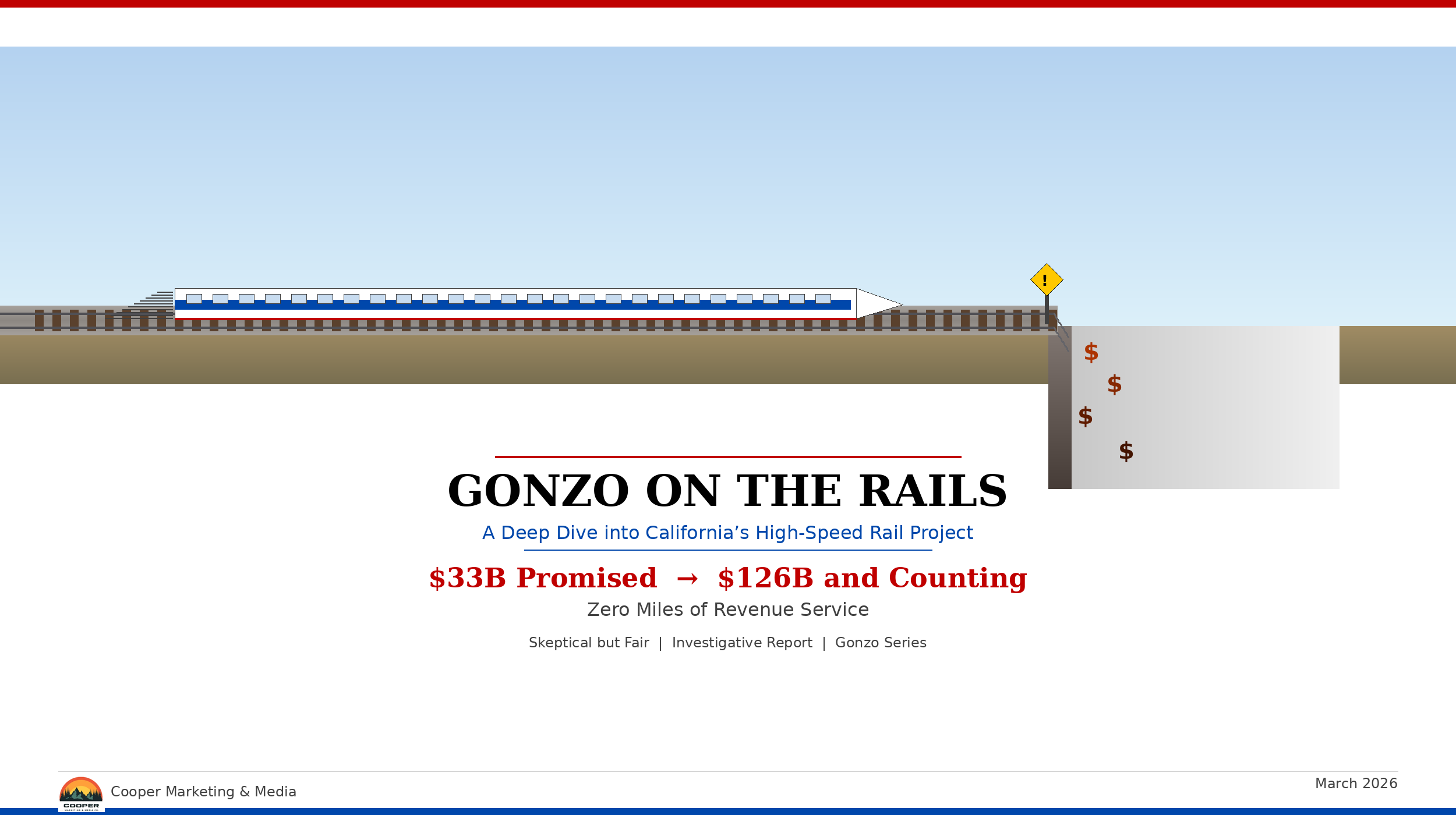
A Deep Dive into California’s High-Speed Rail Project - Where We Started. Where We Are. Where We’re Going.
$33 Billion Promised | $126 Billion and Counting | Zero Miles of Track
From the HippieHaus desk | March 28, 2026
Skeptical but Fair | Investigative Report | Gonzo Series
Through the lens of Steven Pinker’s Rationality and Bent Flyvbjerg’s Iron Law of Megaprojects
I. The Bullet That Never Left the Chamber
Somewhere between Madera and Bakersfield, California, there are 80 miles of concrete guideway stretching across the San Joaquin Valley like a monument to ambition, hubris, or both. No trains run on them. No passengers sit in climate-controlled cars sipping overpriced coffee while the almond orchards blur past at 220 miles per hour. Not a single steel rail has been laid on those guideways, despite 18 years of planning, billions in public spending, and enough political theater to fill every seat in the Sacramento Memorial Auditorium twice over.
This is the California High-Speed Rail project: the nation’s first and, to date, most expensive experiment in whether American democracy can build things that other countries build routinely, on budget, and on time. It is a story about what happens when optimism bias meets the planning fallacy, when campaign promises collide with geological reality, and when the sunk cost trap swallows an entire state’s infrastructure ambitions.
Steven Pinker, in Rationality, defines rational decision-making as deploying “a kit of cognitive tools that can attain particular goals in particular worlds.” The California High-Speed Rail Authority’s projections have undergone revisions so dramatic that scholars studying infrastructure megaprojects now cite the project as a case study. Bent Flyvbjerg’s Iron Law of Megaprojects applies with uncomfortable precision. As detailed in the pages that follow, the question is whether these revisions reflect genuine estimation error, institutional optimism, or something more deliberate. Federal investigators are now asking that very question.
So let’s do what good rationality demands: let’s look at the actual numbers.
II. Follow the Money: The $126 Billion Question
What Voters Were Told
On November 4, 2008, California voters approved Proposition 1A by a margin of approximately 52.7% to 47.3%. The measure authorized $9.95 billion in general obligation bonds for a high-speed rail system connecting San Francisco to Los Angeles in 2 hours and 40 minutes, at speeds exceeding 200 mph, covering 800 miles of track. The total price tag presented to voters: $33 billion in 2008 dollars. The system would, the proponents promised, operate without public subsidies.
Source: Ballotpedia, California Proposition 1A (2008); CHSRA Business Plan 2008
What It Actually Costs
The California High-Speed Rail Authority released its Draft 2026 Business Plan on February 28, 2026. The Phase 1 price tag from San Francisco to Los Angeles/Anaheim now stands at $126.2 billion: a 282% increase from the original estimate. The Authority characterizes a $1.7 billion reduction from the 2024 plan as “streamlining,” though that framing obscures the underlying cost escalation.
Source: CHSRA Draft 2026 Business Plan News Release, February 28, 2026; Railway Age, February 2026
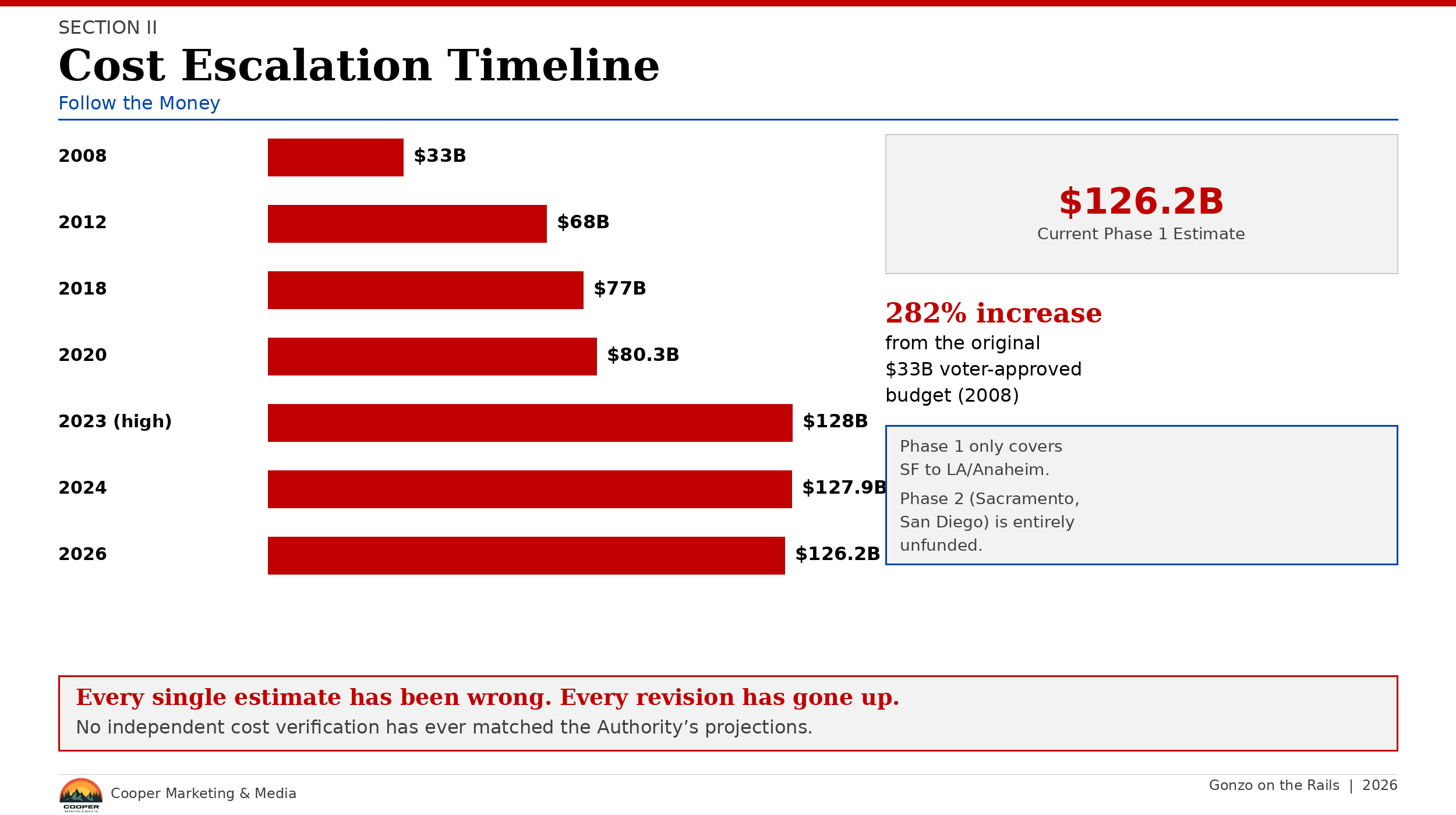
Note: Scope changes across business plan cycles reflect revised route alignments, blended system adaptations, and evolving engineering standards. All figures are year-of-expenditure dollars.
Source: CHSRA Business Plans 2008–2026; CalMatters, March 2023; Railway Age, February 2026; Eno Center for Transportation
Where the Money Comes From
Proposition 1A bonds: $9.95 billion authorized; approximately $8.5 billion appropriated by end of 2023.
Federal funding: Originally, approximately $4 billion from FRA grants (2010–2024). The Trump administration’s Transportation Secretary Sean Duffy terminated all remaining unspent federal funding, roughly $4 billion, in July 2025, citing a 310-page FRA compliance review that found nine areas of non-compliance. California filed suit challenging the termination, then withdrew the lawsuit in December 2025 without prejudice. The Authority characterized the withdrawal as tactical; observers widely interpreted it as an acknowledgment that the federal funding was not recoverable.
Source: U.S. Department of Transportation, 2025; FRA Compliance Review Report
Cap-and-Invest revenue: In September 2025, the California Legislature committed $1 billion annually through 2045 from the state’s Cap-and-Invest program. This was the project’s most significant funding development in years, providing approximately $20 billion in new revenue through 2045.
Source: CHSRA News Release, September 10, 2025; Planetizen, September 2025; Newsweek, 2025
Private investment: The Authority issued a Request for Qualifications in December 2025, targeting a private partner by mid-2026. Approximately 30 entities responded, including six to seven major institutional investors. As of March 2026: zero private dollars committed.
Source: CHSRA News Release, December 19, 2025; Streetsblog California, November 2025; Bond Buyer, December 2025
The Arithmetic of the Gap
Adding the identified future sources: approximately $8.5 billion in bonds (largely appropriated), roughly $20 billion in Cap-and-Invest revenue through 2045. Federal funds of approximately $6.9 billion have already been spent; the remaining ~$4 billion was terminated by the FRA in July 2025, and $929 million was rescinded by Congress. Total identified funding (past and future combined): roughly $35 billion. Against a $126.2 billion Phase 1 estimate, with $15 to $18 billion already spent, the unfunded gap is $77 to $83 billion. The Legislative Analyst’s Office, California’s nonpartisan fiscal watchdog, identified a $7 billion shortfall just for the Merced to Bakersfield segment alone: not the whole system, just the 171-mile first phase in the Central Valley. The LAO warned that without legislative action by June 2026, construction could halt within 15 months.
Source: LAO High-Speed Rail 2025 Project Update; Bakersfield Now, 2025; CaliforniaToday.com
Total Spent to Date
Multiple sources place cumulative spending at $15 to $18 billion as of early 2026. The U.S. Department of Transportation cited “roughly $15 billion.” Railway News reported “more than $18 billion in public funds.” For that investment, the state has zero miles of revenue service, no trains running, and not a single wheel turning on high-speed track.
Source: U.S. DOT, 2025; Railway News, 2026; Hoover Institution analysis
III. Steel, Concrete, and the Smell of Diesel: Construction Status
Here’s the paradox that keeps the project alive: while zero miles of track are laid, there’s real concrete in the ground. Eighty miles of guideway, representing roughly 67% of the 119-mile Central Valley corridor, stand complete. Fifty-eight major structures (bridges, overpasses, viaducts) are finished. Twenty-nine more are underway. Governor Newsom announced on February 3, 2026, that track installation is set to begin: the first steel rails on concrete.
Source: Governor of California, February 3, 2026; CHSRA Project Overview; CHSRA Draft 2026 Business Plan
The Construction Packages
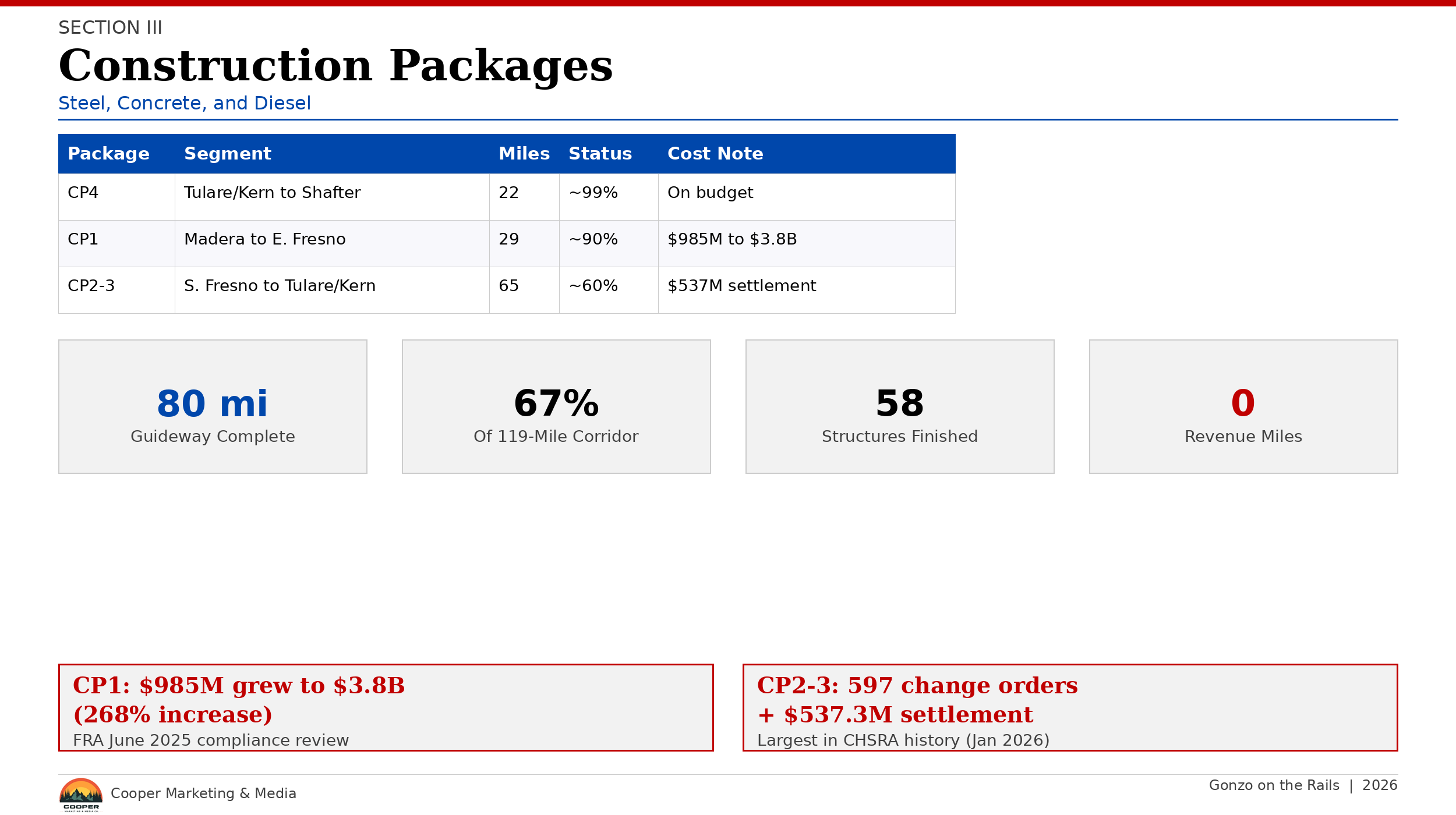
Parsing the three construction packages reveals sharply divergent trajectories.
Source: CHSRA Construction Packages; Railway Track & Structures, 2025
CP4 is essentially done; only a single canal relocation remains. CP1, originally contracted at $985 million, has grown to approximately $3.8 billion. The FRA’s June 2025 compliance review documented a 268% increase from the original $1.022 billion award value (which included initial change orders). The cost growth is attributed to delayed right-of-way acquisition, rapid state official turnover, and failure to secure utility and freight railroad agreements. CP2-3, the largest package at 65 miles, accumulated 597 change orders, including a single settlement of $537.3 million approved by the CHSRA Board in January 2026 to resolve years of accumulated disputed claims. That figure bears repeating: more than half a billion dollars in a single settlement on a single construction package.
Source: Construction Owners, January 2026; Construction Dive, 2025; Streetsblog California, February 2026; Tutor Perini investor communications
Property and Utilities
Right-of-way acquisition is 99% complete: 2,275 of 2,291 parcels delivered. But the remaining 16 parcels continue to constrain construction sequencing. Utility relocations stand at 86%: 1,572 of 1,826 completed, with 102 underway. Property acquisition costs in the Central Valley alone rose from an initial estimate of $332 million to $1.5 billion. Farmers in the project corridor have reported extended delays in receiving compensation after land acquisition, with some property owners waiting years for promised payments.
The Engineering Challenges Ahead
The Central Valley is the straightforward part. The real engineering complexity lies at both ends of the line:
Pacheco Pass Tunnel (San Jose to Merced): Two 28-foot-diameter tunnels, with the main bore expected to run 13 miles, which would make it North America’s longest rail tunnel. The geology presents significant challenges: highly fractured rock, multiple fault zones, and potentially catastrophic groundwater inflows. Environmental clearance is complete, but construction has not started.
Tehachapi Pass Crossing (Bakersfield to Palmdale): At 4,031 feet in elevation, nearly three times higher than Pacheco Pass. The design calls for nine shorter tunnels and multiple viaducts exceeding 200 feet in height. Active fault crossings, groundwater pressures exceeding 50 bar, and methane gas formations add layers of complexity that make the Central Valley guideway look comparatively simple.
Source: CHSRA Pacheco Pass Factsheet; Engineering News-Record; Railway Track & Structures
Source: Federal Permitting Dashboard; CHSRA Section Documents; CHSRA 2026 Business Plan
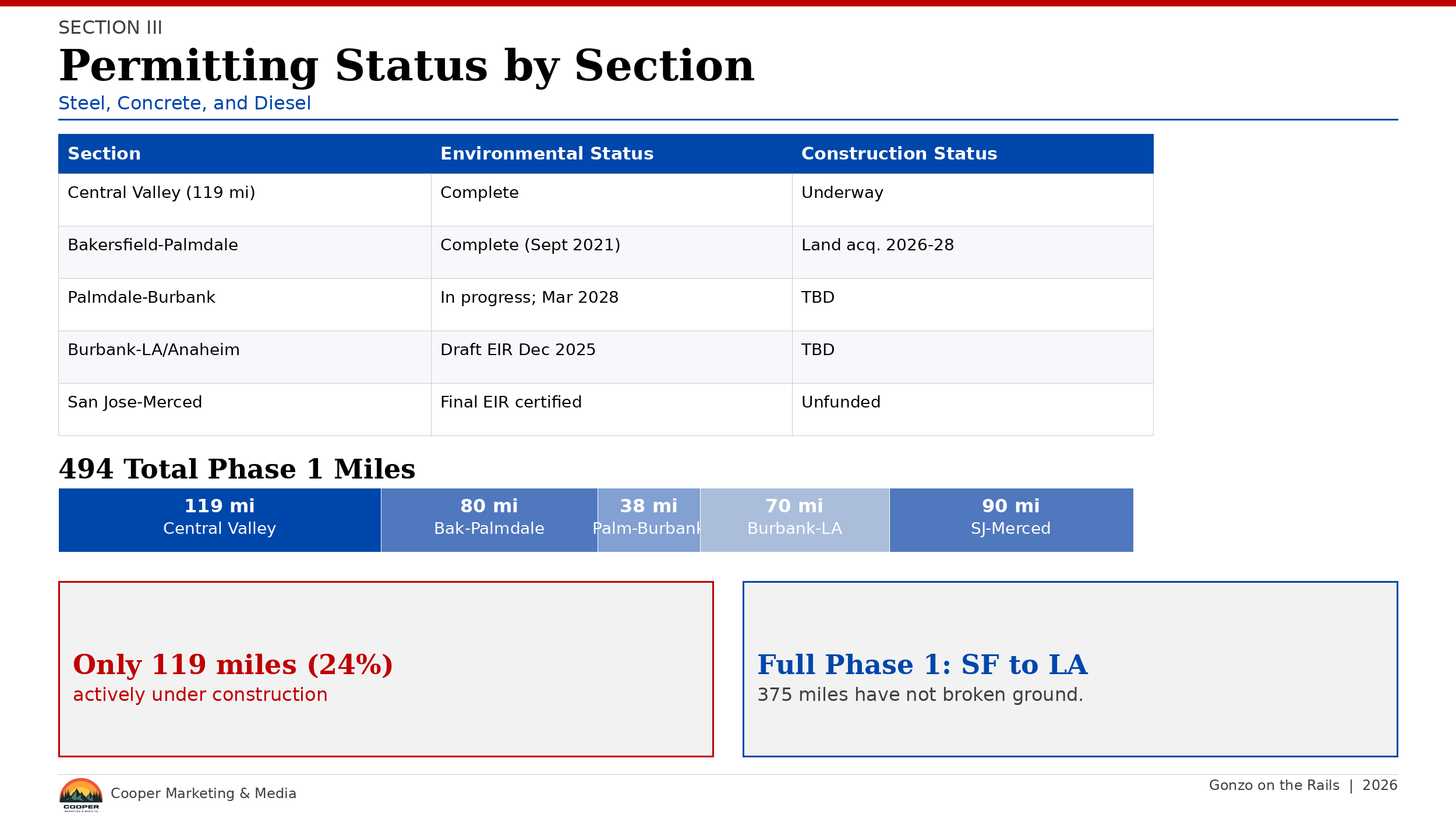
Of the 494 miles in Phase 1, 463 are environmentally cleared. But “environmentally cleared” and “funded and under construction” are two very different things. Only 119 miles are actively being built.
IV. Following the Money: Fund Allocation and Oversight
In any project where $15 to $18 billion has been spent, and the product does not yet exist, accountability demands a clear accounting. Where did the money go, and who received it?
The Contractors
Tutor Perini/Zachry/Parsons (CP1): Won the $985 million contract, which expanded to approximately $3.8 billion (268% per the FRA’s June 2025 compliance review, measured from the $1.022 billion initial award). Documented cost drivers include delayed right-of-way acquisition, rapid turnover among state officials, and failure to secure utility and freight railroad agreements in advance of construction. CHSRA and the contractor are in active litigation: CHSRA claims approximately $400 million in damages for delays; Tutor Perini has countersued for over $1 billion, alleging Authority mismanagement, design changes, and failure to provide timely site access. Tutor Perini Corporation (NYSE: TPC) has managed multiple large public works projects nationally; the California segment has proven particularly complex.
Dragados/Flatiron/Jacobs (CP2-3): The $1.37 billion contract that generated 597 change orders and a $537.3 million settlement. Dragados is a subsidiary of Spanish construction giant ACS Group. Flatiron is a subsidiary of HOCHTIEF, the German construction firm. Both have extensive international high-speed rail experience; the California environment, with its layered regulatory requirements and right-of-way complexities, has presented challenges distinct from European and Asian rail construction.
Source: CHSRA Contract Data; Construction Dive, 2025; Construction Owners, January 2026
Design and Engineering Firms
AECOM, WSP (formerly Parsons Brinckerhoff), and Bechtel have all held significant consulting and engineering roles. Station design is being handled by Foster + Partners and ARUP. The total spent on consulting, design, environmental review, and program management accounts for a substantial portion of the $15 to $18 billion in total expenditures, though the precise breakdown between infrastructure construction and professional services is difficult to discern from public reports.
The Political Alignment
The Supporters
“California is building the nation’s first high-speed rail system, and we’re proving it can be done. California isn’t waiting for the future. We’re building it.” — Governor Gavin Newsom (D), February 2026
Newsom has fully committed to the project, proposing $1 billion in annual Cap-and-Invest funding and personally announcing construction milestones. Senator Dave Cortese (D, Silicon Valley), as the Transportation Chair, has championed SB 545 to secure sustained funding. Assemblymember Lori Wilson (D, Suisun City) chairs the Assembly Transportation Committee and backs the project, though she is also the author of the controversial AB 1608, discussed below. Senator Maria Elena Durazo (D, LA) and Assemblymember Joaquin Arambula (D, Fresno) round out the core Democratic legislative support.
At the federal level, Senator Alex Padilla (D, CA) pushed for FRA grant approvals. Representatives Jim Costa, Zoe Lofgren, and Pete Aguilar lobbied for federal funding.
The Opposition
“We’ve now spent billions of dollars and really no tracks have been laid.” — Senator Tony Strickland (R), Vice Chair, CA Senate Transportation Committee
At the federal level, the opposition is bipartisan in practice but led by Republicans. Representative Kevin Kiley (R, CA) has called on FBI Director Kash Patel to launch a fraud investigation into cost estimates. The House Committee on Oversight and Government Reform, chaired by James Comer, opened an investigation into whether CHSRA “knowingly misrepresented ridership projections and financial viability”; CHSRA disputes the characterization and attributes cost growth to external factors, including regulatory complexity and right-of-way delays. Representative Vince Fong (R, CA) published an editorial titled “537 Million More Reasons to Cancel California’s High-Speed Rail Nightmare.”
Source: California Globe, March 2026; House Oversight Committee, 2025; Rep. Fong editorial, 2025
Transportation Secretary Duffy’s FRA released a 310-page compliance report finding CHSRA in default on nine distinct areas, including a $7 billion funding gap, concerns about ridership projections, and $6.9 billion in federal funds spent with “not a single high-speed track” laid. Congress permanently rescinded $929 million in the Consolidated Appropriations Act of 2026.
The Transparency Question: AB 1608
Assembly Bill 1608, authored by Assembly Transportation Committee Chair Lori Wilson (D), would allow the CHSRA Inspector General to withhold records that the official believes would “reveal weaknesses,” including security risks, fraud-detection controls, pending lawsuits, and internal discussions. Governor Newsom’s administration released a nearly identical budget trailer bill.
“This is a wholesale atom bomb on disclosure.” — Chuck Champion, President, California News Publishers Association (CalMatters, February 2026)
Supporters of the measure argue that certain operational and security information requires protection. Critics, including the California News Publishers Association, contend that the bill would reduce transparency at a moment of heightened financial scrutiny. Wilson has since pledged to narrow the language and require the Inspector General to publicly explain confidentiality decisions.
Source: CalMatters, February 2026; CAP Radio, February 12, 2026
The Lobbying Trail
The Authority itself spent $133,000 on federal lobbying in 2025 (January through September), according to OpenSecrets. The construction firms, including Tutor Perini, Dragados’s parent ACS Group, AECOM, and WSP, all maintain government affairs operations, but detailed contribution data linking specific contractor donations to specific legislators’ votes on HSR funding remains difficult to isolate from public records as of this writing.
Source: OpenSecrets, federal lobbying data, October 2025
Who Else Benefits
The project has created over 16,400 jobs, with over 70% going to Central Valley residents. Thirteen rail unions representing 160,000+ workers formed the High-Speed Rail Labor Coalition. The Authority has directed $1.84 billion to small businesses and disadvantaged enterprises. The effects of property acquisition in the Central Valley have been mixed: some landowners received fair compensation, while others report extended delays in receiving payments.
Source: CHSRA Central Valley data; CHSRA Labor Coalition announcement, November 2023; Fox News, 2026; Governor of California, February 2026
V. The Investigation File: Does the Case Have Merit?
On March 4, 2025, Rep. Kevin Kiley (R, CA-3) sent a letter to FBI Director Kash Patel requesting that the Bureau’s Public Integrity Division open a formal criminal investigation into the California High-Speed Rail Authority. Six Republican colleagues co-signed: Tom McClintock, Jay Obernolte, Mike Garcia, Young Kim, Ken Calvert, and Darrell Issa. Kiley’s central question was blunt: “How is it possible to have spent over $13 billion without a single station opening? Where have these funds gone? Who benefited?”
Source: Kiley.house.gov press release, March 4, 2025; ABC10, March 2025; California Globe, March 2025
That question deserves a serious answer, stripped of partisan theater. Here is the full accounting of every investigation, audit, legal filing, and oversight action touching CHSRA as of March 28, 2026, followed by a rational assessment of legal merit.
The Active File: What Is Actually Being Investigated
1. FBI Referral (Kiley, March 4, 2025)
Status: No investigation announced. The FBI told ABC10 it “does not have any comment on the letter.” No public acknowledgment from Director Patel. No DOJ criminal investigation has been announced. CHSRA responded on X/Twitter: “We welcome this investigation & look forward to working with federal partners. CA High-Speed Rail has been audited over 100x, every dollar is accounted for.”
The letter invokes the FBI’s Public Integrity Division, which investigates public corruption, but does not cite specific federal statutes. The publicly available portions reference the $33 billion-to-$100+ billion cost escalation, zero operating stations, and 17 years without a completed segment. It does not name specific individuals or allege specific fraudulent transactions.
Source: ABC10, March 2025; CHSRA official X/Twitter account response
2. FRA Compliance Review (June-July 2025)
Status: Completed. CHSRA found in default on nine areas. This is the single most consequential oversight action to date. On June 4, 2025, the Federal Railroad Administration issued a Notice of Proposed Determination finding CHSRA in default of its federal grant terms. The findings:
(1) Numerous change orders have already been executed, with more anticipated. (2) Missed deadline for rolling stock procurement. (3) At least $7 billion funding gap for the Initial Operating Segment. (4) No viable path to complete IOS by 2033. (5) Reliance on volatile non-federal funding sources. (6) Lacks time and money to electrify IOS by 2033. (7) Inadequate budget contingency for contractor delay claims. (8) Overrepresented ridership projections for IOS. (9) Lacks the capacity to deliver IOS by 2033.
Finding #8 is the one that most closely approaches fraud territory. If CHSRA knowingly submitted inflated ridership projections to justify federal funding, that could constitute a material misrepresentation. The FRA report does not use the word “fraud,” but it comes as close as a federal agency can without making a criminal referral.
Result: $4 billion in federal grants terminated (July 16, 2025). CHSRA filed suit (July 17, 2025). California dropped the lawsuit (December 23, 2025) without prejudice, stating the “federal government is not a reliable, constructive, or trustworthy partner.”
Source: FRA Notice of Proposed Determination, June 4, 2025 (railroads.dot.gov); FRA Acting Administrator Feeley letter, July 16, 2025; U.S. News & World Report, December 26, 2025
3. House Oversight Committee Investigation (August 2025)
Status: Active. Chairman James Comer (R, KY) launched a formal investigation on August 19, 2025, with a letter to Transportation Secretary Duffy requesting staff briefings, documents, and communications. The focus: whether CHSRA “knowingly misrepresented ridership projections and financial viability” to secure federal and state funds. Deadline for DOT response: September 2, 2025. Status of committee findings has not been publicly released as of this writing.
Source: House Oversight Committee press release, August 19, 2025 (oversight.house.gov)
4. Congressional Rescission: $929 Million (H.R. 7148)
Status: Enacted. Section 156 of the Consolidated Appropriations Act of 2026 permanently rescinded $928.6 million in 2010-era FRA grant awards. Signed into law February 3, 2026. This money is gone. It cannot be restored.
Source: Congress.gov, H.R. 7148; Senate Commerce Committee, February 2026
5. Macedo Legislative Audit Request (February 2026)
Status: Pending. Assemblymember Alexandra Macedo (R, AD-33) filed a formal audit request with the Joint Legislative Audit Committee in February 2026. She cited 1,588 contract changes and nearly $6 billion in cost overruns. The Committee can approve, deny, retain, or refer the request. No determination has been publicly announced.
Source: KEYT, February 18, 2026; Assembly Republicans press release, February 2026
6. CHSRA Inspector General Reports (Ongoing)
Status: Active. The Office of Inspector General, established September 2023 under Benjamin Belnap, has issued its FY 2024-2025 Annual Report with alarming findings: the 2030 target date has been pushed to 2031, staying within the 2033 schedule envelope is “unlikely,” the project could run out of money before completing the Central Valley segment, and the current funding stream may not keep pace with construction costs. The IG has issued 20+ recommendations. The irony of AB 1608 proposing to shield the IG’s records from public disclosure while the IG is actively documenting project failures should not be lost on anyone.
Source: CHSRA OIG FY 2024-2025 Annual Report, July 2025 (hsr.ca.gov); Trains Magazine, 2025
Source: Zoonop, Construction Owners, U.S. News, Progressive Railroading, California Policy Center
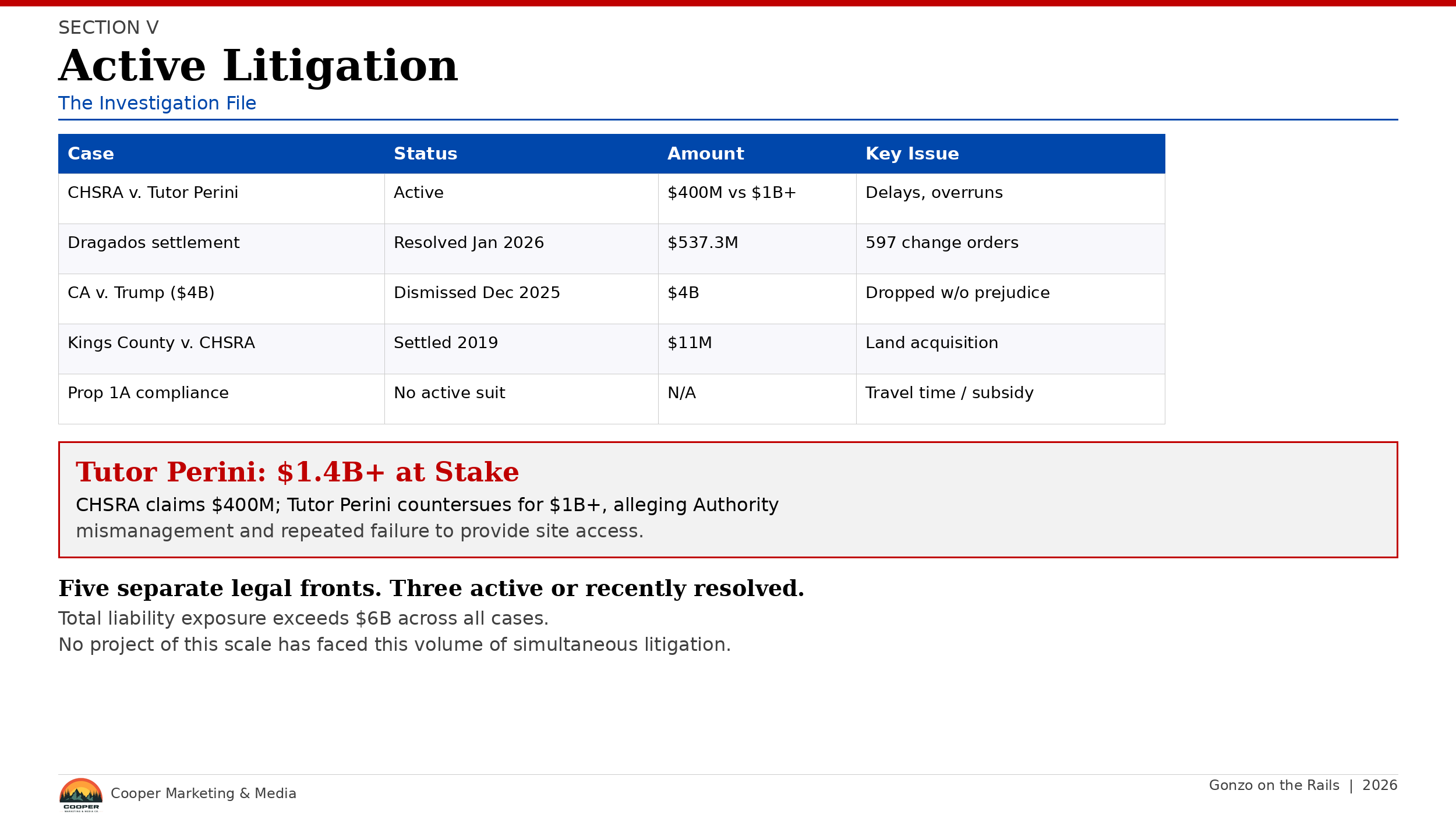
The Tutor Perini litigation is the one to watch. CHSRA claims $400 million in damages for delays and cost overruns. Tutor Perini has countersued for over $1 billion, alleging Authority mismanagement, design changes, and failure to provide timely site access. If Tutor Perini’s counterclaims succeed, the state’s exposure is significant. If CHSRA’s claims succeed, it establishes a pattern of contractor overcharging that could support broader fraud theories.
The Rationality Check: Does the Fraud Case Have Merit?
This is where the Pinker lens matters most, because the human brain is wired to see fraud where there may only be incompetence. Let us apply the actual legal standards.
Criminal Fraud (Wire Fraud, 18 USC 1343; Major Fraud, 18 USC 1031)
Federal fraud requires a knowing and intentional false statement of material fact with intent to deceive. Mismanagement, waste, optimism bias, and honest forecasting errors are not crimes. The question is specific: Did identified CHSRA officials knowingly lie to federal grant-makers about costs, timelines, or project viability?
The FRA’s Finding #8 noted that ridership projections appeared inconsistent with post-pandemic recovery trends. The FRA characterized these projections as “overrepresented” but did not allege fraud. However, the finding raises a legal question: if CHSRA submitted ridership forecasts to the FRA that it knew or recklessly disregarded as unrealistic, each submission could theoretically constitute wire fraud under 18 USC 1343. But proving “knowing” misrepresentation versus “optimistic forecasting” is the difference between a prison sentence and a management failure. Federal prosecutors must prove intent beyond a reasonable doubt.
Precedent: The Boston Big Dig escalated from $2.8 billion to $14.6 billion. Criminal convictions were limited to a specific contractor (Aggregate Industries, for double-billing and concrete fraud) and the project chief (James Kerasiotes, for hiding a $1.4 billion overrun and filing false tax returns). The organization itself was not prosecuted. Infrastructure cost overruns alone have never sustained a federal fraud conviction against government officials in the United States.
Source: DOJ Justice Manual 9-42.000; FBI Boston Field Office press release, 2009; 18 USC 1341, 1343
False Claims Act (Civil, 31 USC 3729)
The FCA provides a lower bar: the government need only prove that defendants “knowingly” submitted false claims for payment. “Knowingly” includes actual knowledge, reckless disregard, or deliberate ignorance. This is a civil standard (preponderance of the evidence), not a criminal one (beyond a reasonable doubt).
This is where exposure is highest. If CHSRA certified compliance with federal grant conditions while the IG and internal reports documented noncompliance, each certification could be a false claim. The $142 million in disputed invoices since 2016, the inflated ridership projections, and the continued drawdown of federal funds while missing milestone after milestone all create potential FCA exposure. California has recovered over $2 billion under its own False Claims Act. No public qui tam (whistleblower) suits have been reported, but sealed cases would not be visible until unsealed.
Proposition 1A Violations
According to the California Policy Center’s legal analysis, the current plan appears to conflict with at least two Prop 1A requirements. The 2-hour-40-minute SF-to-LA travel time, they argue, cannot be achieved with 110 mph operations on the Peninsula and in the LA Basin. The “no operating subsidy” requirement (Streets and Highways Code 2704.08) also appears challenged by the Authority’s own projections showing the Initial Operating Segment will require state support. The Policy Center concludes the plan is “probably not legal.” CHSRA has not publicly conceded noncompliance with Prop 1A. No active lawsuit is challenging compliance as of March 2026, and courts are historically reluctant to unwind voter-approved bond expenditures.
Source: California Streets and Highways Code 2704.08-2704.09; California Policy Center, 2026 Business Plan legal analysis
Plausible Outcomes: What Actually Happens Next
Source: Legal analysis based on DOJ prosecution data, TRAC Reports, and megaproject precedent
The Verdict on the Investigation
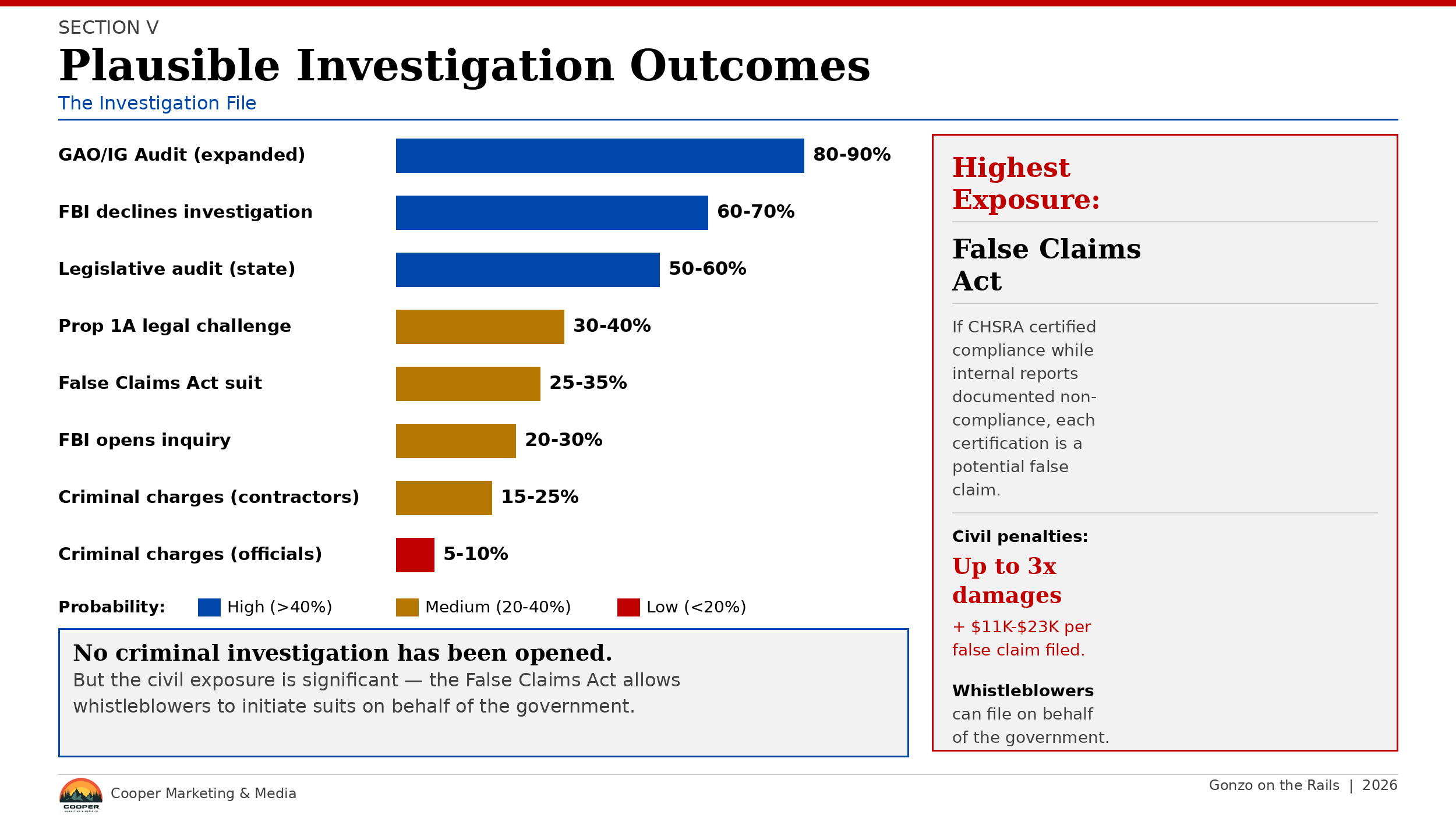
Does Kiley’s FBI referral have merit? Yes, in the narrow sense that the factual record justifies federal scrutiny. A project that has consumed $15 to $18 billion with zero revenue miles, experienced a 268% cost increase on a single contract package, and been found in default by its own federal funder is not a project that should operate without investigation.
Will it result in criminal charges? Probably not against CHSRA officials. The legal threshold for federal fraud requires proof of knowing, intentional deception, not mere incompetence, optimism bias, or institutional dysfunction. The Big Dig precedent shows criminal accountability is reserved for specific false statements by identified individuals, not systemic project failure.
Where is the real legal exposure? False Claims Act civil enforcement against contractors and compliance-certifying officials. If CHSRA submitted compliance certifications to the FRA while internal documents (including the IG’s own reports) contradicted those certifications, the exposure is significant. And if AB 1608 succeeds in shielding those internal documents from public view, it will only sharpen the question of what exactly is being hidden.
The rationalist’s conclusion: the investigations are justified, the fraud case is weak but not empty, the civil exposure is real, and the most consequential action has already happened. The $4 billion federal termination and $929 million rescission have done more financial damage to the project than any FBI investigation likely will. The money is already gone. The question now is whether anyone is held accountable for how it was spent.
VI. The Rationality Check: Pinker, Flyvbjerg, and the Iron Law
Bent Flyvbjerg’s Iron Law of Megaprojects, “over budget, over time, over and over again,” maps with uncomfortable precision onto California’s trajectory. His research shows that 99.5% of megaprojects exceed their budgets, miss their deadlines, or deliver fewer benefits than promised. California High-Speed Rail is not an outlier. It is the poster child.
Source: Bent Flyvbjerg, The Iron Law of Megaprojects; BCG Henderson Institute interview
The Three Cognitive Patterns
1. Optimism Bias. The 2008 estimate of $33 billion had zero land acquisition contingency, zero right-of-way complexity buffer, and no scenario analysis. The alignment was not even specified when voters approved the bonds. This is the equivalent of buying a house based on the listing photo without asking about the foundation.
2. The Planning Fallacy. Pinker defines this as our systematic tendency to underestimate the time and cost of future actions while overestimating their benefits. Every business plan update since 2008 has revised costs upward and timelines outward. The original promise of completion by 2020 is now, at best, 2032 for a fraction of the system.
3. Deliberate vs. Optimistic Underestimation. Flyvbjerg’s research identifies cases in which project promoters deliberately underestimate costs to secure approval, knowing that once construction starts, sunk costs will compel continuation. Whether CHSRA’s initial estimates reflected such deliberate understatement, or rather reflected genuinely optimistic modeling, is a question that remains actively disputed. The FRA’s compliance review raised this question explicitly, and the House Oversight Committee has opened an investigation into the same issue. CHSRA maintains that cost growth reflects external factors and evolving project scope.
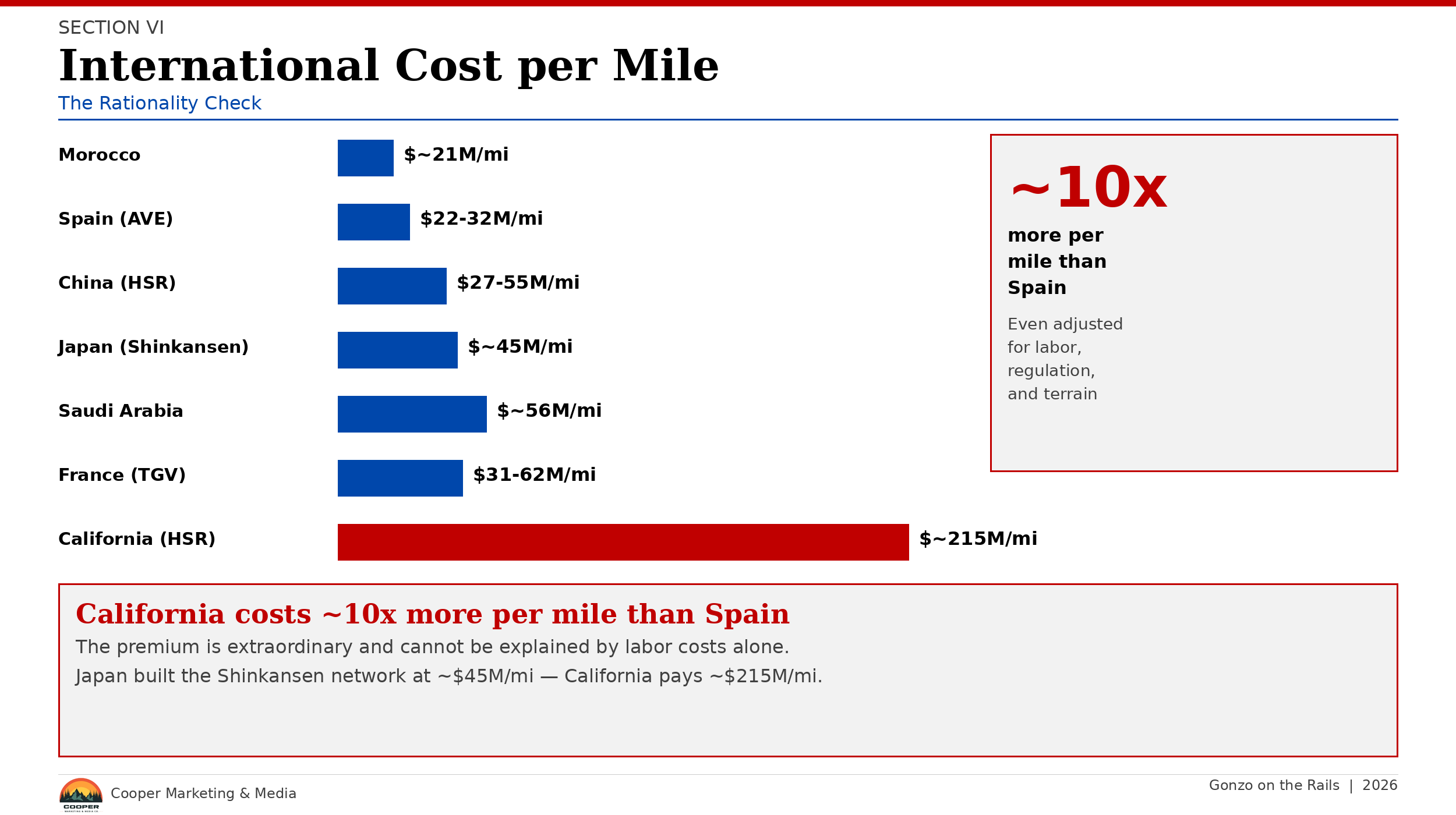
Note: International figures are approximate, adjusted to 2024 USD where possible. Comparisons are inherently imperfect due to differences in what is included (rolling stock, stations, land acquisition) and variations in labor costs, regulatory environments, and terrain.
Source: Transit Costs Project; World Bank, 2014; International Railway Journal; Hoover Institution
Even with caveats, the premium is significant. Spain built the most extensive HSR network in Europe at $22 to $32 million per mile. China’s 25,000+ kilometer network came in at $27 to $55 million per mile. Japan built the original Shinkansen in 5.5 years, under budget.
Why the Cost Differential?
American labor costs run two to three times higher than international counterparts. California’s eminent domain process is slow, litigious, and expensive. CEQA and NEPA compliance add years and billions. Regulatory fragmentation across federal, state, county, and city jurisdictions multiplies approval timelines. Management overhead, including consultant, oversight, and administrative costs, is exceptionally high. And political constraints drive expensive design choices: tunneling instead of open-cut construction, route deviations to satisfy local opposition, and station locations influenced by political considerations alongside engineering ones.
Before we close the book, intellectual honesty demands a question this report has circled but not yet confronted head-on: has any country in the world actually made high-speed rail work? The answer is yes. Several have. And their stories carry lessons that both defenders and critics of California HSR should take seriously.
Japan: The Original, and Still the Standard
The Tokaido Shinkansen, Tokyo to Osaka, broke ground in 1959 and opened on October 1, 1964, in time for the Tokyo Olympics. The original budget was ¥200 billion. The final cost was ¥380 billion: a 90% overrun. The cost escalation was severe enough that both the president of Japanese National Railways (Sogo Shinji) and the chief engineer (Shima Hideo) resigned in 1963. The Japanese government did not cancel the project. It absorbed the overrun, finished on schedule, and opened the line.
The results: 11 million passengers in the first year. Over 6.5 billion cumulative passengers since 1964. JR Central, which operates the Tokaido line, earned ¥1.07 trillion ($10.5 billion) in rail revenue in FY2013, representing 91.5% of the company’s total income. The line has never had a passenger fatality from derailment or collision in 60 years of operation. The average delay in 2019 was 12 seconds. It is, by any measure, the most successful transportation infrastructure project of the 20th century.
The lesson for California: Japan’s Shinkansen went 90% over budget, and it was still worth it. But it was worth it because it connected the country’s two largest metropolitan areas (35 million and 19 million people), demand was immediate and overwhelming, and the government executed with speed and discipline after committing capital. California’s first segment connects Merced (86,000) to Bakersfield (410,000). The demand calculus is fundamentally different.
Source: International Railway Journal; Nippon.com; JR Central financial reports; World Bank
Spain: The Phased Approach That Built Europe’s Largest Network
Spain opened its first AVE line, Madrid to Seville, on April 21, 1992. It then did something remarkable: it proved the concept before scaling. The Madrid-Seville line captured over 50% of the travel market between the two cities within two years. Air traffic share between the cities collapsed from 40% to 13%. Only then did Spain commit to a full national network.
Today, Spain operates over 3,700 kilometers of high-speed rail, the most extensive network in Europe and second globally, only to China. Total public investment through 2015 was approximately €40 billion. The cost: roughly €14.7 to €17.7 million per kilometer ($18 to $22 million per mile). California HSR costs approximately $215 million per mile: ten times the Spanish figure. Even accounting for labor cost differentials, regulatory environments, and land acquisition complexity, the premium is extraordinary.
The lesson for California: Spain proved demand on one line before building a network. California is trying to build a network segment (Merced to Bakersfield) that does not connect the state’s major population centers. Spain’s first line connected its capital to its fourth-largest city. California’s first operational segment does neither. The phased approach only works if Phase 1 generates the revenue and political support to fund Phase 2.
Source: ADIF, “30 Years of High-Speed in Spain,” 2022; Global Railway Review; HSRail.org
France: Proof That Cost Recovery Is Possible
The TGV Paris-Lyon, France’s first high-speed line, opened in 1981 after five years of construction. It carried 10 million passengers in its first ten months. The route connected France’s two largest metropolitan areas (Paris, population 12 million; Lyon, population 2.3 million) at a distance of 450 kilometers, the sweet spot where HSR dominates both air and car travel. The TGV made substantial operating profits for decades.
But the French story also carries a warning. SNCF, the national rail operator, now acknowledges that 30% of high-speed services do not break even. Expansion beyond the most profitable corridors has diluted returns. The lesson is that HSR profitability is route-specific: lines connecting large cities at 200 to 500 mile distances print money; lines serving smaller markets require permanent subsidy.
The lesson for California: The SF-to-LA corridor (382 miles, two metro areas totaling 18 million people) has the demand profile of a Paris-Lyon. The Merced-to-Bakersfield corridor does not. If the full system is ever completed, the economics could work. The question is whether a state that cannot build 171 miles for $36 billion can build 494 miles for $126 billion.
Source: International Railway Journal; SNCF Group Financial Report 2024; TGV historical data
China: Scale, Speed, and Unsustainable Debt
China built the world’s largest HSR network in 15 years: over 48,000 kilometers by the end of 2024, with plans to exceed 60,000 km by 2030. Construction costs ran $17 to $21 million per kilometer, roughly one-third the cost of comparable systems elsewhere. The World Bank attributed this to standardized designs, massive scale, and labor cost advantages.
But the financial picture is sobering. Only six HSR lines in the entire Chinese network turn a profit, representing roughly 2,300 kilometers, or about 6% of the total. Cumulative HSR debt reached 6 trillion yuan ($890 billion) by 2023, approximately 5% of China’s GDP. Dozens of stations sit idle or nearly empty. Leading Chinese economist Lu Ming has described the buildout as “massive overbuilding.” In June 2025, China Railway raised fares up to 20% on profitable routes to cross-subsidize money-losing ones.
The lesson for California: Building it does not mean they will come. China proves that even at one-tenth of California’s per-mile cost, HSR can be a financial catastrophe when demand does not materialize. The Chinese government can absorb losses that equal 5% of GDP. California cannot. Demand validation before capital commitment is not fiscal conservatism. It is basic rationality.
Source: World Bank, 2014; South China Morning Post, 2024–2025; Pekingnology; Chinese government statistics
The UK: A Mirror California Should Not Want to Look Into
The United Kingdom’s HS2 project, originally budgeted at £37.5 billion in 2009 for a London-to-Manchester line, has spent £46.2 billion as of February 2026. The northern legs to Manchester and Leeds have been cancelled. The remaining scope, London to Birmingham, still lacks a reliable cost estimate. Chief Executive Mark Wild initiated a comprehensive “program reset” in late 2024; a new baseline budget may not emerge until late 2026.
Prime Minister Sunak rebranded the cancellation as “Network North,” pledging savings to local road and transit improvements. Follow-through has been uneven; critics note many promised projects were already funded. The parallels to California are uncomfortable: spiraling costs, shrinking scope, political blame-shifting, and a project that has consumed its original budget without delivering operational service.
The lesson for California: HS2 is what happens when a democracy tries to build HSR without the demand profile of a Tokyo-Osaka or Paris-Lyon, at Western labor costs, through complex urban and rural environments, with incomplete political consensus. California checks every one of those boxes for the segments beyond the Central Valley.
Source: UK Government HS2 Parliamentary Report, December 2024; Institute for Government; New Civil Engineer, March 2026
The Synthesis: What Separates Success from Failure
Every successful HSR system shares four characteristics. First, overwhelming demand: they connected large metropolitan areas (10+ million combined population) at distances of 200 to 500 miles, where HSR dominates both air and car travel. Second, sustained political commitment through early cost overruns: Japan absorbed a 90% overrun; Spain and France kept building through political transitions. Third, execution speed: Japan built 515 km in 6 years; France built 450 km in 5 years; Spain proved its first line in under 5 years. Fourth, a first segment that generated revenue and public enthusiasm: each country’s opening line was its highest-demand corridor, which built political support for expansion.
California has the demand profile for a successful HSR system on the SF-to-LA corridor. What it lacks is everything else: the execution speed (18 years and counting), the first-segment demand (Merced to Bakersfield is not Tokyo to Osaka), the cost discipline ($215 million per mile versus $18 to $55 million internationally), and the political consensus (the project is as polarized as any issue in state politics).
This does not mean the project should be cancelled. It means that defenders who cite Japan, France, and Spain as proof that HSR “works” must also explain why California lacks the conditions that made those systems successful. And critics who cite costs and delays must acknowledge that every HSR system in history went over budget in its early phases, and several became the best transportation investments their countries ever made. The question, as always, is not whether HSR works in the abstract. It is whether this project, in this state, with these institutions, can join the list of successes rather than the list of HS2s.
What It Would Deliver, and for Whom
Cost-per-mile analysis, essential as it is, answers only half the question. The other half: what does the public get for the money, and who benefits?
Climate. The LA-to-SF air corridor is the most heavily traveled domestic route in the United States. Southwest Airlines alone operates over 30 daily flights. CHSRA’s Environmental Impact Report projects 142.6 million metric tons of avoided CO2 over 50 years of operation. The California Air Resources Board has validated that estimate as consistent with the state’s legally binding net-zero-by-2045 target. That is not a talking point. It is a measured externality that cost-only analysis systematically excludes.
Source: CHSRA Environmental Impact Report; California Air Resources Board; Bureau of Transportation Statistics
Equity. The Central Valley is one of the poorest, most polluted, and most transit-isolated regions in America. Fresno County’s median household income is approximately $58,000; Kern County’s is $55,000. Both are majority-Latino. Neither has direct rail connections to Bay Area or Los Angeles job markets. HSR would reduce geographic inequality in a state where a two-hour drive separates communities with $60,000 median incomes from communities with $130,000 median incomes. The 16,400 construction jobs created, with over 70% going to Central Valley residents, represent a down payment on that economic connectivity.
Source: U.S. Census Bureau, American Community Survey 2023; CHSRA Employment Data; Governor of California, February 2026
The personal math. At $126.2 billion for 39.5 million Californians, the project costs approximately $3,200 per resident, or roughly $8,000 per household. Spread over the 20+ year construction timeline, that is $160 per person per year. Whether that is a reasonable investment depends entirely on whether the system delivers the mobility, climate, and equity returns projected. A conservative household that drives 15,000 miles per year on deteriorating roads has a legitimate question: Would $8,000 go further fixing the roads I use today? A liberal household in the Central Valley has a different but equally legitimate question: when do I get a transportation option that does not require a car I can barely afford?
The point is this: an investigative report that counts every dollar of cost but none of the projected benefit is not neutral. It is incomplete. The financial forensics in Sections II through IV tell the cost story with precision. This section ensures the benefit story gets equal rigor.
VII. To Build or to Punt: The Rational Case
Both arguments that follow contain rational merit under different value frameworks. The question is not which side is “right” in the abstract, but which path maximizes public value from this point forward.
The Case for Continuing
The continuation argument rests on several substantive pillars. First, climate: the system’s projected 142.6 million metric tons of avoided CO2 over 50 years of operation is significant, and the California Air Resources Board has validated this as consistent with the state’s legally binding net-zero-by-2045 target. Second, equity: Central Valley cities like Fresno, Bakersfield, and Merced lack direct connections to coastal job centers; HSR would reduce geographic inequality in one of the nation’s most economically stratified states. Third, legal obligation: voters approved the bonds, and outright cancellation could damage the state’s credit rating and trigger federal clawback demands. Fourth, infrastructure already built: 80 miles of guideway and 58 structures represent real, world-class infrastructure that only has value if the system operates. Fifth, stable funding: the $1 billion annual Cap-and-Invest commitment provides a 20-year funding floor that did not exist before September 2025.
“This is the only high-speed rail system of its type anywhere in the United States of America. If you care about Main Street, you care about this project. If you care about rural areas, you care about this project.” — Governor Gavin Newsom (D), 2026
Source: California Climate Investments HSR profile; CHSRA 2026 Business Plan
The Case for Cancellation
The strongest arguments for pulling the plug are financial and mathematical. The project has consumed $15 to $18 billion and delivered zero operational miles. The current estimate of $126.2 billion exceeds identified funding by at least $90 billion. The Merced to Bakersfield segment alone faces a $7 billion shortfall. Private investors have expressed interest but committed nothing. Ridership projections for the initial segment show only 35 to 49% cost recovery, which would require permanent taxpayer subsidies of $69 to $121 million annually, a potential conflict with Prop 1A’s no-subsidy mandate.
Flyvbjerg would argue that continuing to invest primarily to recover sunk costs is textbook irrationality. Only forward-looking costs and benefits matter. And the forward-looking math is stark: closing the funding gap requires another $77 to $83 billion and 20+ years. That same capital, deployed in conventional rail improvements, bus rapid transit, or highway expansion, could serve more people, sooner, for less.
“After 25 years and billions in federal subsidies, not a single train operating in California.” — U.S. Senate Commerce Committee statement, February 2026
The Rational Middle Ground
Pinker’s framework demands we set aside tribal loyalties and ask: given where we are today, not where we wish we were, what is the utility-maximizing path forward?
The pragmatic answer may be this: complete the Merced to Bakersfield segment. Get trains running. Prove the technology works in an American context. Use it as a proof-of-concept to attract the private capital and federal support needed for extensions. This accepts that early segments may require subsidy, a tradeoff justified only if it unlocks additional funding for the broader network.
But honesty demands acknowledging what that means: a 171-mile train between two mid-size Central Valley cities that will require public support for the foreseeable future. Not exactly the gleaming future voters imagined in 2008.
VIII. When Do We Get Our Beer on the Bullet Train?
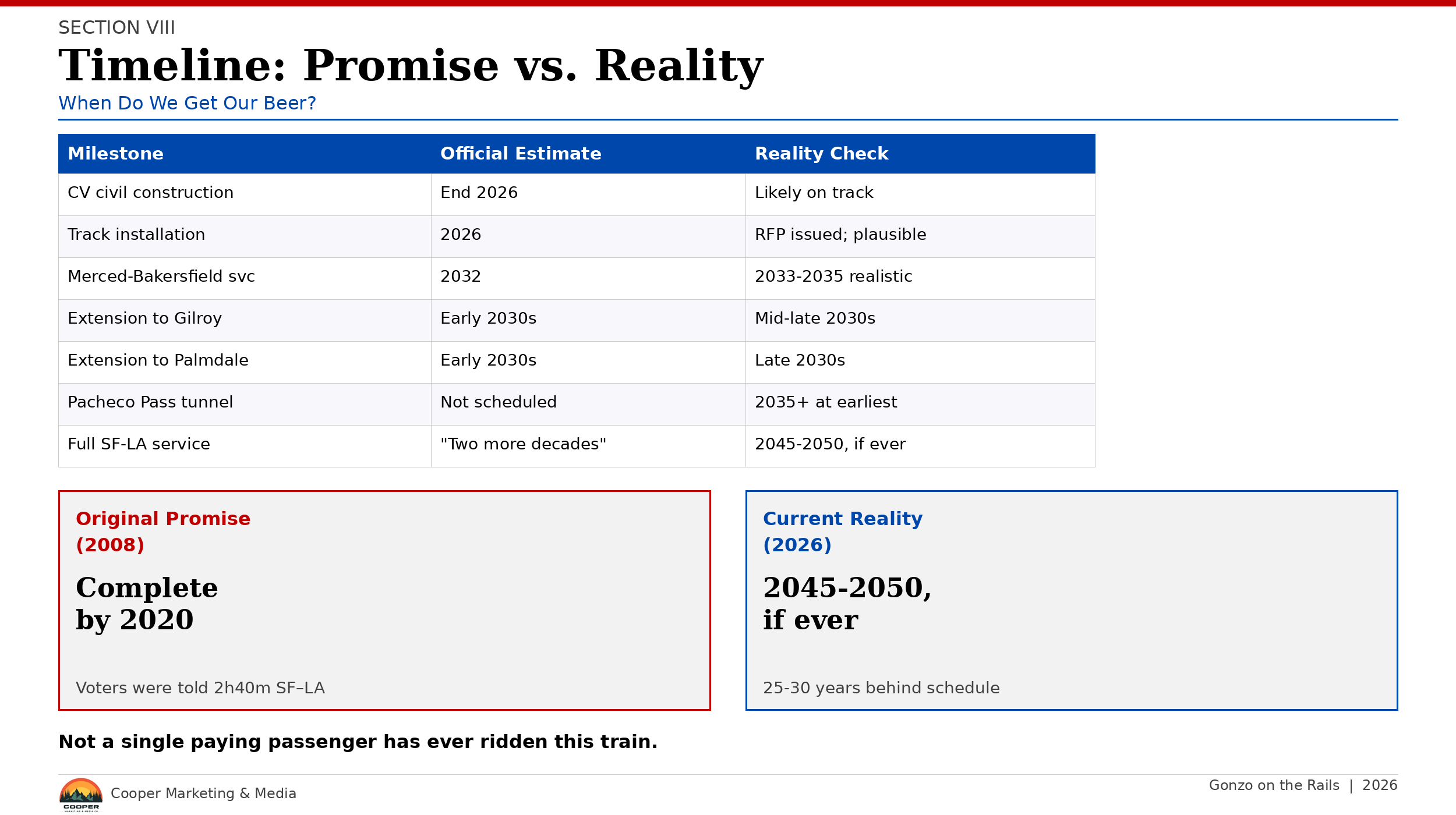
Here is the honest timeline, stripped of political optimism:
Source: CHSRA 2026 Business Plan; Railway Age, February 2026; CHSRA CEO statements
The timeline divergence is stark: the 2008 promise pointed to a 2020 start date; the 2026 reality shows the earliest Merced to Bakersfield service in 2032 to 2035, with the full system potentially decades further out.
How Much More Money?
The math is straightforward and sobering:
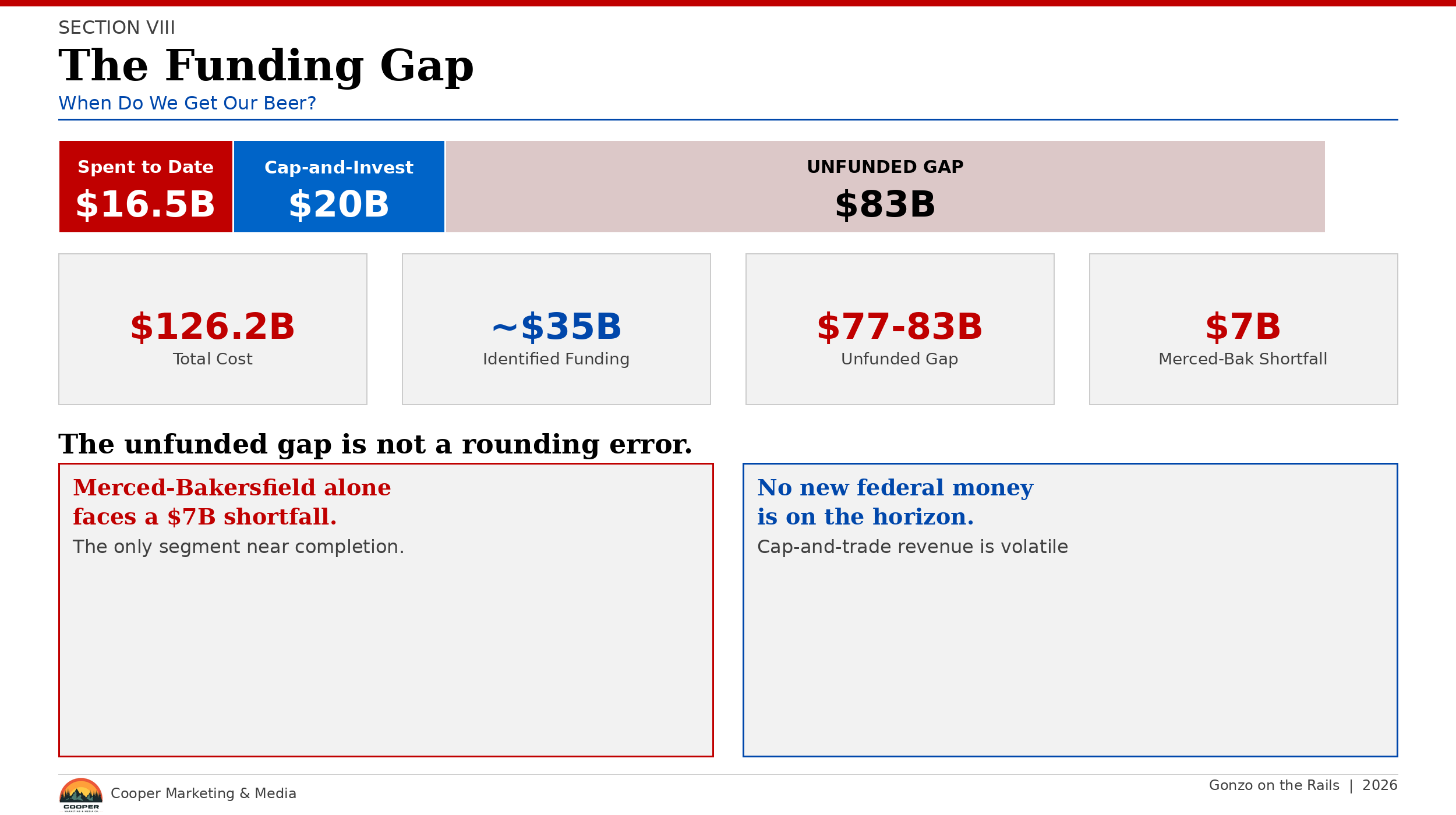
Note: Federal funding of approximately $4 billion was terminated by the FRA in July 2025; Congress rescinded $929 million in the 2026 Consolidated Appropriations Act. Approximately $6.9 billion in federal funds had already been spent. California dropped its lawsuit challenging the termination in December 2025 (Bloomberg, Dec. 24, 2025).
Source: Calculated from CHSRA 2026 Business Plan; LAO analysis; multiple sources
To close that gap, California needs either massive new federal funding (unlikely under any administration with competing priorities), private investment on an unprecedented scale (unproven), or additional state revenue sources (politically difficult). The unfunded gap of $77 to $83 billion is not a rounding error. It is a structural challenge that no business plan revision can paper over.
IX. The Verdict: Rationality at 220 MPH
Eighteen years into this project, the rational observer is left with an uncomfortable truth: California High-Speed Rail is simultaneously a genuine engineering accomplishment (80 miles of world-class guideway in the Central Valley), a historic cost escalation ($126 billion and counting), a political flashpoint (leveraged by both parties for their own purposes), and a test of whether American democracy can still build transformative infrastructure.
The Pinker lens demands honesty. The cost trajectory, from $33 billion to $126 billion, tells a different story than the original projections. Whether that gap reflects genuine estimation error, institutional optimism, or something more deliberate is now the subject of formal federal and congressional investigation. What is not in dispute: the project has overrun its original budget by 282%. It has missed its original completion date by at least 12 years, likely 25 to 30. It has spent $15 to $18 billion with zero operational service. Its ridership projections have been questioned by the federal government, its own fiscal watchdog, and independent analysts.
But rationality also demands we acknowledge the other side: 80 miles of concrete do not build themselves. The Central Valley needs economic connectivity. Climate goals require modal shifts. Infrastructure already built only has value if it connects to a functioning system. And every successful high-speed rail system in the world started somewhere.
The question is not whether high-speed rail is a good idea. In the abstract, it is a very good idea. The question is whether this project, managed by these institutions, under these governance constraints, at these costs, can deliver a product that justifies its price tag.
Flyvbjerg advises “Think slow, act fast”: spend time in rigorous planning before committing capital, then execute with speed and discipline. California did the opposite. It approved bonds in 2008 with incomplete engineering and has spent 18 years in costly corrections. The only rational path forward is radical transparency, independent oversight, realistic cost projections, and the political courage to either fund the project properly or admit that the dream has outgrown the state’s capacity to deliver it.
Either way, the beer on that bullet train from San Francisco to Los Angeles? Pack a lunch. It’s going to be a while.
X. The Alternative: Reroute the Money, Ride the Rails We Already Have
Here is the question nobody in Sacramento wants to ask out loud, because asking it means admitting the emperor has been naked for a decade: What if we took the remaining $77 to $83 billion and spent it on things that actually move people today?
Not a fantasy train that might carry its first passenger in 2033 (or 2035, or 2040, depending on which business plan you read). Not a construction project that has consumed $15 to $18 billion and produced zero revenue miles. But the Amtrak routes that already carry over six million Californians a year (FY2022 data). The highways that 39 million drivers use every single day. The bridges that are, quite literally, falling apart.
This is not an ideological argument. It is an arithmetic one. And the arithmetic is devastating.
The Wind Down: What Cancellation Actually Costs
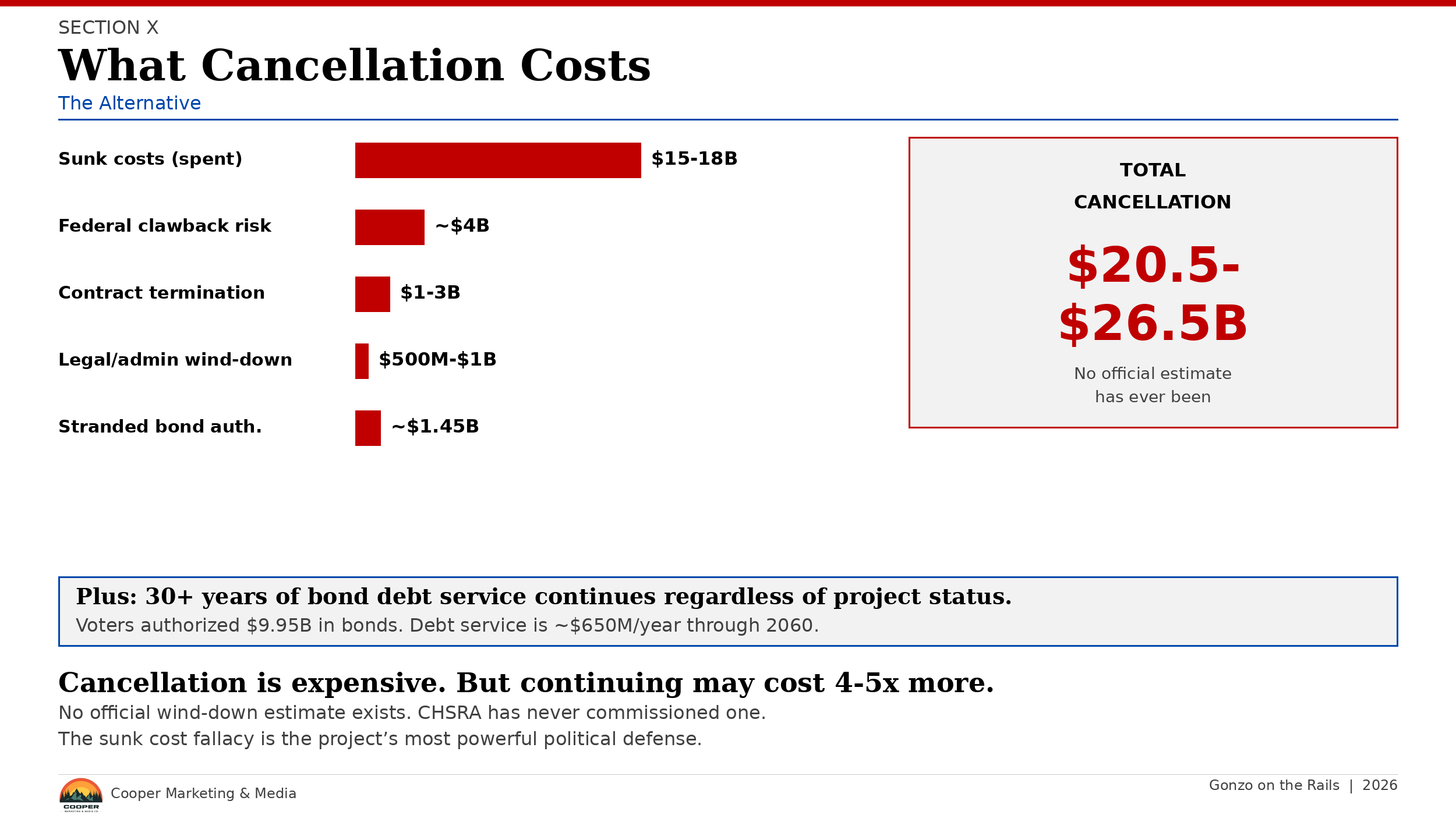
Let us start with the bad news, because anyone who tells you cancellation is free is lying. The estimated cost of shutting down the California High-Speed Rail project falls between $20.5 billion and $26.5 billion, and that number only covers the immediate damage.
The breakdown is sobering. There is the $15 to $18 billion already spent, which is a sunk cost that no amount of political rhetoric can recover. Federal clawback risk adds approximately $4 billion: the Federal Railroad Administration has grounds to demand return of grant funds if the project fails to deliver its stated purpose. Contract termination costs with Tutor Perini/Zachry/Parsons, Dragados/Flatiron, the Rail Delivery Partner, and dozens of subcontractors would trigger aggressive litigation. Early estimates place termination liabilities at $1 to $3 billion, but anyone who has watched California HSR contractors litigate knows that number could climb.
Then there are the bonds. Proposition 1A authorized $9.95 billion in general obligation bonds, of which approximately $8.5 billion has been appropriated. The remaining ~$1.45 billion is authorized but unappropriated. Bonds already sold carry interest obligations that extend 30 or more years. California taxpayers are servicing this debt whether or not a single additional rail is laid.
And here is the legal trap: Proposition 1A was a voter-approved ballot measure. Its funds are constitutionally earmarked for high-speed rail. Redirecting them to Amtrak or highways would require either a new ballot measure or a legal determination that the project’s purpose can be satisfied through alternative means. California’s Legislative Analyst’s Office has not issued a formal opinion on this, but legal scholars consider the hurdle substantial.
The Cap-and-Invest funding, worth roughly $1 billion per year through 2045 under the September 2025 agreement, may be contractually vested. AB 398 and its successors tie these revenues to greenhouse gas reduction programs. Redirecting them requires legislative action, and with a Democratic supermajority that views the HSR project as a climate priority, the political math is unfavorable.
No official wind-down estimate exists. CHSRA has never commissioned one. The Authority’s position is that cancellation is not under consideration; they point to 80 miles of completed guideway, 16,400 jobs created, $1.84 billion directed to small businesses, and the September 2025 Cap-and-Invest commitment as evidence that the project has turned a corner. That counterargument deserves acknowledgment. But the absence of a wind-down study also means California has no exit plan, no cost estimate for stopping, and no framework for evaluating whether continuation or redirection maximizes public value.
Source: Analysis based on CHSRA business plans, LAO reports, FRA grant documents, and bond disclosure statements
XI. Revitalize What Exists: The Amtrak and Highway Investment Case
Amtrak California: Four Million Riders Deserve Better
California’s Amtrak system is the quiet workhorse of the state’s transportation network. Three state-supported routes (the Pacific Surfliner, the Capitol Corridor, and the San Joaquins) carry over 6.6 million passengers annually (FY2022, Amtrak Fact Sheet), recovering from a pandemic-era low of 3.6 million toward a pre-pandemic peak of 11.2 million. The Capitol Corridor served 1.8 million riders in its 2019 peak and has recovered to approximately 1.13 million in FY2025, with full service restored December 2025.
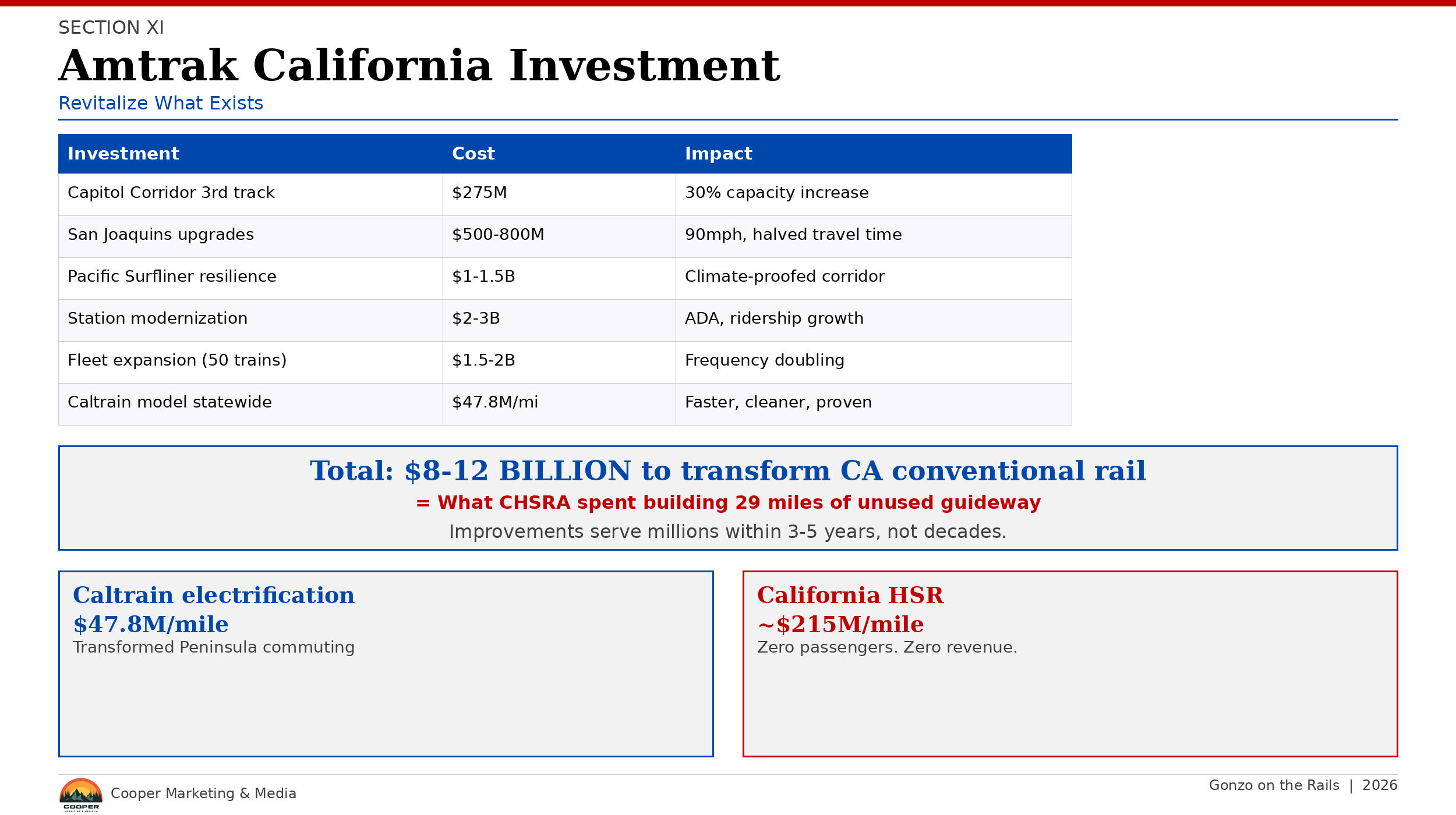
The fleet is in the middle of a modernization cycle. New Siemens Charger locomotives and Venture trainsets are rolling out, and Caltrain’s electrification (the Peninsula Corridor) offers a working proof of concept at $47.8 million per mile. That is expensive. But it is one-fifth the cost of HSR construction in the Central Valley, which runs $215 million per mile (based on the $36.75 billion Merced to Bakersfield estimate divided by 171 miles, per the Eno Center for Transportation) and climbing.
What would a serious Amtrak investment look like? The numbers are striking in their modesty compared to HSR:
Source: Caltrain Electrification Program, Capitol Corridor Joint Powers Authority, LOSSAN Rail Corridor Agency, California State Rail Plan 2023
Total estimated cost to transform California’s conventional rail into a competitive intercity network: $8 to $12 billion. That is roughly what CHSRA has spent in the Central Valley to build 29 miles of guideway that no train has ever used.
The Brightline West project between Las Vegas and Rancho Cucamonga offers an instructive comparison. Originally budgeted at approximately $12 billion for 218 miles (~$55 million per mile at groundbreaking in April 2024), revised estimates as of October 2025 place costs at $21.5 billion (~$98.6 million per mile). Even at the revised figure, it remains less than half the per-mile cost of California HSR. Brightline now targets service by 2029. That is five years from dirt to passengers, against CHSRA’s 18 years from bond to nothing.
California Highways: 49th in the Nation and Sinking
If the Amtrak case is about opportunity, the highway case is about emergency. California’s roads are in crisis, and that is not opinion. It is data.
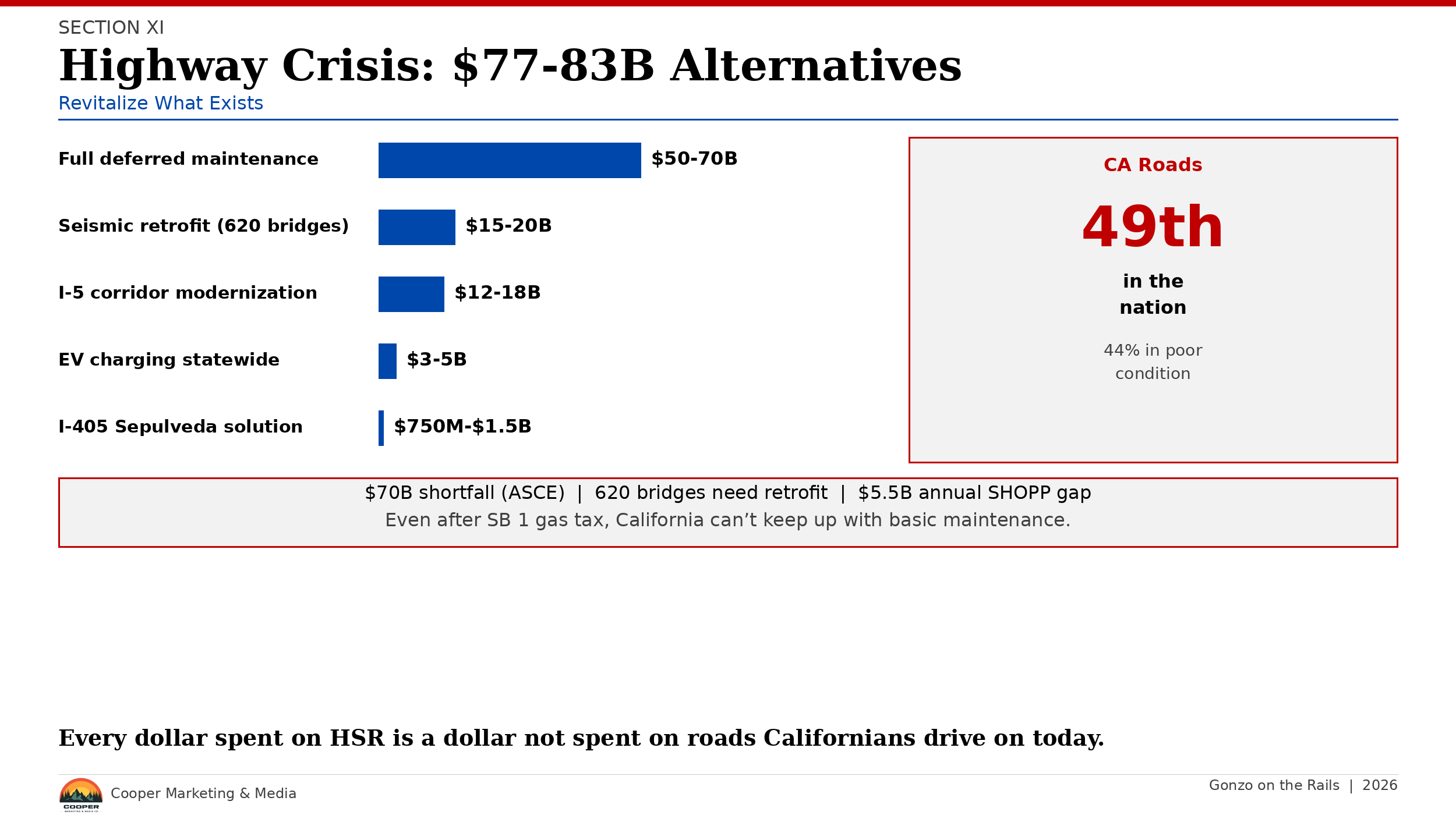
44% of California’s roads are in poor condition. The state ranks 49th nationally in road quality, according to the Reason Foundation’s Annual Highway Report. Only New Jersey and Rhode Island fare worse. The American Society of Civil Engineers gives California’s infrastructure a C- grade and identifies a $70 billion funding shortfall over the next decade.
The ASCE identifies a $70 billion funding shortfall over the next decade, and the State Highway Operation and Protection Program (SHOPP) carries an annual shortfall of approximately $5.5 billion even after accounting for Senate Bill 1 gas tax revenues. SB 1 generates roughly $5.4 billion per year (Caltrans), but it barely keeps pace with deterioration, let alone reduces the backlog. Meanwhile, 620 bridges on the state highway system require seismic retrofitting per Caltrans’s July 2024 Seismic Safety report, with a target to reduce that number by 70% by 2028. In an earthquake-prone state, this is not a policy failure. It is a public safety gamble.
What $77 to $95 Billion Could Build
Source: Caltrans 2024 State Highway Operation Report, ASCE 2025 Infrastructure Report Card, Reason Foundation 28th Annual Highway Report
Consider the comparison: the HSR project’s remaining unfunded gap of $77 to $83 billion could eliminate California’s entire deferred maintenance backlog, retrofit every seismically deficient bridge, and still have $10 to $15 billion left for new capacity projects. Or it could fund another decade of litigation with contractors in the Central Valley.
“We don’t need a train that goes 220 miles per hour. We need roads that don’t destroy your suspension at 65.” — A Caltrans employee speaking anonymously, as reported by CalMatters, 2025. Cooper Marketing & Media has not independently verified this quote.
XII. The Political Landscape: Sentiment, Scorecard, and Forecast
If you want to understand why California High-Speed Rail continues to absorb billions despite producing zero revenue miles, stop looking at the engineering reports. Look at the political map. This section maps the full terrain: voter sentiment, scenario forecasting, and the positions of every elected official who controls the money.
So the arithmetic works. The alternative investments are cheaper, faster, and more broadly distributed. The question is not whether rerouting makes rational sense. It does. The question is whether it can survive in Sacramento.
The Feasibility Rating
We rate the plausible success of the full reroute hypothesis on five dimensions:
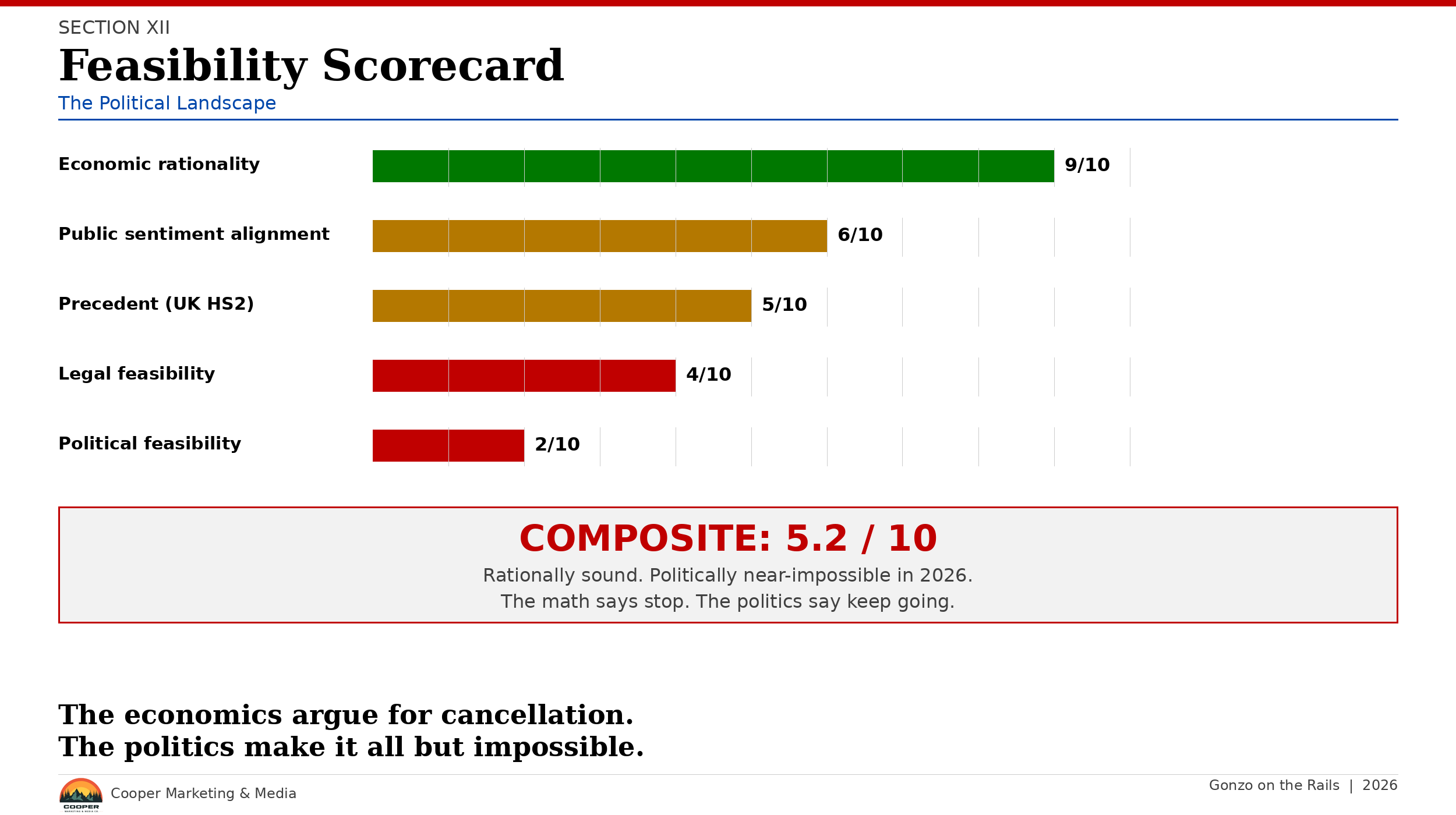
The bottom line: a 5.2 out of 10. The math is elegant. The politics are brutal.
Voter Sentiment: The Paradox of Support Without Belief
Here is the strangest data point in the entire HSR saga: 62% of California voters still support the concept of high-speed rail (POLITICO/Citrin Center/Possibility Lab poll, August 2025), but only 40% believe the investment has been worthwhile, while 33% say it has not (Newsweek, June 2024). That is cognitive dissonance at scale. Voters want the dream, but they have largely given up on the dreamer.
The framing matters enormously. The 2024 Newsweek/Redfield & Wilton poll found that 27% of voters remain undecided on whether the project is worthwhile, a persuadable bloc larger than the margin between supporters and opponents. When the question shifts from “do you want high-speed rail” to “would you prefer your tax dollars fix the roads you drive today,” sentiment shifts. Voters do not want to be told they were wrong in 2008. They want to be told their investment can be redirected toward something that works.
The United Kingdom’s cancellation of HS2’s northern legs in October 2023 provides the closest international precedent. Prime Minister Rishi Sunak rebranded the cancellation as “Network North,” pledging the saved funds to local road and transit improvements across Northern England. Polling on HS2 had shown declining support (28 to 34% in various surveys) before cancellation, and the rebranding initially softened public reaction. But follow-through has been uneven, and critics note that many “Network North” projects were already funded. The lesson for California: the rebranding only works if the money actually arrives.
The Fortune Teller’s Forecast
We deal our cards. Three scenarios, each with a probability weighting:
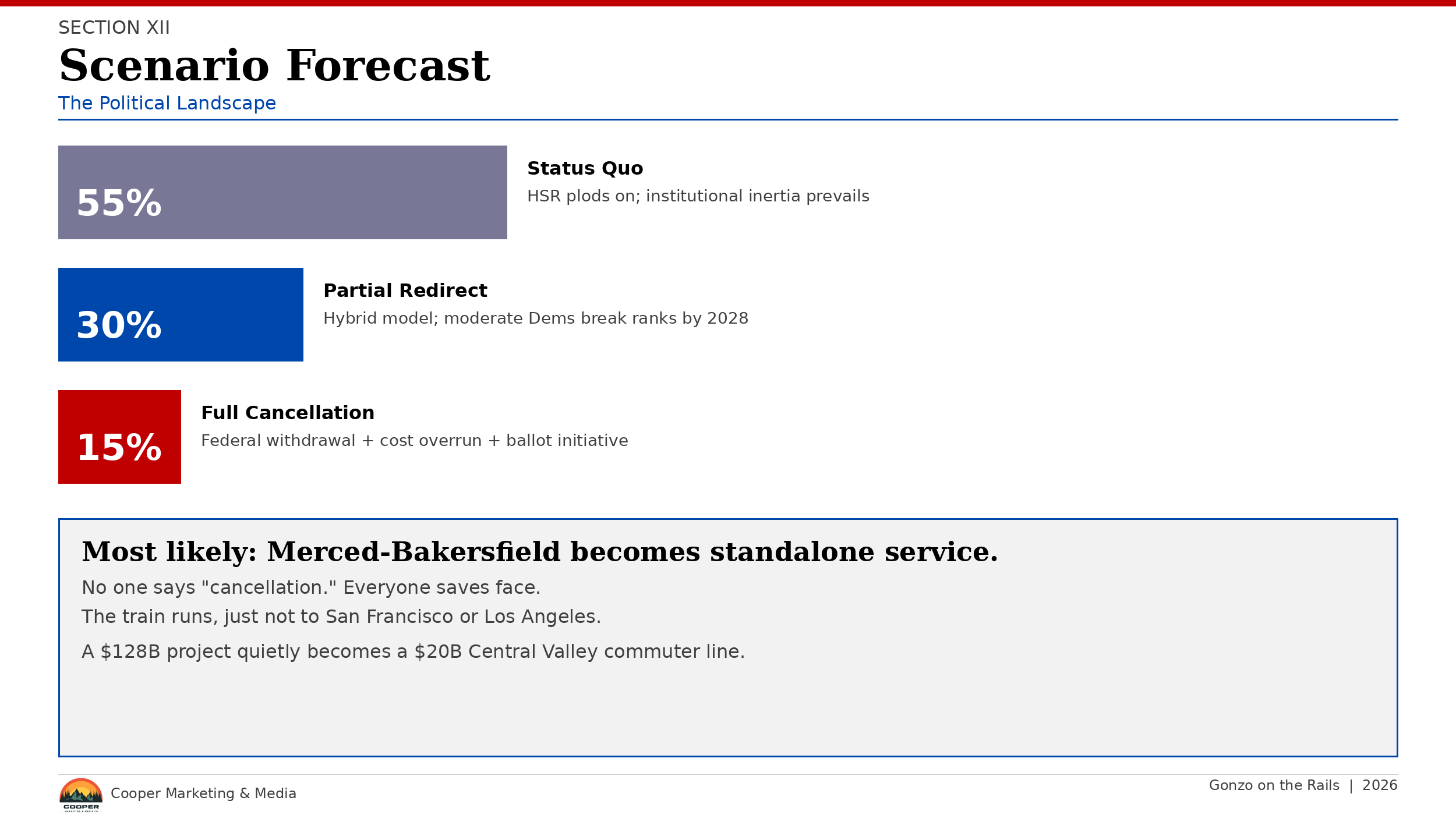
The most likely path is a slow evolution toward Scenario B: a hybrid model where the Merced to Bakersfield segment is completed as a standalone service (perhaps rebranded as the “Central Valley Express”), future phases are indefinitely deferred, and freed-up Cap-and-Invest and state general fund dollars are quietly redirected to Amtrak improvements and highway maintenance. No one has to say the word “cancellation.” Everyone saves face. The train runs, just not to San Francisco or Los Angeles. And the beer? You drink it in Fresno.
Full cancellation requires a perfect storm: simultaneous federal funding withdrawal (possible under a Republican administration), a dramatic cost overrun that exceeds even California’s tolerance for escalation, and a well-funded ballot initiative that reframes the question from “do you want high-speed rail” to “would you rather fix every road in your county.” That storm could form, but it has not yet.
“The rational choice is not always the likely one. In politics, the most expensive option is often the one nobody has to explain.” — Adapted from Steven Pinker, Rationality (2021)
The fortune teller puts her cards away. The crystal ball shows a bullet train running between Merced and Bakersfield sometime in the early 2030s. It shows Amtrak getting modest upgrades funded by state surplus and federal infrastructure dollars. It shows California’s highways continuing to deteriorate at roughly $5.7 billion per year faster than they can be repaired. And it shows the voters of California still waiting, some with patience and some with fury, for the beer on the 220 mph train they were promised in 2008.
The rationalist in us hopes for Scenario B. The Gonzo journalist in us knows that Scenario A is the house bet. In Sacramento, the machine does not stop because the math says it should. It stops when the money runs out. And California has not yet found the bottom of that well.
The Political Scorecard: Where They All Stand
The Outgoing Governor: Newsom's Final Act
Governor Gavin Newsom (D) is term-limited and cannot run again, which means he has nothing to lose and everything to cement. His position is unambiguous: full-throated support. In February 2026, Newsom announced the completion of the Southern Railhead Facility in Kern County as a “major milestone” and declared that “California is building the nation’s first high-speed rail system, and we’re proving it can be done.” The Cap-and-Invest deal, committing $1 billion annually through 2045, was his signature 2025 achievement. He defended the project against the Trump administration’s federal funding termination. For Newsom, HSR is legacy infrastructure.
Source: Governor of California press release, February 3, 2026 (gov.ca.gov); Cap-and-Invest legislation signing, September 2025
2026 Gubernatorial Candidates: The Next Governor Will Decide
The June 2, 2026, primary features ten declared candidates. Their positions on HSR range from “complete it at any cost” to “end this madness.” The next governor will inherit the project’s $77 to $83 billion funding gap and every political landmine that comes with it.
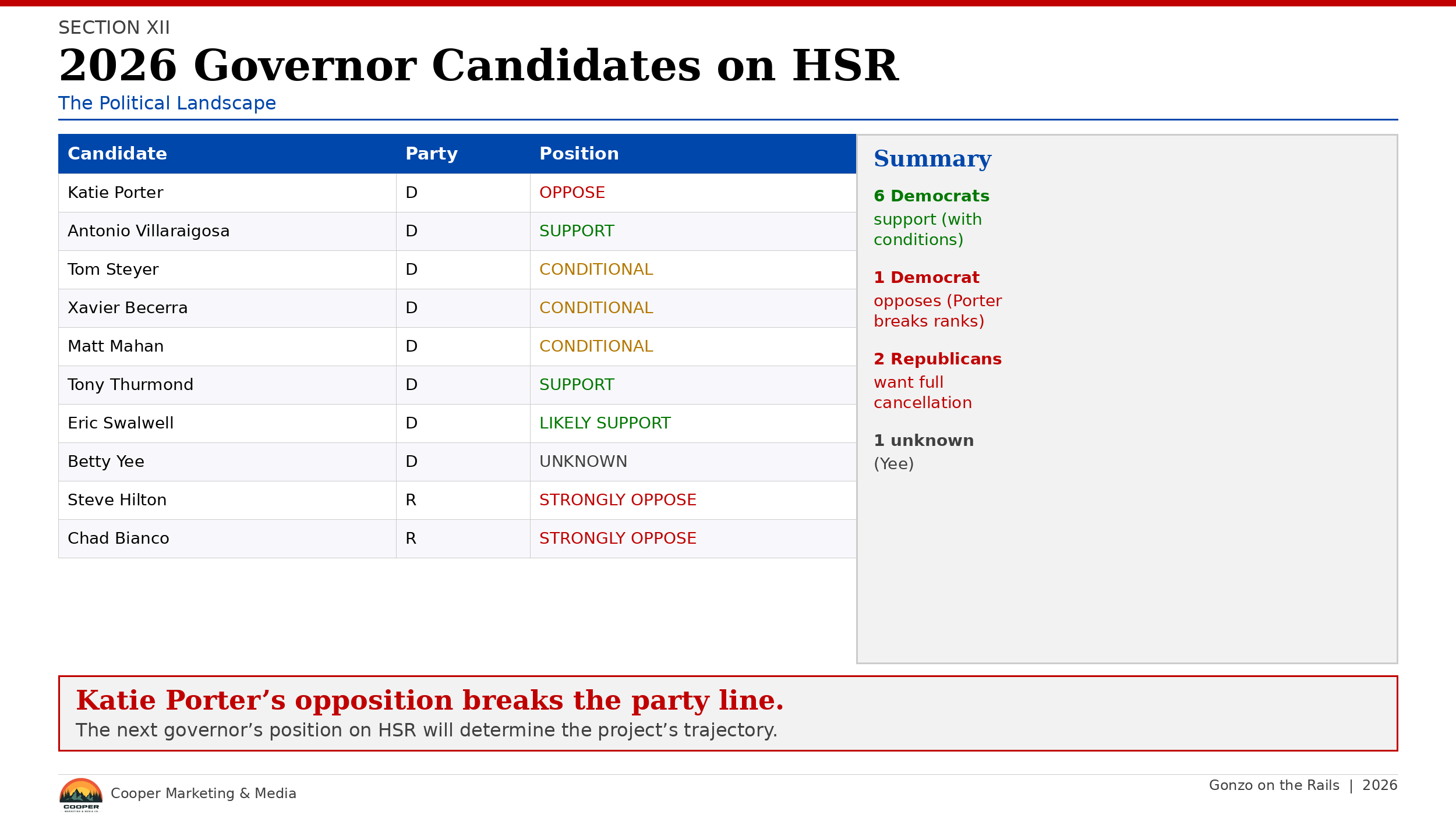
Source: Newsweek, “California High-Speed Rail: Where Candidates Stand,” March 2026; California Globe; KGET 17 News; SF Examiner; campaign websites
The pattern is striking: six Democrats support completion (with varying conditions), one Democrat opposes, one is unknown, and both Republicans want cancellation. Katie Porter’s opposition is the outlier that breaks the party line and signals that HSR skepticism is no longer exclusively a conservative position. Her framing (“don’t BS voters”) is calibrated for the pragmatic middle, not the ideological right.
Streetsblog California devoted an entire episode of its StreetSmart podcast (March 5, 2026) to “The Governor’s Race and High-Speed Rail,” noting that the project has become a genuine dividing line in the Democratic primary for the first time since Prop 1A’s passage.
U.S. Senate: United in Support (For Now)
Both California U.S. Senators are firmly in the HSR camp. No Senate race is on the 2026 ballot (next California Senate elections are 2028).
Sen. Alex Padilla (D): “California is leading the nation in realizing the vision of building the nation’s first true high-speed rail.” Co-authored a joint statement with Sen. Schiff blasting the Trump administration’s $4 billion funding termination. Previously secured $3.1 billion in FRA funding and pushed for a $536 million tunneling design grant.
Source: Padilla.senate.gov press releases, 2025-2026
Sen. Adam Schiff (D): Co-authored the Padilla joint statement opposing federal funding withdrawal. Known as the “Father of the Gold Line” for his role in expanding LA Metro rail. Co-signed letter with Padilla, Costa, Lofgren, and Aguilar urging Secretary Buttigieg to approve $536 million in tunneling design grants.
Source: Padilla.senate.gov; GovTrack.us
U.S. House: The Battle Lines
The House is where the fight is loudest. The split follows party lines with one notable exception, and the rhetoric has escalated from budget disagreements to FBI referrals.
Opposition (Republican)
Rep. Kevin Kiley (R, CA-3): Filed a formal request for FBI Director Kash Patel to open a criminal investigation into CHSRA. “This malfeasance leads to questions that transcend mere incompetence. How is it possible to have spent over $13 billion without a single station opening? Where have these funds gone? Who benefited?” (Kiley.house.gov, March 2026)
Rep. Vince Fong (R, CA-13): Represents the Central Valley, where construction is happening. Titled his February 19, 2026, op-ed “537 Million More Reasons to Cancel California’s High-Speed Rail Nightmare.” Cited the 400% cost increase from the voter-approved budget and called the Authority “chasing a fantasy fueled by mismanagement.”
Source: Fong.house.gov, February 19, 2026
Rep. Doug LaMalfa (R, CA-1): “This project is a train to nowhere. It was supposed to be done by 2020. Now they’re saying 2030 just to finish a small stretch that costs more than the entire original plan.” Introduced the “High-Speed Refund Act” to redirect funds to highway projects. (LaMalfa.house.gov, June 2025)
Rep. David Valadao (R, CA-22): Co-authored legislation to allow California voters to stop the project. Called the proposed $98 billion business plan “financially irresponsible and reckless.” (Valadao.house.gov)
Support (Democratic)
Rep. Jim Costa (D, CA-20): Original co-author of Proposition 1A (1989). The Fresno-area Democrat is the project’s most vocal House champion. “High-speed rail is a modern solution to California’s transportation needs, and dismissing it as a pipe dream will only lead to continued congestion on our roads and delays in our skies.” Cites 14,500 jobs and $22 billion in economic activity. Secured $3.3 billion through the Bipartisan Infrastructure Law. (Costa.house.gov, 2025-2026)
Rep. John Garamendi (D, CA-8): Co-authored the original 1989 HSR legislation with Costa. Highlights Central Valley employment impact: Stanislaus County unemployment dropped from 18% to 7% during construction. (Garamendi.house.gov)
Rep. Zoe Lofgren (D, CA-19): Bay Area representative who testified before the House Transportation & Infrastructure Committee in support. Co-signed the $536 million tunneling grant letter. Warned that “Republican attempts to block High-Speed Rail would derail safety and economy.” (Lofgren.house.gov)
California State Legislature: Where the Money Is Controlled
The state legislature holds the real power over HSR funding, particularly Cap-and-Invest allocations and bond appropriations. The Democratic supermajority makes legislative cancellation effectively impossible in the current session.
Sen. Tony Strickland (R, SD-36), Vice Chair, Senate Transportation Committee: The most quotable HSR critic in Sacramento. “Sacramento Democrats keep moving the goalpost on this failed project with decades of delays, rising costs, and endless raids on cap-and-trade revenues. The only thing high-speed about this bullet train is the speed at which they waste our money.” Strickland has also predicted on the record: “This train, as proposed, will never be built, given the price tag that keeps climbing with no end in sight.” (Strickland.senate.ca.gov; ABC10, 2026)
Assemblymember Alexandra Macedo (R, AD-33): Filed a formal legislative audit request with the Joint Legislative Audit Committee in February 2026. Cited 1,588 contract changes, nearly $6 billion in cost overruns, and called the Central Valley structures “modern-day Stonehenge.” “Every ounce of this project should be available for public consumption.” (KEYT, February 18, 2026)
Assemblymember Lori Wilson (D, AD-6), Chair, Assembly Transportation Committee: Author of AB 1608, which would allow the HSR Inspector General to withhold records believed to “reveal weaknesses.” Wilson states the intent is to protect whistleblower identities and fraud investigation details, not to reduce transparency. Critics, including Strickland, call the bill an attempt to create a “veil of secrecy” around the project. (CalMatters, February 2026; CAP Radio, February 12, 2026)
California Mayors: The Local View
Mayors occupy a peculiar position in the HSR debate: they bear the local impacts of construction (disruption, eminent domain, traffic) while hoping for the long-term economic benefits of station access. Most major-city mayors have been cautious about taking strong public positions.
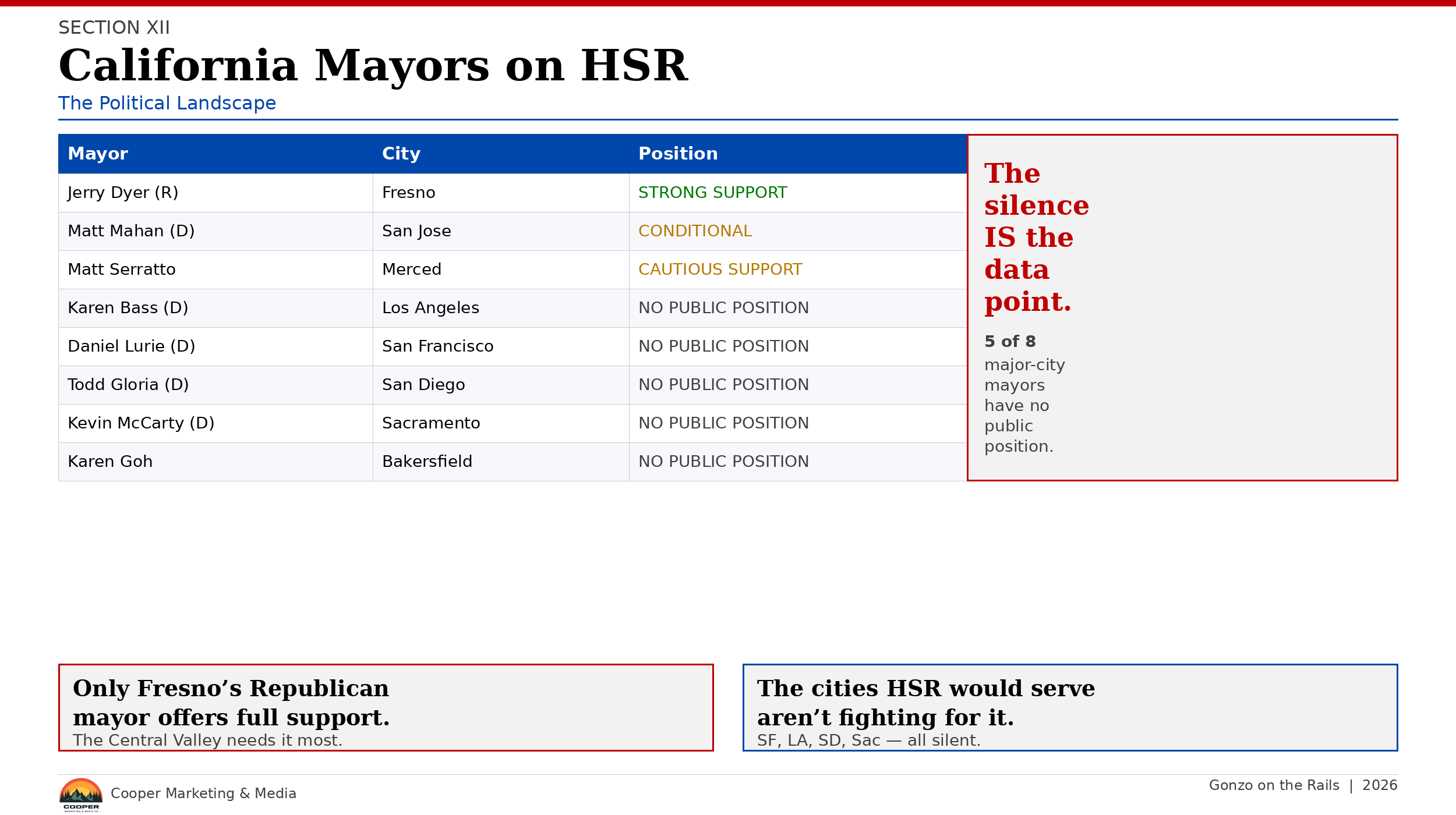
Source: Fresno Bee, 2025-2026; Newsweek; Merced Sun-Star, January 12, 2026; campaign websites; official mayoral press offices
The silence from Los Angeles, San Francisco, San Diego, Sacramento, and Bakersfield is itself a data point. These are the cities that would benefit most from a completed HSR system, and none of their mayors have publicly championed it. When the biggest beneficiaries will not advocate, it tells you something about the project’s political toxicity. Only Fresno’s Jerry Dyer, a Republican in the heart of the construction zone, has broken ranks to offer full-throated support, because for Fresno, HSR is not a theoretical policy debate. It is a $250 million downtown infrastructure overhaul that is already reshaping his city.
County Voices: The Ground Truth
Kings County (Doug Verboon, Board Chair): Fought HSR in court from 2014 to 2019 over farmland loss. Settled in August 2019 for $10 million in relocation costs and General Plan updates. Now conditionally supports completion, advocating Amtrak service even if HSR funding stops. “It doesn’t seem to me like the state government is in a hurry to finish it.”
The Political Reality in One Table
Here is the full partisan breakdown of California’s elected officials on HSR, reduced to its essence:
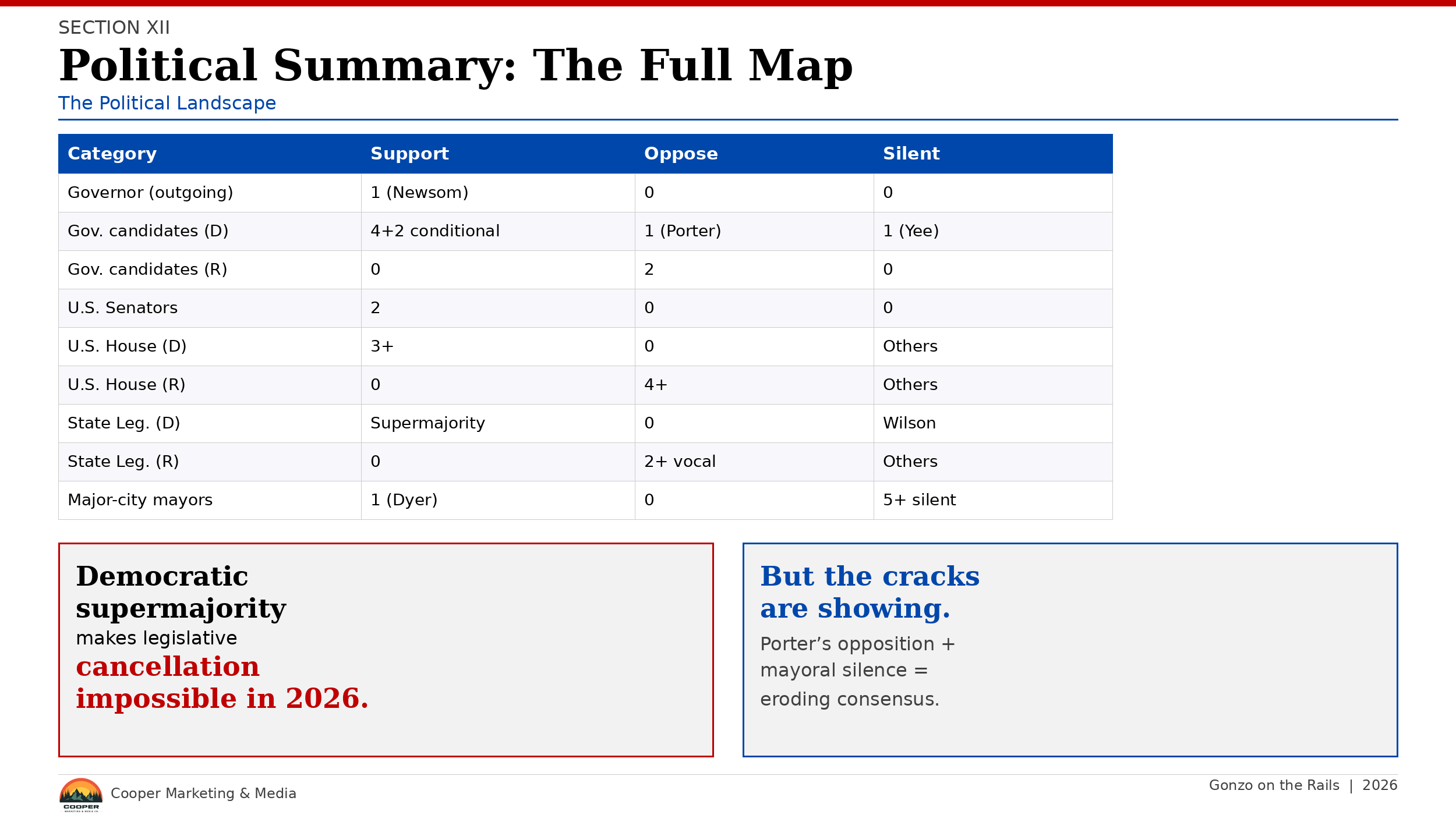
The conclusion is inescapable: the political infrastructure supporting HSR remains overwhelmingly Democratic, and the Democratic supermajority in Sacramento makes legislative cancellation impossible in 2026. But the cracks are showing. Porter’s opposition, the silence of big-city mayors, the escalation from budget complaints to FBI referrals, and the growing appetite for a legislative audit all suggest the political consensus is eroding from within. The question is whether it erodes fast enough to matter before the next $20 billion is spent.
This is a skeptical but fair investigative report. Coop has no financial interest in the California High-Speed Rail project. The sourcing is multi-partisan; the framing is skeptical-leaning-neutral, as befits investigative journalism. All facts are drawn from public records and reporting across the political spectrum.
©2026 Cooper Marketing & Media. All rights reserved.
Sources & Citations
All sources verified as of March 28, 2026. This report draws from official government documents, nonpartisan analysis, and reporting from media outlets across the political spectrum.
Official Government Sources
CHSRA Draft 2026 Business Plan News Release, February 28, 2026 (hsr.ca.gov)
CHSRA 2024 Business Plan and Basis of Estimate (hsr.ca.gov)
CHSRA News Release, September 10, 2025: Cap-and-Invest Funding Agreement (hsr.ca.gov)
Governor of California, Major High-Speed Rail Milestone, February 3, 2026 (gov.ca.gov)
U.S. Department of Transportation, FRA Compliance Review and Grant Termination, 2025 (transportation.gov)
Legislative Analyst’s Office, High-Speed Rail 2025 Project Update (lao.ca.gov)
Federal Permitting Dashboard, Multiple Section Reviews (permits.performance.gov)
House Committee on Oversight and Government Reform, CHSRA Investigation, 2025 (oversight.house.gov)
H.R. 7148, Consolidated Appropriations Act of 2026 (congress.gov)
News and Media
CalMatters, “New cost estimate puts California bullet train $100 billion in the red,” March 2023
CalMatters, “California high-speed rail record exemption,” February 2026
Railway Age, “CHSRA Issues Draft 2026 Business Plan,” February 2026
Streetsblog California, “2026 Could Be the Year Everything Changes for California High-Speed Rail,” November 2025
Streetsblog California, “New Draft CA High-Speed Rail Business Plan is Less Costly,” March 3, 2026
Planetizen, “California Commits $1B Annually for 20 Years to High-Speed Rail,” September 2025
Newsweek, California High-Speed Rail coverage, 2025–2026
Fox News, “California farmers furious over payments for high-speed rail,” 2026
Construction Dive, “What’s behind the California bullet train’s latest woes,” 2025
Construction Owners, “High-speed rail board advances $537M settlement,” January 2026
California Globe, Rep. Kiley FBI investigation request, March 2026
CAP Radio, “Critics say bill creates veil of secrecy,” February 12, 2026
Bond Buyer, California HSR RFQ for Private Partners, December 2025
Bloomberg, “California Abandons Fight with Feds Over High-Speed Rail Funds,” December 24, 2025
Newsweek/Redfield & Wilton Strategies, California HSR Public Opinion Poll, June 2024
POLITICO/Citrin Center/Possibility Lab, California Transportation Policy Poll, August 2025
Trains Magazine, “California Drops Suit Over Cancellation of High-Speed Rail Funding,” December 2025
Registry Northern California, “CHSRA Board Approves $537.3M Settlement,” January 2026
Fox Business, “Timeline: California’s Years-Long, Disastrously Overpriced High-Speed Rail Project,” 2025
Railway Age, Brightline West cost revision reporting, October 2025
Think Tanks and Academic Sources
Hoover Institution, “The Little Engine That Couldn’t” and federal funding analysis, 2025–2026
Reason Foundation, California HSR commentary and analysis
California Policy Center, “2026 Draft Business Plan Is Ambitious, Expensive, and Still Legally Problematic”
Eno Center for Transportation, “California High-Speed Rail Still $7B Short of Merced-Bakersfield Cost,” 2025
TRIP, “California Transportation by the Numbers,” 2025
Caltrans, Seismic Safety of California Bridges Report, July 31, 2024
Taxpayers for Common Sense, “California’s Rail Project Costs More Than Double,” 2024
Bent Flyvbjerg, “The Iron Law of Megaprojects,” White Paper; Oxford Saïd Business School
Bent Flyvbjerg, “How Big Things Get Done” (BCG Henderson Institute)
Steven Pinker, “Rationality: What It Is, Why It Seems Scarce, Why It Matters” (2021)
Transit Costs Project, High-Speed Rail Preliminary Data Analysis
World Bank, “Cost of High-Speed Rail in China,” Press Release, July 2014
International Railway Journal, “How China Builds HSR for Less”
OpenSecrets, Federal Lobbying Data, CHSRA, 2025
California Climate Investments, High-Speed Rail Project Profile (caclimateinvestments.ca.gov)
Politician Statements and Positions (Section XII)
Governor Gavin Newsom, HSR milestone press release, February 3, 2026 (gov.ca.gov)
Senator Alex Padilla (D, CA), Press Releases on HSR funding, 2025–2026 (padilla.senate.gov)
Senator Adam Schiff (D, CA), Joint statement with Padilla on federal funding termination, 2025 (padilla.senate.gov)
Rep. Kevin Kiley (R, CA-3), FBI investigation request, March 2026 (kiley.house.gov; ABC10)
Rep. Vince Fong (R, CA-13), “537 Million More Reasons to Cancel,” February 19, 2026 (fong.house.gov)
Rep. Doug LaMalfa (R, CA-1), “High-Speed Refund Act” and DOT compliance report statement, June 2025 (lamalfa.house.gov)
Rep. David Valadao (R, CA-22), legislation to allow voter cancellation (valadao.house.gov)
Rep. Jim Costa (D, CA-20), Prop 1A author, HSR defense and $3.3B BIL funding, 2025-2026 (costa.house.gov)
Rep. John Garamendi (D, CA-8), original HSR legislation co-author, employment impact data (garamendi.house.gov)
Rep. Zoe Lofgren (D, CA-19), House Transportation testimony and $536M grant letter (lofgren.house.gov)
Senator Tony Strickland (R, SD-36), Senate Transportation Committee remarks, 2026 (strickland.senate.ca.gov; ABC10)
Assemblymember Alexandra Macedo (R, AD-33), Legislative audit request, February 18, 2026 (KEYT)
Assemblymember Lori Wilson (D, AD-6), AB 1608 author, Assembly Transportation Committee (CalMatters, Feb 2026; CAP Radio, Feb 12, 2026)
Newsweek, “California High-Speed Rail: Where Governor Candidates Stand,” March 2026
KGET 17 News, Katie Porter HSR opposition interview, 2026
California Globe, “Not All Aboard: The Growing Divide of 2026 Gubernatorial Candidates on HSR,” March 2026
Streetsblog California, StreetSmart Podcast 14.2: “The Governor’s Race and High-Speed Rail,” March 5, 2026
SF Examiner, Steve Hilton gubernatorial plans and HSR opposition, 2026
CalMatters, “The Field Is Set”: 2026 Governor Candidates, March 2026
Fresno Bee, Mayor Jerry Dyer HSR support statements, 2025–2026
Merced Sun-Star, Mayor Serratto on station relocation, January 12, 2026
U.S. Senate Commerce Committee statement, February 2026
Investigation and Legal Sources (Section V)
FRA Notice of Proposed Determination, June 4, 2025 (railroads.dot.gov/elibrary)
FRA Acting Administrator Feeley, Grant Termination Letter, July 16, 2025 (railroads.dot.gov)
CHSRA 30-Day Response to FRA, July 7, 2025 (hsr.ca.gov)
House Oversight Committee, Chairman Comer Investigation Letter to Secretary Duffy, August 19, 2025 (oversight.house.gov)
CHSRA Office of Inspector General, FY 2024-2025 Annual Report, July 2025 (hsr.ca.gov)
CHSRA OIG Schedule Engagement Report, February 2025 (hsr.ca.gov)
California State Auditor, Report 2018-108: High-Speed Rail Authority (bsa.ca.gov)
California State Auditor, Report 2009-106: High-Speed Rail Authority (bsa.ca.gov)
DOJ Justice Manual, Section 9-42.000: Fraud Against the Government
18 USC 1341, 1343 (Mail Fraud, Wire Fraud); 18 USC 1031 (Major Fraud)
31 USC 3729 (False Claims Act)
California Streets and Highways Code, Sections 2704.08-2704.09 (Proposition 1A)
FBI Boston Field Office, Big Dig Fraud Convictions Press Release, 2009 (archives.fbi.gov)
TRAC Reports, Federal White-Collar Crime Prosecution Data, FY 2024-2025 (tracreports.org)
California Policy Center, “2026 Draft Business Plan Is Ambitious, Expensive, and Still Legally Problematic”
Senate Commerce Committee, “After 25 Years and Billions in Federal Subsidies,” February 2026 (commerce.senate.gov)
KQED, “Some California High-Speed Rail Records Could Remain Secret Under Proposed Law,” 2026
Mass Transit Magazine, FRA Compliance Review Report Coverage, June 2025
International HSR Comparison Sources (Section VI)
International Railway Journal, “Shinkansen: Half a Century of Speed,” 2014 (railjournal.com)
Nippon.com, “Japan’s Shinkansen: How Does It Stack Up Worldwide?” 2024 (nippon.com)
JR Central, Annual Financial Reports and Investor Relations (jr-central.co.jp)
ADIF, “30 Years of High-Speed in Spain,” May 2022 (eimrail.org)
HSRail.org, “How a High-Speed Line Saved Passenger Rail in Spain,” 2023
Global Railway Review, “Spanish High-Speed Rail: The Most Extensive in Europe,” 2024
SNCF Group, Full-Year Financial and Sustainability Report 2024 (groupe-sncf.com)
International Railway Journal, “France Faces Tough Choices Over Future of TGV,” 2024
World Bank, “Regional Economic Impact Analysis of High-Speed Rail,” 2014 (worldbank.org)
South China Morning Post, “China’s High-Speed Rail Nears 50,000km Milestone,” 2025
Pekingnology, “China Massively Overbuilt High-Speed Rail, Says Leading Economic Geographer,” 2024
UK Government, “HS2 6-Monthly Report to Parliament,” December 2024 (gov.uk)
Institute for Government, “HS2: Costs and Controversies,” 2025 (instituteforgovernment.org.uk)
New Civil Engineer, “HS2: £46.2bn Already Spent but New Total Estimate Not Yet Detailed,” March 2026
Alternative Investment and Wind-Down Sources (Sections X–XI)
Caltrain Electrification Program, Peninsula Corridor Cost Reports (caltrain.com)
Capitol Corridor Joint Powers Authority, Capital Improvement Program, 2025 (capitolcorridor.org)
LOSSAN Rail Corridor Agency, Corridor Strategic Implementation Plan (lossan.org)
California State Transportation Agency, 2023 California State Rail Plan (calsta.ca.gov)
Brightline West, Environmental Impact Statement and Construction Timeline (brightlinewest.com)
Caltrans, 2024 State Highway Operation and Protection Program (dot.ca.gov)
American Society of Civil Engineers, 2025 Report Card for California Infrastructure (infrastructurereportcard.org)
Reason Foundation, 28th Annual Highway Report: Performance of State Highway Systems, 2025
Amtrak California, Annual Ridership Statistics, 2024–2025 (amtrak.com)
POLITICO/Citrin Center/Possibility Lab, California Transportation Policy Poll, August 2025
Newsweek/Redfield & Wilton Strategies, California HSR Public Opinion Poll, June 2024
UK Department for Transport, Network North Plan, October 2023 (gov.uk)
The Guardian, “HS2 Northern Leg Cancellation: What It Means,” October 2023
Proposition 1A (2008), Full Ballot Text and Legal Analysis (sos.ca.gov)
AB 398, California Cap-and-Trade Extension, Statutory Text (leginfo.legislature.ca.gov)
OpenSecrets, HSR-Related Lobbying Expenditures, 2020–2025 (opensecrets.org)
California Building Trades Council, High-Speed Rail Employment Data, 2025
World Bank, “The Economics of Rail: Conventional vs. High-Speed,” 2023