The Reality of an Energy Independent America
How I Learned to Stop Worrying About the Talking Points and Love the Actual Numbers
An Op-Ed by Coop | From the #Hippiehaus Desk: April 2026
There is a peculiar madness loose in Washington, and it has nothing to do with the usual menagerie of grifters and true believers who populate the corridors of power like mold in the walls of a building nobody bothered to inspect. This madness is more specific, more dangerous, and far more consequential than anything Washington's political theater produces. And we have all gotten far too comfortable with it.
The madness is this: We are being told, loudly and repeatedly, that America has achieved "energy dominance." That we are free. That the shackles of foreign oil dependence have been shattered by the righteous fury of deregulation and the drill-baby-drill gospel. The White House declared in February 2026 that "American Energy Dominance is back under President Trump," and the faithful received it like scripture.
Here is the problem. The numbers do not agree with the sermon.
The Uncomfortable Truth About "Energy Independence"
Let us start with what "energy independence" actually means, because the term has been worked over so thoroughly it ought to file a restraining order.
The United States produced 103.3 quadrillion BTUs of primary energy in 2024 while consuming 94.2 quadrillion BTUs, according to the EIA. We exported 23.0 quads and imported 19.6, leaving us with a net surplus of 3.4 quads. On paper, that looks like independence, in the way that a man who grows his own tomatoes but still buys steak at the grocery store might call himself "food independent."
The reality beneath the headline is this: America still imports roughly 30 to 35 percent of its crude oil as of 2025. We produced a record 13.6 million barrels per day that year, which sounds magnificent until you learn that our refineries need approximately 16.5 million barrels per day to keep the lights on, the trucks moving, and the petrochemical plants humming. That gap, roughly 6 million barrels per day of imported crude, comes overwhelmingly from Canada (62 percent of imports) and Mexico (7 percent), per EIA data. We import because our refineries were built to process heavy crude, and we produce mostly light crude from the Permian Basin and Bakken formation. This is primarily a physics and infrastructure challenge that policy alone cannot solve.
Now, unlike 1973, when OPEC held the American economy hostage, nearly 70 percent of our crude imports now come from Canada and Mexico, nations with whom we share deeply integrated energy markets. The vulnerability is real, but it is narrowly geographic, not existential. That distinction matters.
The EIA projects U.S. oil production will remain essentially flat at 13.6 million barrels per day through 2026. The era of explosive production growth is slowing, not because of regulation, but because the best shale plays are maturing and the economics of marginal wells are getting tighter.
When someone tells you we have achieved energy independence, the honest answer is: sort of, depending on what you mean, and only if you squint.
The Fossil Fuel Ledger: Costs They Do Not Print on the Billboard
Here is the part of the ledger that never makes it into the stump speech.
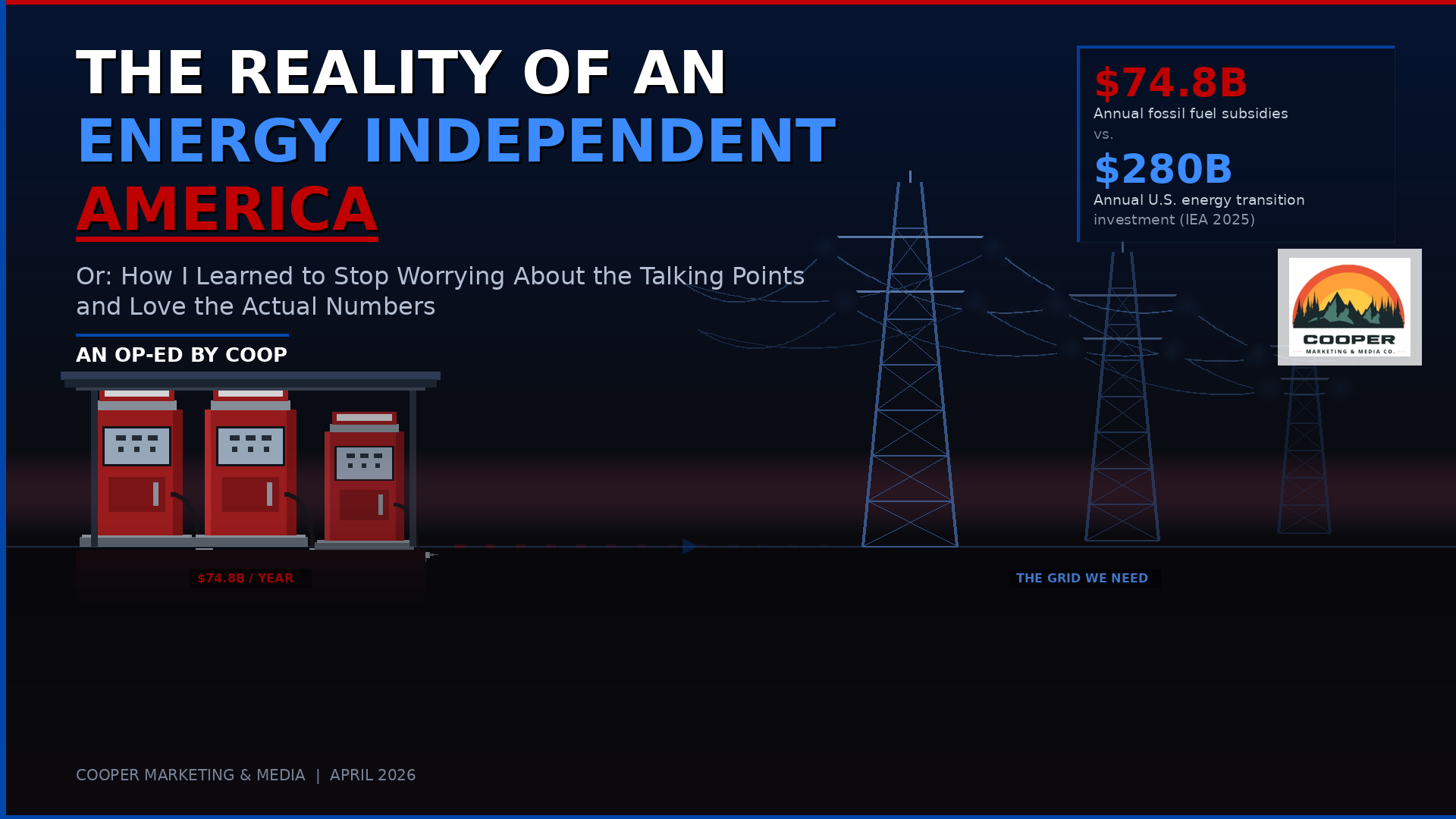
The fossil fuel industry receives approximately $74.8 billion per year in federal subsidies, according to Oil Change International's 2025 analysis. That figure includes the $34.8 billion in existing annual support plus nearly $40 billion in new subsidies added by the current administration. That is not a typo. We are subsidizing one of the most profitable industries in modern history to keep doing what it was already doing, while simultaneously being told the free market is in charge. Somebody is lying to somebody, and the taxpayer is the only one not laughing.
Meanwhile, fossil fuel air pollution and climate change impacts cost Americans $820 billion per year in healthcare costs alone, according to a 2024 NRDC study. That works out to roughly $2,500 per American, per year, extracted not at the gas pump but at the hospital, the pharmacy, and the funeral home.
Coal, once the backbone of American electricity, is in structural decline. Production dropped from 512 million short tons in 2024 to a projected 467 million short tons in 2026, per the EIA. Employment in coal mining stands at roughly 38,000 to 44,000, depending on the data source and quarter, down from 84,000 in 2010 per BLS data. Morgan Stanley projects the coal industry will shrink to negligible scale by 2033. Wall Street analysts have no sentimental attachment to anything except returns, and the returns are telling them to get out.
Natural gas had a record year in 2025, hitting 118.5 billion cubic feet per day per the EIA. It still generates 40 percent of our electricity. But here is what the "natural gas bridge" crowd does not want to discuss: U.S. carbon emissions rose 2.4 percent in 2025 to 5.9 billion metric tons of CO2 equivalent, according to Rhodium Group analysis, driven partly by a 13 percent increase in coal-fired electricity generation and partly by the ravenous appetite of data centers and cryptocurrency mining operations. The bridge, it turns out, is smoldering. And we keep adding traffic.
We have 46.4 billion barrels of proved oil reserves as of end of 2023, down 3.9 percent from the 2022 record, per the EIA. The math on depletion is not complicated. It is just unpleasant.
The mathematics of depletion is merciless. But while Washington argued about drilling permits, an entirely different energy transformation was already underway, one that did not require permission, one that did not fit the old political categories, and one that is reshaping the American grid from the ground up.
Solar: The Revolution Nobody Voted For
Solar did not wait for Washington's approval. It just showed up, cheaper than the competition, and started building.
The United States ended 2025 with 279 gigawatts of installed solar capacity, per EIA data. Another 43.4 gigawatts are planned for 2026, a 60 percent increase over 2025's annual additions. The levelized cost of energy for utility-scale solar hit $39 per megawatt-hour in 2025, according to Lazard's 2025 LCOE analysis. For comparison: new natural gas combined-cycle plants come in at $48 to $107 per MWh. New coal plants cost $65 to $150 or more per MWh.
In the majority of U.S. electricity markets, solar now beats every other new power source on price.
The solar industry employs 280,119 Americans in primary solar roles, with an additional 90,000-plus spending a plurality of their time on solar work, for a broader workforce of over 370,000, according to the 2024 National Solar Jobs Census. The Bureau of Labor Statistics projects 42 percent job growth for solar installers through 2034. There is a projected 53,000-worker shortage heading into late 2026, per a PV Magazine analysis. That is the kind of problem that translates directly into training programs, apprenticeships, and careers.
The Inflation Reduction Act turbocharged domestic solar manufacturing. For the first time in over 12 years, as of September 2025, all major module supply chain components, polysilicon, ingot, wafer, cell, and module, are being produced domestically, per SEIA data. U.S. module manufacturing capacity hit 60 gigawatts that same month.
The environmental trade-offs deserve honest discussion. By 2030, the U.S. is expected to have 1 million tons of solar panel waste, per EPA estimates. Only about 10 percent of panels are currently recycled, because it costs $30 per panel to recover $3 to $8 in materials versus $1 to landfill it. The EPA has proposed new rules to address this, with a final rule expected by end of 2026. Land use impacts are real, particularly for utility-scale installations.
But context is everything. Solar generation in 2024 avoided 1,658 million tonnes of CO2 globally, according to IEA data. A solar panel pays back the energy required for its manufacture within one to four years, then produces clean electricity for another 25 or more. The net math favors solar, though challenges remain.
What solar cannot do, at least not yet, is run the grid by itself. The sun sets. Clouds roll in. A 16-hour winter night in New England does not care how many panels you installed last summer. This is the intermittency problem, and anyone who tells you it does not matter is selling you something. The answer is to pair solar with storage, with baseload power, and with every other tool in the box, because no single technology solves this alone.
Wind: Blowing Through the Obstacles
Wind energy added over 7 gigawatts of new capacity in 2025, a 36 percent increase over 2024, with 11.8 gigawatts planned for 2026, per EIA projections. The onshore wind LCOE ranges from $37 to $86 per MWh according to Lazard's 2025 analysis. Newer offshore projects are achieving $40 to $50 per MWh, competitive with natural gas and cheaper than new coal.
The big offshore news: Vineyard Wind 1 (804 MW, Massachusetts) completed construction on March 13, 2026. Revolution Wind (704 MW, Rhode Island) began delivering power that same day, enough capacity to power 350,000 homes. These projects survived court challenges after the administration attempted to halt them on national security grounds, an argument that crumbled under judicial scrutiny like wet cardboard.
Wind supports an estimated 125,000 to 130,000 workers nationally, per DOE data, with thousands more in supply chain and manufacturing. Wind turbine technicians are ranked as the single fastest-growing occupation in America by the BLS, projecting nearly 50 percent growth through 2034. Median annual wage: $62,580. These are not gig economy scraps. These are careers with pensions and benefits. The kind of thing politicians love to talk about at ribbon cuttings, but somehow forget to fund.
The environmental concerns are real. Wind turbines kill an estimated 600,000 to 1.5 million birds and 1.7 to 2.8 million bats annually in the U.S. That sounds terrible until you learn that fossil fuel power generation kills 5.18 birds per gigawatt-hour versus wind's 0.269, per U.S. Fish and Wildlife Service data. Painting one blade black reduces bird fatalities by over 70 percent, according to a Norwegian study published in Ecology and Evolution. Ultrasonic deterrents cut bat mortality by 54 percent. The mitigation tools exist, and they work.
The headwinds are significant and largely self-inflicted. The IEA, in its 2025 Renewables report, cut U.S. renewable capacity forecasts by 50 percent for 2025 to 2030, citing the phase-out of federal tax credits, import restrictions, suspension of offshore wind leasing, and stricter permitting on federal land. Policy uncertainty reduced the five-year wind forecast from 75.8 gigawatts to 45.1 gigawatts, a 40 percent cut. The Interior Department also spent $1 billion buying out TotalEnergies' offshore wind leases in March 2026, per Department of Interior public filings.
We are not watching the market fail. We are watching policy sabotage the market.
Nuclear: The Sleeping Giant That Wall Street and Silicon Valley Just Woke Up
America operates 94 nuclear reactors across 54 plants, generating 97 gigawatts of capacity and 19.1 percent of our electricity, per NRC data. Nuclear runs at a 92 percent capacity factor, meaning it produces power almost all the time. Wind runs at 34 percent. Solar at 23 percent. For baseload reliability, nuclear is in a class by itself on the current grid.
The lurking problem is cost. Plant Vogtle Units 3 and 4 in Georgia, the first new U.S. nuclear reactors in a generation, came online in 2023 and 2024 at a final cost of approximately $36.8 billion, more than double the original $14 billion estimate and years behind schedule. The new-build LCOE for nuclear runs $141 to $220 per MWh according to Lazard's 2025 analysis. That is expensive. Nobody should pretend otherwise.
But the existing fleet tells a different story entirely. Fully depreciated nuclear plants produce electricity at less than $40 per MWh, per EIA data, competitive with the cheapest renewables when you factor in their round-the-clock availability. The NRC approved 13 reactor license renewals in 2025, extending 12,000 MW of capacity for another 20 years. Keeping these plants running is, by any measure, the most cost-effective clean energy decision available. And nuclear is not the only technology capable of delivering this kind of baseload power at scale. One largely overlooked option may prove even more versatile, and we will get to it shortly.
The tech giants have figured this out, and they are writing very large checks. Microsoft signed a 20-year power purchase agreement to restart Three Mile Island Unit 1 (837 MW) with Constellation Energy, backed by a $1 billion DOE loan announced in November 2025. Google committed to 500 MW from Kairos Power small modular reactors, targeting 2030. Amazon secured a 1,920 MW deal with Talen Energy through 2042 and is exploring SMRs with X-energy and Dominion Energy. Amazon, Google, Meta, and Microsoft have all pledged to support tripling global nuclear capacity by 2050. When the four largest technology companies on earth are all writing billion-dollar checks to the same energy source, that is not a trend. That is a verdict.
Small modular reactors represent the next frontier. NuScale holds the first NRC-certified SMR design, approved in 2023. TerraPower expects NRC approval in mid-2026, per company guidance and DOE statements. X-energy's decision is expected by November 2026, per NRC regulatory timelines. The first commercial SMRs in the U.S. are currently projected for the 2029 to 2030 timeframe, with China's ACP100 reactor potentially reaching commercial operation by end of 2026, according to the World Nuclear Association.
Nuclear employs 67,900 workers, per the 2024 U.S. Energy and Employment Report, who earn a 52 percent wage premium over the median for all electric power generation. A fleet of AP1000 reactors would create an estimated 44,300 jobs annually during a 13-year construction phase and generate $1.03 trillion in cumulative GDP over 80 years of operation, according to a March 2026 American Nuclear Society study.
The waste problem is real but overstated by its loudest critics. The U.S. has accumulated over 75,000 metric tons of spent fuel, per NRC data. Yucca Mountain, the congressionally approved permanent repository, had its funding terminated in 2011. The NRC subsequently confirmed the design would safely contain waste for one million years. We have a tested solution. What we lack is the political will to implement it. Short of consensus on Yucca, hardened above-ground dry cask storage remains safe for decades, and reprocessing technologies deployed successfully in France and the UK could extend the timeline indefinitely.
One critical vulnerability demands attention: in 2023, the U.S. imported 99 percent of its uranium, per EIA data. Domestic production surged 13-fold in 2024 to 677,000 pounds, but total U.S. reactor requirements run approximately 40 million pounds per year. Congress has committed $2.7 billion to revive domestic uranium production, with a new Utah processing facility targeting 2 million pounds annually by 2026. The gap is enormous, and until it closes, "energy independence" through nuclear carries a very large asterisk.
The administration has set a target of expanding nuclear from 100 GW to 400 GW by 2050, per DOE. The DOE has initiated plans to add 2.5 GW by 2027 and 5 GW by 2029 through uprates and restarts.
Fusion: The Promise That Is Actually Getting Closer
Nuclear fusion, the process that powers the sun, has been "30 years away" for the past 60 years. That joke is getting stale. The timeline is compressing, and the money is getting serious.
The National Ignition Facility at Lawrence Livermore achieved its 10th ignition event in October 2025. In April 2025, they recorded their most impressive result: a target gain of 4.13, producing 8.6 megajoules from a 2.08 megajoule input. That is not a laboratory curiosity. That is a scientific proof of concept demonstrated repeatedly.
The private sector is moving faster than the government, which should surprise exactly nobody. Commonwealth Fusion Systems began assembling its SPARC tokamak in March 2025 and expects completion by end of 2026, with first plasma operations targeted for 2027. Helion Energy, which has built more fusion prototypes than anyone (seven generations), achieved 150 million degrees Celsius in its Polaris machine in February 2026 using deuterium-tritium fuel, a first for any private fusion device. Helion broke ground on its Orion commercial plant in Washington state on July 30, 2025, with a 50 MW power purchase agreement with Microsoft targeting 2028 delivery.
The DOE allocated $806 million for fusion research in the FY2026 budget. Total private fusion investment exceeds $7.1 billion to date, per the Fusion Industry Association. The ITER international project targets first plasma by 2033 to 2034.
Is commercial fusion guaranteed? No. Are the engineering challenges enormous? Yes. The honest assessment is that grid-scale commercial fusion remains projected for the early 2030s at the earliest. But by most measures, the trajectory of achievement is steepening, not flattening. A decade ago, nobody expected private companies to reach ignition-class results this quickly.
What Is Next: The Technologies Most People Are Not Watching
Before we add up the whole portfolio, several emerging sectors deserve attention. One of them may be the most consequential energy technology in America that nobody is talking about.
Enhanced Geothermal Systems. Remember that promise, a few paragraphs back, about a baseload technology that might rival nuclear? Here it is. Fervo Energy's Cape Station in Utah is bringing 100 MW online in late 2026, with 400 MW more by 2028, for a total of 500 MW at a single site, per company filings. Fervo has raised approximately $1.5 billion since 2017, including a $462 million Series E in December 2025, and secured a partnership with Google to power data centers in Nevada with 115 MW of geothermal energy.
Unlike solar and wind, enhanced geothermal runs 24 hours a day, 365 days a year. It provides the same baseload reliability as nuclear with zero fuel costs and minimal waste. It does not require enriched uranium from Kazakhstan. It does not produce spent fuel rods. Current costs run approximately $140 per MWh, but DOE projects that could drop to $60 to $70 per MWh by 2030 as drilling techniques improve. The EGS market is projected to grow at 18.2 percent annually through 2030, per industry analysis.
The deployment risk is real. Fervo has proven the concept at one site. Scaling to meaningful grid contribution requires drilling in regions where seismic risk and groundwater contamination need regulatory clearance. But the physics works, the economics are improving, and the baseload advantage is enormous. If any technology deserves ten times its current attention and funding, it is this one.
Green Hydrogen. Costs sit at $3.50 to $6.00 per kilogram today, with the DOE targeting $1.00 per kilogram by 2031 through its Hydrogen Shot initiative. The global green hydrogen market is projected to reach $62.5 billion by 2033. Hydrogen is not a grid power source so much as a storage medium and industrial fuel, critical for decarbonizing steel, shipping, and heavy transport where batteries fall short.
Cold Fusion and Low-Energy Nuclear Reactions. This remains the most speculative item on the list. The fundamental problem since Fleischmann and Pons's 1989 claims has not changed: experiments cannot be reliably reproduced, and no accepted theoretical framework explains the reported phenomena. However, ARPA-E allocated $10 million in 2023 to eight projects specifically designed to determine whether LENR is real or a measurement artifact. Growing research programs exist in both the U.S. and Japan. The honest assessment: LENR remains speculative for any commercial application through the 2030s, but rational inquiry demands investigation rather than dismissal of phenomena not yet fully understood.
Wave and tidal energy is a $1.83 billion market in 2026, growing to $4.07 billion by 2035, with the U.S. PacWave South testing facility opening this year. Space-based solar power has multiple orbital demonstration missions planned through 2030, with gigawatt-scale deployment targeted for 2035, contingent on achieving launch costs below $100 per kilogram to orbit. These are longer-horizon plays, but the physics is sound and the investment is real.
The All-of-the-Above Math
Here is where rationality must prevail over partisan thinking.
The Lazard 2025 LCOE analysis shows that solar ($38 to $78 per MWh) and onshore wind ($37 to $86 per MWh) are the cheapest new electricity sources. Existing nuclear (less than $40 per MWh) is the cheapest baseload power on the grid today. Natural gas ($48 to $107 per MWh) is flexible and abundant. New nuclear ($141 to $220 per MWh) is expensive but provides unmatched reliability and zero-carbon baseload. Grid-scale battery storage hit a record low of $78 per MWh in 2025, per BloombergNEF, a 27 percent year-over-year decline. Enhanced geothermal could reach $60 to $70 per MWh by 2030.
The U.S. grid generates electricity from natural gas (40 percent), nuclear (19 percent), coal (16 percent), wind (11 percent), solar (6 percent), and hydroelectric (6 percent), based on 2025 EIA data. Wind and solar combined hit 17 percent in 2025, a record, and are projected to reach 21 percent by 2027.
The grid is under historic stress. Thirteen of 23 North American assessment areas face elevated or high reliability risk over the next five years, per NERC's 2025 Long-Term Reliability Assessment. Summer peak demand could surge by 224 gigawatts, 69 percent more than previously projected, driven overwhelmingly by data center and AI electricity demand. Between 30 and 46 percent of U.S. grid infrastructure has exceeded its useful life. The AI boom is outpacing grid buildout. Without accelerating transmission infrastructure, renewable deployment alone cannot meet the demand curve. This is not a technology problem. It is a permitting and land-use problem.
The grid interconnection queue tells a story of its own: 1,400 GW of generation capacity and 890 GW of storage are waiting to connect, per Lawrence Berkeley National Laboratory's 2024 Queued Up report. The median time from request to operation has doubled from less than 2 years (2000 to 2007) to more than 4 years (2018 to 2024). That backlog is an infrastructure and permitting failure, and it affects every energy source, though it disproportionately slows renewable deployment needed to hit 2030 and 2035 targets.
Grid-scale seasonal storage, the ability to bank summer generation for winter demand, remains the unsolved infrastructure problem. Current lithium-ion batteries provide four to eight hours of discharge. A 16-hour winter night in the Northeast, with minimal solar and inconsistent wind, requires longer-duration solutions: hydrogen storage, compressed air, or next-generation battery chemistries still in development. Until we solve this, claims that renewables can fully replace baseload generation remain aspirational, not operational.
A UC Berkeley Goldman School analysis found that achieving 90 percent clean electricity by 2035 is feasible without increasing consumer bills, would inject $1.7 trillion into the economy, and create a net increase of 530,000 energy sector jobs per year. The DOE estimates that full power sector decarbonization would cost $330 to $740 billion in additional system costs but could prevent up to 11,000 premature deaths annually and avoid over $1 trillion in cumulative climate damage costs.
The IRA allocated $783 billion for energy and climate investments when signed in August 2022. Current annual U.S. energy transition investment stands at approximately $280 billion, per the IEA's World Energy Investment 2025 report. Grid expansion and reinforcement hit a record $115 billion in 2025, per BloombergNEF. The DOE's SPARK program committed $1.9 billion for transmission upgrades in 2026.
The workforce reckoning Washington refuses to name. Clean energy already employs more Americans than fossil fuels, per the 2024 U.S. Energy and Employment Report. Solar employs over 370,000 workers (280,119 in primary roles, with an additional 90,000-plus in plurality roles). Wind supports an estimated 125,000 to 130,000 workers. The two fastest-growing occupations in America, per the BLS 2024 Occupational Outlook Handbook, are wind turbine technician and solar photovoltaic installer. Meanwhile, Chevron announced plans to cut 15 to 20 percent of its staff by end of 2026, and coal mining employment has roughly halved since 2010.
But here is the part that demands intellectual honesty from both sides: the coal miners in West Virginia and the oil field workers in the Permian Basin are not going to become solar installers in Arizona overnight. The geographic and skills mismatch is real. Retraining programs cost roughly $30,000 to $50,000 per worker. For 50,000 displaced fossil fuel workers, that comes to $1.5 to $2.5 billion, which is pocket change next to the $74.8 billion we spend subsidizing the industry that is displacing them. A genuine all-of-the-above strategy must include aggressive retraining programs, relocation support, and transition funding for communities whose economies are built on fossil fuel extraction. Any energy plan that ignores this is not serious. It is a talking point.
What If We Redirected the $74.8 Billion?
Let us do something that Washington finds genuinely terrifying. Let us look at the receipts.
The U.S. federal government provides an estimated $74.8 billion per year in direct and indirect subsidies to the oil and gas industry, per the International Monetary Fund's 2023 global fossil fuel subsidy analysis and Treasury Department revenue data. That figure includes both direct budget outlays and tax expenditures. Some of these provisions date back more than a century. They are older than commercial aviation, older than antibiotics, and in several cases, older than the income tax code itself.
The Subsidy Ledger: What They Are and How They Got Here
What follows is the bill. Not the talking-point version. The actual, line-item, tax-code-citation version that lobbyists hope you never read and Congress hopes you never ask about. If your eyes glaze over at tax code references, skip to the dollar totals. They will wake you up.
Intangible Drilling Costs Deduction (IRC Section 263(c)), enacted 1913. Allows oil and gas companies to immediately deduct 70 to 100 percent of drilling expenses, including wages, fuel, supplies, and ground clearing, rather than capitalizing them over the life of the well. Estimated annual cost: $2.3 billion per year, per the Joint Committee on Taxation and Congressional Budget Office. This was written into the tax code in the same year the Sixteenth Amendment created the federal income tax. The industry argues it is essential for incentivizing exploration in an inherently high-risk business where roughly half of exploratory wells are dry holes. That was a defensible argument in 1913. It is less persuasive when the five largest Western oil majors reported a combined $196 billion in profits in 2022, per their SEC filings and annual reports.
Percentage Depletion Allowance (IRC Section 613), enacted 1926. Permits independent oil and gas producers to deduct 15 percent of gross revenue from a well, regardless of actual investment cost, often allowing total deductions exceeding the original capital investment. Estimated annual cost: $1.5 to $1.7 billion, per CBO and Joint Committee on Taxation estimates. Passed during the Coolidge administration as a way to account for the declining value of a finite resource. The industry calls it a recognition that oil in the ground is a wasting asset. Critics note it is the only depletion allowance in the tax code that allows deductions exceeding the taxpayer's basis in the property. No other extractive industry gets this deal at this scale.
Last-In, First-Out Accounting for Fossil Fuel Companies (LIFO), ongoing since 1939. LIFO inventory accounting lets companies match revenue against the most expensive inventory first, shrinking taxable income when prices rise. Annual benefit to fossil fuels: $1.5 to $2.0 billion, per Treasury Department estimates. It is an accounting trick as old as World War II, and the petroleum refining sector, which manages enormous physical inventories of crude and refined products, benefits from it more than any other industry.
Master Limited Partnerships (IRC Section 7704), enacted 1987. MLPs allow midstream oil and gas companies, pipeline operators, storage facilities, and processing plants, to structure as partnerships, passing income directly to investors while trading on public exchanges like corporations. This avoids the corporate income tax entirely. Estimated annual benefit: $4 to $6 billion in foregone federal revenue, per Congressional Research Service and Treasury analyses. Originally designed to fund capital-intensive infrastructure, MLPs are available almost exclusively to fossil fuel companies. The IRA expanded MLP eligibility to some clean energy projects in 2022, but the vast majority of MLP tax benefits still flow to oil and gas.
Foreign Tax Credit for Oil and Gas Royalties (IRC Section 901), expanded for petroleum 1950. Allows U.S. oil companies to claim royalty payments to foreign governments as dollar-for-dollar tax credits against their U.S. federal tax liability, rather than as deductions. Estimated annual cost: $1.8 to $2.0 billion, per Treasury data. This provision was formalized in a 1950 IRS ruling at the request of Aramco (now Saudi Aramco) to offset Saudi Arabia's newly imposed income tax on oil operations. The State Department supported it as a Cold War tool to keep Middle Eastern oil flowing without direct U.S. foreign aid. The industry argues it prevents double taxation. But the structure, credits rather than deductions, is far more generous than what other industries receive for foreign tax payments.
Section 199A Qualified Business Income Deduction (enacted 2017, replacing Section 199). The 2017 Tax Cuts and Jobs Act repealed the original Section 199 domestic manufacturing deduction but replaced it with the Section 199A deduction, a 20 percent deduction on qualified business income for pass-through entities. The overall 199A deduction costs the Treasury an estimated $50 to $60 billion per year across all industries, per the Joint Committee on Taxation. Oil and gas pass-through entities and MLPs capture a portion of that total; the precise share is not publicly disaggregated by sector, but the structural overlap between 199A and MLP tax treatment means a substantial flow to fossil fuel producers.
The smaller provisions that add up. The Enhanced Oil Recovery Credit (IRC Section 43, enacted 1990) provides a 15 percent tax credit for tertiary recovery methods like CO2 injection, costing $100 to $200 million per year, per CBO. The Marginal Well Tax Credit (IRC Section 45I, enacted 2004) provides up to $3 per barrel for low-output wells when prices drop, costing $50 to $100 million annually. These are small individually, but they illustrate the principle: once a subsidy enters the tax code, it never leaves. The EOR credit is particularly instructive. The industry frames it as climate-friendly because it injects CO2 underground. What it does not mention is that most of that CO2 comes from natural gas processing, not from direct air capture. It is a net carbon emitter in a climate-mitigation costume.
OBBBA 2025 Provisions (One Big Beautiful Bill Act, passed March 2025). The budget reconciliation bill signed in early 2025 expanded fossil fuel subsidies by an estimated $40 billion over ten years, per the Congressional Budget Office's score of the legislation. Key provisions include new accelerated depreciation schedules for LNG export terminal construction, expanded Section 45Q carbon capture credits structured to benefit integrated oil companies, and rollbacks of IRA methane fee provisions. The bill's sponsors framed these as essential for energy security and LNG export competitiveness. Opponents called it the largest single-year expansion of fossil fuel subsidies since World War II.
Additional provisions include below-market federal land leasing rates for drilling on public lands (estimated $2 to $4 billion annually per BLM and GAO audits), the exemption of hydraulic fracturing chemicals from Safe Drinking Water Act disclosure requirements (no direct dollar value, but an enormous implicit subsidy in avoided compliance costs), and various state-level severance tax breaks and royalty holidays totaling an estimated $5 to $8 billion per year, per Resources for the Future.
And then there are the externalities nobody puts on the balance sheet. The IMF's 2023 analysis estimates that when you include the unpriced costs of air pollution, climate damage, and health impacts, total U.S. fossil fuel subsidies, explicit and implicit, reach $757 billion annually. The portion we pay through our tax code is $74.8 billion. The portion we pay through our lungs, our climate, and our infrastructure damage is ten times that.
The "What We Could Do" Reallocation: $74.8 Billion Per Year for 50 Years
Now here is where Thompson would lean in, because this is the part where the math gets genuinely dangerous to the status quo.
If we redirected $74.8 billion annually, not all at once, but phased over five years as existing contracts and commitments wind down, here is what the money could build, based on current DOE, EIA, NREL, and BloombergNEF cost benchmarks:
Transmission infrastructure: $15 billion per year. At current costs of roughly $2 to $3 million per mile for high-voltage transmission lines, per DOE and WIRES Group estimates, this funds approximately 5,000 to 7,500 miles of new transmission annually. Over 50 years, that is 250,000 to 375,000 miles of new high-voltage lines, enough to connect every major renewable generation zone to every major demand center in the country multiple times over. For context, the existing U.S. high-voltage transmission network spans over 240,000 circuit miles, per the American Society of Civil Engineers and DOE. The current DOE-identified transmission deficit is roughly 47,000 miles by 2035, per the National Transmission Needs Study. This budget solves that deficit in under a decade and then builds redundancy.
Grid-scale energy storage: $10 billion per year. At BloombergNEF's 2025 benchmark of roughly $125 per kWh for grid-scale lithium-ion systems installed (declining an estimated 8 to 12 percent annually), this funds approximately 80 GWh of new storage per year at 2025 prices. As costs decline, annual deployment rises. Over 50 years, assuming conservative cost declines, cumulative deployment exceeds 5,000 GWh, enough to provide eight-plus hours of backup for the entire U.S. grid. The current U.S. grid-scale storage capacity is approximately 137 GWh as of late 2025, per EIA. This multiplies it more than thirty-fold.
Small modular nuclear reactors: $10 billion per year. At the DOE's target cost of $4,000 to $6,000 per kW for first-of-a-kind SMRs (expected to decline to $3,000 to $4,000 per kW at scale), this funds 1.7 to 2.5 GW of new nuclear capacity annually. Over 50 years, that is 85 to 125 GW of new zero-carbon baseload, roughly matching the current total U.S. nuclear fleet of 95 GW. Combined with existing plants, this gives the U.S. nearly 200 GW of nuclear baseload, more than any nation on Earth.
Renewable generation: $15 billion per year. At current utility-scale solar costs of roughly $0.90 to $1.10 per watt and onshore wind at $1.20 to $1.50 per watt (per Lazard and NREL), this funds approximately 10 to 16 GW of new solar and wind capacity per year. Over 50 years, that is 500 to 800 GW of new renewable capacity, roughly tripling the current installed base.
Workforce transition and R&D: $10 billion per year. Split between $5 billion for worker retraining, relocation, and community transition funds (enough to retrain 100,000 to 150,000 workers per year at $30,000 to $50,000 per worker) and $5 billion for advanced energy R&D (more than doubling the current DOE Office of Energy annual research budget). Over 50 years, this retrains up to 7.5 million workers and invests $250 billion in next-generation energy technology, from fusion to enhanced geothermal to advanced nuclear fuel cycles.
Grid modernization and resilience: $14.8 billion per year. For smart grid upgrades, distribution automation, cybersecurity hardening, and grid interconnection processing. The current interconnection queue backlog of 1,400 GW of generation and 890 GW of storage exists in large part because grid operators lack the staff and infrastructure to process applications. This funding clears that backlog within five years and builds the modern, digitized, resilient grid that AI-driven demand growth requires.
The 50-year ledger. Total reallocation over 50 years: $3.74 trillion. That is not a moonshot figure. It is roughly what the U.S. has spent on fossil fuel subsidies at current rates over the past 50 years, adjusted for inflation. The difference is what you get for the money. The current subsidies sustain an industry that the EIA projects will decline in market share every decade through 2050. The reallocation builds an energy system that gets cheaper, cleaner, and more reliable every year.
For comparison: China invested $676 billion in clean energy in 2023, per BloombergNEF. China now controls 80 percent of global solar panel manufacturing, leads the world in nuclear construction with 30 reactors underway, and deployed more grid-scale battery storage in 2024 than the rest of the world combined. The European Union invested $380 billion. The United States invested $280 billion, and current policy is pulling that number down, not up.
This is not about picking winners. It is about refusing to keep subsidizing the losers with money that could fund the future. The oil and gas industry will not disappear. It does not need to disappear. Natural gas is a critical transition fuel, and petrochemicals are embedded in everything from medicine to agriculture. But the argument that an industry generating $196 billion in annual profits requires $74.8 billion in public subsidies to survive is not economics. It is mythology.
The Verdict
Genuine energy independence requires building across every viable technology simultaneously, not betting everything on one fuel.
Solar and wind are the cheapest new electricity available. Build them, and build the storage to back them up. Nuclear is the most reliable baseload power and the only proven zero-carbon option at scale. Keep the existing fleet running, build SMRs, and for the love of all that is rational, resolve the waste storage question, whether that means Yucca Mountain or an alternative. Natural gas is a flexible transition fuel; use it wisely, but be honest about its costs and its expiration date. Fusion is closer than the cynics believe; fund it aggressively. Enhanced geothermal is the baseload alternative that deserves ten times its current investment, and federal coordination with permitting agencies to accelerate drilling capacity. Battery storage is the linchpin that makes intermittent renewables viable. And none of this works without $50 to $100 billion in worker transition funding to make the shift politically durable and ethically defensible.
The current administration's approach of expanding fossil fuel subsidies to $74.8 billion per year while the IEA simultaneously cuts U.S. renewable forecasts by 50 percent due to American policy uncertainty is not "energy dominance." The administration argues this supports energy security and preserves jobs, and those are legitimate concerns worth taking seriously. But the data suggests a different conclusion: we are picking winners, and the winners we are picking are the technologies of the last century, while China invests aggressively in nuclear, solar manufacturing, and next-generation energy, and Europe builds offshore wind at a pace that makes our progress look glacial.
Steven Pinker would tell you to look at the data, not the rhetoric. The data suggests we are positioned to lead the most significant energy transition in human history, if we choose to.
Hunter Thompson would tell you something considerably less polite. He would tell you that anyone pushing a single-fuel future is not reading the same spreadsheets the rest of us are, and that the gap between the press conference and the data has never been wider.
Physics does not care about your politics. The economics does not care about your nostalgia. And the grid does not care about your press releases.
We have the technology. We have the capital. We have the workforce, or at least the capacity to build it if we stop pretending that the future looks exactly like the past.
That is not a policy position. That is arithmetic.
Coop is the founder of Cooper Marketing and Media. The views expressed are his own, informed by publicly available data from the U.S. Energy Information Administration, the Department of Energy, Lazard, the International Energy Agency, BloombergNEF, the Bureau of Labor Statistics, the Nuclear Regulatory Commission, NERC, Lawrence Berkeley National Laboratory, and the UC Berkeley Goldman School of Public Policy.